
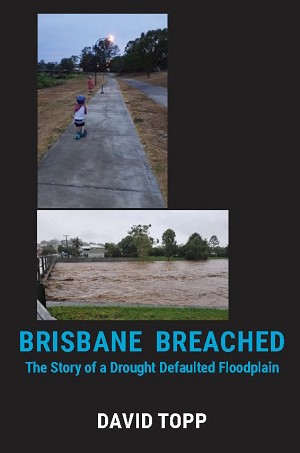
 A CAPITAL DISASTER – BEFORE AND AFTER A BRISBANE FLOOD
BRISBANE BREACHED: THE STORY OF A DROUGHT DEFAULTED FLOODPLAIN by David Topp
Connor Court 2024
ISBN 9781922815781
RRP: $39.95 (pb)
Reviewed by Deane McLennan
Anyone who has grown up or lived in Brisbane in the last 50 years will have a story to tell you about flooding. My own story is the ironic fact that during two flood events in a decade (2011 and 2022), I was not there to experience either of them. But I have researched and written history on some of Brisbane’s flooding and, much like David Topp in his new book Brisbane Breached: The Story of a Drought Defaulted Floodplain, not only is the storytelling drawn from personal experience and a connection to the landscape, but the full story goes far beyond the disaster itself.
Topp’s book swiftly takes the reader into the events of early 2022 when eastern Australia faced some of its worst flooding, hones in on Brisbane, and explores the events, consequences, and how the past and future are hinged on what happened. Essentially, he gives the reader the ubiquitous Queensland experience of sunshine, humidity, drought, flooding, cyclones, and even an earthquake, as well as brief acquaintances with some of the more colourful political characters ranging from Sir Joh Bjelke-Petersen and his dam building to Peter Beattie and his drought restriction egg timers.
Topp, a Brisbane barrister, rightly considers the book a sequel to his 2012 Tennyson Breach in the truest sense of the word. It is, for the most part, a continuation of the events of that work, though not something he — or his readers — probably expected a sequel to, and so quickly. In Tennyson Breach, Topp addresses flood of 2011, and its impact on a development of riverside apartments in the suburb of Tennyson. The sequel, encompassing ten chapters, sees him scope the landscape of southeast Queensland and the circular logic that has reinforced the political and developmental values that ostensibly orient around a merry-go-round of droughts and floods. Like Margaret Cook’s own historical study of Brisbane flooding in A River with a City Problem (2019, with a revised edition published in 2023), he places himself into the narrative as both an observer and an investigator.
Introducing the reader to his familial connections to landscape and drought, he transports the reader to Plainland, a town midway between Brisbane and Toowoomba, and how his grandmother had lived through four major flood events, but more importantly that drought was “the long-term default”. From here, juxtapositions of this style are woven throughout the entire book; a severity of one or the other, but rarely meeting midway. For example, he demonstrates the chief difference between the flooding of 2011 and 2022. During the former, Wivenhoe Dam — Brisbane’s primary dam — was mere centimetres away from disaster, yet the city flooded in characteristic Queensland sunshine; the latter, the dam was only part full before quickly being laden, while the city became overwhelmed beneath torrential rain.
Topp’s main narrative commences in February 2022 and, through a combination of personal investigation including interviews and photographs (with some assistance from his daughter) and external sources such as social media posts and newspaper articles, Topp unexaggeratedly details the chain of events that unfolded across Brisbane. His descriptions of torrents of water and overloaded creek systems, particularly in Kedron Brook, are truly genuine despite sounding chaotic. Through this he directs the readers attention toward the damage and destruction of businesses and infrastructure, reminding them of the anticipated medium to long term effect of the disaster on Brisbane City Council’s infrastructure and budget. The storytelling is at times well contextualised but can be a bit disjointed if the reader is unfamiliar with Brisbane, and would benefit from having a map included. While the writing in this section is occasionally loose and casual, statements like “how disproportionately natural disasters harm and hurt the less well off” become very important thematically as the book continues.
Departing from the present, Topp then provides a general overview of Brisbane’s flooding history, drawing upon a variety of sources, including the older, but still esteemed work of historian J.G. Steele. He outlines what are essentially considered the terrible three: 1893, 1974, and 2011. But he does more than just retell the facts. Instead, he emphasises what risks becoming a mere talking point if not treated seriously: that Brisbane is built upon a floodplain. Moreover, he critiques the “once in a hundred years” mantra that has dominated the discourse, instead suggesting 42 years to be a better figure. However, this was an opportunity to reinforce his argument by accommodating the lesser discussed 1887 flood that has been alleged to have been worse than the notorious 1893 and 1974 floods. His use of diagrams and illustrations here is advantageous, though the quality of their presentation is sometimes lacking.
After providing a comfortably understandable historical context, Topp turns his focus to what I felt was my favourite part of the book – the story of dams and their development. Similar to Cook, he delicately balances the complexity of the Wivenhoe Dam’s construction, the issues of juggling a periodically dry city with a full dam, a seemingly invisible technocracy informing these decisions, and scolds the media for their blasé reporting of Joh Bjelke-Petersen’s 1985 claim that Brisbane would never flood again.
The middle of the book — where Topp’s vocation takes command of the narrative, and he shines — brings the reader back to Tennyson Breach, and ironically sees the conclusion of that saga occurring almost simultaneously with the unfolding 2022 disaster. For those legally minded, this will be an interesting section; for those not, while it may prove challenging, Topp navigates through it succinctly, but uncompromisingly. The investigative mind of Topp really emerges with his assessment of the now infamous “manual” that dictated the operations of Wivenhoe Dam. Unsurprisingly, this is the book’s longest section. After this, Topp pivots toward the present, first by analysing the problems of weather forecasting, the political and legal issues that arose post-2022 and will continue to do so into the future, and the current state of matters in relation to planning, policies, and possible future flood events. Although this section does briefly acknowledge the broadness of the disaster across eastern Australia, it is very general, and mostly in the context of insurance, such as comparison to Darwin’s 1974 Cyclone Tracy, and Sydney’s 1999 hailstorm.
Another interesting subject is then raised: the buy-back and retrofitting schemes established in the wake of 2022. A deeper examination of this could have been conducted by comparing Brisbane to similarly affected locations of the disaster, such as Lismore in New South Wales. Importantly, Topp raises the question of whether some of these places — including the notoriously flood prone suburbs of Rocklea and Goodna in Ipswich — will ever be liveable again. By asking such a question, Topp evokes one of the key ideas of Cook’s own thesis: the importance (or absence) of flood memory across generations. Even though he does give some attention to the differences of a pre- and post-pandemic Queensland and their relationship to the 2022 disaster, the detail is narrow. Nonetheless, he has created a foundation for further research into what a growing population, and one unfamiliar with the history of flooding, may have on Brisbane in the future.
Before bringing his book to its conclusion, in what is probably the most personally interesting study of his work, Topp analyses the devastating impact of Kedron Brook’s flooding on Toombul Shopping Centre. If I were asked to identify a shopping centre as mine, then it would be Toombul; and he addresses the matter flawlessly, especially the fascinating social and economic impact its closure had on nearby shopping centres in Lutwyche and Chermside. In one of the moments of wit that are dispersed throughout the book, he informs us — as if the floodwaters had a twisted sense of humour — that Mirvac, the firm that had developed the apartments studied in Tennyson Breach, were also the owners of the shopping centre.
Bringing his book to its conclusion, Topp fixes upon a crucial future date: August 2032. After decades of unsuccessful bids, Brisbane has secured the revered Olympic games. Finally, he synthesises the preceding chapters of circular logic concerning drought and flooding, and reflects on what it will be like when the world turns its attention to the city. He reminds the reader of two sober truths: housing has increased, but infrastructure has stagnated and, most importantly, that dams will not help protect Brisbane, as 2022 demonstrated.
Overall, Brisbane Breached: The Story of a Drought Defaulted Floodplain is generally well structured and addresses the key points surrounding the disasters of 2011 and 2022 in requisite depth. Topp draws upon a broad selection of sources that do truly give a balanced view, though occasionally their quality is somewhat diminished through their reproduction. Despite a minor mistake of claiming Kedron Brook derives its name from Kedron (it is the reverse), and some of the expression feeling repetitive, there is scope for his work to be expanded upon or incorporated into future research. At times, the editing needed to be just a little more concise. Lastly, while well intentioned and certainly a pragmatic argument, Topp’s suggestion for continued growth in what he considers “truly flood-free land” in decreasingly industrial Hamilton, and the gentrification of neighbouring Pinkenba owing to the proximity of disused railway infrastructure, strikes me as chancy proposition.
Nonetheless, Brisbane Breached is not only an enjoyable and down-to-earth read, but will eventually become one of two things: a cautionary tale that has been heeded, or a cautionary tale in the making that will, like Tennyson Breach, require a sequel. Sadly, that question may have already been answered as the subtext of the book is very self-aware: there will be more writing on this matter, be it by him, or Cook, or others that are prepared to take the subject of development across floodplains seriously.
If Topp set out to provide an appropriate reading experience in humanising Brisbane’s flooding woes and critique the historical and contemporary problems without compromising the urgency and severity of the disasters, then he has well and truly achieved his objective. So, if you have read Tennyson Breach, or are interested in knowing more about flooding in Brisbane, then this book is definitely recommended.
Deane McLennan is a researcher of Brisbane’s urban and environmental history. His writings argue for increased scholarship toward suburbia, and the relationship between the natural and built environments.