
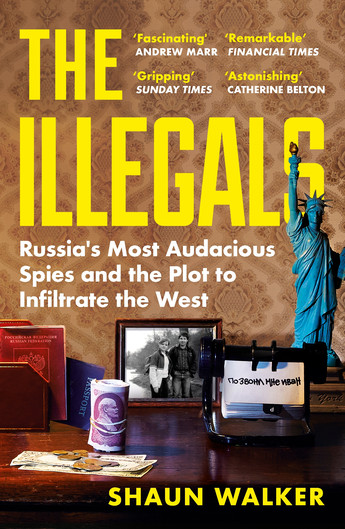
 A CENTURY OF SPIES – HOW MOSCOW INVADED THE WEST
THE ILLEGALS – Russia’s Most Audacious Spies and the plot to infiltrate the West
By Shaun Walker
Profile Books 2025
ISBN: 978 1 78816 7772
RRP: $53.92 (HB)
Reviewed by Anne Henderson
The successful TV series The Americans is a spy drama set in Virginia USA and involves unbelievable amounts of double life and extraordinary espionage. But it is in fact to be believed and backed by real life stories over a century.
The full account of how such Soviet Union/Russian espionage happened can now be sourced and absorbed in Shaun Walker’s page turner of a book The Illegals, the true stories of one of the world’s most audacious yet successfully hidden assaults by many thousands of undercover agents directed by the KGB and Directorate S to infiltrate both the west and Soviet enemies. For all the efforts of these tens of thousands, resources and successful subterfuge over a century, it is the book – not the television series – that demonstrates how unsuccessful the operation was in conquering the West.
Walker has done an enormous amount of research – searching records reaching over decades, countries and personalities. Along with individual stories of particular agents and their exploits, readers unravel the history of the Soviet Union, its origins, its rise and its demise. By the end of the book, taking in the enormous energy, intelligence and risk the program involved, one will question if it offered any advantage for the USSR and later Russia, emerging from a world where the mindset was conspiratorial and totalitarian.
From the murder of Leon Trotsky, the betrayals of the purges to the undercover work of agents destroying the hopes of the Prague Spring and later undercover connections that brought about the execution of the Rosenbergs in the US, Walker weaves the canvas of a huge project and how it was created. His use of individual agents and their exploits exposes the complexities and scope of the agents’ work along with landmark turning points in the struggle to internationalise communism against the West’s resistance that prevented a spreading “iron curtain” taking hold in the Cold War.
Walker’s introduction offers one story that seems to have inspired The Americans. A family known as the Foleys – respectable mother and father with two sons – are arrested on an afternoon in June 2010 in Cambridge , Massachusetts. They are back from a celebratory lunch for their son’s 20th birthday. The son has just finished his sophomore year at George Washington University. What could be more apple pie American? But the Foley parents are in fact illegals working for the KGB.
The true story of the Foleys is the story of the illegals – Ann Foley was in fact Elena Vavilova from Siberia. Her husband Tim was in fact Andrei Bezrukov, also from Siberia. Their assumed names were those of dead Americans, Elena’s (or Ann’s) was that of a child who had died at 7 weeks in Montreal General Hospital in 1962. Their American life was staged, beginning in Toronto where they were remarried and later had two sons. Andrei (Tim) won a place at Harvard’s Kennedy School so they came to Boston living as a middle class American couple and doing espionage for the Soviets. Their sons had no idea of their parents’ double life. Unlucky for the Foleys, by 2010, the CIA and American intelligence had caught up with the Soviet’s spy organisation known as the illegals.
The work of the illegals begins with what Walker describes as one who needed no training in espionage. Born in 1901, the son of a strong and social activist mother, Dimitry Bystrolyotov (surname meaning the fast flier) after surviving the revolution and civil war with escape to Constantinople and doing odd jobs such as grave digging then going to sea had, by the time he returned to Russia and taken up with the ruling Soviets, much experience in adopting a variety of identities:
He had lived as an aristocrat and a refugee; he had been a bookish student and a manual labourer. He had supported the Whites and then the Reds. He spoke fluent Russian, English, French, Turkish and Czech. And he was still only twenty-eight years old.
In one of his first exploits, Dimitry as Czech Jozsef Perelly was sent to groom Englishman “Charlie” (Ernest Oldwell) who had offered British documents to the Soviet embassy in Paris. Dimitry, as Perelly, would follow Charlie to England, sleep with his Oldwell’s wife while plying Oldwell for better information, having already dumped his French fiancée (another he was grooming) and married a Czech named Iolanta Shelmatova when stationed briefly in Prague. Dimitry was capable of many lives at once. He acquired top secret documents from a German secretary in Nazi Germany and between European jobs travelled to the Belgian Congo “to gain intelligence on the mood in the European colonies for his bosses in Moscow”. Walker writes:
He used various guises to win trust or slip through border checks: in addition to Perelly, he still had the Greek passport of Alexander S. Gallus and a Dutch document in the name of Hans Galleni. At other times he took on the guise of a Yugoslav butcher, a jaundiced English lord or a Norwegian herring salesman.
In 1936, Dimitry was given permission to return to Moscow. He hoped to save his fragile marriage there but was forbidden to leave the service. In time, he would watch colleagues destroyed in Stalin’s terror. Dimitry was himself arrested on trumped up charges. He was beaten and interrogated but refused to admit guilt. Stalin’s devotion to long-term undercover missions had come full circle. By the mid-1930s, Stalin believed some spies among the illegals had double loyalties and were working to spy on the Soviets. Dimitry had made a loyal decision to return to Moscow but ended up serving long years in prison. On his release in 1954, Walker writes, “he emerged disillusioned and broken, a very different person from the twinkle-eyed illegal who for a decade had seduced women and fooled men across Europe”.
By the 1930s, the illegals roamed Europe at will. The Soviets were well ahead of their adversaries when it came to espionage. In spite of this, when information obtained through the illegals network came to Stalin at the beginning of June 1940 that Germany was planning to attack Russia in a matter of weeks, he declared it “disinformation”. Later, when the sources were revealed as genuine, Stalin scrawled a response in pencil, “Send your source from German aviation to his fucking mother.” For all the good it did, the Soviet Union sent some 15,000 operatives across the lines during the years of the Second World War.
Illegals were also used against troublesome communist allies such as Yugoslavia’s Josip Tito. Tito had split with Stalin in 1948. In 1953, Tito met with what he believed was a well connected Costa Rican diplomat named Teordoro Castro. The move was expected to help forge Yugoslav relations with a Central American nation as Tito sought independence from Moscow. Teodoro Castro was in fact Iosif Grigulevich, a Soviet illegal, who had never been to Costa Rica. Grigulevich had assumed the identity of an illegitimate son of a wealthy Costa Rican coffee producer, already deceased.
Iosif was a hardened illegal with a failed attempt to kill Leon Trotsky behind him as well as accomplished murders of Communist and Bolshevik individuals who were not loyal to Joseph Stalin. For all that, he had known the assassination mission against Tito would likely mean his own death warrant. He was saved by Stalin’s death in March 1953, after which the plot to murder Tito was aborted. Grigulevich returned to Moscow and lived out his days as an academic.
With the opening of the trial in a Brooklyn courthouse of Rudolf Abel in October 1957, it was clear US intelligence was catching up with the Soviet illegals operation. Abel was in fact the son of Russian emigres from Newcastle in England – real name William Fisher. Life magazine described him as a master spy who had “successfully slipped himself into the stream of American life”. He was spared execution and given a sentence of 30 years. However, in time, he would be traded for Gary Powers, the US pilot shot down over the Soviet Union. Walker writes, “[O]n a freezing morning in 1962, Abel and Powers walked slowly past each other on Berlin’s Glienicke Bridge”.
The case of Yuri Linov is revealing of how the system of recruitment worked for illegals. Yuri, from a “backwater” town 400 miles southwest of Moscow was encouraged by local military authorities to extend his education after which he could enlist in state services and travel abroad. Yuri was earmarked as a potential illegal. By 21, Yuri was a KGB agent and was constantly tested as to his loyalty and ability not to reveal his other life. His dormitory was bugged and he was encouraged to report on his fellow students. He was sent to Kyiv, given a position at a scientific research centre and left to settle in. After a weekend spent shopping, a handler arrived and questioned him on his movements in the two days. He passed the test except for forgetting he had drunk a second glass of wine at a market place which the handler had observed. He was being watched constantly.
Yuri spent years as an illegal moving from East Germany to Ireland and England, Vienna and Italy and even Israel. He married a woman who joined him in the service but who was released after she suffered from the long absences from her husband, even her children. Yuri trained for various roles from languages to mechanics. He was used in operations to smash the Prague Spring. It would be in Israel, though, that Yuri was caught – the Shin Bet and Mossad had their own illegals set up. Tried and sentenced at a closed hearing in August 1973, Yuri was given 18 years in prison. But he was released after just one year, traded for the release of 16 Soviet Jews. Finally, Yuri was dismissed from illegals work and threatened with being sent to an asylum unless he agreed to live in Kyiv with his wife and children. There, he worked for an institute for international affairs while doing work on the side for the KGB. Four years after his move, while fixing a broken radiator, he found a listening device in the wall behind it. He still was not trusted.
The work of the illegals set up involved a huge amount of resources both in Moscow and in the field. It is hard to understand given the demise of the Soviet communist bloc at the end of the twentieth century. Walker seeks to explain why as he unfolds the stories writing:
Why did the KGB stick so doggedly to a system that no longer seemed worth the enormous time and effort it demanded? Partly, the institutional memory of the successes during the early Soviet period and the roots in the Bolshevik underground kept the organisation wedded to illegal work as a key part of its internal mythology. It was also clear that short term illegal assignments … could still be fruitful. And then there was the chance that the Cold War might turn hot. Should that happen, today’s delivery boy could become a vital link in a communications network during World War III
Anne Henderson is Deputy Director hard of The Sydney Institute and author of Menzies at War, which was shortlisted for the 2015 Prime Minister’s Award for Australian History.