
Speaker
Ruth Powell
Speech Date
20170807
Issue
Issue 39
Dr Ruth Powell has been a researcher and writer with the National Church Life Survey Research since 1991, completing her PhD on age differences among church attenders. Prior to becoming Director in July 2007, she has also held a communications role, including media liaison, speaking, newsletter production and website design for the NCLS. At an evening seminar at the Sydney Institute on Monday 7 August, Ruth Powell joined the Pew Research Center’s Conrad Hackett to discuss the topic “World religions – Who’s Up, Who’s Down”.
A CHANGING AUSTRALIAN RELIGIOUS LANDSCAPE
RUTH POWELL
This paper focuses on shifts in the Australian religious landscape. I bring an empirical overview that draws primarily on three sources: the national Census, our own surveys of the Australian population and the National Church Life Surveys – the largest longitudinal study of local church life in the world with a quarter of a million participants from 3000 local churches.
In particular, I will highlight three factors: secularisation, cultural or ethnic diversity and generational change.
Australians are moderately religious
How religious are Australians? I want to begin by acknowledging the deep spirituality of our First Peoples developed over tens of thousands of years.
I want to begin by acknowledging the deep spirituality of our First Peoples developed over tens of thousands of years.
At this time in our history, based on a range of measures, I would describe Australians as moderately religious. From the 2016 National Census, we learn that six in ten Australians have a religious affiliation.
A sample survey of Australians in late 2016 found that nearly six in 10 believe in God, a spirit or life force. The decline in this, and other religious beliefs over time, is evidence for the secularisation thesis – which, in its simplest form, is that there is a negative relationship between modernisation and religion.
Yet, religious practices and experiences are persistent.
- Three in ten Australians pray or meditate at least once per week.
Three in ten Australians pray or meditate at least once per week.
- More than a quarter (28%) have had a mystical or supernatural experience.
More than a quarter (28%) have had a mystical or supernatural experience.
- 18% attend religious services at least monthly.
Australian religious identity is changing in line with other Western nations
Let me address some changes in the religious landscape. One feature is the change in religious identity, affiliation, or belonging. “Who is my tribe?”
The national census question “what is your religion?” gives us insight into the way Australians construct their religious identity.
Figure 1 tracks religious identity across more than 100 years using Census data. Christian affiliation remains the largest group overall at 52 per cent.
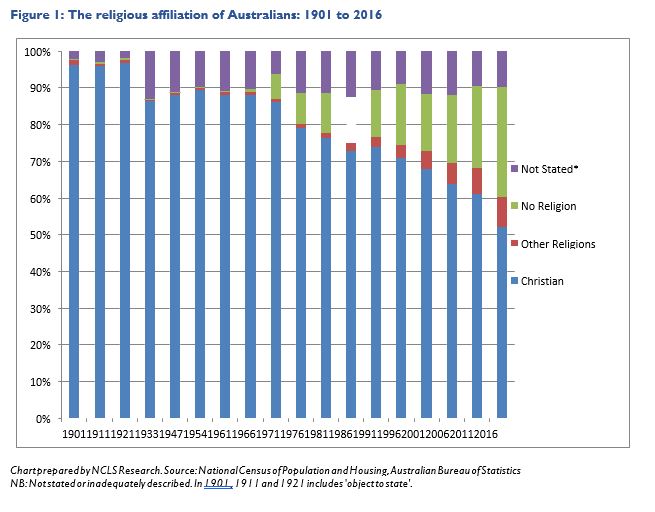 One trend in recent decades is increasing religious diversity, which is tied to cultural diversity. The rise in “other religions” – now 8 per cent – partly reflects higher immigration from South East Asia.
One trend in recent decades is increasing religious diversity, which is tied to cultural diversity.
A second trend is the increase in “no religion” (30%), particularly among young adults. While there is evidence to suggest that the proportion of “religious nones” will decline in the context of the future global population, within the Australian context, we expect this group to continue to increase in size – driven by generational change.
The church landscape has changed significantly in recent decades
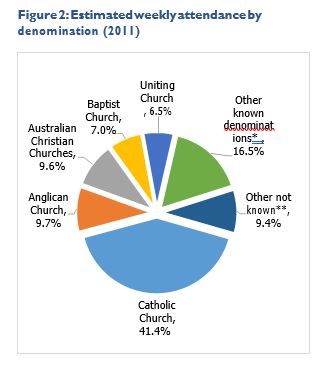
I turn to our research within Christian churches where there has been substantial change in recent decades. The story most often told is one of a decline in church attendance. The evidence offers some counterpoints to this narrative. For example, local churches remain as a presence across the nation with 12,400 locations. As a comparison, there are around 6,500 service stations.
Further, the decline in attendance has slowed. Monthly self-reported attendance at religious services declined by 22 per cent between 1950 and 1990, compared to a 5 per cent decline between 1990 and 2016.
Further, the decline in attendance has slowed. Monthly self-reported attendance at religious services declined by 22 per cent between 1950 and 1990, compared to a 5 per cent decline between 1990 and 2016.
Weekly attendance (or head counts) as church worship services has declined as proportion of the population to 7 per cent in 2011. However, there has been little change over 20 years in the actual number of people who attend. Around 1.6 million Australians attend church in an average week in 2011 compared to 1.7 million in 1991.
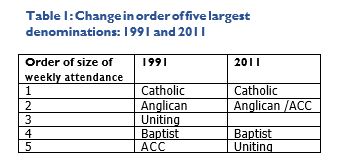
 Within Christian churches, there have also been significant changes in a short period. For example, the top five denominations by size have changed order. Australian Christian Churches, the largest Pentecostal denomination (previously called Assemblies of God) have jumped from 5th position in 1991 to joint second in 2011. The Catholic Church remains the largest denomination in terms of weekly attendance.
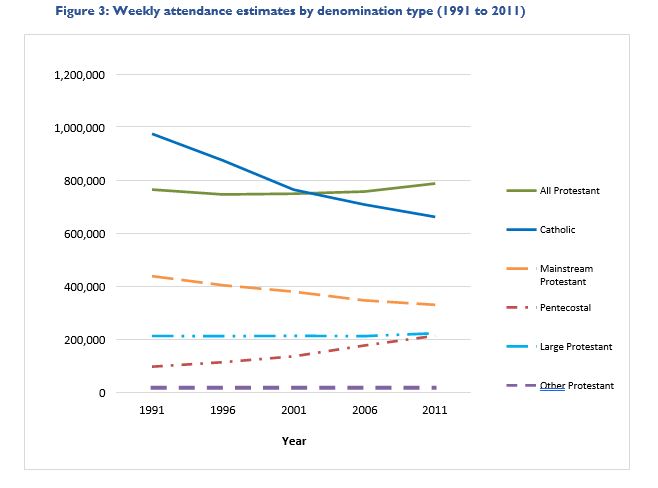
 It may also surprise some that weekly attendance in Protestant churches has been largely stable over 20 years. Rapid growth in Pentecostal movements has offset declines in mainstream Protestant churches.
Demographic factors will continue to influence Christian church attendance profile
Looking forward, I want to highlight two demographic factors that will continue to shape Christian churches and wider religiosity in Australia. The first is cultural diversity; the other is generational change.
two demographic factors that will continue to shape Christian churches and wider religiosity in Australia. The first is cultural diversity; the other is generational change.
Australia is one of the most multicultural nations in the world with a third of the population born overseas in 2016. Depending on the character of future migration flows, religious diversity in Australia will probably continue to increase.
Within churches, the proportion born overseas is even higher and has risen dramatically (36% in 2016 vs 28% in 2006), particularly from non- English-speaking backgrounds (27% in 2016).
Within churches, the proportion born overseas is even higher and has risen dramatically (36% in 2016 vs 28% in 2006), particularly from non- English-speaking backgrounds (27% in 2016).
Churches already experience a degree of disruption and innovation as individuals and new communities of different backgrounds bring new life and energy. I suspect we may have the highest percentage of multicultural congregations in the world. The intercultural communication skills being learnt within these faith communities is a potential resource for wider Australia.
The other demographic factor I wish to highlight is age – o r generational change. Australia is like other Western nations, where each cohort is a little less religious than the cohort before. If you want to predict which adults will be religious, look to their childhood household and family influences. Mums, followed by dads, are the most important people to transmit faith across generations.
Although decline in attendance has slowed in recent decades, I foresee another wave of decline, particularly in mainstream denominations, due to their ageing profiles. High mortality and low birth rates is likely to hit the mainstream hard, even if younger Pentecostal movements continue to grow.
Although decline in attendance has slowed in recent decades, I foresee another wave of decline, particularly in mainstream denominations, due to their ageing profiles
The role of religion and of Christian churches is contested
Finally, the role of religion, and of Christian churches, is being contested in Australian society.
When asked in 2016 if religion was “good for society” around four in 10 Australians (39%) agreed and two in 10 (21%) disagreed. The remaining four in 10 were neutral or unsure. It is incorrect and unhelpful to frame the views of Australians as two opposed camps. The size of the middle group is substantial and their views are key to the future.
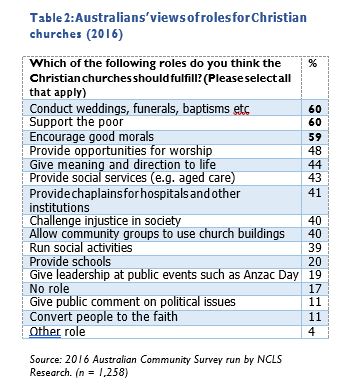
What is the role of churches? Australians are most likely to say that the roles churches should fulfil are to
- Conduct weddings, funerals, baptisms etc (60%)
- Support the poor (60%)
- Encourage good morals (59%)
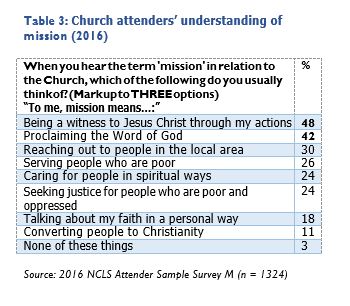
 While the question is not directly comparable, when church attenders were asked about how they understood the mission (or purpose) of the church, the highest responses were:
- Being a witness to Jesus Christ through my actions (48%)
- Proclaiming the Word of God (42%)
 So, what of the future?
As we share similar world views and values with other western nations, Australia seems likely to follow the same trends with regard to religion.
As we share similar world views and values with other western nations, Australia seems likely to follow the same trends with regard to religion.
One point of potential differentiation is our multicultural character, which feeds religious diversity. As a historically tolerant & largely successful multicultural nation, could Australia offer leadership in models of effective cross-cultural life?
The future will also be determined by the power of generational transmission. What will households and families pass on with regard to religion and spirituality?
The future will also be determined by the power of generational transmission. What will households and families pass on with regard to religion and spirituality?
Perhaps I can give the last word to the quarter of a million church attenders who completed the 2016 NCLS. Eight in 10 say they would personally support new approaches in the ministry and mission of their local church. An attitude of openness to innovation is on the rise.