
 A LEGACY OF CRIME AND REDEMPTION
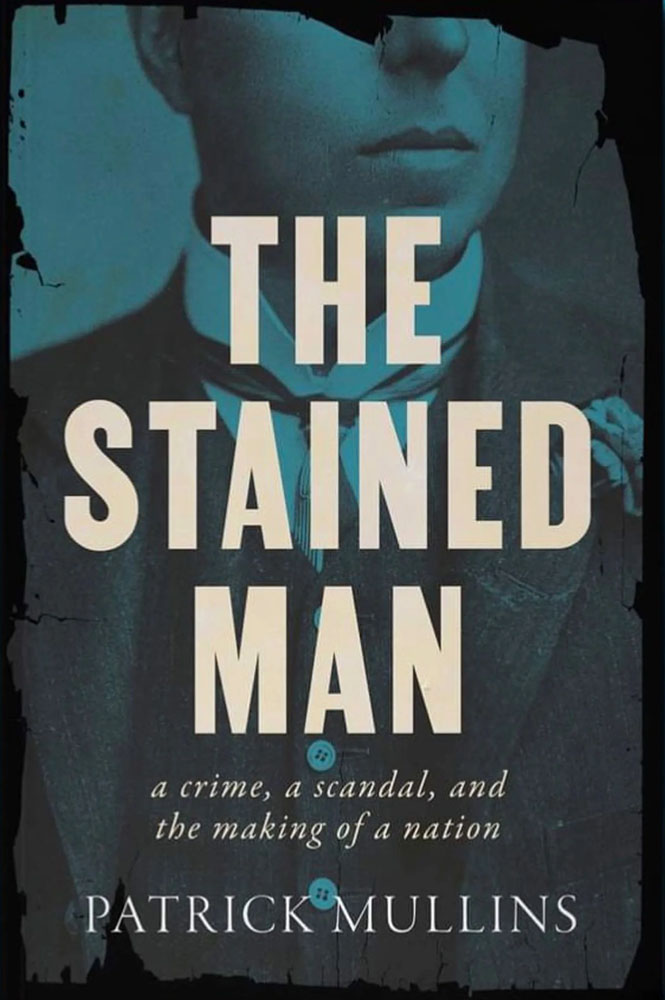
THE STAINED MAN – a crime, a scandal, and the making of a nation
By Patrick Mullins
Scribe Publications 2026
ISBN: 978 1 761381 95 9 (Australian edition)
RRP: $39.99 (PB)
Reviewed by Anne Henderson
Patrick Mullins is a great storyteller. He is also a meticulous researcher, historian and has a fine legal background. Who else then could do justice to the story of barrister and politician Richard Meagher, prominent and notorious in his day at the time of colonial fusion to form a federated Australian nation but lost to history after his death in September 1931. Patrick Mullins has dug up Meagher from the archives to record the public life of an amazing survivor, a man who fell from the heights by his own hand only to persevere as a leading Sydney figure through humiliation and electoral success.
It is hard to imagine how and why the case against George Dean, a ferry boat master arrested in March 1895 and accused of trying to poison his wife, could have had such a profound effect on the courts, the news media and the political system of New South Wales for as long as it did. With Patrick Mullins’ careful weaving together of how the myriad of forces in the story worked with and against each other, not only does the reader become absorbed by the twists and turns, it is clear that the story of Richard Meagher as told by Mullins is worthy of a TV series.
The case of George Dean caught the attention of Sydneysiders partly because of Dean’s popularity as a ferryman and partly because of the outrageous campaign against the poisoned wife and her mother – in his defence and pushed by Meagher – that the women were associated with criminals and brothels and had created a poisoning to rid themselves of Dean. After a court case where Mary Dean attempted to get maintenance payments from Dean for her and her baby, Mary and her mother “were followed by a crowd that jeered them all the way to Oxford Street”. Dean did nothing to assuage the public’s misconceived view of his wife.
The slander endured by the two women – especially Mary Dean’s wife – when read more than a century later is example enough of the truly misogynistic society that ruled the courts, the media and the parliament in colonial times and beyond. Alongside that was the moralistic judgement of many commentators and witnesses that George Dean was a person of such integrity and utmost good character that it was inconceivable he might have committed a crime.
The drawn-out battle over George Dean’s guilt or innocence was played out in various stages. He was found guilty initially, but later Richard Meagher managed to whip up a public outcry over the judge, Sir William Windeyer, who was seen to have shown antipathy to the accused. Meagher continued his campaign even after visiting Dean in prison where Dean confessed he was guilty. Meagher’s campaign was not only successful in bringing about a Royal Commission into the verdict which quashed Dean’s conviction on 28 June, it also helped Meagher win the seat of Sydney-Phillip on 24 July 1895. As the truth of Dean’s confession of guilt slowly leaked out and Meagher’s part in it, various dramatic moments played out in parliament and the press. Mullins writes:
Meagher began constructing the narrative he would come to perfect – about how he had done nothing wrong in the case, and that powerful and malevolent forces were lying and manipulating matters to save their own skins.
There is a lot of detail in the unfolding story of the Dean case. Well known public figures became involved especially as Meagher turned the matter into a political stoush as well as a legal one – all the time enhancing his public stature. Political figures such as Edmund Barton and George Reid had their small parts in the drama.
Meagher was successful, in these initial stages, at playing the injured party when he was in fact the puppeteer who had sought to free a man he knew was guilty. Into this melee, Meagher dragged Sir Julian Salomons QC when he took a libel case and in briefing Salomons admitted he had known of Dean’s guilt. Salomons reaction and subsequent action (or inaction) created further complications that, in time, led to Meagher being struck off the roll of solicitors. For Dean, there was no happy ending. He was eventually given 14 years for perjury when the full story of his guilt had unfolded.
The compelling impact of Mullins’ story telling is that he can weave the saga from numerous sources but never let the detail overwhelm the tale. There are twists and turns, there are moments of real life action. Truth owner/editor John Norton took aim at Meagher at one stage heading a stinging attack in his newspaper “Mr Mendax Meagher” and calling him “the premier perjurer of our public life and the champion criminal of this continent”. Meagher horsewhipped Norton in the street near Her Majesty’s Theatre at matinee time. Norton retaliated by chasing Meagher and shooting at him with his hand gun near Imperial Arcade. The upshot of it all was that neither man was seriously injured but both faced charges of assault.
Mullins offers an up-close look at New South Wales society at the time of Federation and beyond. A world that was, in many ways, still raw and frontier as its colonies came together as a nation. Meagher was an ambitious would be, dragging himself forward from his Irish/Australian/Catholic roots and policeman father into the highest levels of Sydney’s parliamentary and judicial society. For much of his rise – MP, mayor of Sydney – he was advantaged for some time by his membership and friendship with NSW Labor as it emerged as a political party.
Yet Meagher was flawed and the flaw was a public staining, one that whatever he would achieve outside the law in politics would never properly compensate for his removal from the roll of solicitors. After the Dean case but he could never quite shrug off the public demise he created. A demise that took down his partner William Crick who was accused of knowing about Dean’s guilt. Meagher took office at various levels in both state and council chambers. He headed causes and attracted both supporters and enemies.
Mullins’ ability to keep the momentum of Meagher’s life engrossing after the dramatics of the Dean case is compelling. Meagher was a fighter to the end. His obsession with regaining his place on the roll of solicitors yet another of his odysseys. He eventually achieved this after 25 years – but only as a result of a bill in the state parliament being passed after some very late night sittings before a limited number of MPs, all of whom were weary and desperate to go home.
Patrick Mullins has revealed a sort of modern hero, an anti-hero in some ways but also one creating sympathy in his belief in himself and for his endurance. That he was in denial over his wrong doing in the Dean case is a given. But in his almost heroic stand to resurrect his name, Meagher can be seen as a representative of what might be called a stained country. The colonial stain of convicts and the demise of the continent’s Indigenous people at the time of Federation saw a nation born with flaws – however miraculous the vote to unite the colonies.
In Richard Meagher, Patrick Mullins has offered the tale not just of one man but also, in many ways, the spirit of the nation that was his home.
Anne Henderson is Deputy Director hard of The Sydney Institute and author of Menzies at War, which was shortlisted for the 2015 Prime Minister’s Award for Australian History.