
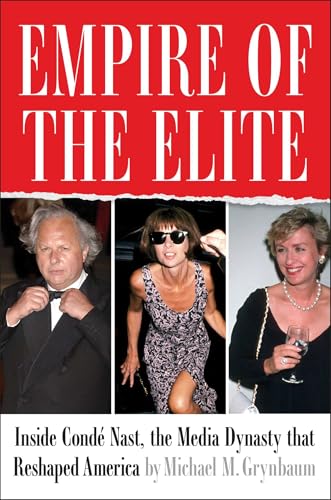
 EMPIRE OF THE ELITE – INSIDE CONDÉ NAST, THE MEDIA DYNASTY THAT RESHAPED THE WORLD
By Michael M Grynbaum
Coronet (Hodder & Stoughton) 2025
ISBN: 9781399707220
RRP: $34.99 (PB)
Reviewed by Anne Henderson
When the movie The Devil Wears Prada, featuring lead character Miranda Priestly as a fictional Anna Wintour, editor of Vogue, appeared on screens in 2006, the Condé Nast magazine conglomerate seemed at the height of its influencer powers. It certainly had an enviable track record of dictating the boundaries of high class fashion, art and opinion. From Vogue, The New Yorker, GQ and Vanity Fair and more besides, Condé Nast editors and contributors along with the featured lives, homes and careers of the rich elite had set the trends for decades.
Based on a novel of the same name, the movie explored a naïve young woman fresh out of college suddenly exposed to the culture and workday routines of the fictional Runway – a magazine like Vogue, obsessed with status, fashion and celebrities. Now that a sequel to The Devil Wears Prada is currently being shot, it is interesting to note that another book has got ahead of the movie mindset on Condé Nast – it is Michael M Grynbaum’s Empire of the Elite – Inside Condé Nast, the Media Dynasty that Reshaped the World.
Anyone wanting to get an insight into what this Devil Wears Prada sequel might explore should get a copy of Grynbaum’s book. Following the highs and lows, Grynbaum has charted, in a page turner of record and analysis, the extraordinary rise and fall of one company’s ability to build a network of influence through the pages of glossy magazines. More than that, it became an empire of style and taste or, as Grynbaum opines:
The minting of a new financial overclass … a renewed market for cultural sherpas who could tell parvenus which artists to collect and which writers to read, what theatre was worth seeing and which celebrities were worth ogling. …a baby boom generation that was busy casting aside the ideals in favour of the pleasures of the material world, as embodied by the four-figure Shiatsu massagers on sale at their local Sharper Image.
Condé Nast’s originator was Condé Montrose Nast – born in New York City in 1873. Having made a society marriage, Nast realised his ambitions by finding investors to purchase Vogue, a magazine founded by a “clique of old money scions” and one Nast believed had potential to broaden its readers by being “aimed not just at the affluent but those who yearned to be”. Condé Nast took Vogue to being a new cultural signpost in the Gilded Age’s leading city.
But it was not the originator who would build the empire. As the Condé Nast era of early success faded over the middle decades of the 20th Century, in 1959 its magazines were bought by upwardly social newspaper owner Samuel Newhouse. As with Condé Montrose Nast, Newhouse’s origins were humble – in his case immigrant Jewish. Grynbaum writes: “Nast had to escape Missouri, and Sam had to escape his past.” In spite of a thirteen-room apartment in one of Manhattan’s most desirable neighbourhoods, Sam Newhouse’s purchase of Vogue was, in reality, to help advance his wife Mitzi’s social status. In doing so, he managed to purchase the whole of Condé Nast.
Sam Newhouse’s son, Si Newhouse, was given the Conde Nast magazines in 1964 as a space for a publishing mogul’s son who did not quite fit in with the money making side of the family business – that chain of regular newspapers across the US delivering information and entertainment for ordinary folks. In time, Si Newhouse would be the founder of a Condé Nast empire – not that he knew that as he relished his new task.
Grynbaum writes of Si being “besotted by the world of Vogue” and saw ownership of Condé Nast as “a role in his father’s empire where he did not feel woefully out of place”. This was so even as he found, initially, the atmosphere at CN something of the nature of a “women’s finishing school”. What brought the change? Enter the man known as the “Silver Fox” – Alex Liberman – also like Si a Jewish outsider but one whose background was exiled wealth first from Russia’s Ukraine and then the Nazis’ Paris. In partnership with Si, over coming decades, Liberman would groom Si in the excesses of superior taste and become Condé Nast’s powerful editorial director. As Grynbaum writes of Si and CN’s indulgent direction under Alex:
Within twenty-five years of his arrival, Condé Nast would be transformed from a clubby little business to the imperious steward of global brands like Vanity Fair, GQ, Architectural Digest and Allure … and, taking a cue from his father, purchased and revived struggling rivals, including The New Yorker … Condé Nast went from a publishing laggard to the centre of the culture-making industry. And Si remade himself from a feckless scion into an esteemed patron, splashing out millions to hire the country’s finest writers and photographers and filling his townhouse with blue chip works.
It’s a giddy ride. Grynbaum has rich material to work with but never allows the details of celebrity names, high powered editors and their conflicts, scandals in the media and juicy gossip to swamp the telling. Readers are swept along with careful rendering of individuals’ rise and fall or rise and rise with much inside information swelling the tales. The movie captures the essence; Grynbaum captures the many spicey dramas.
Tina Brown, Anna Wintour and Graydon Carter feature on Grynbaum’s cover. They surface as the trio that took Condé Nast to the heights. Tina Brown had made her mark at Britain’s Tatler with intrusive exposés of the rich and aristocratic – penetrating Princess Margaret’s island of Mustique (a Club Med for royalty she called it), getting an interview with Prince Andrew’s then girl friend Koo Stark and a field guide to London’s eligible bachelors that included the comment “a rising young barrister with a keen interest in ladies briefs but an even keener interest to the road to Number 10”.
Brown caught Si’s eye and he bought Tatler. Eventually she accepted the job as editor-in-chief of Vanity Fair. The cat and mouse wheeling and dealing as she swung her bid for top place at the magazine is but a trinket in Grynbaum’s story telling. But her sassy handling of Si assures readers there’s much more to come. He had hired his first “It” girl and she would shake Vanity Fair as never before. Her philosophy was firmly embedded in the need to make the sexy serious and the serious sexy. Brown went on to edit The New Yorker. By then, Anna Wintour had shaken Vogue. Graydon Carter would do likewise for men’s magazine GQ in time moving to edit Vanity Fair as Brown moved to edit The New Yorker.
Covers made the difference – shocking sometimes, alluring at others, and unexpected always. There was “The Reagan Stomp” where Nancy and Ronald danced together for photos to die for; there was the Demi Moore full bellied pregnancy shot. Hillary Clinton claimed she didn’t need a legacy – she had made the cover of Vogue. Melania Trump was a vision of bridal loveliness in 2017 when Trump rode on the Condé Nast spirit as an emblem – “Like Si, Trump was an outer-borough scion who out-performed his old man, transcended declassé roots, and remade himself as a Manhattan king,” writes Grynbaum. After Trump appeared on the cover of GQ in 1984, the issue sold better than ever which led Si to take the Trump article to the next level and Trump’s book The Art of The Deal was unleashed.
No expense was spared held up by the slush funds coming to Si from his father’s lucrative newspaper industry. When celebrity photographer Annie Leibovitz ran up a $475,000 bill for an LA cover shoot, Graydon gingerly told Si it was a good and bad story: bad that it cost so much, good that it was indeed a $475,000 cover. Being over budget was considered a positive most of the time. Expenses for staff, even families to travel together were normal – and all on business and first class travel staying at the best hotels, days or weeks at a time. Reporters and writers were commanded to stay at the Ritz in Manhattan since no Condé Nast person could be seen entertaining or interviewing anywhere less. Excess was everything. Meanwhile, Si lived “vicariously through the exploits of his butterfly editors”. As Grynbaum puts it, “Tina and Anna Wintour, with their whirling social calendars, offered Si the perfect entrée to the elite circles he adored.”
Add to that the moments of petty snobbery, such as with the mispronunciation of a name:
Once Alex Liberman overheard an editor mispronounce Francoise de la Renta – Oscar’s first wife and a Vogue editor herself – as “fran-SWAH”, not the correct “fran-SWAZZ” Alex’s eyes narrowed. The editor was out of a job weeks later.
Such is human nature’s weakness for running with the pack, Condé Nast thus captured the global market for high class influencing. Gatherings such as the dedication of the Anna Wintour Costume Centre, where there were visible displays of emotion and two first ladies present in hailing this Wintour deity, brought a powerful set together. High end calendar events such as the Vanity Fair Oscars party, complemented the magazines and brought in the advertising revenue. Today the annual Met Gala stands tall as one of the last remaining of such events. Being seen with the crowd was to be seen with the gods of taste and acceptance. That this empire was centred on New York, spreading to its sister city LA, is a testament to America’s need to find its own way to establish an aristocracy outside of a monarchy. It would be Tina Brown’s great regret that she had retired from Condé Nast in July 1998. Life would never reach the heights she had known there.
Time and the internet would catch up with Condé Nast – taking influencers to the masses and diminishing the revenue to be made by magazines. Grynbaum covers this well. The internet’s inevitable effect on CN’s decline can be summed up by Anna Wintour’s early comment: “This is Vogue. We don’t do email. It’s so impersonal.” Si died in October 2017. Tellingly, the years to come would complete the story of an empire in decline. Going online brought down CN exclusiveness, victim of the lower levels of mass circulation competition. As the book draws to a close, the great unwashed of the internet has swirled through the CN culture and overtaken it.
And, as if to confirm the death of the CN era, Grynbaum’s publishing date in early 2025 leaves him contemplating the future for Anna Wintour, CN’s iconic personality. In June 2025, Anna stepped down as editor-in-chief of Vogue.
Anne Henderson is Deputy Director of The Sydney Institute and author of Menzies at War, which was shortlisted for the 2015 Prime Minister’s Award for Australian History.