Speaker
Gordon Parker
Speech Date
May 22, 2012
Issue
Issue 16
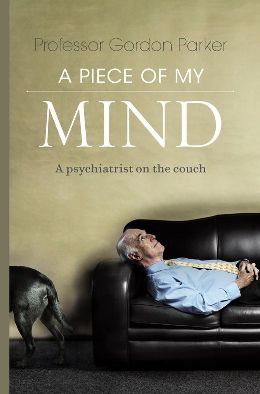
Gordon Parker AO is one of Australia’s foremost clinical psychiatrists. He has been described as “charming, witty and erudite” but also sometimes “intimidating and intolerant”. But he is also an achiever and highly recognised for his professionalism. He is also one of the leading figures behind the widely acclaimed “Black Dog Institute” for depression sufferers. Following the publication of his memoir A Piece of My Mind: A Psychiatrist on the Couch, Gordon Parker addressed The Sydney Institute on Tuesday 22 May 2012.
A PSYCHIATRIST ON THE COUCH – VIEWS FROM THE OTHER SIDE
GORDON PARKER
Thank you very much Gerard, thank you Anne, and thanks to you in the audience for coming to-night.
This opportunity to talk about one’s autobiography and memoir1 is a wonderful exercise in self-indulgence that an only child like myself can appreciate. One memoir objective was to look at what brought me into psychiatry, and the book therefore has about 80 pages supposedly whimsical in a Clive James-derivative style considering what I thought I might have brought into psychiatry to lay the ground for a later topic – the attractions of being a psychiatrist, not overviewed here.
I suggest that we develop – particularly in adolescence – rather like a plant develops. We send out aborising tendrils. Some become established and take firm roots. Others wither
So, what brought me to psychiatry? Looking forward, there was no way I could have predicted where I was going to go in my life. Looking back, it seems bleeding obvious. Not an uncommon story – but, if explicated, then contemplating its relevance for our children and grandchildren might be useful – and save some angst.

I suggest that we develop – particularly in adolescence – rather like a plant develops. We send out aborising tendrils. Some become established and take firm roots. Others wither. And I argue that this process is not merely chance, having personally ceased believing in the principle of serendipity in my early thirties. It’s only recently that the science of neuroplasticity has informed us about how interactions with our environment have the potential to shape our trajectory, particularly in building on our latent strengths. Our career choices when we come to forks in the road are not entirely dictated by chance, and I seek to articulate an alternative model building on personal experience.
Thus, a career often only becomes obvious in retrospect or as Christopher Hitchens said, “The stages by which one mutates or pupates from one identity to another are not always evident while they’re being undergone.” And, as observed by Kierkegaard – “One is condemned to live life forward and review it backward”.
My brain was more weighted towards implicit memory – with an emphasis on intuition and pattern analysis
One retrospectively judged issue contributing eventually to my career choice was that my brain is not linear-weighted. I was academically mediocre in the sciences at school – not an advantage in pursuing a career in medicine. And I was particularly poor in all the sciences at medical school. The Krebs Cycle did my brain in. It was really only in writing the autobiography that I appreciated the differences between having a left-brain weighting and a right-brain weighting – each having limitations and advantages depending on whether one finds or shapes one’s career ecological niche. Then, as I argue, one’s career can then further shape – and ideally – build on innate strengths. And actually change one’s brain – the concept of neuroplasticity – to potentially allow those focussed strengths to be further honed.
Basically, people who are left brain weighted tend to be good at the sciences and they have an ‘explicit’ memory; they remember facts.
My brain was more weighted towards implicit memory – with an emphasis on intuition and pattern analysis. In writing this book, I realised how my implicit brain actually worked for me at a relatively young age. At a medical student convention – when we’d partied hard and drunk too much alcohol one night – I woke early the next morning on a Brisbane beach. About 400 metres away, I could see a woman walking along the edge of the water, and an image came into my brain – ‘undine’ – although I’m sure that I had never heard that word before.
Such a brain weighting did not assist in getting into – or getting through – the medical course, a challenge to my self-esteem that I wisely denied as of any relevance over those years
She turned out to be a fellow medical student whom I’d known casually, and it was the start of my relationship with my future wife. As life has gone on, I have appreciated that my wife is a wonderfully pacific and supportive woman. And the concept of “undine” – being one with nature – was something that had emerged in a visual flash, almost like love – but certainly a pattern analytic temperament profile – at first sight. I doubt whether such issues are unusual if your brain function is weighted to implicit memory. It takes you down strange pathways at times, but it can be an advantage in certain fields. Certainly, in Psychiatry but I would also argue for all of clinical medicine.
Such a brain weighting did not assist in getting into – or getting through – the medical course, a challenge to my self-esteem that I wisely denied as of any relevance over those years. But later, when I became a surgical registrar and realised I was also technically incompetent, that made for some extra challenges and difficulties. One of my big dilemmas in adolescence had been the question about what career to choose or default to. I had a family weighted with doctors, and I was not sure whether I should follow. If I did, was I merely doing what my parents wanted. You don’t have to be Jewish or a mother to be a Jewish mother, as Dan Greenburg says.
The concept of whether I would live my life for the vicarious gratification of family, one defined by medicine, was a dilemma. It was resolved one Boxing Day when I broke my neck and ended up in the Royal North Shore Hospital under the care of the neurosurgeon John Grant. That was my lucky break. I actually saw people who had what I regarded immediately, and have ever since, as evidencing a value system of duty and care – often expressed modestly and humbly. And that was it. I was into medicine.
So I decided, as is the tendency of an only child, that I would be – not simply aspire to be – a fiction writer
I went off to the University of Sydney and wrestled with the Krebs Cycle and other learning tasks. While I was studying away earnestly, having to rote learn everything, I realised that around me the University of Sydney was humming with a lot of luminaries. There were myth-makers, now household names, beating to drums of exhibitionism, promotion and self-promotion. The sirens were dancing while I endured boring, day-time rote learning. I began to think of how I might extend myself.
Looking back, the three things that I might have had going for me then were that I was fairly open-minded. As Woody Allen said, “Ninety per cent of life is just turning up.” And I enjoyed observing people and trying to work out what made them tick. Hal Porter’s The Watcher on the Cast Iron Balcony resonated with me very much. I also had a creative streak that was seeking expression. So I decided, as is the tendency of an only child, that I would be – not simply aspire to be – a fiction writer.
I sat down and wrote a book of fiction on a typewriter with two fingers. It took me six weeks – being slowed by going to university during the days. I sent it off to a publisher who advised that it would be difficult to publish as I didn’t have a track record. Track record? Right. I’d record one.
I contributed to the ABC Science show in Sydney, and later in London. I wrote the Sunday doctor column for The Sun Herald, supposedly the views of a Macquarie Street honorary when, in fact, those of a junior medical student. I also became a cartoonist for The Bulletin and for Oz, and a book reviewer for The Sydney Morning Herald and The Australian for ten years.
That was a very heady time. I wrote for the New South Wales version of Mavis Bramston in 1964 and, when the Mavis Bramston Show went national, I had the great pleasure of writing its opening skit in 1965. With a track record, my slightly revised novel was published by Lloyd O’Neil and Lansdowne Press in 1966.
The psychiatrists that I started with were a mix of good souls and zealots, and I found that many addressed their insecurity by intellectual incest
Was I merely doing all this for narcissistic reasons? I don’t think so and I hope not. In evidence, the book and most of my writings emerged under a pseudonym. The main aim was to attempt to be creative, to determine if I had a strength in that field. While pursued marginally over the years, when I went into Psychiatry, nearly all my creative juices were taken up by Psychiatry itself.
The psychiatrists that I started with were a mix of good souls and zealots, and I found that many addressed their insecurity by intellectual incest. They had a great need to form sects, and that really worried me. And so, for the college exam – where you required to provide psychotherapy to one patient for 50 sessions under supervision by one psychiatrist – I actually chose three patients and three supervisors, because I wanted to avoid or avert the risk of intellectual incest. And I wanted to have the opportunity to test differing models, and take components from all supervisors that appeared cogent. It was an early expression of my search for the ‘right’ model or paradigm in Psychiatry.
As a researcher, I like looking at the models and trying to work out for the important domains (e.g. how do we classify clinical depression – and distinguish it from normal sadness).
I found the field immensely attractive. It pressed the same buttons that I’d had as an adolescent in terms of social injustice, in particular. I remember my second week, where I came across a man who was a paraplegic. He hadn’t been able to walk for two years, he lived in a country town in a car, and he had an 18 year-old girlfriend, and they were in love. It was an inspiring story of resilience and I remained struck by stories of human resilience from the start, Psychiatry being redolent with such stories.
I’ve been at the University of New South Wales for nearly half a century, having led the Psychiatry School for 20 years. I’m still at Prince of Wales and I also ran the hospital psychiatric service for 15 years before I got smart and helped establish the Black Dog Institute and where I was Executive Director for 10 years. The last was the most privileged position of my career. It was an opportunity to start something quite different, based on an operative model involving clinical work, research work, community activities and education (both professional and community), and using the web to inform and offer diagnostic screens. But, and being Executive Director for 10 years and about to hit 70, such round numbers suggested a need to pass on the baton. I’ve now gone back to my day job which is at the University of New South Wales as a researcher and teacher, and also functioning as a clinician.
As a researcher, I like looking at the models and trying to work out for the important domains (e.g. how do we classify clinical depression – and distinguish it from normal sadness). If the model strikes me as flawed, I seek to argue for its modification – arguments underpinned by voluminous research. And constantly consider the treatment implications of the alternate models.

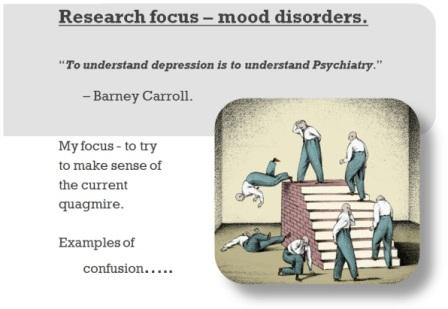
So what did I bring to Psychiatry? In terms of content, I’ve focused on mood disorders. Barney Carroll, an ex-Australian psychiatrist now in the States, said that to understand depression is to understand Psychiatry, because there are so many differing models for the many differing depressive disorders.
I’ve also brought a contrarian personality style and a pattern-analytic approach of trying to look at issues intuitively, but not merely operate by intuition itself. What I’ve tried to do in the last 20 years in particular is to make sense of the quagmire that’s lies around depression classification and its treatment. So, the second part of the book deals with the really difficult issues. Such as how do we model depression? Do antidepressants work? That’s the heartland – the psychiatric domain that I feel most passionate about as current practices risk both over-treatment and under-treatment as a consequence of the flawed models.
Louis Menand wrote in The New Yorker: “Although other areas of medicine continue to make genuine advances, Psychiatry is founded in an ivory tower-spun web of diagnoses that jumble differing diseases together. The psychiatric literature is confusing and even the dissidents disagree”. (And this dissident agrees). Menand again: “Everything from the science (do the medications actually work), to the metaphysics (is depression really a disease?) will confuse you. As a branch of medicine, depression seems to be a mess.”
The Loss of Sadness is probably the most articulate book in terms of explaining how psychiatric imperialism has increasingly moved the bar (defining its domain) from clinical disease states, through disorders, down to normative states – and with such moves worrying many in the profession as well as many in the community.
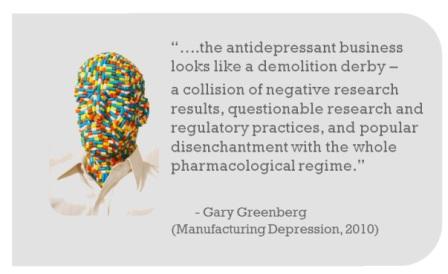
Gary Greenberg, a psychologist who wrote the book Manufacturing Depression, said, “The anti-depressant business looks like a demolition derby – a collision of negative research results, questionable research and regulatory practices, and popular disenchantment with the whole pharmacological regime.” Horwitz and Wakefield, who’ve written a book called The Loss of Sadness, argue that Psychiatry has continued increasingly to pathologise normal states, particularly confusing pathological mood disorders with normative states like grief. They accuse psychiatrists of advancing and pathologising conditions and then applying psychopharmacology in a way that beggars irrelevance.
Thus a concern about cosmetic psycho-pharmacology is raised. The Loss of Sadness is probably the most articulate book in terms of explaining how psychiatric imperialism has increasingly moved the bar (defining its domain) from clinical disease states, through disorders, down to normative states – and with such moves worrying many in the profession as well as many in the community.
Leading weeklies such as News Week and Independent, as well as a dozen books in the last few years have expressed grave concern about the lowering of diagnostic criteria for defining ‘clinical’ mood disorders and whether differing pharmacology treatments work. Anatomy of an Epidemic by Whitaker exemplifies a powerful polemic. Manufacturing Depression by Gary Greenberg raises serious practical questions.
The DSM-III optics were that major depression would be the territory of the psychiatrist and that it required medication, while the minor depressions were to be left to the analysts for analysis and psychotherapy
Let me now try to cover what I think have been the concerns. Depression is, in my view, a meaningless word. It’s rather like saying “breathlessness”. Depression can be clinical. We have disease-like states which we call melancholia and bipolar depression. We also have non-disease states, such as the group of non-melancholic clinical disorders. And we have also experience “normal” depression. It is worth emphasising that it is normal for all of us to get depressed.
But in 1980, DSM-III arrived and tried to knock the analysts out of the ring. From then on we have had a very simple severity-based ‘dimensional’ model of depression, throwing away a classificatory model that contrasted depressive diseases and stress and personality-based depressive reactions – the old ‘binary model’ of two principal depressive ‘types’.
The DSM model positions depression as a single condition, varying by severity. As simple as that. There is “major depression”, which sounds important but – as defined – captures psychological ‘sneezes’ through to severe depressive diseases. DSM also included a set of “minor depressions”. The DSM-III optics were that major depression would be the territory of the psychiatrist and that it required medication, while the minor depressions were to be left to the analysts for analysis and psychotherapy. Some of my colleagues refer to this political strategy – in the absence of a scientific rationale – as “the neurotic peace treaty”.
ICD-10 (auspiced by the World Health Organization) similarly dimensionalised depression as severe, moderate and mild. The predictable problem then emerged. Up to the 1950s, your lifetime chance of clinical depression was probably 5-10 per cent. But after dimensionalising clinical depression with major and minor categories, the lifetime risk grew considerably. And, progressively, dimensionalising has moved to include categories such as “sub-syndromal” and “sub-clinical” depression”. DSM-5 is proposing an even more minor category called “mixed anxiety depression”. This category (acronym is MAD) requires only two minor symptoms. When you include – as DSM would encourage – all these criteria as capturing clinical depression, then the lifetime risk reaches 100 per cent. Clinical depression has, with redefinition, become a universal lifetime experience. Such psychiatric imperialism concerns me intrinsically and in terms of its consequences. It also helps to explain why antidepressants – to my mind, the first line of treatment for the disease-like state of melancholia and often helpful for some non-melancholic depressive conditions – do not appear to be superior to placebos in clinical trials of their efficacy. Evaluating their utility is further confounded and confused by the design of such clinical trials.
A key concern is that many professionals and non-professionals suggest that antidepressants are merely placebos or act like placebos
Who gets into the clinical trials for antidepressants? Basically, community volunteers who have at best mild to modest levels of depression and with a high chance of spontaneously improving and where – especially in the United States – they may be paid significantly for contributing. Excluded – by a set of strategies – are those with the more serious depressive conditions and especially those with melancholia (and where antidepressant drugs are particularly effective). So, when you look at the trials comparing antidepressant drugs to placebo, separation is minimal as the “apples” of clinical trials are being compared to the “oranges” of real world clinical practice. However, it is such flawed clinical trials that provides Psychiatry’s evidence base. And so, the phrase ‘evidence-based psychiatry’ risks being an oxymoron.
A key concern is that many professionals and non-professionals suggest that antidepressants are merely placebos or act like placebos. That has major consequences for people who might and would benefit from such medications.
The model invokes the aphorism that if all you have is a hammer then everything looks like a nail.
The dimensional model is non-specific and leads to non-specific treatment, actually more shaped by the background discipline of the practitioner. If you seek help for depression type X and see a doctor, you’ll get an antidepressant drug. If, for the same type of depression, you see a psychologist you’ll get cognitive behavioural therapy. If you see a lady wearing a caftan, you’ll get crystal therapy. Practitioners tend to practice their own discipline-based treatment modality and apply it across depressive conditions due to quite differing causes. The model invokes the aphorism that if all you have is a hammer then everything looks like a nail. I know of no other model in medicine where the patient is fitted to the background training of the practitioner, rather than, as in medicine, the model is to identify the cause (be it biological, social or psychological) and determine how to rationally and specifically address it. In medicine a diagnosis of major breathlessness would be viewed as non-specific and uninformative. You and your doctor would want to find out if you had asthma, pneumonia or a pulmonary embolus and identifying the cause would shape the choice of a specific treatment.
In destigmatising “depression” there has been much dumbing down
Ned Shorter, a medical historian, cogently criticised the DSM model, stating that ‘major depression’ was essentially a political artefact born of academic infighting and observed that “this was not supposed to happen”. He went on to state that to so broadly define major depression was to make it “applicable to almost any conceivable market basket (treatment)….Major depression served the then-nascent field of biological Psychiatry the way psychoneurosis had once served psychoanalysis”.
In destigmatising “depression” there has been much dumbing down. We need greater sophistication of diagnosis and choice of treatment. DSM was, and continues to be, a political document rather than a diagnostic system based on science, and marked by increasing expansionism. The next edition – DSM-5 – has been under increasing criticism, for example, in risking pathologising grief and in seeking to create an “attenuated psychosis syndrome” – where the patient might be treated with antipsychotic drugs before the development of any psychosis. In the last week, however, and responding to fierce criticism including a petition signed by 18,000 people, DSM-5 has retracted both conditions, the first distinct response to concerns over the last five years. Again, such changes appear more to reflect politics rather than science.
I believe that Australia is way ahead of every other country in the world in destigmatising the mood disorders.
The psychologist Gary Greenberg observed that “When doctors turn suffering into symptoms, symptoms into diseases, and diseases into conditions to be cured, they are acting not as scientists but as moral philosophers”.
Nevertheless, there are some advantages to this whole process. In expanding the boundaries, I think depression has become democratised. It’s less “them versus us”, it’s more a case of “we’re all in this together”. That joining waters down stigmatisation.
I believe that Australia is way ahead of every other country in the world in destigmatising the mood disorders. The education campaign to the public has been led by politicians and sportsmen talking openly. This suggests true leadership. And more people are getting to help. Gary Greenberg again offer poignant words:”Call your sorrow a disease or don’t. Take drugs or don’t. See a therapist or don’t. But, whatever you do when life drives you to your knees, which it’s bound to do, which maybe it’s meant to do, don’t settle for being sick in the brain. So, seek help.”
My campaign as a psychiatrist has been critique, critique, critique.
However, we need to make sure that, when we encourage people to get help, they get sophisticated help. My campaign as a psychiatrist has been critique, critique, critique. Particularly to define melancholia, its causes and demonstrate differing treatment responses, and also try to identify other meaningful depressive disorders more precisely, particularly bipolar II disorder, which is increasingly being recognised as requiring quite differing treatments than offered to those with a primary ‘depressive’ condition. I argue for improving the definition and measurement of these conditions, clarifying their specific therapies, and I argue against the non-specific model of treatment which is seemingly dominant.
My personal style is to be Mr. Blunt
What worries me is that we’ve had the decade of the brain with well-trained and really bright scientists all around the world, particularly in the United States, working assiduously and with great dedication. But, if the diagnostic paradigms and the treatment models are flawed, it invokes the Bavarian proverb: “What’s the use of running if you’re on the wrong road?”
The middle section of the autobiography is an attempt to take such arguments “on the road”, to extend them to the wider community and, unfortunately, in so doing, challenging much of Psychiatry’s approaches to the mood disorders. At the personal level it is captured by Ginsburg’s theorem – “You can’t win, you can’t even break even and you can’t even quit the game”. My personal style is to be Mr. Blunt and – in this domain – a contrarian. In defence of being a contrarian, I would argue that science is not consensual. Further, I invoke Ricky Gervais (”If you’re not offending someone, you’re not doing anything”) and the local lad, Alan Kohler, who observed that “Collegiality is too highly valued. Every board should contain a prickly bastard who keeps asking questions and won’t shut up”.