
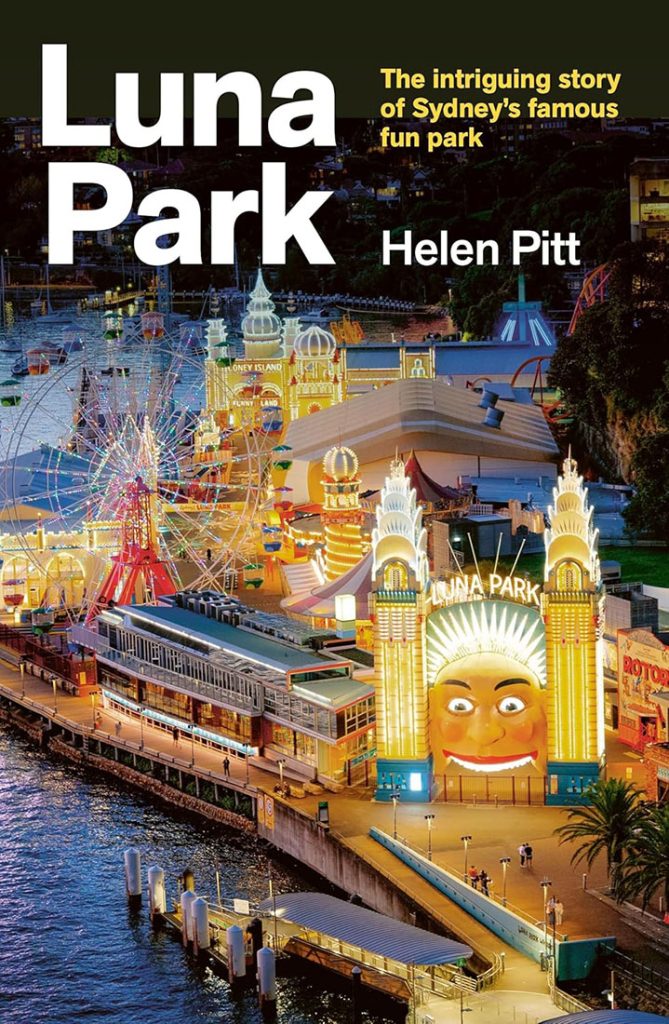
 A TALE OF SURVIVAL – JUST FOR FUN
LUNA PARK – The extraordinary story of the showmen, shysters and schemers who built Sydney’s famous park
By Helen Pitt
Allen & Unwin 2026
ISBN: 978 1 76106 511 8
RRP: $34.99 (PB)
Reviewed by Anne Henderson
The Victorian age of industrial expansion left many legacies, but fun parks are not often linked to this development. As mechanical invention eventually spawned myriads of gadgets, it was in the area of fun that the traditional circus found a home. The attraction of exotic animals could be found in the earliest of fun parks in the late nineteenth century, but they quickly became replaced by numerous new mechanical excitements invented to scare, thrill, entertain and amuse not only millions of children who came but the adults who brought them.
In Luna Park, Helen Pitt has brought the world of fun parks’ technicolour and experimentation to shine on her absorbing and detailed account of many early fun parks and then at length on Sydney’s iconic Luna Park – how it came to be, how it endured years of doubt over its survival and how it emerged into the twenty-first century stronger than ever as a monument in time below Sydney’s landmark Harbour Bridge. As Artist Martin Sharp, a long time supporter of Luna Park, put it:
One must see through the eyes of childhood to perceive the reality of Luna Park. Luna Park holds the Opera House and its serious high culture in a balance with its own cheeky popular culture. … It’s the travelling fair that’s settled down.
The remains of a fun park in Glenelg, Adelaide, would be unloaded from the SS Mungana ahead of being reassembled for Sydney’s original Luna Park, on a bleak day in June 1935. In St Kilda, Melbourne, a Luna Park had opened with a world first gigantic “moon” face as its entrance in 1912. Each fun park had taken the name Luna Park from the hugely successful Coney Island Luna Park in New York, backed by Thomas Edison’s million or so light bulbs, which opened in 1903.
Helen Pitt’s history spins a web of the fun park movement across the most famous of the United States and less well recalled in Australia. She traces how developments across the globe found traction in various Australian states. In Brisbane, a Luna Park opened in 1944, the year a fire brought New York’s Coney Island Luna Park to an end. In Adeliade, the fun fair at Glenelg closed, passing on its heritage to Milsons Point in Sydney. As Pitt writes:
Luna Park [Sydney] rose from the dirt floor of the old industrial complex that had created the Sydney Harbour Bridge. … It was the painters on the Bridge with their bird’s eye view of Milsons Point that spread the word among their old unemployed mates about work being offered at Luna Park.
These investments in people’s entertainment were gambles for the men who worked and put their money forward – some in vain and open to loss; others riding high on success. Pitt singles out such heroes of Sydney’s Luna Park as showman David Atkins who began Luna Park Glenelg and Luna Park Sydney and Ted Hopkins, who as a young man oversaw the dismantling of the Glenelg big dipper and its reassembling in Sydney. He finally retired from Luna Park Sydney in 1973 aged 71.
Fun parks like Sydney’s Luna Park had to keep with the times to stay afloat. Sydney’s Luna Park attracted film crews from Hollywood and showcase personalities like singer Johnnie Ray among others. But as the era of colour television, videos, pinball parlours and mass entertainment in movie houses sapped fun park interest, new investors were lured to make a difference at Luna Park. Pitt handles this part of Luna Park’s story delicately but has been taken to task by former adviser to Premier Neville Wran, Milton Cockburn, for ignoring information that might have enlightened behind-the-scenes involvement.
In June 1970, under the Liberal Party Askin government, Luna Park was set to be dismantled and relocated. The park was run down and needed refurbishment. The owners included Leon Fink and Nathan Spratt and the proposal was that the site of Luna Park be rebuilt as a $50 million International Trade Centre. The proposal did not go ahead. Fink, instead, could see that the park could become a home for fun artwork and engaged artists like Martin Sharp. But at the tender stage for a new lease on Luna Park after the new Labor Wran Government was sworn in. In spite of Fink’s friendship with Wran, Wran refused to let the tender go to Fink and Spratt with the ill feeling being left as something Spratt had done to Wran. As Cockburn queries:
Would the state have been better off if the Fink/Spratt company gained a renewed lease in 1976 without a public tender? Should the Fink/Spratt company have been the winning tenderer when a public tender was ordered in 1980 after the fire? Pitt seems to have lacked interest in exploring these questions. – The Occasional, May 2026
The great tragedy that would engulf Luna Park was undoubtedly the fire in the ghost train on 9 June 1979. The fire took the lives of six children and a father. Pitt covers the event in a most moving way – capturing not only the disaster but the aftermath of mourning and controversy.
Undoubtedly, with NSW Police shutting off the area and making an unsubstantiated claim the cause was electrical within hours of the fire there was no proper forensic investigation. An inquest of 1900 pages failed to resolve the matter and led to an explosion of conspiracy theories around arson, in spite of the fact there was much evidence to suggest the site was an accident waiting to happen.
Pitt avoids the now disproven allegations against any involvement by Premier Wran and concedes the latest ABC documentary on the fire Exposed: The Ghost Train Fire went into theories with no support for the arson allegations. But she gives credence to links with underworld figure Abe Saffron albeit never proving any link. Had there been a more thorough investigation at the time of the fire, such rampant imaginings re Saffron and his ilk might never have taken off. The whole matter remains a mess.
But it is on a high note that Luna Park ends. It survived legal push back over the height and sounds of a new big dipper from near-by residents – such Harry and Penelope Seidler. The outcome was a rational compromise by all involved. And today Luna Park Sydney is a heritage site, its laughing monster mouth part of the Sydney Harbour landscape. What’s more, its new venture is a partnership with Netflix.
Anne Henderson is Deputy Director hard of The Sydney Institute and author of Menzies at War, which was shortlisted for the 2015 Prime Minister’s Award for Australian History.