
Speaker
Heidi Douglas
Speech Date
May 8, 2026
Issue
Issue 16
Issue 16 | May 2012
Heidi Douglas is a veterinarian and ex-RAAF pilot who set herself the challenge of travelling around the brim of the Australian continent on foot. Catch Up with the Sun (Finch 2012) is the account of this remarkable achievement, a journey through the outback of Australia with horses and camels. Douglas covered Victoria, NSW, Queensland, Western Australia, and the Northern Territory. On Tuesday 8 May 2012, Heidi Douglas brought her slide show to The Sydney Institute where she addressed an audience of couch adventurers on the highlights of her journey. What follows is an edited transcript of this talk.
AUSTRALIAN DREAMING – SUN, CAMELS AND GRUMPY KELPIE
HEIDI DOUGLAS
Thanks everyone for coming here today.
I’m here is to speak to you about how I rode a horse, alone, around Australia with pack horses and pack camels. The ride took two years and three months, raising money for Youth Off The Streets. It was a dream I had believed in since I was a kid, when I was sent away to boarding school from a property in southern New South Wales. I hated every second of those six years at school and it made me determined to go back to the country and see Australia, as it really was.
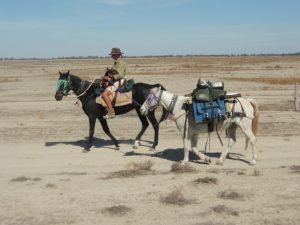
A weekend with pack horses can wear the horses out and I had months, and even years, to go.
I did my trek on my own; I didn’t have a support crew or anything like that. I had to carry everything I needed on two pack horses so it required some pretty intense preparation. Training the horses took time and patience. I actually tried out 20 horses before I found the best combination for the journey; the ones that could cut the grade, or so I thought. I designed and made my own pack saddles. Being a veterinary chiropractic practitioner I’m pretty fussy about saddle fit which can make or break a horse, especially a horse that is going to be working for me all day every day for months, even years. The next step was to plan a route. The horses would need water at camp every day as well as feed to graze. There’s no point getting a pack horse to carry water because it would drink around the same amount per day that it could carry.
I set off on 1 October 2006, at Healesville near Melbourne, heading up the Bicentennial National Trail (BNT) with a couple of friends that rode with me for the first few days. It was a very steep learning curve. I’d never done packing before. A weekend with pack horses can wear the horses out and I had months, and even years, to go. I could not afford to treat my horses carelessly. I needed to keep the water and feed up to them to keep them in good condition, as well as keep them pain free. After three weeks I was well into the Victorian Alps by which time one of my horses became three-legged lame, which meant she couldn’t even weight bear on one of her legs. I camped for about four days at Howitt Hut and threw everything at her, every drug and every technique I had, but she didn’t improve. Eventually, I had to have the horses trucked out from the mountains, and find myself a replacement horse. This meant losing valuable time. I had a strict schedule; I had to make it to the north in time for the dry season.
while with the trucking company, all three of my horses died of salmonella infection within a matter of 18 hours. It was devastating
I had my team of horses transported to north of Sydney, where I planned to start riding again. This just meant I had a new finishing post. But, while with the trucking company, all three of my horses died of salmonella infection within a matter of 18 hours. It was devastating, to say the least. I had spent two years preparing my ride and all of a sudden I’d lost everything. I’d lost my business (given away all my clients), sold my ute. I had nowhere to live. I had no job. All of a sudden everything I’d been preparing for in the last couple of years had gone. But the other and more devastating fact was that the two horses I’d ridden through the Alps with, who had worked so hard for me, had died. It had been really tough going – rough country, poor feed and hard yakka – but they had kept on going for me. Then I had put them on a truck and killed them – that was my state of mind at the time, anyway.
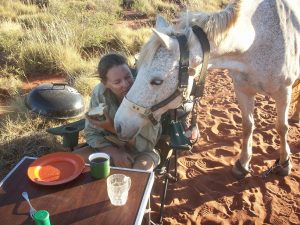
I bought three new horses at the dog meat sales. I bought Gumby, the Legend, for $250.
I seriously doubted if I should go on; whether I could do this to more horses. Finally, with the support of family and friends, I managed to pick myself off the ground and decided to ride on. I was home for about eight weeks, and had to find more horses. I bought three new horses at the dog meat sales. I bought Gumby, the Legend, for $250. He wasn’t a giant but he was an absolute machine. The best $250 I’ve ever spent. He was with me for the rest of the trip. Then there was Willow, a really hard worker with terrible feet and an arthritic neck I had to manage. Bart was a stunning, chunky Welsh cob that was scared of his bum and a bolter. Piglet, the horse that went three-legged lame in Victoria, had recovered and I decided to take her too. It was a rushed packing education and preparation for these new horses. Poor old Bart, he was on a float up to Queensland the same week I bought him off death row.
As we passed through some of the properties and towns I met small children who had never seen rain
Because of the time I had lost, and the fact that my horses were unfit and pretty green, I floated them up to Queensland to start again. My sister, Trina, rode with me at this second start for four days, to help with the new horses. We left from Marlborough in January 2007 in the middle of a drought, in some fairly ordinary country with very little feed for the horses. We made around 30 kilometres a day from waterhole to waterhole. After a couple of weeks the wet hit. We slowed down a bit with the humid weather and wet and boggy tracks, but the horses were much happier.
With the humidity I had to find salts for the horses as well as myself because we all started to get bad cramps. The rain meant we had plenty of water even in between camps and the feed was growing rapidly. As we passed through some of the properties and towns I met small children who had never seen rain before this downpour. Travelling was hard work for us all but with the added humidity I was really struggling. By the time I reached Nebo I was physically and mentally exhausted and wondering if I could go on. Then, out of the blue, a total stranger called Julia rang me up saying she had heard of my ride and asked if she could join me for a bit. She drove some 1500 kilometres in a day to reach me. At Nebo she left her car and off we set. She was with us for about five weeks and basically rescued my sanity. She was just what I needed to keep me going at that point.
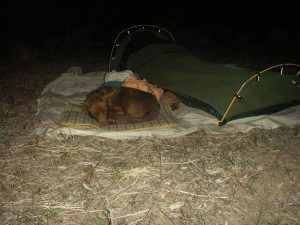
Every night I looked forward to having a tub in only a couple of hundred millilitres of water and crawling into bed at sunset
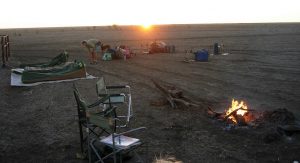
Camping became a real art. When choosing a place to camp all you care about is water for the horses, feed for the horses and, only then, shelter for yourself, if it’s possible. Camps had to be flexible. At times I had to be quite inventive to construct a shelter and get out of the rain. In Queensland, the dew could be worse than the rain and by morning everything could be soaked. At the end of every day, I would unload the horses, give them a rub down and let them go in their hobbles to graze. Before they set off for a feed they would luxuriate in a long roll in the dirt; that was their “beer” at the end of the day. I would then still have to set up camp, build an electric fence yard around the best grass, cook myself dinner and yard my horses just before dark. Every night I looked forward to having a tub in only a couple of hundred millilitres of water and crawling into bed at sunset.
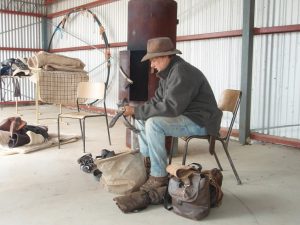
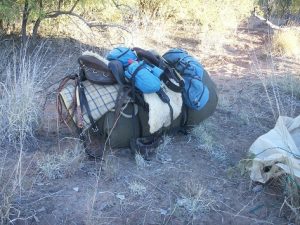
Getting going in the morning took about two hours, from getting out of my swag to packing up camp and loading the horses up. Saddling a pack horse is a skill in itself. Each side of the horse has to be weighed correctly and balanced to within around 200 grams. I actually had a set of fish scales that I used to weigh every item. An unbalanced horse will get through the day, but would struggle the following days because it would be so sore. Apart from the fact that I did not want my kids to suffer, I could not afford to waste one day’s travel. My horses did not have shoes for most of the trip – they were “barefoot” because I wanted them to have good, healthy feet. Shoes get in the way of that on such a trek. In stony areas I had “easyboots”; specially designed boots to fit over the horses hooves. I learnt to hate those boots as they made a lot of extra work for me.
In town, we would camp for a few days, usually at the showgrounds. I hated going into towns because there was so much to do; work out the next route, ring property owners getting the appropriate permission to go in certain areas, wash all the gear, shop for the next few months of supplies, repair gear, do chiro on the horses, trim feet, post stuff home and so on.
On the track, if something scary happened, instead of racing off, they would turn around to me, as if to say “you’ll fix it, you’ll protect me”.
From Nebo, we headed to Collinsville then up to Charters Towers then west across to Mt Isa. Here the country started to open up… it started to dry up as well. It was round April, and I was following stock routes through mostly cattle properties. Parts of the stock routes were difficult to follow. In earlier times, the drovers kept the tracks worn and clear but these days hardly any drovers operate. My horses were my work mates; living and breathing and working with me the whole time. I’ve worked with horses all my life but not until now did I realise just how hard they will work for you. On the track, if something scary happened, instead of racing off, they would turn around to me, as if to say “you’ll fix it, you’ll protect me”.
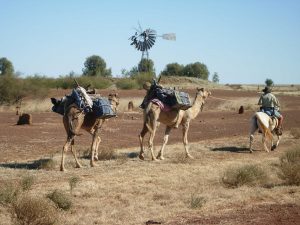
When I got to Mt Isa, the country was quite dry. I sent all of my horses, except Gumby, home. Somehow, Gumby drew the short straw to continue on with the two camels Andrew Harper provided for me. Andrew works in the Simpson Desert, running camel treks and expeditions. He is an amazingly generous guy. Before I set off on my ride, I rang him (he didn’t know me from a bar of soap) for advice about. From that conversation, it was decided I would take camels for part of the way, in the drier regions. He generously lent me two camels for nine months, along with all the gear they needed, all for no charge, and he delivered them to Mt Isa.
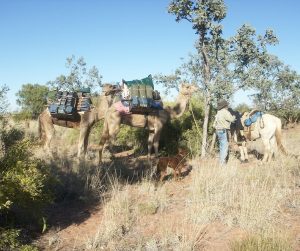
If they don’t respect you, they just look at you as though you’re an idiot and refuse to do anything you ask. My first couple of weeks with these camels were pretty tough.
I was petrified on my first day with Pam and Gypsy. I’d only worked with camels for a couple of weeks, twelve months before, at one of Andrew’s camps. The girls didn’t want to have a bar of me. The thing about working with camels is that they work really, really hard if they respect you. If they don’t respect you, they just look at you as though you’re an idiot and refuse to do anything you ask. My first couple of weeks with these camels were pretty tough. But I finally won them over and then they would do anything for me. Horses normally hate camels, but Gumby loved them. When I first let him go in the yard with them, he ran over to them to say “g’day” but they panicked and ran away from him. He just adored them, much more than he liked horses.
I decided if he had been a human, he’d probably be a postal worker that ended up being sacked and going back to his place of work with a bomb strapped to his waist that, in the heat of the moment, he failed to set off properly
Whenever we were at a camp and the camels were sitting down, usually staring at the sunset, Gumby would hobble over and sit between them, looking side to side at each of them as if to say, “See? I’m one of you!” They didn’t really like him, but luckily he never worked that out. My girls had huge characters that constantly entertained me. Pam was a serious, hard worker. She didn’t want any funny business and definitely didn’t want to be patted, just wanted to work really hard. Gypsy was flighty, but affectionate and needy. She was a huge source of frustration and entertainment, often at the same time. It’s very different travelling with camels. With all horses, you tend to ride one while leading the pack horses. With camels, it tends to be all done a lot easier with teamster walking. So I did a lot of walking, leading “the girls” and Gumby.
All my kids seemed to hate the kelpie dog, Furphy. He was a very strange dog. I decided if he had been a human, he’d probably be a postal worker that ended up being sacked and going back to his place of work with a bomb strapped to his waist that, in the heat of the moment, he failed to set off properly, just singeing a few hairs on his chest. But he was always very loyal and never any trouble. He seemed to just tag along with the rest of us, whether he was invited or not.
So, with the camels, we travelled from Mt Isa, north to Savannah Way then west into the Northern Territory across the Barkly Stock Route to Elliot, then Top Springs and Bililuna, in Western Australia. On the Barkly Stock Route, in June 2007, we had unseasonable weather. Ten inches of rain fell in a week, and it was freezing. This presented me with one of my first major challenges. It was physically really difficult and I began to wonder if I would survive the leg at all. It was very wet and cold and travelling was treacherous with the slippery roads that the camels struggled on, and there were black soil sink holes off the road that Gumby just about disappeared into.
the Barkley Breeze that blows continuously from March to November. It’s relentless and tends to mess with your mind
I knew no one was going to come along to “save” me as the road was impassable by vehicle for hundreds of miles. Afterwards, I recognised it as a mental challenge, not so much a physical threat to my survival, even though I did feel at the time I was physically at risk. I found I was making vital decisions that were important to me and my kids. If I travelled, it was dangerous to the camels and horse and if I didn’t travel we were going to be stuck there in the freezing rain and there wasn’t enough feed for them for more than one night. Then, around the eighth day of rain, the sky cleared, the sun came out and defrosted us, and I reached Anthony Lagoon Station. It was the first civilisation I’d been at for what felt like years, but in reality was only a few weeks. At that moment, everything changed. Everything was clear. I knew I was never in any danger, but mentally I had been really struggling.
On the Barkly Stock route there is an easterly wind called the Barkley Breeze that blows continuously from March to November. It’s relentless and tends to mess with your mind. I was in it for about three months. After a while, I had to contain myself from leaping in any passing car and shutting all the doors and windows just to get a moment’s peace. I learnt that being outside, at the mercy of the weather 24/7, was even more of a mental challenge than a physical one.
I travelled due west for pretty much the whole of the Northern Territory and got very bored, desperate to turn north or south just to break up the leg. It was here that I began to recall the Pink Floyd song “Time”. The song has the line in it “you run and you run and you catch up with the sun but it’s sinking, racing around to come up behind you again. The sun is the same in a relative way but you’re older, shorter of breath and one day closer to death.” That’s why I called my book Catch up with the Sun, because it felt just like I was trying to catch up to the sun, but never getting anywhere, just getting older.
any relations driving past would stop and say “you look a bit dry”, and give me a can of beer, even at 10 in the morning! I probably averaged a couple of beers before noon each day.
Outback people’s hospitality and generosity was overwhelming. In fact, the experience instilled in me a renewed faith in humanity. In western Northern Territory, I passed through a string of family properties. They were having an extended family reunion while I was there which went for three weeks. For hundreds of kilometres, as I was walking through their properties, any relations driving past would stop and say “you look a bit dry”, and give me a can of beer, even at 10 in the morning! I probably averaged a couple of beers before noon each day. That was a great leg, even though I found the early morning beer a bit of a struggle and would have to ride Gum for most of the afternoon.
As I crossed the Northern Territory I got my first taste of the desert. My route took me across a corner of the Tanami Desert. I loved it. By the time I reached Bililuna, at the top of the Canning stock route in the north west of WA, I was really looking forward to the 1800 kilometres of desert. The Canning was built over 100 years ago to move cattle from the north, as far east as Queensland, to Perth and Kalgoorlie. In the end, not a lot of drovers travelled the stock route. It was pretty tough work. The wells are on average 30 kilometres apart, but a lot of the wells nowadays are derelict. Some of them have been renovated by people and various clubs but they are not necessarily reliable, as I discovered.
That was the water I had to drink for the next 500 kilometres. I called it “skanky snake water”. I reckon the smell of dead and rotting reptile is one of the worst.
I was running a little late in the season, travelling the Canning from August to November, so it was getting pretty hot. It was really tough and an average day saw the temperature climb to between 40 and 45 degrees. I could only carry 300 litres of water which was about eight days worth. The water we carried was for Gumby, Furphy and me, and the girls had a drink only when we were at a working well. Some working wells were over 200 kilometres apart so the kids had to work pretty hard on some of the legs. It was very tricky to manage my water, especially considering Pam was getting sick and struggling to work without more regular drinks and the water quality was variable and unreliable. At the best well (or so it was documented) there was a dead, rotting snake and maggots in the water. That was the water I had to drink for the next 500 kilometres. I called it “skanky snake water”. I reckon the smell of dead and rotting reptile is one of the worst. I could taste the water even before it was in my mouth! It was awful.
My morale began to sink at this time. I even became a bit confused. I used to do a lot of calculations in my head about the distance, time and directions I was travelling. I’d get to the end of my calculations and forget what I was trying to calculate. Then I came across some tourists that stopped and asked me if I needed anything. Did they have any water? They gave me around 20 litres of fresh, clean water in my jerry cans and filled my day water bottles as well; my brain lifted as soon as I started drinking it. Then, as I walked on, I realised I had put fresh water in the wrong jerrys and had mixed it with the salty water I was carrying that only the camels and Gum could drink. It was then I realised the importance of fresh water for clear thinking and morale, not just for keeping me hydrated.
My camels were starting to lose weight, and Pam was sick and had lost a lot of condition.
About two thirds of the way down the Canning, my father and uncle caught up with us (after 4 days driving) and camped with me for a couple of weeks. This saved me mentally. My camels were starting to lose weight, and Pam was sick and had lost a lot of condition. With a Land Cruiser in tow, I managed to offload the girls to give them a break. We didn’t have to carry as much stores of water because Dad and Uncle Don could travel ahead or behind and ferry water to the camps. I was able to water Pam every day which made a big difference to her condition and ability to travel.
Furphy was also struggling with the heat so he travelled in the air conditioned ute and actually went back home when they left. Poor Furphy had lost a lot of weight and I was very concerned about heat stress and frying his organs! At the end of every day, I’d sit down and if I had water to spare I’d put my feet in it to help get the swelling down from the days walking. My shoes were already a bit too small but in the hot weather it was much worse and was starting to create problems. While I “shrank” my feet I would plan the next day’s route on my maps.
Some properties I went through had not had stock on them for over three or four years. Even so, the locals would catch up with me out at my camp, cook up a feast from the back of their ute, give me a few beers, my horses some hay, the dog a bone and even donate money to Youth Off The Streets.
I finally reached a property called Granite Peak Station at the bottom of the Canning Stock Route. Here I decided I couldn’t continue with the camels. I trucked all the kids back to New South Wales. I knew I couldn’t cross South Australia without camels (because of Pam’s condition), or at least without horses and a back-up crew and I certainly didn’t have the finances or resources to do either.
I restarted my trek at Broken Hill with my own horses, the camels having been returned to Andrew Harper. I also
got a new kelpie pup. Furphy had become very attached to Dad and I was quite happy to leave him behind. I travelled south east from Broken Hill to southern New South Wales. This was the most drought affected country I travelled through. Some properties I went through had not had stock on them for over three or four years. Even so, the locals would catch up with me out at my camp, cook up a feast from the back of their ute, give me a few beers, my horses some hay, the dog a bone and even donate money to Youth Off The Streets. I found the tougher the country was, or the more remote it was, then the more generous the locals were to me, my kids and Youth Off The Streets. Such amazing, generous people. I rode all the way down to my parents’ place in southern New South Wales.
On 10 December 2008, Gumby and me, with the rest of the crew, walked through the gates at home to be greeted by a small crowd of locals armed with champagne glasses
By then it was May and I still had the leg from home to Marlborough, in Queensland. I bought an old wreck of a truck I called Tumbleweed (it only wanted to roll in the direction of the wind) and packed up my three horses, Piglet, Bart and Gumby, for Queensland. I left the truck there then headed back towards southern New South. I travelled south, down the BNT, which parallels the east coast of Australia. It was great country, but sometimes I’d be going through places with five acre blocks and busy roads. At one stage I had two Chiahuahuas chasing me down the road barking at me. My kids could not work out what the noise was because they couldn’t actually see the little midgets snapping at their heels. Once I hit New South Wales I headed further west into more open country with larger blocks and stock routes and quiet roads.
On 10 December 2008, Gumby and me, with the rest of the crew, walked through the gates at home to be greeted by a small crowd of locals armed with champagne glasses and numerous questions. We had travelled for over two years and gone nearly 8,000 kilometres. Gumby and I still plan to do the Nullarbor. When I can afford to get some more camels, we’ll be on our way. But I’ve still got to pay off my first ride and I think I should do that first.