
Speaker
Michael Waterhouse
Speech Date
May 3, 2011
Issue
Issue 11
Michael Waterhouse is a historian and author of the book Not a Poor Man’s Field. The New Guinea Goldfields to 1942 – An Australian Colonial History. Foreword by Ross Garnaut. Michael has been a Senior Adviser in the Treasury. He spoke at The Sydney Institute on Tuesday 3 May 2011.
AUSTRALIA’S COLONIAL EXPERIENCE IN NEW GUINEA BETWEEN THE WARS
MICHAEL WATERHOUSE
Today few people know much about Australia’s colonial experience in New Guinea up to World War 2. Destruction of records by Japanese and Australian troops, the latter as part of a scorched earth policy in 1942, means the historical record is poorly documented – which has discouraged research into this part of our history.

Map 1
At the outbreak of war in 1914, Germany had a significant naval force in the Pacific. There was a coaling station at Rabaul, which was also part of a chain of wireless stations connected to Berlin. In view of this threat, an Australian Naval and Military Expeditionary Force was despatched from Sydney a fortnight after war was declared on 4 August. The Force arrived at Rabaul on 11 September, and by the end of the day the wireless station had been captured, though not without cost. Six men were killed and four injured – the first Australian casualties of World War 1.
A military administration operated for the next 6½ years – though with the future of German New Guinea undecided, it was little more than a holding operation.
At the Versailles Peace Conference, the Australian Prime Minister Billy Hughes argued strongly for the full annexation of German New Guinea by Australia.
In the end, a compromise was reached, with Australia being given a mandate to administer New Guinea on behalf of the League of Nations. This permitted Australia to apply its laws to New Guinea – though not to exploit the Territory for its own profit. The Mandate imposed various obligations on Australia. In particular, Article 2 required it to promote to the utmost the material and moral well-being and the social progress of the inhabitants of the territory. The New Guinea Act – which provided the framework for the Administration’s activities – pointedly excluded any reference to this obligation. The government was far more interested in expropriating German property and businesses, both as reparation for some of its war losses and the employment opportunities they would provide for returned soldiers.
The government was far more interested in expropriating German property and businesses, both as reparation for some of its war losses and the employment opportunities they would provide for returned soldiers.
On 9 May 1921 a new civilian Administration took over from the Military Administration. The government’s indifference towards New Guinea was reflected in several early decisions. The new administrator, Brigadier-General Evan Wisdom, was not a good choice. He lacked any experience in colonial administration, was strongly opinionated, pompous and disinclined to listen to the views of others. Preference was given to World War 1 veterans when appointing administration staff. Most of them were untrained and unsuited to the challenges ahead. The government further impeded the scope for effective administration by providing that the Governor-General make ordinances – the Administrator only being permitted to make regulations. All important decisions regarding the Territory’s administration were thus to be made in Australia by the Minister for Home & Territories and his Melbourne-based Department.
Finally, the government imposed a financial straight-jacket on the Administration. In his 1921 Budget, Treasurer Sir Joseph Cook articulated the government’s policy when he said:
In accepting the mandate, Australia has entered upon additional responsibility, but no stone will be left unturned to prevent further financial burdens being entailed thereby.
New Guinea’s economic base lacked the capacity to generate revenue on a scale necessary to discharge its responsibilities under the Mandate.
With a lacklustre administration, a narrow revenue base and virtually no infrastructure it seemed inevitable that New Guinea would remain a backwater in the years to come.
This all changed with the discovery of gold.

Map 2
The first major discovery was at Edie Creek in 1926, 32 miles inland from Salamaua, the only place on the coast where ships could find a safe anchorage. A prospector struggled up Mt Kaindi and found gold so concentrated, that each dish he washed contained up to 20 ounces. Shortly afterwards, using simple sluice boxes, two other members of his syndicate recovered 7,600 ounces of gold in six weeks. At the prevailing gold price, this was worth $1.1 million in today’s terms.
This discovery led to a rush from Australia, despite the best efforts of the Administrator to discourage it, and despite the fact that – to get there – miners with teams of carriers and labourers had to hike for six to eight days through mountainous, jungle-covered terrain. Most of those who joined the early rush were inexperienced, unlucky or both, and soon disappeared when the promised riches didn’t materialise. Others who were more fortunate – or who simply liked the lifestyle – stayed, and gradually a small frontier society developed that was quite unlike that on other goldfields.
In 1926, 90 per cent of New Guinea’s white male population had served in the Great War
Everyone is so lackadaisical about gold in New Guinea. You go into miners’ huts to have a wash and find the basin full of gold or maybe there is a biscuit tin of it on the floor.
Gradually small townships began to form. I say “small” as there were only about 150 Europeans on the field in 1928 – though there were at least ten times as many labourers and carriers. Salamaua was the main point of entry. As might be expected of a settlement that developed in such a short time to meet the needs of miners on the field or passing through, conditions were basic, though the new Salamaua Hotel soon became a home-away-from-home for miners down from “on top”.
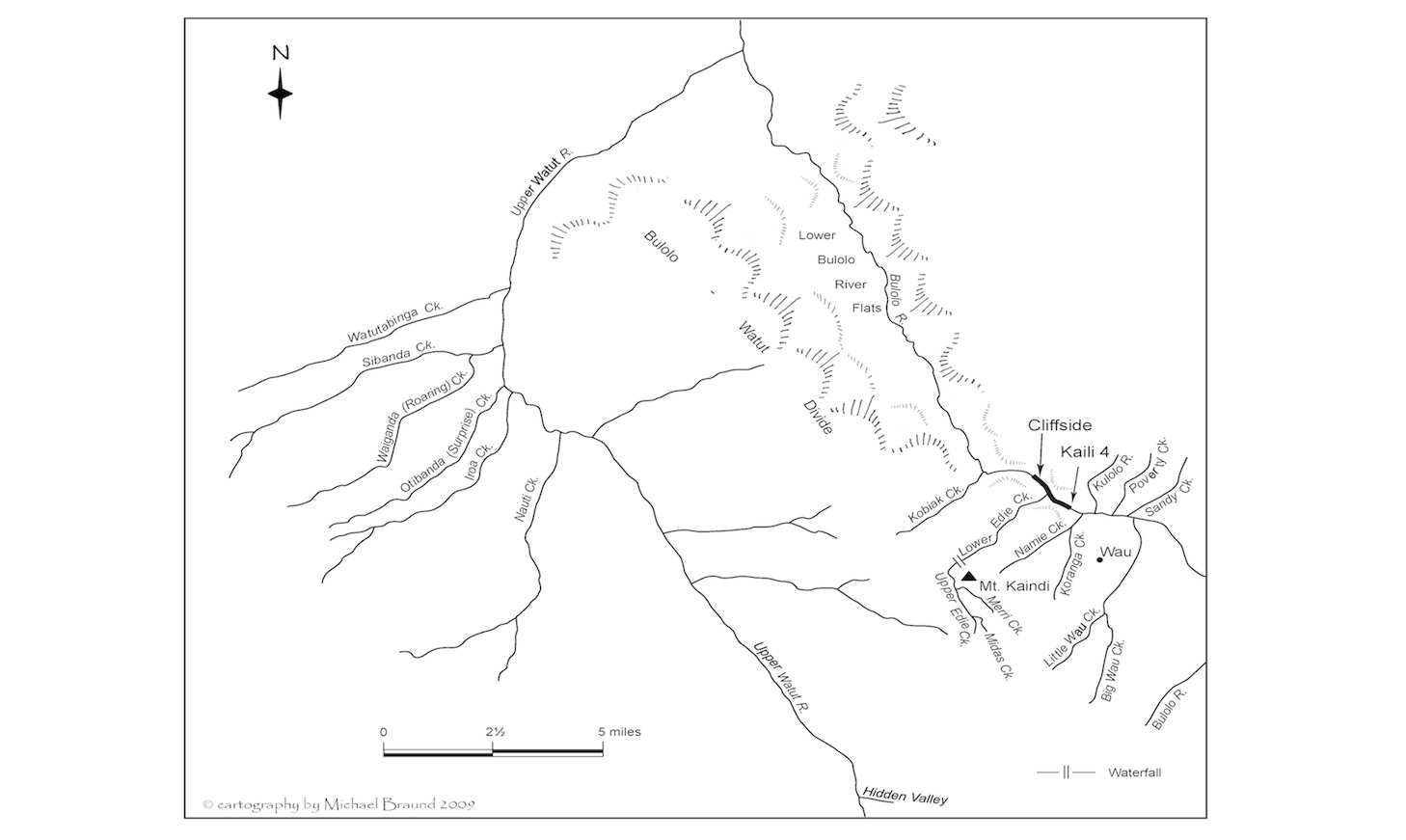
Inland, a small settlement began to form around a new airstrip at Wau on the lower slopes of Mt Kaindi. It was several hours walk from Edie Creek and being 3,500 feet lower, offered respite for miners from the bitter cold. And it had a pub. The long trek in from the coast to Edie Creek was the catalyst for the arrival of aeroplanes, the first of which reached Wau in April 1927. Most of the early planes were fabric-covered single engine plywood biplanes, some of them ex-World War 1 bombers, and designed neither for freight nor New Guinea’s humid climate. But they changed the goldfields dramatically. For those who could afford it, a 40 minute trip from the coast beat a six to eight day hike every time.
Most of the early planes were fabric-covered single engine plywood biplanes, some of them ex-World War 1 bombers
Map 3
The second discovery, though not as rich, was more extensive. After passing through a gorge, the Bulolo river opened out into a broad valley that was a mile or more wide and 10 miles long. In 1929, a small Canadian mining company, Placer Development, tested the alluvial gravels and confirmed the presence of significant quantities of gold. This was the catalyst for extraordinary events.
This was the catalyst for extraordinary events.
An operating company, Bulolo Gold Dredging, was established, the necessary capital raised – the depression notwithstanding – and within 21 months the first dredge had been launched. To achieve this, several thousand tons of material had to be ordered from several countries and shipped to Lae. As there were no port facilities, everything was landed using lighters or simply floated ashore, then flown in to a newly cleared aerodrome on two Junkers G31 aircraft – each of which could carry nearly three tons of freight and, at the time, were amongst the largest planes in the world.
At Bulolo, jungle was cleared, roads built and power lines erected while a huge dredge and a hydro-electric plant were constructed. This first dredge was followed by a further seven dredges, the last of which was completed in 1939.
Everything required to construct and maintain these – as well as three hydro-electric power stations and two townships – was flown in from Lae, mainly on the two G31s
The operations of Bulolo Gold Dredging were largely responsible for the New Guinea goldfields becoming the second largest gold mining province in Australasia in the 1930s. Its dredges produced 1.3 million ounces of gold and 600,000 ounces of silver – more than 60 per cent of the field’s production. Most importantly for the Administration – it was a major source of revenue. Royalties, fees and import duties paid by Bulolo Gold Dredging contributed around 25 per cent of the Administration’s revenue during the 1930s.
Royalties, fees and import duties paid by Bulolo Gold Dredging contributed around 25 per cent of the Administration’s revenue during the 1930s.
The operations of the G31s were complemented by those of a myriad of smaller planes – largely flying between Salamaua and Wau, which acted as a hub for mining camps and small airstrips scattered far and wide. This frenetic but sustained activity meant that, during the 1930s, planes in New Guinea flew more than half as much freight as all planes in the United States, Canada, Germany, France and the UK combined. Up to 1942, aeroplanes in New Guinea flew 104,000 tons of freight, far in excess of planes in Australia, which flew a mere 5,000 tons.
From around 1930, the European population began to grow rapidly – due largely to the activities of Bulolo Gold Dredging and another new mining company, New Guinea Goldfields, whose operations were at Edie Creek and close to Wau. By 1938, with its more benign climate and busy aerodrome, the European population of Wau had grown to around 1,000 – more than in the capital Rabaul. On the goldfields as a whole, there were around 1,800 Europeans – or about 40 per cent of New Guinea’s total European population. While collectively no more than in a small Australian country town, there were also more than 10,000 indentured labourers and 200 Chinese – many of whom ran trade stores catering to the needs of labourers.
Each township, small as it was, had its own distinctive personality, reflecting its location, climate and the activities of the people who lived and worked there. But each also saw itself as part of a unified goldfields community. This sense of community was fostered by such factors as the unhealthy climate, their distance from – and poor communications with Australia, and their antagonism towards the Rabaul bureaucrats who – despite the importance of the goldfields as a source of revenue – were unwilling to provide basic services there.
The fact that they were at the top of the social hierarchy, despite being numerically in the minority, also contributed to a sense of unity.
As in Australian country towns, Anzac Day drew the community together – an annual service attracting hundreds of people to Wau from other townships. From the early 30s, Wau, Salamaua, Lae and Bulolo competed for a trophy in tennis, billiards, snooker and cricket. Teams and their supporters flew to townships which were hosting events. Barracking was vigorous, as was the partying before and afterwards. Other competitive sports that provided a reason for air travel between townships included horse racing, swimming, yachting and golf.
As in Australia at the time, dances were popular, and people would fly in for one from all over the goldfields.
But the Australian colonial experience is not simply a white man’s story.

Map 4
The history of encounters between Europeans and villagers in New Guinea is a bloody one. Wherever Europeans broke into new territory, there was always conflict.
At Nakanai, on New Britain, the murder of four prospectors led to a punitive patrol in November 1926 – the use of a machine gun contributing to the death of 18 villagers.
I never heard any evidence of the kukukuku putting white men on the menu though they killed a few; I found that native people were distrustful of strange food.
Inevitably, Europeans found themselves in conflict with some of these villagers. In January 1927, several carriers travelling back to the coast from Edie Creek were killed by the Biangai after their vegetable gardens had been raided on several occasions. The reprisals that followed culminated in the death of several villagers.
Shortly afterwards, Wisdom wrote to his Minister defending the use of aggressive action where villagers resisted the arrest of murderers. He argued
Opposition must be broken down when met and failure to do so will inevitably bring about much greater bloodshed later.
Patrol officers usually resolved difficult situations with courage and imagination. But there were exceptions. During my research, I uncovered compelling evidence that – during two separate patrols in 1931 and 1932 – patrol officers killed every man, woman and child in three kukukuku villages close to the border with Papua.
Patrol officers killed every man, woman and child in three kukukuku villages close to the border with Papua.
Indigenous labour was pivotal to the success of the goldfields, and was provided by a highly organised indentured labour system. Labourers were recruited from villages in areas previously opened up to European influence and transported to the goldfields, often over long distances. They were usually contracted for three years. For the most part, their job was unskilled manual labour – unloading ships at Salamaua or Lae, carrying supplies, working sluice boxes for individual miners or clearing the jungle ahead of dredges. All European households had houseboys to undertake cooking, washing and other manual chores.
Increasingly, however, some of the labourers performed a range of semi-skilled activities, such as driving trucks and operating machinery. The Lieutenant-Governor of Papua, Sir Hubert Murray, suggested that the indentured labour system was “really rather like slavery”. But the facts suggest otherwise.
Sir Hubert Murray, suggested that the indentured labour system was “really rather like slavery”. But the facts suggest otherwise.
The Administration specified minimum standards of clothing, food rations, housing, beds, medical services, working conditions and wages for labourers in great detail. Those living in townships or working for companies usually lived in compounds. They enjoyed a lifestyle free from village discipline, playing soccer, gambling, visiting wantoks and on special occasions performing singsings. While desertions were by no means uncommon, miners didn’t have great difficulty attracting new recruits and up to half [of the] time-expired labourers re-engaged each year, suggesting that most labourers found the life and lifestyle attractive.
There were, however, strict rules governing interactions with Europeans.
Administrative regulation enforced racial segregation in a way that was little different from what later came to be known as apartheid.
… but they are being used by all the natives in town! I think the same rule should apply here as does in Rabaul (and in native countries generally) in that natives should walk close to the side of the road and leave the footpaths to the white population.
With nearly as many Chinese as Europeans in New Guinea, the White Australia policy was applied vigorously. There was no greater champion than the Administrator. In 1930, Wisdom advised the Prime Minister’s Department:
I must confess that, if the effect (of the Depression) is to reduce the numbers of Chinese in the Territory, such a result will be welcome to me. Our policy has always aimed at reducing the Chinese to zero if possible and, if not, then as low a number as possible.
Chinese were not allowed to live on or own land in the European areas of towns, hold long term leases, acquire plantations, possess firearms or engage in recruiting or mining. Nor were Chinese residents who married abroad after 1922 permitted to bring their wives and children back to New Guinea.
In this final part of my talk, I’d like to review Australia’s performance in discharging its responsibilities under the Mandate. The challenges the new Administration faced in 1921 should not be under-estimated.
The indigenous population was widely dispersed over inaccessible country, spoke hundreds of languages – and unlike African colonies – had no hereditary chiefs
And there was the Australian Government’s determination that New Guinea should be financially self-supporting. Australia was required to report annually to the League of Nations on its obligations under the Mandate. This provided the basis for an examination over a couple of days by the League’s Permanent Mandates Commission. As I mentioned earlier, central to the Mandate was that Australia should promote the well-being and social progress of the Territory’s inhabitants. However, if the League expected Australia to translate these high-sounding words into concrete objectives and policies, it was very much mistaken.
The Commission was soon expressing concern about Australia’s lack of financial support for the Territory. In this it was given a “free kick” when the government appointed an experienced former British colonial official, Colonel Ainsworth, to review the system of administration in New Guinea.
Ainsworth’s 1924 Report was scathing
The Territory cannot, from its present resources, provide for an effective administration and at the same time make provision for the many urgent and absolutely necessary requirements, such as roads, communications, and other essential public works.
The government responded with several small annual grants for native welfare. However, the Commission saw them for what they were – a token gesture. There was also a darker side to the financial relationship.
Australia was required not to exploit the Territory for its own profit. However, it did so by systematically creating dubious liabilities, then ensuring that the “loans” to which they gave rise were repaid as soon as practicable. These liabilities included amounts paid to the Prize Court for ships captured from the Germans – despite the Commonwealth Auditor-General’s view that the ships were practically worthless. A further significant liability – created in 1927-28 – was for stores supplied and services rendered for civil purposes up to seven years earlier – even before the commencement of the civilian administration.
The debts arising from these and other unexplained liabilities were duly repaid – the Administration having to borrow twice from its Trust Funds to do so. The Administration’s ability to promote the well-being and social progress of the Territory’s inhabitants was further impaired by its own rigidly conservative fiscal policy. Already burdened by the need to generate sufficient revenue to service and repay loans to the Commonwealth, the Administration recorded a cumulative budgetary surplus every year from 1926-27.
Administrative salaries and departmental contingencies also often exceeded 80 per cent of total expenditure, leaving little scope for expenditure on social and economic development.
No-one had a potentially greater impact on achieving Article 2 of the Mandate than district staff. They undertook patrols to extend and consolidate Administration influence, conduct censuses, collect taxes, settle disputes, investigate complaints and crimes, appoint village officials, inspect villages, undertake medical inspections and give basic advice on crop growing. And yet expenditure on district staff increased at about two thirds that of overall Administration expenditure after 1926-27. As a result, little more than 40 per cent of the Territory was deemed to be under control in 1940, with 30 per cent unpenetrated and thus beyond the scope of any administrative activity.
Despite the need for revenue, successive Administrators showed little interest in establishing infrastructure as a platform for future economic development. Although most of the population and economic activity were on the mainland, 60 per cent of the Administration’s meagre expenditure on roads and five of the six government schools, were in New Britain and New Ireland. However you had the curious situation where world aviation records were being set regularly on the mainland but the Administration saw no need for an aerodrome in Rabaul until 1938. Officials preferred a more leisurely form of travel – by ship.
World aviation records were being set regularly on the mainland but the Administration saw no need for an aerodrome in Rabaul until 1938.
The Administration also had a strained relationship with mining companies. Remote from the mainland, the reputation of Rabaul bureaucrats for obstructing rather than facilitating development was an enduring source of frustration. Process was more important than progress. Despite poor communications between Rabaul and the mainland, decisions of any importance were rarely delegated to District staff.
The legacy of Australia’s colonial experience in New Guinea was so much less than it might have been. The revenue from gold should have provided a platform for the development of a more diverse economic base. In fact, it had the opposite effect – by removing any incentive to develop the Territory’s infrastructure or its agricultural, pastoral and timber industries. But perhaps the Government’s most glaring shortcoming was its failure to develop the Territory’s social capital. By 1941 very few New Guineans were employed for their skills – and where they were, these had usually been acquired while working for mining companies. Few could read and write. Australia was to bear the cost of its narrow vision after the war, and arguably still does so today.