
 BEYOND THE CONTROVERSY – JACKSON POLLOCK’S BLUE POLES AND GOUGH WHITLAM
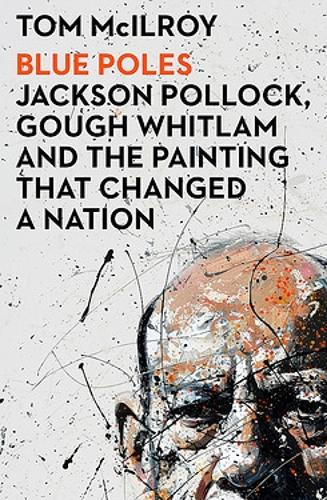
BLUE POLES – JACKSON POLLOCK, GOUGH WHITLAM, AND THE PAINTING THAT CHANGED A NATION by Tom McIlroy
Hachette Australia, 2025
ISBN: 9780733651960
RRP: $34.99 (pb)
Reviewed by Judith Pugh
Tom McIlroy’s writing, the best kind of writing, has the immediacy and clarity of good journalism; it is confident and unpretentious. He takes his reader to the families and the America that produced the artist Jackson Pollock, and although Pollock’s story has been told before, especially in the artworld, it is a pleasure to see the artist develop on these pages.
Born in 1929, Pollock was the youngest of five sons of a farmer who struggled against ill-health, the mother unsettled; the family moved from place to place, never wealthy: but four of the boys trained, and worked, as artists. Pollock grew up in a culture in which artists had been supported through New Deal programs designed to re-start the economy, and which normalised the occupation of artist, with hundreds of painters sculptors and printmakers making public art or working on community projects. Pollock was taught and mentored by Thomas Hart Benton, who made his subject —often in vast murals —the American people.
Benton not only taught the young man to draw and paint: he and his wife supported Pollock, emotionally and materially, and the scale of Benton’s pictures, by example, avoided the traditional constriction of easel-sized imagery as a source of income. Scale would become very important for Pollock. McIlroy doesn’t romanticise the relationship: with a considerable range of sources, he conveys Pollock’s need for stability, for a mentor, his uncertainty about his work within the conviction that he would succeed in becoming an artist.
McIlroy admirably situates the tale in its time, resisting the fashion for reviewing past actions through the filter of present attitudes. He frames the artist’s alcoholism within the drinking habits of the time, without dramatizing the concomitant destructiveness. Pollock’s wife, the painter Lee Krasner, put her career to one side for some years to support the artist; again, McIlroy does not dwell on the complexities of such sacrifice, he lets Krasner assert that she knew what she was doing and that she did so because she believed in Pollock’s work.
Because he avoids filtering his narrative through an ideological lens, McIlroy conveys the mid-twentieth century democratic certainties in America. Through precise detail — the food served at the dinner Blue Poles’ owner gave for its admirers on the eve of the picture’s departure for Australia; the schoolboy Christmas holiday scrapbook of the founding Director of the National Gallery of Australia’s James Mollison; the advertisements for Pall Mall cigarettes and Black & White scotch beside Life magazine’s “sprawling feature” on modern art that made Pollock famous; and that Whitlam’s press conference defending his decision to buy the painting Blue Poles began with announcements including that the auditor-general was on leave after a car accident — McIlroy anchors the legendary participants in the history of the work and its purchase.
He also points out that the purchase took place as the Labor Government continued to make decisions on cultural matters at a speed that was unsettling for voters who had spent years of post-World War II growth under the cleverly calm Prime Ministership of Robert Menzies. Menzies understood that some decisions needed careful management because they seemed peripheral to issues such as wages, health care, war, or pensions, but were costly. Menzies’ governments continued and expanded initiatives of the post-war Labor governments to expand migration, to bring tertiary students to Australia from Asia. Menzies’ strategy for Federal spending on cultural change was to appoint a committee of eminently respectable individuals to enquire into and report on an issue and, where he could, to drive the recommendations of their report through his cabinet.
During Menzies’ incumbency, using this strategy to normalise change, six new Universities were built, a scholarships scheme introduced so that tertiary education was not restricted to the upper middle class, the capital city of Australia, Canberra, took shape through the National Capital Development Corporation; and the National Library, the Australian Academy of Science, the Institute of Aboriginal Affairs were established. Menzies, whose father was an artist, expanded the budget of the Commonwealth Art Advisory Board, which had responsibility for the collection to be installed in the National Gallery, gave the Board independence in collecting, and established an enquiry into the need for that Gallery.
James Mollison was trained first by Daryl Lindsay (CAAB Chair, the Director of the National Gallery of Victoria and Chair of the enquiry into the need for an Australian National Gallery). On becoming exhibition officer of the National Collection, Mollison was mentored by the CAAB, all trained successful artists with a shrewd sense of the art business, the politics of the local and international artworld, and the intersection of the artworld with wider civic politics. Middle-aged when appointed, they were not as aware as Mollison of certain styles and movements, but they encouraged him to present them with examples of “younger” work, then asked him to select from these, and from that time embraced newer forms of art with enthusiasm.
In 1973 the acquisitions committee of the proposed Gallery consisted of the painter and critic James Gleeson, sculptor Clifford Last, painters Leonard French and Fred Williams, and Mollison. McIlroy has unfortunately adopted the idea — never fostered by Mollison but which has been popularised— that Mollison drove every policy and the design of the National Gallery. Those who met the NGA Council members and acquisitions committee members, intelligent direct tough experts, at gallery openings and over dinner, are aware, as indeed a scrutiny of the CAAB minutes confirms, of the common purpose and closeness with which the group worked. McIlroy suggested Mollison had scouts across the world looking for works of art: but the Australian artworld was not large, most artists of any success travelled, everyone knew that the collection was being developed, and everyone made or passed on suggestions to them.
Mollison had worked for Max Hutchison, a New York art dealer who alerted him to the possibility of the sale of what was regarded as the most important Pollock not yet in a public collection. Its owner was reluctant to part with it and wanted a high price: McIlroy reports that the only member of the acquisitions committee who opposed the purchase was Len French. I think French — the only member of the committee who was a public supporter of the Labor Party — may have taken the view, as did artist Clifton Pugh when Whitlam sought his opinion, that as the political mood in Australia was very unsettled, despite the desirability of the painting, a decision to buy would be unwise. When defending the cost of the painting and the purchase itself, Whitlam claimed to have made the decision alone; the the idea of Whitlam as art afficionado and supporter prevails.
McIlroy explains that purchase and the record price paid for the picture had been leaked, so there was no opportunity for the announcement to be formally made and the significance of the picture for the reputation of the collection, even its possibilities for tourism, to be discussed. Whitlam was not expecting the question at his press conference and, on the defensive, he blustered. The price was the highest painting for a Pollock and added to the perceived chaos of the government.
Australia’s commitment to the Vietnam war, to conscription for that war, and to sending conscripts overseas, had undermined the conservative power base; a set of carefully explained policies including Medicare to improve health, funding for crucial urban infrastructure, and legislation to protect heritage, had brought Labor to government after twenty-three years. But upon election, without every announcing it as a policy, the new, untried, government had abruptly changed the National Anthem, and were attempting to change the Flag, and hence seemed to be determined to swerve, rather than gently alter, the culture.
Economic problems not of their own making beset the new government, there was noticeable discord in the party, and this added to its apparent instability. The cost of the painting and that the picture itself was “abstract-expressionist” allowed the Conservative Coalition in opposition to encourage conservative artists and others on the edge of the artworld, to argue the painting was of itself an unfortunate choice and, even if thought by some to be a good painting, far too expensive.
McIlroy’s own brief biography mentions he graduated from RMIT and Melbourne University, but omits that he studied Fine Arts as well as economics; he has been a political correspondent for some years. His book reflects on the politics of Whitlam’s government, and admirably describes the art movements of the period, the work of artists around Pollock and those of earlier generations the artist admired. It conveys the excitement and uncertainty of an artist in working through a new vision of painting: people commenting, visitors encouraging, critics astonished and doubting curators too; shows including new talent, the sense of the openings, the dinners, the trips, the deals, the talk.
Bohemia — and with it the artworld of Pollock and indeed of the artists and artworld which supported the Australian Labor Party’s election in 1972 — has been commodified now. Performances, displays, public acquisitions and awards are measured not by their contribution to the discipline, the genre, the skill with which they are made, the insight into society or the human condition. They are subjected to risk assessment. Imagination, intelligence, training, are no longer the criteria for becoming an artist, risk is now anathema for institutions and funding. Risk assessment was not Pollock’s way, or indeed that of his friends and fellow artists, but they forged a new approach to imagery.
Tom McIlroy brings his journalist experience and scholarly training to the Pollock section of his book with great effect, investigating facts, balancing the motives of informants and commentators on the work, the artist, the scene and discusses technique and effect successfully, without condescension.
His scholarship and investigative skills as a journalist then turn to Australia’s purchase of Blue Poles and its place in the culture, and Whitlam’s role in what was seen to be a time of Australian cultural change. The problem here is the source material, and the failure of scholarship: not McIlroy’s, but of those discussing that period: superficial acceptance of predominant narratives, hero-worship, echoes of Cold-War habits of mind, all carrying undue weight by the patronising tone of expatriate commentators.
I am reviewing McIlroy so I will here give only one example of the persistent — and one might argue self-serving — misrepresentation of Australian culture, at the time about the time, through ignorant and shallow analyses by “celebrities” since the Whitlam whirlwind.
McIlroy quotes numbers of people on the mood at the time for change, and indeed that is true. But the mood comprised elements common to virtually every Europeanised nation. The major element of disappointment with, and disdain for, conservative governments had the drama of being matters of life, death, and criminality: the question of a role in the Vietnam war and of conscription for it and that those resisting conscription were gaoled.
This and other were issues being raised in every other Europeanised nation. Accounts of demonstrations, meetings, articles, photographs — in print and on radio and television —informed the public. Apartheid in South Africa, Mandela in gaol; the issue of that country’s involvement in sporting competitions. Women’s employment equality, their reproductive rights, were canvassed everywhere Europeans had a foothold. Homosexuals were fighting for their freedoms.
As I write this, I remember the cheerful meetings about each or any of these issues, when everyone came to support everyone else. These were cries for change in France, America, England, Scotland, Ireland, South Africa. The rhetoric of the era and the way Whitlam was abruptly dismissed, and his own reaction to this, has allowed local unsophisticated writers to project their complaints onto the “culture” of the previous period. Such projection is of course a common, and sometimes perhaps accurate, phenomenon. But in this country the vivid sustained complaints, especially made by the then young and inadequately trained unobservant and unsophisticated commentators, including Clive James and Robert Hughes, have encouraged the idea that Australia had fewer facilities, less cultural activity and, on a lower level, than anywhere else, before the 1972 ALP government.
In fact, the reverse was true. Australian resources, especially public resources in state capital cities, and even provincial towns, were in advance of most provincial English cities, and a lively cultural life had gradually been extended by infrastructure, public institutional, and private support. The ABC maintained a touring orchestra in every state, and of course employed writers, actors, musicians, making original local programs.
There was one obstacle to support for the performing Arts. The performing artists union, Actor’s Equity, asked the Victorian ALP leader, Clyde Holding, for assistance to remove the control of performing arts subsidies from H.C. “Nugget” Coombes. Holding set up a committee to develop an Arts Policy. Don Dunstan put that policy through the Federal Conference; it became ALP National Policy: it mandated that professionals in the arts would manage funding through a reconstructed Australian Council for the Arts, rather than a controlling ideologically driven bureaucrat. Using performing artists who understood the Coombes problem, this writer, managing the campaign from Victoria, used the policy to convince the public to vote for the ALP. Labor was elected, but to the horror of everyone in the Arts who had worked to elect him, Whitlam left Coombes in control, allowing Coombes to retain control of arts funding.
Whitlam had wit and took the skills of a barrister: articulate argument, rhetoric, into the parliament, and shone there. Before he became Prime Minister, he and his team were closely supported by well-informed interest groups, and these groups worked with members of the cabinet to introduce many welcome legal and social reforms; these were at the time being introduced in comparable democracies across the globe. Whitlam was not really engaged with any artists. He liked to read and quote the classics, but he was not comfortable in bohemia. His greatest fault was his complete inability to judge character and match people to positions. It was a fatal flaw, but is not analysed: the idea of Whitlam as a effective politician, let alone a cultural warrior, is misplaced.
These comments should not detract from the enjoyment of McIlroy’s book: the process of installing Whitlam as art aficionado has been effective and thorough. When he spoke at The Sydney Institute, I explained that before accepting the recommendation to buy Blue Poles, Whitlam did in fact telephone Clifton Pugh, to seek his opinion, but that opinion — that while a marvellous picture and wonderful to have, Blue Poles’ price might threaten the Party’s flimsy popularity and was not advisable — did not reach Whitlam before he signed off on the purchase. I explained to the group and to Tom McIlroy that readers can check The Sydney Institute website. I recommend Tom McIlroy’s first book and look for many more.
Because I have named Robert Hughes as a culprit in the inaccurate representations of the Australia of the 1960s, I want to provide evidence. The following illustrates my point; I include it because one cannot challenge Hughes without facts and his writing is brilliant. His apparent need to distance himself not only from local contemporary product but the histories on which it might draw, intersects, interestingly, with Pollock and abstract expressionism. These intersections begin with the 1961 exhibition of Australian Art at London’s Whitechapel Gallery. Although the show was an initiative of the art historian Bernard Smith, the gallery director, Bryan Robinson, invited the then very young Robert Hughes, innocent of qualifications in art history, to write the catalogue essay. Robinson was at the time finishing a book on Jackson Pollock, presenting him (Smith points out) as an untutored force of nature. Hughes, educated at Riverview without absorbing any training in history or research, and in spite of every form of evidence, asserted that Australian artists were ignorant of the Renaissance tradition and that Australian painting was vital and exciting because of Australia’s isolation from that tradition.
This risible assertion was expanded in his Penguin history of Australian painting published in 1970, together with the astonishing claim that, “apart from the collection of the National Gallery of Victoria, Australian galleries are provincial to a fault, both in space and in time: Rome may be represented by one chipped marble head of Apollo, Athens by a red-figure Kylix found in Magnae Graecia, and the court of the Sun King by an ormulu mirror…”
The University of Sydney, where Hughes studied architecture and arts for a couple of years (but failed to complete either degree) had then in its quadrangle the Nicholson Museum. Now incorporated into the Chau Chack Museum, the Nicholson was directly below the University Library. There could be found the largest collection of classical antiquities in the Southern Hemisphere. The Nicholson Museum was founded in 1860. Paraphrasing the website:
As to Greece: The collection contains artefacts representative of the material culture of the Greek mainland, islands and surrounding regions, from the Bronze Age through to the Late Hellenistic period. As to Italy: The Museum’s Italian collection is representative of the diversity of the ancient Italian world with significant cultural material from Etruria, South Italy and the Roman World. Sir Charles Nicholson spent considerable time in Rome collecting Latin inscriptions, Etruscan funerary urns and bronzes, South Italian vases and Roman lamps, figurines and ceramics. Additional large sculptural works were also acquired by Sir Charles including two life-sized togatus statues along with several fragmentary figures. The Italian collection was further developed with the acquisition of a significant corpus of South Italian vases by A.D. Trendall. The Italian collection is further enriched by the Roman period artefacts incorporated into the collections from Egypt, Cyprus and the Near East. These provide a unique overview of early trade routes and of Greek and Roman empires.
Although some items have been donated since Hughes’ time at the University, it is impossible to overstate the inaccuracy of his assertions. His silly bullish assertions might be irrelevant if his rhetoric, sheer luck, and his energetic disdain of the institutions that had attempted to educate him had not played into a profitable trope used by him and other colourful expatriates and taken root in scholarship and popular discourse and which misleads research by thoughtful authors such as Tom McIlroy.
Judith Pugh is an art dealer and award winning writer and author of Unstill Life
Art, politics and living with Clifton Pugh