
 BREAKING THROUGH THE CORDON OF SILENCE
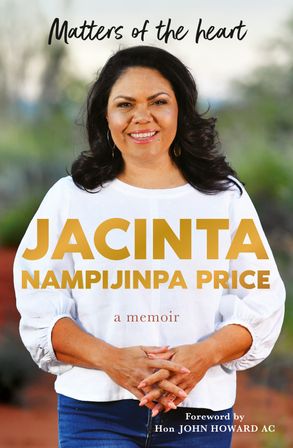
MATTERS OF THE HEART – A MEMOIR
By Jacinta Nampijinpa Price
HarperCollins Publishers 2025
ISBN: 978 1 4607 6676 7
RRP: $36.99 (PB)
Reviewed by Anne Henderson
This is a remarkable book, not just for its dramatic and honestly told life story but for what it represents to Australia as a nation. The story of Jacinta Nampijinpa Price’s life, raised in Alice Springs, brings into the open, in ways not done before, the story of the culture clash that has been part of the land Down Under since white settlement began.
That clash has changed in nature and evolved over time. But today, Indigenous Australians in big urban centres do not reflect the real clash of cultures that impinges on the lives of women and children in Australia’s remoter towns and settlements. Jacinta Price, in telling her own story courageously and plainly in a page turner memoir, has now broken a cordon of silence that has romanticised Indigenous culture and hidden its dark side for generations.
Price acknowledges in her book that, as she puts it, “my feet have always been in two worlds”. Her mother Bess Price, born in October 1960 under a tree on the edge of the Tanami Desert and saved from death by her grandmother after her mother abandoned her, has also pushed through the clash of cultures and established her own leadership credentials in becoming a representative in the Northern Territory parliament. But Bess acknowledges the enormous chasm at the heart of remote Indigenous masculinity. As she puts it, speaking of the dilemmas surrounding black male violence and dysfunction: “When they follow black laws, they break white laws; when they follow white laws, they break black laws.”
In 2023, Jacinta Price became one of the most heard and seen leaders in Australia due to her part in the referendum campaign for the Voice – a vote on constitutional change to create a separate Indigenous body as part of Australia’s government in an advisory capacity. Price became a senator for the Northern Territory in the 2022 federal election and sits with the National Party in the Senate. In April 2023, as the Voice campaign began in earnest, Price was appointed shadow minister for Indigenous Affairs in the Peter Dutton Coalition opposition. This began Price’s trajectory to national recognition. She became the spearhead, alongside Nyunggai Warren Mundine and her Senate colleague Kerrynne Liddle, for the “No” campaign, holding up her racially mixed Australian family as an example of how the Voice would divide Australians. As she puts it in her memoir:
Big or small, city or country, we showed up to share our heartfelt message: that we believed this proposal was dangerous, and that it would divide our beautiful country, fracturing the very foundations it was bult on. The risk was far too great.
When the “No” campaign won just over 60 per cent of the referendum vote, Jacinta Nampijinpa Price became a national star.
It had been a remarkable rise for a young woman of Indigenous background with a little over a year in federal politics. But a more pressing campaign was to come. It had been a side issue in Price’s arguments against the Voice – that an urban based Indigenous Canberra collective advising national government would in fact do nothing for the biggest Indigenous problem, which was the plight of women and children living with traditional Indigenous culture in remote Australia.
Price’s life in Alice Springs and as a Warlpiri woman from the Yuendumu community has given Price a lifetime of evidence this problem is not only endemic but also a national tragedy largely ignored by government. From her address to the National Press Club in Canberra during the Voice campaign, Price describes her confrontation with The Guardian’s Josh Butler:
“No, there’s no ongoing negative impacts of colonisation on Indigenous Australians today.” I told them that for my family in remote communities, it was tradition, not colonisation, that caused suffering. I gave the examples of young girls married off to older husbands. “We haven’t had a feminist movement for Aboriginal women,” I said. “We’ve been expected to toe the line when it comes to Aboriginal activism for the rights of our race, but the rights of women have taken second place.” It caused a stir, but it was time we spoke the truth.
Price’s Indigenous opponents – largely longtime leaders such as Marcia Langton and Noel Pearson have attacked her for being what many term a “coconut” meaning her views have been hijacked by white propaganda. She was told by Pearson that she was simply caught up in a “tragic redneck celebrity vortex” and by Langton “that if you started pulling arguments for the No case apart, you’d always get down to base racism”. Other Indigenous critics of the “No” case have claimed Price speaks without evidence.
So, now comes the full throated Jacinta Nampijinpa Price, her story, that of her family and community and evidence aplenty that cultural clash in remote indigenous communities and towns such as Alice Springs is a national scourge brought about not by racism but as a result of traditional law that allows male ownership of very young women immediately following puberty, along with rape and violence for any who resist, even death. Price summarises the effect of this tribal license for males in a few lines:
There is not a woman in my family who has not experienced some kind of physical or sexual abuse at some point in her life. And none of the perpetrators was white.
Unlike well known Indigenous leaders Australians have for years recognised, Price is a home grown remote Indigenous woman whose grandfather first sighted white men in the 1920s, just a century ago. So different from the likes of Langton and Pearson who knew the suburbs of Brisbane in their teenage years with Pearson attending St Peters Grammar school in his secondary years. Price describes the Warlpiri massacres of 1928 from her grandfather Dinny’s recollections and tells of how, while working on a cattle station, he was taken in chains to a camp or reservation settlement outside Alice Springs. Later, he acknowledged that in this time he learned valuable skills that assisted him in future employment. Price’s grandmother Clara, born in 1929, had to be “bought” by Dinny from Old Wally to whom she was promised. Even after payments in tea, flour and blankets, Old Wally attacked Dinny savagely until local missionaries became involved and further payments saw Old Wally thumb print a document giving up rights to Clara. The year was 1947.
As Price tells it, her grandparents settled into Aboriginal reserve life at Yuendumu, some 250 kilometres north west from Alice Springs, happily accepting its bare European style settlement buildings and living in what they called humpies. Price describes the living conditions:
…makeshift shelters constructed from sheets of scrap metal or corrugated iron and wood, often covered with branches or leaves, and in some cases tarpaulins … The community used fire for warmth and to cook, and to keep insects away. In those days, there was no running water or electricity. People continued to hunt and forage to survive.
For all that, her mother Bess cannot remember being uncomfortable or even cold or wet. And she recalls how many of the inhabitants of the community took a while to get used to sleeping indoors.
What emerges from Price’s family story is a strong sense that individuals are responsible for their progress in life. Yet, in spite of seeking every chance to educate herself, Bess bore her first child at 13, was later given to the young man who fathered her child, was eventually subjected to life threatening domestic violence but escaped, after which she stubbornly pursued every opportunity at further education.
In this she met her future husband David Price, a white school teacher from Newcastle in NSW, with whom she became an expert in Walpiri languages and history. Together they raised their only child Jacinta in a mixture of Indigenous and white culture. Posted to bush schools, the Price family lived in the sparse conditions of outback communities. Jacinta was as accustomed to bush hunting, digging for sugar ants and watching the aunties dance as she was with global travel taking her first overseas trip with her parents at 13 and seeing parts of the world from Harare in Zimbabwe to Paris, Rome and Prague in Europe, London and Ireland, and the east coast of the US in New York and Boston. The family had saved and planned such a trip to widen their experience and education.
For all that, in her final year of high school, Price fell pregnant and did her final exams in and out of hospital with false contractions. Jacinta and Simon, the non-Indigenous Mauritian Australian father of her child, were supported by their families and went on to marry and have three sons. But, later, with marriage break down and separation, Price fell into experiences she confesses as her own dark experience: beatings from an Indigenous boyfriend and later taking drugs when her boys were with their father. Cleaned up and back on track, Price took up work as a co-host of Yamba Playtime. Music and Aussie Rules football became her creative outlet. She travelled around Australia, wrote scripts and songs and eventually formed a relationship with the musician Colin Lillie, a Scotsman, whom she went on to marry.
Price’s life is a story of real accomplishment told against a background of violence. Violence which even she could not escape. Her aunties would tease her that she had been promised to Old Bob. While just in fun, it made her terrified. “Warlpiri girls,” she writes, “are trained to be submissive from birth, and their fear is laughed at.” Her mother had told her of the first occasion she had witnessed an old man grab his intended young wife: “She was kicking and screaming the whole way and the entire camp could hear her … ‘Everybody just seemed to accept that this was the norm…. It was just accepted that this was part of our culture,’ Mum recalls.”
David Price was shocked when he first arrived in Alice Springs at an incident while at the movies. As he told it, “Everyone was seated, ready to start the film, when all hell broke out from somewhere at the back. A woman came running down the aisle screaming, chased by a bloke who I came to learn was her husband. He belted the living daylights out of her in front of everyone, with the whole cinema watching on. No one did anything about it. They all just sat there.” These sorts of incidents dot the book. One of Jacinta’s aunties was dragged off at age 14 by her much older promised husband, violently raped, tied with rope like a kangaroo and left with a scarred womb unable to bear children. And then there was Marion, a cousin of Bess.
Marion at 14 was known to be resisting her much older promised husband, a person Price describes as “a nasty, violent man who’d already served time in prison for murdering his first wife.” Marion had been promised as a small child by her father, a prominent land rights activist. She was last seen being driven in a car with four men towards the West Australian desert. She never returned and the men said, when the car ran out of petrol and they waited for help, she had run off into the scrub. It was two days before they reported her missing. Price writes that “the idea she’d simply run off into the bush – or headed to Queensland – was frankly ridiculous. People had run away from Yuendumu before but they’d always found a way to keep in touch with families.” The case was never properly investigated. Price is now on a mission to find out why and what really happened.
Matters of the Heart – A Memoir is a watershed moment in Australia’s history of cultural clash. In many ways, the first true account. Price denies the problems for women and children in Australia’s remote settlements have anything to do with colonisation and is out to bring attention to the real causes behind what she describes as, “gangs of children aged six to sixteen wandering around with no adult supervision in the early hours of the morning … children [who] have witnessed, or been subjected to, normalised alcohol abuse and domestic, family and sexual violence throughout their young lives.”
In her maiden speech to parliament, Price told of taking her colleague, Julian Leeser, about on a visit to Alice Springs. Price recalls, “I don’t know where else in Australia a member of federal parliament can provide a tour of the numerous places where their direct family members have been violently murdered or have died of alcohol abuse, suicide or alcohol-related accidents. On one route, I pointed out seven separate incidents relating to places we had visited and made reference to numerous other incidents across the Northern Territory, all just within my own family.”
It is Jacinta Nampijinpa Price’s hope that her memoir will begin an end to the cordon of silence and be a first step to a better way forward.
Anne Henderson is Deputy Director of The Sydney Institute and author of Menzies at War, which was shortlisted for the 2015 Prime Minister’s Award for Australian History.