
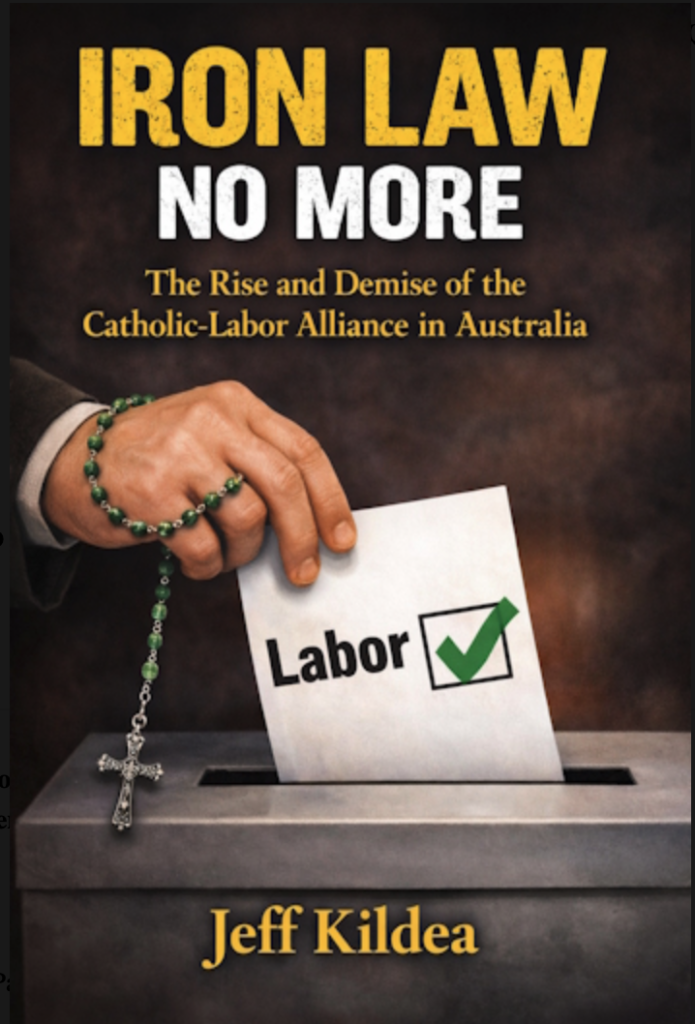
 CATHOLICS AND THE ALP – NO MORE AN ALLIANCE
IRON LAW NO MORE: THE RISE AND DEMISE OF THE CATHOLIC-LABOR ALLIANCE IN AUSTRALIA by JEFF KILDEA
Connor Court Publishing/Australian Solidarity Press, 2026,
ISBN: 9781923568730
RRP: $39.95 (PB)
Reviewed by Keith Harvey
Jeff Kildea, a prominent historian of all things Catholic, especially those Irish Catholic, in Australia has written a detailed account of the relationship between Catholic voters, the ALP and Catholic representation in the Federal parliament since Federation.
A word of warning: there is a large volume of numbers and percentages in these pages which can, at times, cause the mind to reel as they ebb and flow over the years. This is because the author has painstakingly researched the religious affiliation of every member of the Federal Parliament up to that elected in 1975 and has calculated the proportion of Catholics in each Parliament and Ministry.
A note of caution: as Kildea points out there are difficulties in being certain about the classification of a person’s religious belief. The author has followed an accepted classification system drawn from another source, except where he had access to different information. But he has also applied the informal rule “once a Catholic, always a Catholic”.
This rule doesn’t necessarily apply in all cases. Kildea himself mentions the case of John Curtin, an ALP prime minister who was raised a Catholic but who renounced his faith as a teenager. Curtin is still classified as a Catholic for Kildea’s purposes and is still described in the book as such when – as Prime Minister – he died in office. This raises the obvious question as to what the nominal religious status of any particular person of any faith may actually tell us about that person.
Thirty Federal Parliaments are analysed by the author, including any changes that occurred within the life of each Parliament because of byelections caused by deaths and resignations. This is a massive undertaking but the reader may occasionally get lost in the detail of the percentage movements in Catholic representation from Parliament to Parliament.
The trends are clearly articulated however and make interesting reading. While the focus of the book is the Labor side of politics, the number and percentage of Catholics in Parliament on the non-Labor side is also recorded. In summary, there were very few such politicians in the first 75 years of Federation. This has changed dramatically since, of course, but the book concludes with an Appendix detailing the small number of non-Labor Catholic politicians who “proved the rule.” The rule being that the Labor Party was, for the first 75 years at least, the natural home of Catholic voters and politicians.
The most interesting discussion in the book is its detailed historical survey of the reasons for the attachment of Catholic voters to the ALP, despite many challenges to the relationship over the years.
In a sense the Catholic-Labor alliance was an obvious one: in the days (now gone) when voting intentions could largely be predicted on class or income and occupation, working class Catholic voters would naturally feel that a genuine Labor Party would naturally best represent their economic and social interests.
It might be supposed, of course, that the Australian Labor Party and its colonial precursors was formed mainly by Catholics given that they made up a considerable proportion of the working classes in Australia. But this was not the case: early counts of the religious affiliation of elected Labor MPs showed that they were much more likely to be evangelical Christians, especially Methodists, than Catholics. This is not discussed in Kildea’s account.
There were also significant policy challenges to Catholic support for the Labor cause. These included especially since the very earliest days the question of State Aid (that is government aid to religious schools) as well as the dreaded bogeyman of “socialism”. Free secular and compulsory education meant that Catholic and other denominational schools got no government funding.
In addition, Catholic doctrine enunciated in a number of places (including the first social encyclical of Pope Leo XIII) condemned socialism as both atheistic and contrary to Church teaching on the right to private property. As Kildea notes, Australia’s leading cleric at the time of Federation, Sydney’s Cardinal Patrick Francis Moran, played a key role in diffusing this debate by drawing a distinction between doctrinaire European socialism and the more pragmatic and gradualist social reform policies of the emerging Labor Party in Australia.
The ALP’s commitment to socialism, which has continued in theory (but not in practice) right up until the present day, did not prevent Catholic voters supporting the ALP even when in the 1920s the Party adopted a strong socialisation policy (later somewhat watered down by the so-called Blackburn interpretation).
But it was the issue of Conscription during the First World War which, Kildea says, created the “iron law” of Catholic attachment to the Labor Party which was to last for many decades. During the war Labor Prime Minister Billy Hughes (a non-Catholic) became convinced of the need to introduce Conscription to support the war effort of the Empire. While Catholics were volunteering in significant numbers (Kildea has written extensively about this elsewhere) support for the war waned particularly after the 1916 Easter Uprising in Dublin in support of Irish independence from Britain.
The moves by Hughes to hold two referenda on this issue were opposed by the organisational wing of the ALP and most trade unions. The Party split federally and in many states on this issue. The Conscription referendums were opposed by prominent Catholics, especially Melbourne’s Archbishop Daniel Mannix and Queensland Labor Premier T J Ryan. Both referenda were defeated. Ryan’s role in opposing conscription is just briefly mentioned by Kildea but would have been worth more extensive coverage.
Moreover, although it only affected a small number of people, the Hughes government acted against what it perceived to be supporters of Irish independence (and therefore against the war effort) arresting and detaining seven “Sinn Fein” supporters towards the end of the war. They were not released until the conclusion of the war (and, in one case, not until February 1919).
This episode is only touched on in this work of Kildea but he has written about it extensively elsewhere. Another factor that he does mention is Hughes’s “bachelor tax” which was legislated to force unmarried men to enlist. Kildea notes that Hughes refused to exempt Catholic priests and brothers from the tax, a move widely condemned by Church authorities. The tax was widely unpopular and never implemented.
All these factors led Catholics to develop a firm commitment to the ALP but the Hughes-led breakaway party which merged with non-Labor forces continued to hold sway federally. As a result, Catholics came to play a much more significant role in the Federal ALP and to gain party preselection and win seats in Parliament.
Catholic influence over the ALP was strengthened by the fact that the split over Conscription led to many of the ALP’s Protestant members leaving the Party. Catholics were seen as disloyal to the Empire (and therefore, it would seem) not to be trusted on the non-Labor side of politics.
As a result, when the Scullin Government came to office in 1929, no less than eight of its 13 ministers were Catholic – and this number later rose to ten. However, this Government also split and fell over the handling of the 1930s Depression and was short-lived. One of its Ministers, the Catholic Joseph Lyons, led a successful non-Labor administration which included few Catholics. Lyons had been a Tasmanian premier. Lyons was the last Catholic leader of a non-Labor Party for 76 years (until the election of Brendan Nelson in December 2007).
Catholics were still prominent in the ALP and remained so when the Curtin government came to office during the Second World War. Some tensions emerged under John Curtin’s successor Ben Chifley, a Catholic, when he proposed the nationalisation of the banks which some Catholics thought compromised the Church’s teaching on socialism and private property. Chifley, incidentally, was raised a Catholic but married outside of the church again raising the issue as to what the “once a Catholic, always a Catholic” rule tells us, if anything.
At the time that Chifley announced this decision, more than half the Cabinet and more than 60 per cent of the Federal caucus were Catholics, according to Kildea’s figures, although neither were really consulted about the decision. Any Catholic concerns may have been partly alleviated by the Catholic Bishops’ 1948 Social Justice Statement drafted by B A Santamaria who, to assist the struggle against communism in the trade union movement, was keen to see no reason why Catholics should leave the ALP over this issue.
The Chifley legislation was defeated in the High Court and the Government fell in 1949, defeated by Robert Menzies’s new Liberal Party. The biggest difficulties for Catholic support for the ALP were yet to come in the face of the attempt by the Menzies government to ban the Communist Party and the efforts of Labor leader Bert (“Doc”) Evatt to oppose both the legislation and the referendum that followed.
In the mid-1950s, the big Split came when Evatt attacked the work of the ALP Industrial Groups and the activities of B A Santamaria’s Catholic Social Studies Movement (the Movement) in assisting the Groups combat communist penetration of the union movement.
The Victorian ALP split (as did the ALP in Queensland, although on different issues and later) leading to the formation of the Democratic Labour Party which preferenced the Liberal Party ahead of the ALP. The Liberal/National Party Coalition government of Menzies and his successors held sway until 1972.
Kildea notes that because of the split in the ALP during the First World War, non-Catholics left the Party. As a result of the 1950s Split, Catholics left. He might have added that they were not replaced by Protestants but by secularists.
In some respects, the impact of the Split on the Catholic vote for the ALP can be overstated. Kildea has a table showing voting trends from 1954 (just before the Split) until 1958 [p. 209]. In 1954 73.6 per cent of Catholics voted ALP. By 1958, 18.3 per cent of Catholics were voting DLP, but it is notable that some 50 per cent of Catholics were still supporting the ALP.
The Split was concentrated in Victoria and Queensland. In NSW Kildea records that the NSW Catholic Bishops “urged” the faithful not to split the NSW Party – some involved note that the Bishops virtually instructed the faithful not to take any action that would jeopardise the State ALP government.
However, it is fair to note that the DLP vote was strongly drawn from the Catholic community. Moreover, in the post-Split period, some sections of the ALP, particularly in Victoria, seemed to deliberately seek to adopt policies on a range of issues that they knew would alienate Catholics and keep them out of the Party: access to abortion, for instance. Few Catholics, if any, won preselection for Victorian ALP seats although in NSW business went on much as usual.
At the same time, Kildea notes, the conservative parties as the beneficiaries of valuable Catholic preferences via the DLP began to realise the value of Catholic votes and to drop some of their prejudices against appealing to this electorate. Beginning in 1963, under the Coalition government, for example, limited amounts of State Aid to non-government and religious schools began to flow in the form of funding for science blocks and the like.
It has often been said that the existence of the DLP allowed Catholics, as they distanced themselves from their working-class origins, to gradually transfer their allegiance to the non-Labor parties as their incomes and social status rose. Presumably, several factors were at work as memories of earlier periods and issues faded and new ones arose. The ALP in the 1960s moved to oppose Australia’s involvement in the war against Communism in Vietnam but on the other hand the Whitlam government’s “needs based” funding of schools eventually eliminated the State Aid issue, much to the displeasure of the anti-Catholic factions on the left of the ALP.
Kildea’s account ends with the Parliament elected in December 1975, following the Dismissal of the Whitlam Government. By this stage, the “iron law” of Catholic allegiance to the ALP which had endured since the First World War had well and truly broken down. Catholics were now finding their way into the Coalition parties, into Parliament and the Ministries, although for a long time this process was slow.
Oddly perhaps, even though the chronology ends with the parliament elected in December 1975, Kildea makes only passing reference to Brian Harradine. Harradine, a prominent Tasmanian union official (and a Catholic) had been elected to the ALP’s Federal Executive in 1968 but after making a remark that “the friends of the Communists” would try and keep him from taking his seat, was indeed barred from the Executive.
This dispute rolled on for seven years, until Harradine was expelled from the ALP in 1975 on trumped up charges. Harradine then ran as an Independent winning a Senate seat that was previously held by the ALP and kept it for nearly 30 years until he retired. The ALP’s attitude towards Harradine would have also affected Catholic voters.
As noted, Kildea’s account ends with the Parliament that ended in 1977. Since then, much has changed. Catholics are now just as likely or even more likely to be Coalition voters, MPs, cabinet Ministers and party leaders.
Kildea’s book is focused on Catholics and the ALP but he also comments on the absence over many, many decades of Catholics in conservative parties and consequently sitting in parliament and ministries on the non-Labor side.
The final part of the book is an Appendix that lists the exceptions to the rule; that is the very small number of Catholics supporting the conservative parties and making it into parliament or a Ministry in the first 75 years of Federation. Kildea well describes the reasons why Catholic support for the ALP waxed and waned over the years but there is little discussion of why the conservative side of politics was a closed shop to Catholics for so long.
Throughout Kildea’s text there is the implication that Catholics should be represented in parliaments and governments in reasonable proportion to their numbers in society. However, in the mind of this reviewer there is a downstream question that is not asked or answered in this text. That is, having gained access to the corridors of power, either through the ALP or more latterly on the other side, what difference, if any, has Catholic participation in politics brought to the Australian body politic? Have they made a difference?
As Kildea notes in his Introduction, the label “Catholic” once allowed a reasonable judgement to be made about the beliefs that the person might hold. This is less true today and thus any assessment of what a Catholic might have brought to the public sphere through political life might require a finer level of distinction than just a broad religious label.
Keith Harvey is a non-factional member of the Victorian Branch of the ALP. His biography of Brain Harradine was published by Connor Court in 2023.