Speaker
Wendy Craik
Speech Date
September 20, 2014
Issue
Issue 28
The 2014 Productivity Commission’s draft of its investigation into childcare has recommended a single, means-tested childcare payment should replace the existing array of government subsidies to parents, nannies should be covered by the plan, and the Prime Minister’s paid parental leave scheme should be tapped to help fund it. The aim is to make childcare more affordable and accessible – and enable 47,000 more parents return to work. Productivity Commissioner Wendy Craik has been described as “a woman of many firsts” (Wisdom Interviews) and is also currently Chair of the National Rural Advisory Council, and chair of the Board of the Australian Rural Leadership Foundation (2010 – ). On Wednesday 17 September 2014, Wendy Craik addressed The Sydney Institute to outline the recommendations of the Productivity Commission’s draft report.
CHILDCARE AND EARLY CHILDHOOD LEARNING
WENDY CRAIK
It’s a great pleasure to be back here again a few years down the track. The Australian government asked the Productivity Commission to look at the early childcare and education sector, or what I’ll call childcare for short, in relation to optimising child development and in relation to facilitating workforce participation. That was the task that they set us.
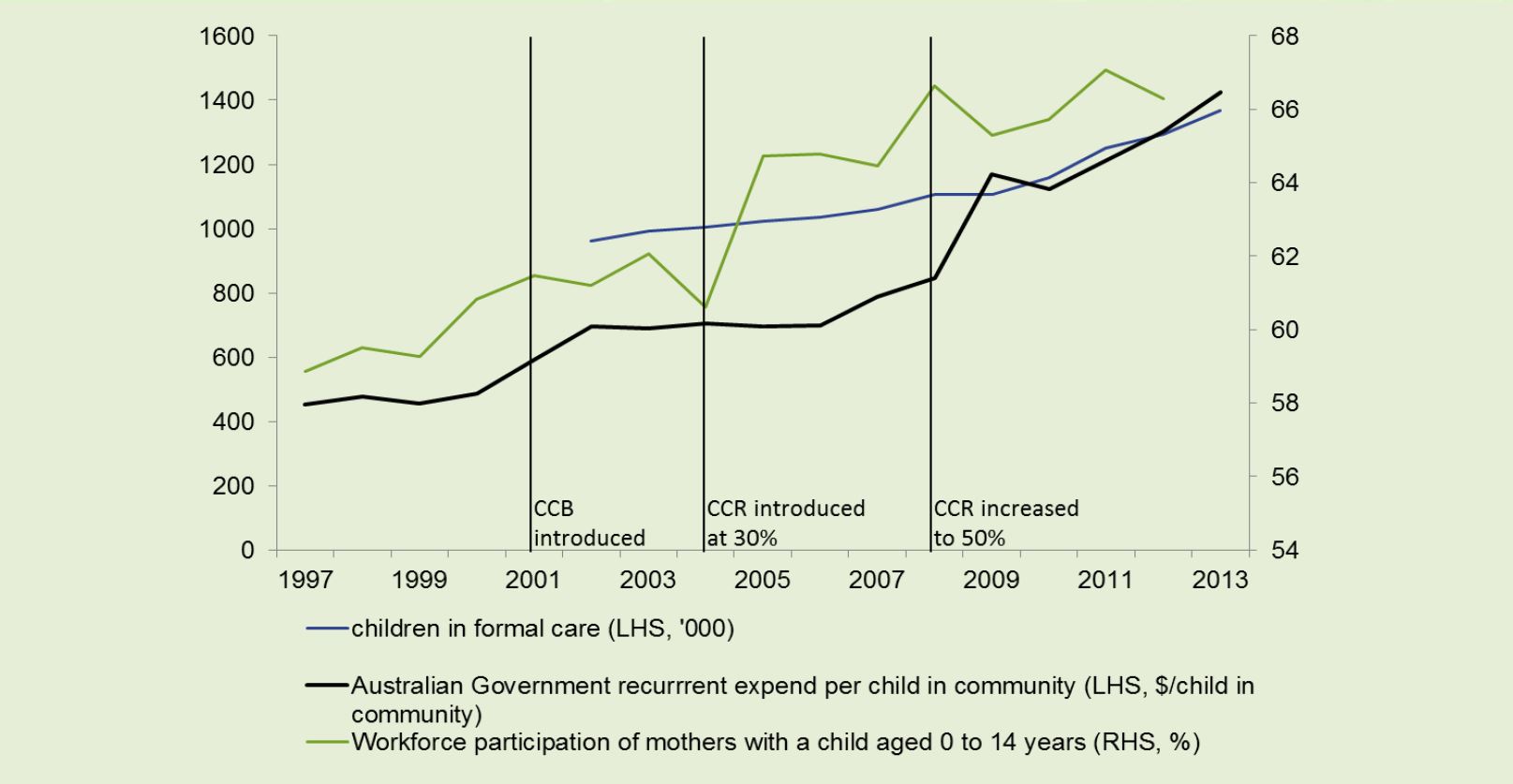
The statistics show that the cost to the Australian government has been rising, in fact 80 per cent in the last five years. It’s now about $7 billion a year. The number of children in childcare has grown about 36 per cent in the last 10 years to reach around 1.4 million children. Workforce participation of mothers with a child under fifteen is now about 66 per cent. We have a lower workforce participation rate for mothers in Australia than we see in the OECD. The last year for which there’s comparable data is 2009 when Australia was 62 per cent and the OECD average was about 66 per cent.
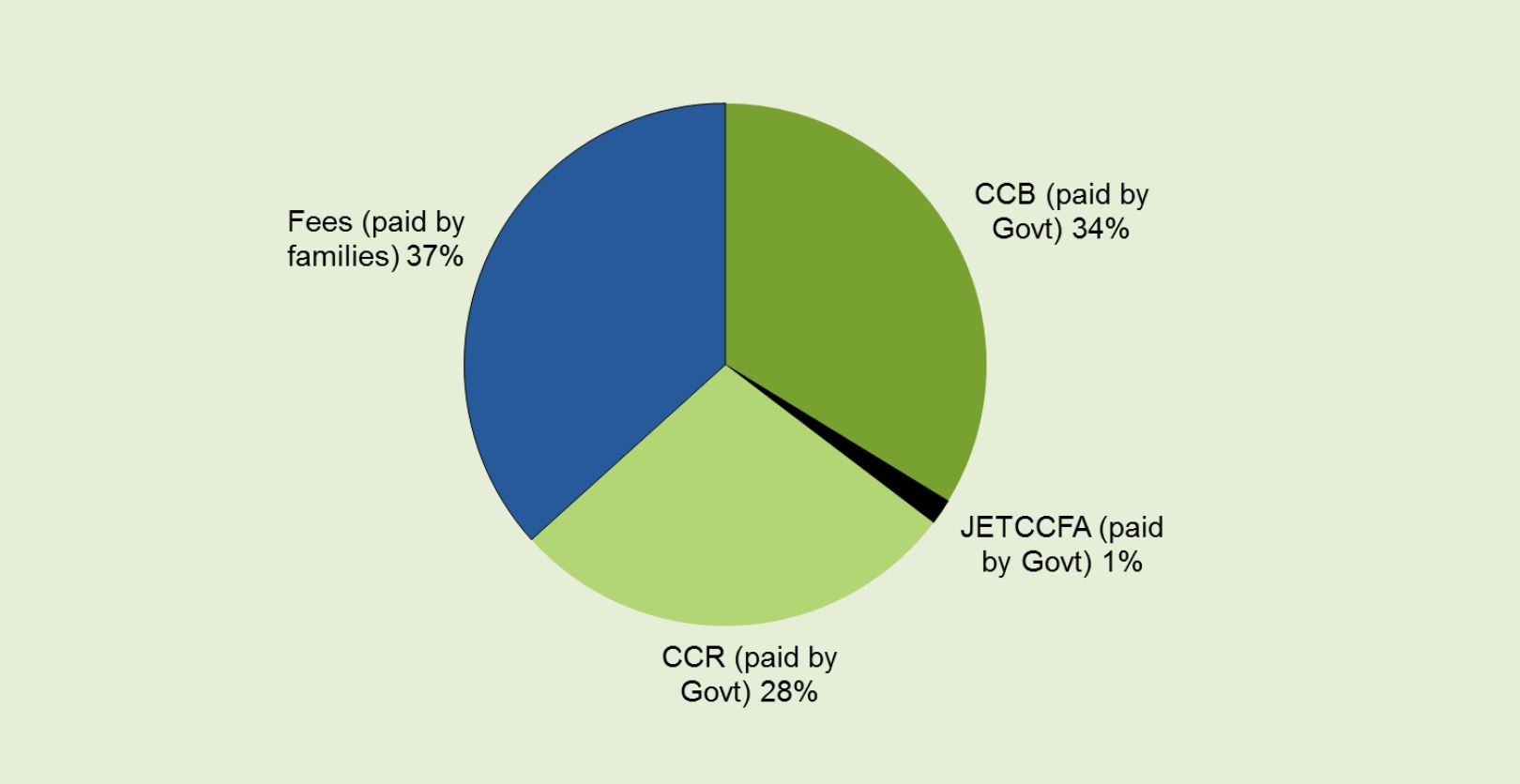
The interesting thing about Australian mothers is that they tend to work part time more than any other country in the OECD. About 50 per cent work part time. The federal government pays about $7 billion or two thirds of the cost. Parents pay roughly the other third. We offer two major subsidies – a means tested subsidy and a non-means tested subsidy or a capped subsidy. In fact, that capped subsidy has been growing. If the system continues the way it is, the applied subsidy will outpace the childcare benefit, and the means tested subsidy, very shortly. Fees paid by families is about a third of the total cost meaning out-of-pocket costs are around about 27 per cent of average wages.
The interesting thing about Australian mothers is that they tend to work part time more than any other country in the OECD
That’s higher than the OECD average, which is 17 per cent, but it’s lower than countries like NZ, Canada, the US and the UK. All countries have slightly different systems, and people like to use comparisons that suit them. I shall stick mostly to the OECD and like countries. So the question is, what’s wrong with the current system?
The answer is, quite a bit. It’s a system that has grown in different places with different objectives and has been brought together and evolved over the years. The main issues of concern relate to a declining proportion of assistance going to lower income families, the families least able to afford childcare services. There’s a myriad of programs. The Australian government has at least 20 funding programs for childcare. In fact, since the Productivity Commission draft report came out, we have discovered three new ones we didn’t know about.
Some of those programs had an original, quite specific, target but today the funding is much broader than the original target. It’s often complex for families. We had a lot of submissions complaining about the difficulty and the challenges of trying to fill out the forms. Even with all the expenditure, quite a reasonable percentage of children starting school have at least one developmental vulnerability, in at least one of the five domains that are measured. These are concentrated in disadvantaged communities but spread across the socioeconomic spectrum. There are serial parent debtors who move from service to service and do not pay their bills. And some parents really want to work but are unable to find a place with the price, the quality, the location and the affordability that they want and need. The other issue, in relation to workforce participation, is that the interaction of the tax and welfare system really discourages the second income earner from working more than a couple of days a week.
some parents really want to work but are unable to find a place with the price, the quality, the location and the affordability that they want and need
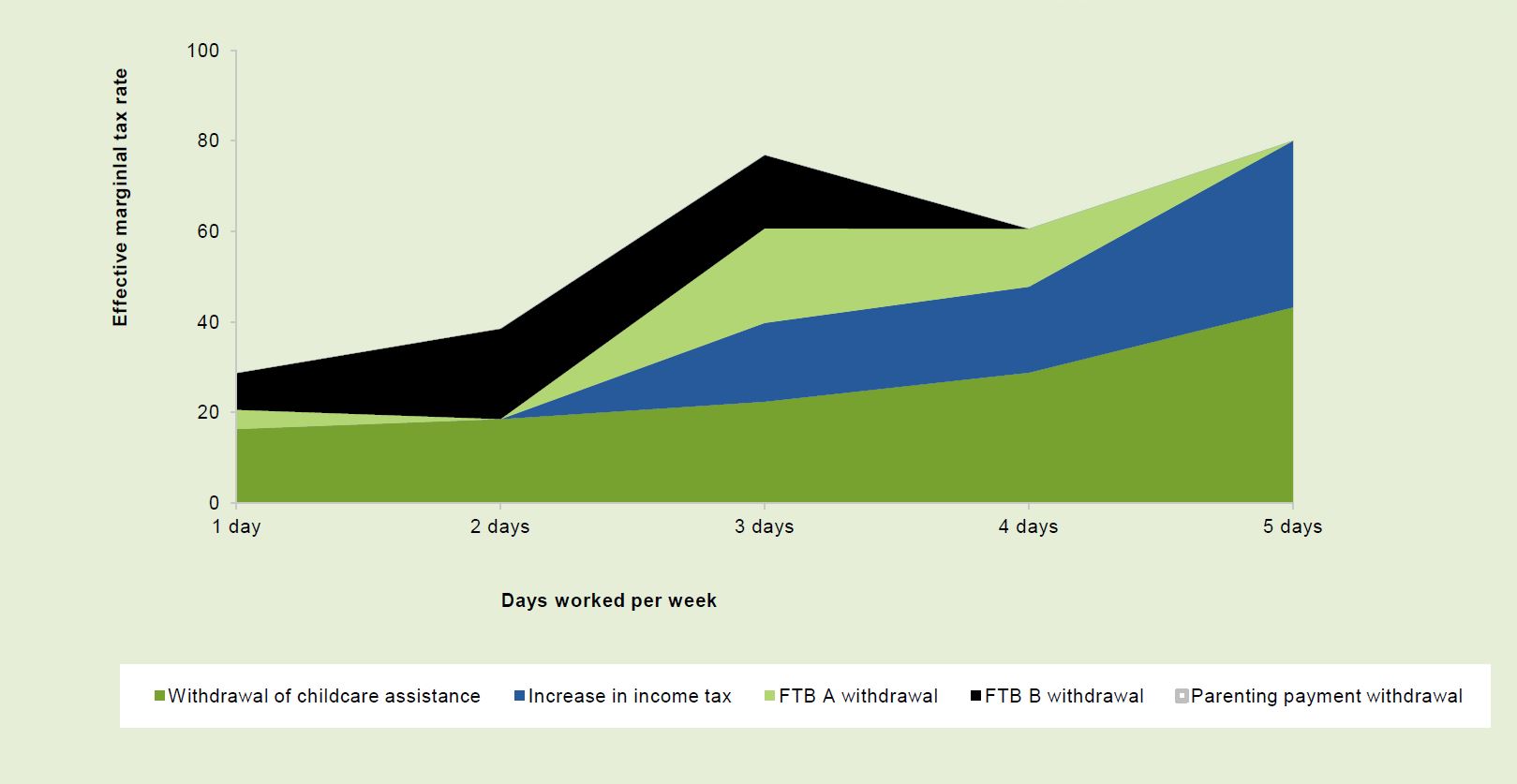
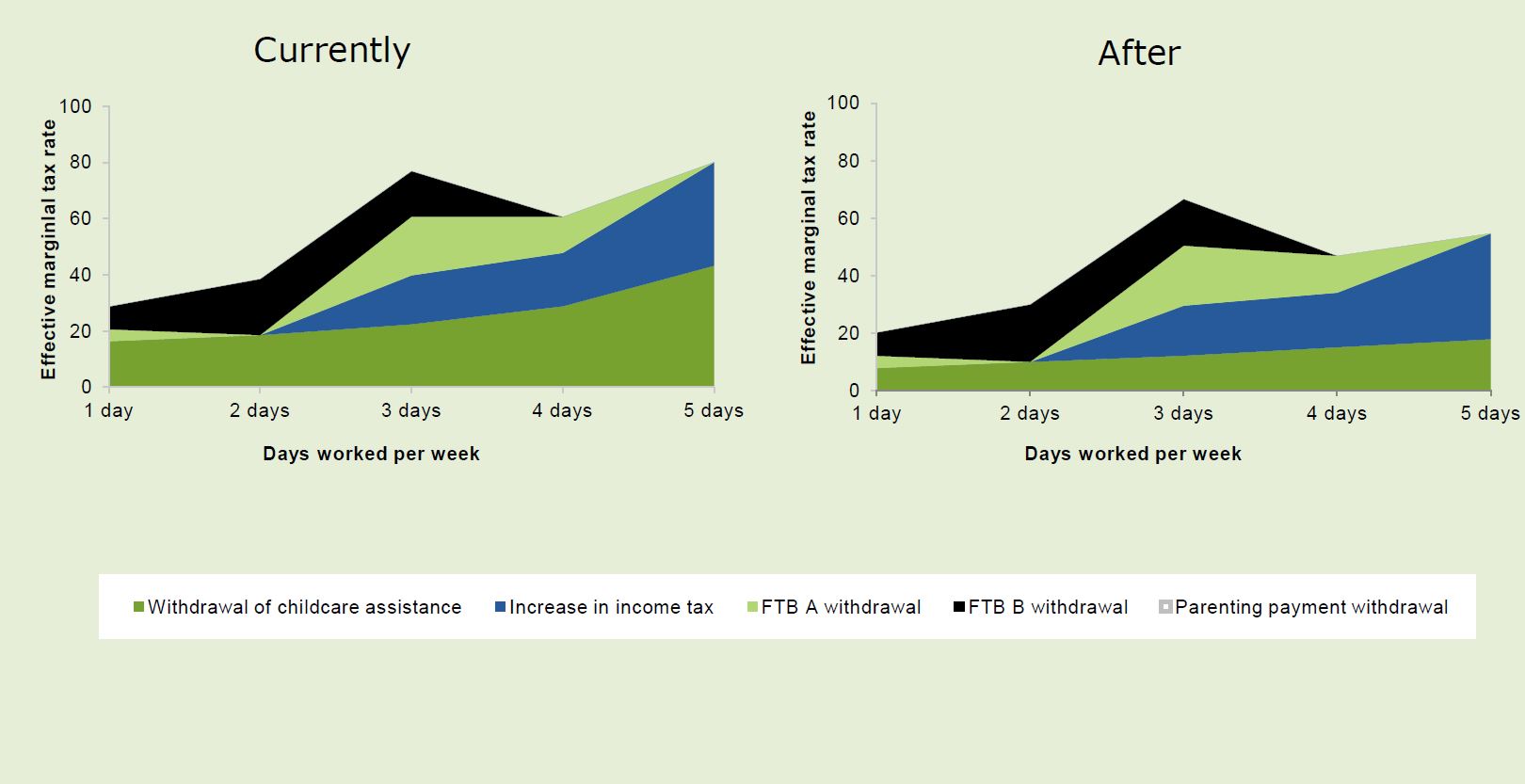
Take the case where a mother is earning $21 an hour, or about $44,000 a year, with the partners’ combined income at $110,000, caring for two children three and six years old, one in day care, and one in after hours school care. As your income increases, you get a reduction in childcare support. And you pay increased income tax as your income goes up alongside a reduction of Family Tax Benefit A and Family Tax Benefit B. On day three, if the secondary earner works for three days a week, the effective marginal tax rate is about 80 per cent, which means a take home pay of 20 cents in the dollar. So there’s not much incentive to work for 20 cents in the dollar. Thus, the secondary income earner is very unlikely to work more than two days a week because it’s just not worth it.
This is a real issue for secondary income earners in relation to childcare. There are some secondary income earners who face these high effective marginal tax rates, but work on the principal that staying in the full time workforce will pay career dividends after the children have left childcare.
Our starting point was to investigate what it is that childhood development research tell us. And what it tells us is that family characteristics are the strongest predictor of outcomes for children. The evidence is pretty clear that one year of preschool before school has very positive impacts on transition to school, on child development and socialisation. For children under three, the research is less conclusive. Some tests and examinations of children and children’s outcomes after being in childcare, for under-3s, show positive results, some show negative results, some show no results at all. What you do see is that where there’s quality childcare you get greater benefits. This certainly applies for children who are disadvantaged. And if the quality of their care at home is less than the quality of the care in the childhood sector, they’re better off attending a childhood sector. But, if the child is very young and spends a lot of time in childcare, there can be some negative effects.
The evidence is pretty clear that one year of preschool before school has very positive impacts on transition to school, on child development and socialisation
One of the challenges is trying to relate specific factors to specific outcomes, particularly in relation to qualifications for under-3s. It’s very difficult to say you need to have certain qualifications to lead to particular outcomes. For preschool, it’s pretty clear that graduate teachers are very important for successful outcomes. However, one of the things that comes out consistently is that a warm, nurturing relationship between the carer and the child is critical to good outcomes. And, of course, many factors can go into making that particular relationship. When you look at child development, good childhood development has both public and private development. With the best of both, you get reduced harm, you overcome disadvantage and you get good transitions to school. The increasing workforce participation also has benefits. It leads to greater social engagement, it leads to reduced unemployment and welfare and it leads to greater output and tax revenue, which is positive.
So what do we recommend to the government? In the draft report, we’ve recommended reorganising the funding to three main funding streams – a mainstream funding scheme, funding for children with additional needs and funding for preschools. The mainstream funding scheme we proposed involves only one subsidy instead of a whole raft of subsidy programs and this should be a single child-based subsidy with a different rate for centres – that is day care centres as opposed to home-based care like family day care. We have recommended that nannies be included in the home-based care subsidy arrangement subject to meeting certain qualifications, and that would be available for up to 100 hours a fortnight.
In the draft report, we’ve recommended reorganising the funding to three main funding streams – a mainstream funding scheme, funding for children with additional needs and funding for preschools
There would be an activity test, a work activity test, for 20 hours a fortnight. And there’s a series of exemptions that go with that. It would be paid directly to the childcare providers of the parents’ choice and would be based on total family income. There would be no total dollar cap on the amount of assistance and we’d base it on a deemed cost of care. The idea of the deemed cost is to work out a reasonable cost of basic care. Some centres offer additional services to children who come into childcare, like ipads, zumba classes, yoga classes and things like that. One even advertises European linen. Our view was that this is not the sort of thing the government should pay for or the taxpayer should pay for. Government should pay for a basic cost of reasonable care. And that would be a deemed cost.
Some centres offer additional services to children who come into childcare, like ipads, zumba classes, yoga classes and things like that. One even advertises European linen
There would be an hourly cap on the subsidy as with the current childcare benefit, which is an hourly rate. This avoids the effect of the other subsidy, the childcare rebate, which is the capped amount, and non means tested. The problem with the childcare rebate is once people exceed the rebate it puts their effective tax rates up enormously. We suggested that our subsidy would vary with the type of service centre provided so it would be either centre based, home based or after hours school care. And it would vary with the age of the child – that is under-3s and over-3s. The cost of looking after an under-3 is about twice the cost of looking after an over-3.
The preliminary data we had for the draft report suggested that currently there is no logical variation in fees for geographic area, even though some CBDs (Sydney, Melbourne and Canberra) carry very high costs of childcare – $160/$170 a day in long day care. There seems to be much variation in fees but it’s not necessarily related to geography. As I mentioned, we wanted funding based on the cost of a reasonable standard of care. Initially, we thought of developing a reasonable cost model, indexed on a yearly basis. For the draft report, because we didn’t have time to develop a cost model, we used the median price of childcare in long day care and family day care and in after hours school care for our modelling purposes. We took the national median level price and used it in the modelling. Again, for time reasons, we didn’t discriminate on age basis but we would recommend that happen down the track.
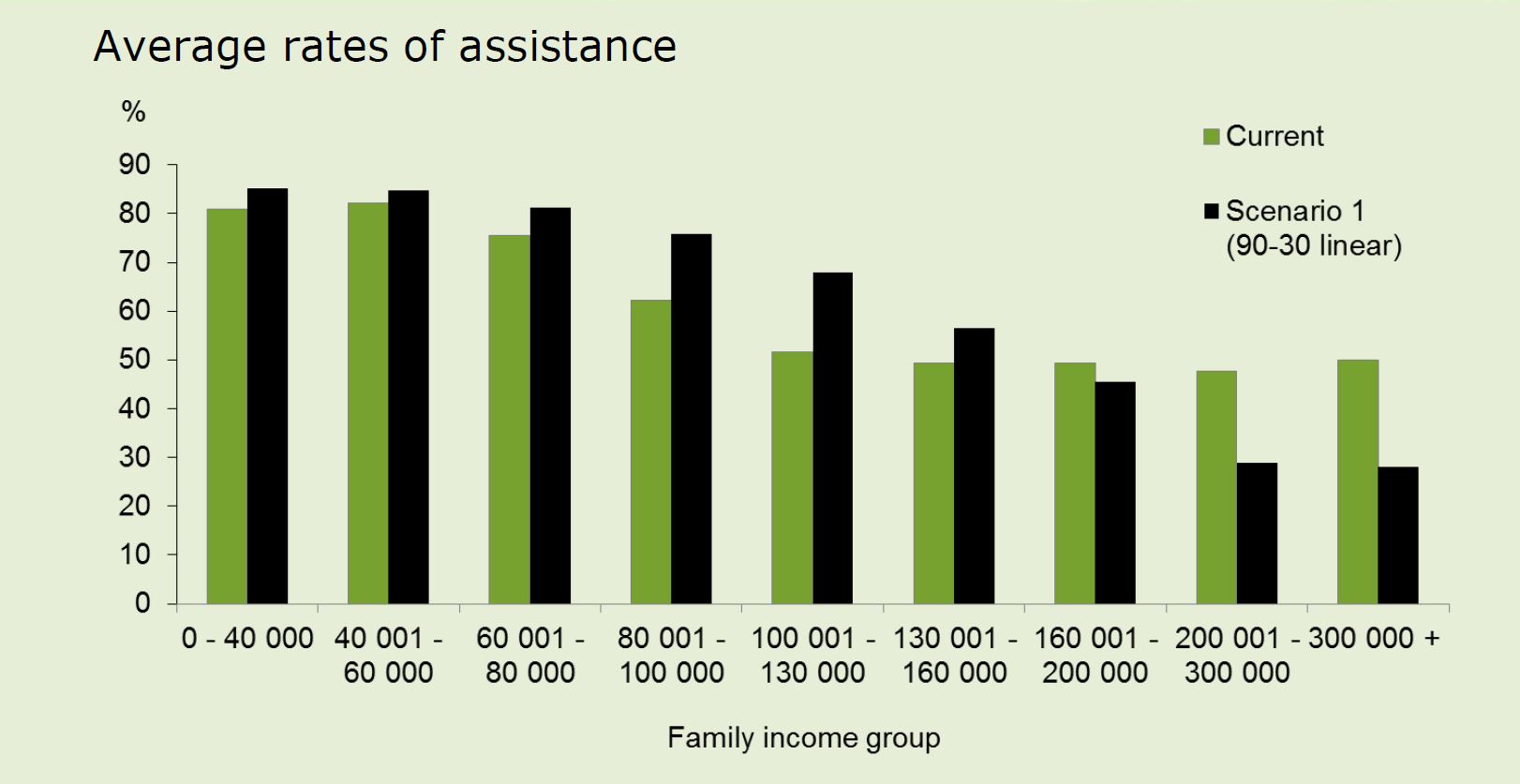
The figures we have indicate that families with incomes up to $160,000 would, on average, be better off under our system than families of over $160,000 family income where they’d actually, on average, be worse off
So we modelled four different scenarios for three different kinds of care. The scenario we preferred was the one that gave the greatest increase in use of childcare, the greatest increase in workforce participation, the greatest reduction in parents out-of-pocket cost and the greatest increase in GDP.
How then does the scenario that we recommended to the government affect affordability for parents? The figures we have indicate that families with incomes up to $160,000 would, on average, be better off under our system than families of over $160,000 family income where they’d actually, on average, be worse off. The overall share of fees paid by parents would go from 80 per cent of the total to around about 30 per cent, so it would be a reduction in the overall share. But some families with incomes over $160,000 can be better off under our system. For rural and regional areas, where often there’s fluctuating attendances depending on seasons or drought, we suggested that all centres in rural and regional Australia that providers could apply for a grant three years out of the seven to keep them going. But with reviews after two years. If it looked like a centre was in terminal decline they’d have a year to wind things up. But the idea is to keep them going but not keep paying grants to keep them going.
For children with additional needs, we recommended three programs. Firstly. There should be a top up subsidy on top of the basic childcare subsidy. We envisaged something like the National Disability Insurance Scheme the subsidy could be up to 100 per cent of the deemed cost of the particular need. Children who are regarded as at risk of abuse or neglect would get 100 per cent of the subsidy. We also thought that there should be grants-based programs for inclusion so that providers could apply for grants for training staff or up-skilling their staff or particular equipment. For disadvantaged communities, particularly indigenous communities, who currently get annual funding but without any certainty year by year, we’re suggesting is that, where there’s a viable labour market, to try and give grants to help transition to a child-based subsidy arrangement. Where there’s no viable labour market, you’d have to keep the grant funding going. But we suggest not on a yearly basis but on a three or four yearly basis.
Trying to find a rational, sensible approach was challenging. But there’s clearly established value to a year of preschool before school
Pre-schools was the other area we looked at. The federal and state governments agreed, a couple of years ago, to provide universal access for children the year before school. This access to preschool was for 15 hours a week, 40 weeks a year. Each state, not surprisingly, is completely different. The amount of state and federal funding which goes into each state, and the arrangements, are completely different in each state. Trying to find a rational, sensible approach was challenging. But there’s clearly established value to a year of preschool before school. We suggested that the federal government negotiate with the state and territories to agree to funding arrangements within their school funding, negotiate it so it’s part of the school funding.
Some states have preschools regulated under education legislation and some have it regulated under the national quality standard for childcare – in the usual way we do things in this federation. We recommended removing one layer of regulation and have it regulated under the education legislation that was particularly popular with the sector. We also thought that funding should be provided on a per child basis, at about $15,000 per child. We suggested that the Commonwealth give their $15,000 to the states and the states should pass it on to the centre providing the preschool program. If the states don’t provide it to the long day care centres, which in the past they haven’t done, then the Commonwealth should provide it directly to the childcare centres.
we recommended a fringe benefits tax exemption for employers so they could have childcare centres for their employees and they wouldn’t be tagged to a particular person
We also suggested that receipt of Family Tax Benefit Part A be linked to preschool attendance. In New Zealand, pre-school attendance is linked to attempts to find work and if an unemployed person does not send his/her child to preschool, looking for work payments are at risk. Another issue that came up was trying to provide child care that is more accessible and flexible, because people work shift work, they work part time, they work Saturday and Sunday and so on. Regular centre based hours of 6am to 6pm aren’t going to work for everybody. Thus, we recommended that nannies be brought into the system of subsidised childcare but they would have to meet certain standards. Under the conditions of visas for au pairs working here now, they can only stay with a family for six months. Then they have to move to another family for the next six months. We have recommended an au pair should be permitted a visa for 12 months with a single family if wanted.
Currently long day centres are required to open a certain number of hours a week, and a certain number of weeks a year. so we’re suggesting deregulating those hours of operation to make it more flexible. And we recommended a fringe benefits tax exemption for employers so they could have childcare centres for their employees and they wouldn’t be tagged to a particular person, it would mean they might have five staff who could use those childcare places as they needed.
Continuing with the flexibility and accessibility, we thought that if after hours school care were more readily available this would likely have a very big impact on workforce participation. Once children are in school it’s probably a lot easier for parents to work. We have suggested that consideration about providing an after school care centre should be the responsibility of the principal. A principal should make sure it is available, if there are viable numbers of children wanting it. We also raised the issue of after hours pre-school care for pre-schoolers to make it more like long day care. We have suggested some changes or tailoring of the qualifications requirements for long day care for staff; for under-3s, a Certificate III would be adequate given the evidence that was available. That has probably been the most unpopular thing in the whole report. One of the other things that we suggested was that there be consistency in ratios nationally, particularly for after school care, because they’re currently quite different in every state.
An extra $300 million is about 3 or 4 per cent on $7 billion, so it’s not wildly out of the ballpark. To cover the increased cost, we have suggested re-evaluating the proposed paid parental leave scheme to see if there is merit in having some money transferred from there
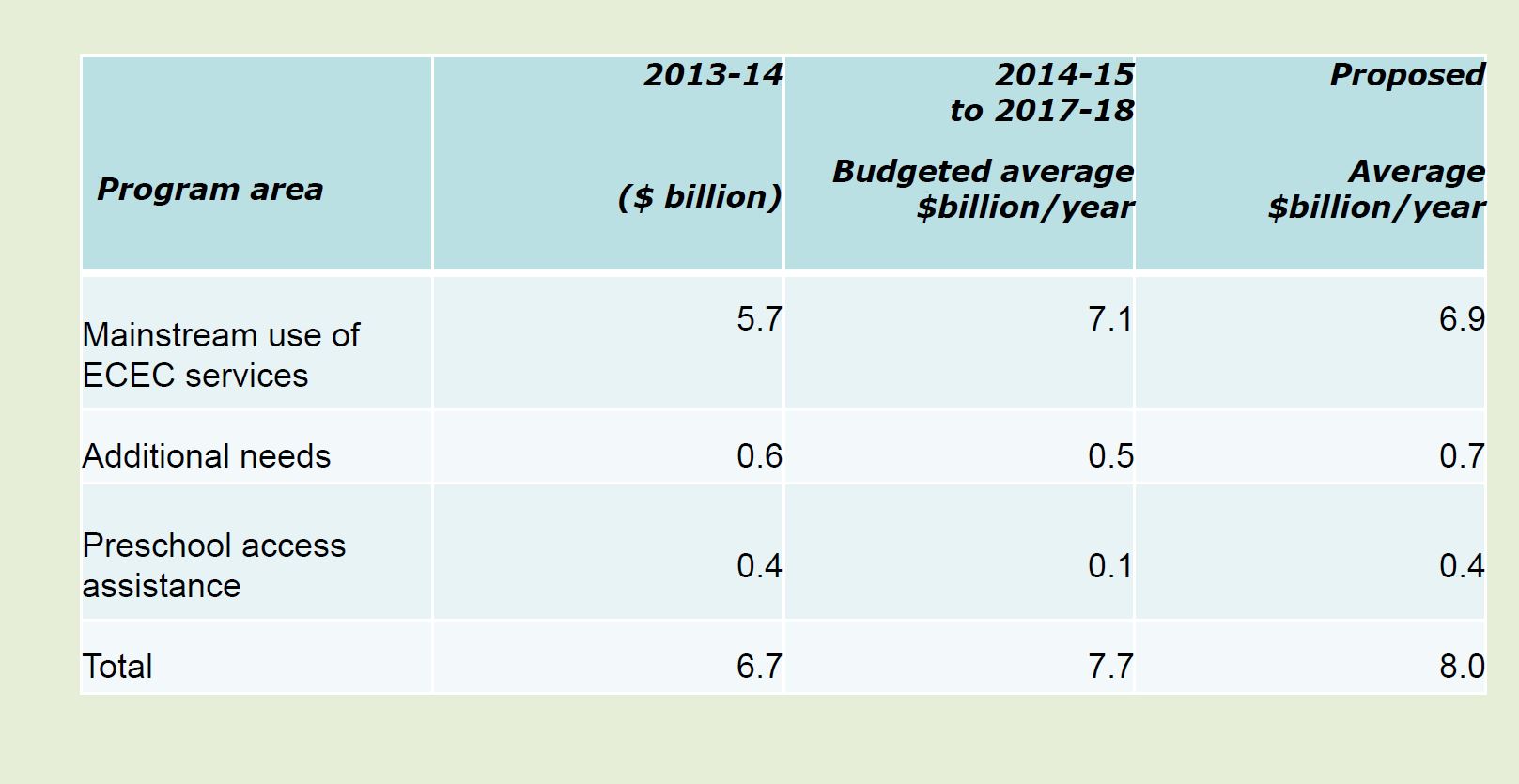
So what does this all add up to? Currently, for 2013-14, the federal government spent $6.7 billion, and they’re projecting about $7.5 billion a year for the next four years. Our preferred scenario would end up costing about (in total) $8 billion or about $300 million more than the federal government has projected. They did ask us to give them a recommendation that was in the current funding envelope. What we did was recommend our preferred option, but there are a number of options within the current funding scenario. An extra $300 million is about 3 or 4 per cent on $7 billion, so it’s not wildly out of the ballpark. To cover the increased cost, we have suggested re-evaluating the proposed paid parental leave scheme to see if there is merit in having some money transferred from there. A lot of our submissions also made the point that funding for childcare was more important than extra funding for paid parental leave. The National Commission of Audit suggested that as well.
So what does this do for families? The single, low income mother who works three days a week and has two children would be better off by $53 a week. A couple family with father full time, mother two days a week and two children would be better off by. A family with an income of $95,000 would be better off by $32 a week. Families with higher incomes – e.g. one with income of $286,000 and three children would be slightly worse off by around $27 a week. And if they looked at hiring a nanny they would be out of pocket quite a lot more.
What about workforce participation? Most of the increase in workforce participation is at lower income levels rather than high income levels. In fact, there would not be much impact on the changes of the subsidy rates at high income levels over about $200,000. Some people then say, why subsidise high income people anyway. The reason is that it recognises child care as a cost of work, and we hope it might reduce withdrawal from work of some of those high income people. There’s no doubt that there is a public benefit from child development. Although, one might say that the additional benefit of a taxpayer paying for it at high income levels is probably quite small. This shows you that changes to the childcare assistance arrangement can only do so much for workforce participation. There’s only a limited amount that you can do by changing the subsidy arrangements.
We got about 450 submissions for the draft, and we’ve had another 450 come in since we put our report out. We had about 700 comments online before the draft and we’ve got about a further 600 comments online
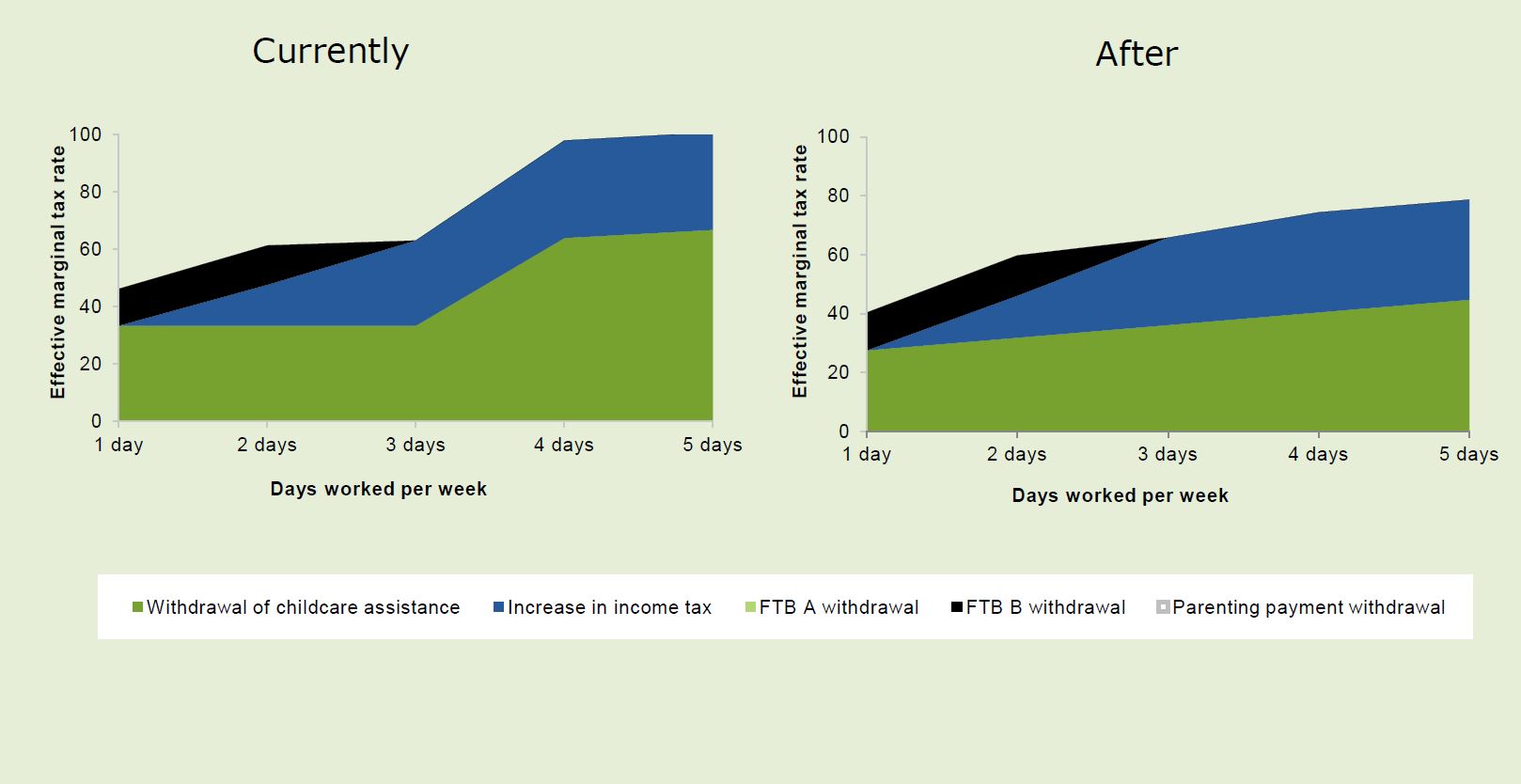
Under the current scheme, there’s no incentive to work more than two days a week for the second income earner. Under our scheme, my charts show that on day 4 and day 5 the effective marginal tax rate comes down a bit so there might be some encouragement to work an extra day or two. Looking at the graphs, Family Tax Benefits A, Family Tax Benefits B, and parenting payments all need to be looked at in terms of their actual structure to encourage workforce participation.
So what came out in the public hearings? We got about 450 submissions for the draft, and we’ve had another 450 come in since we put our report out. We had about 700 comments online before the draft and we’ve got about a further 600 comments online. So we’re flat out reading because the draft has to be in by the end of October. The main issue has been qualifications for educators for children under three. We agree that quality is important, we agree that education levels are important and we agree that education has a relationship to quality. But the real issue is the contribution of specific qualifications to outcomes. The evidence for pre-schoolers is really clear, but the evidence for under-3s really appears to be inconclusive. We haven’t read all our submissions yet and more are coming in, but so far that’s pretty much we’re where at. It’s interesting that graduates are required for long day care but for family day care a Certificate 3 is required, and graduates not required. And for in-home care no qualifications are required at all, so it’s not very consistently spelled out.
The government is not obliged to respond they can ignore it but we all hope they won’t
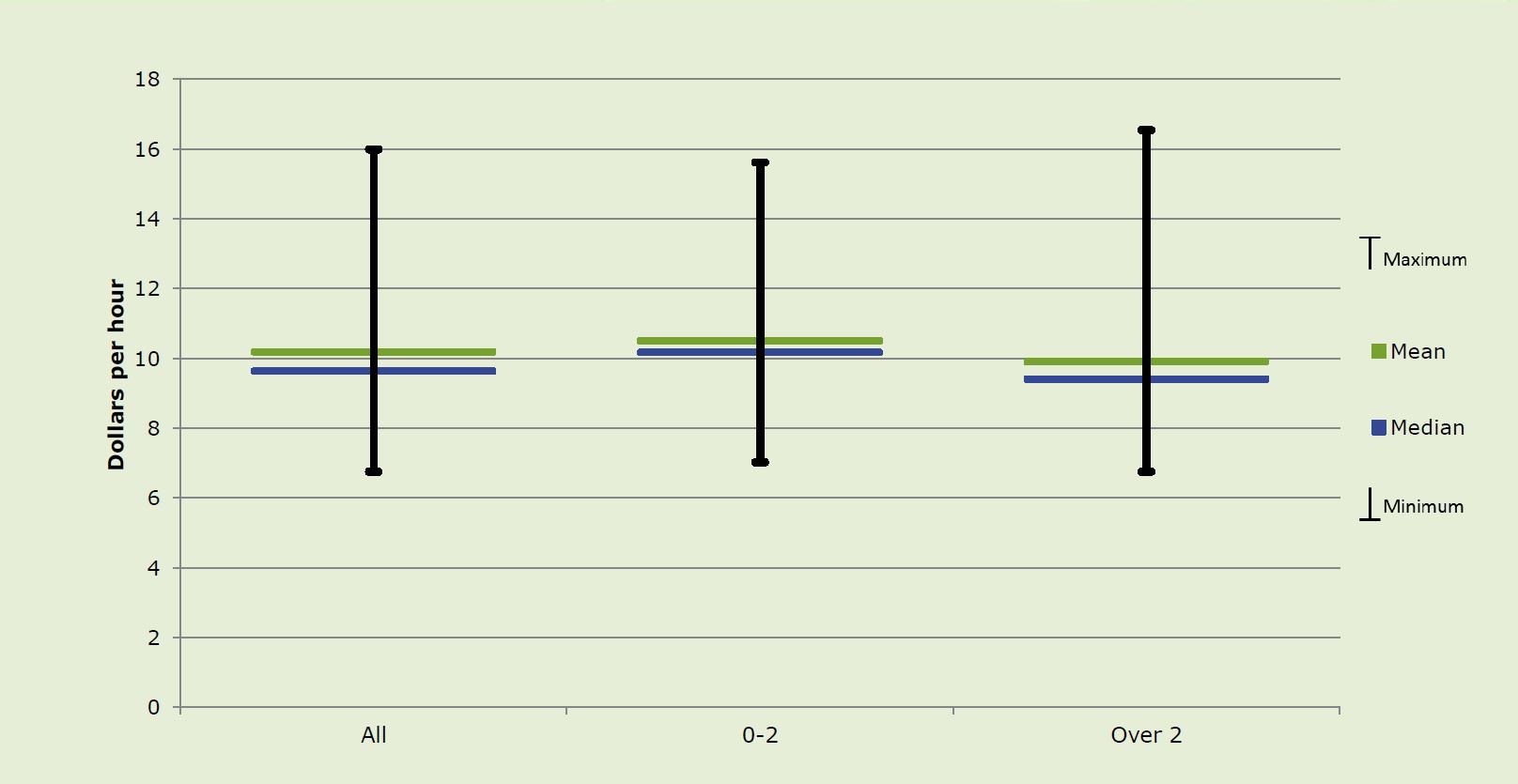
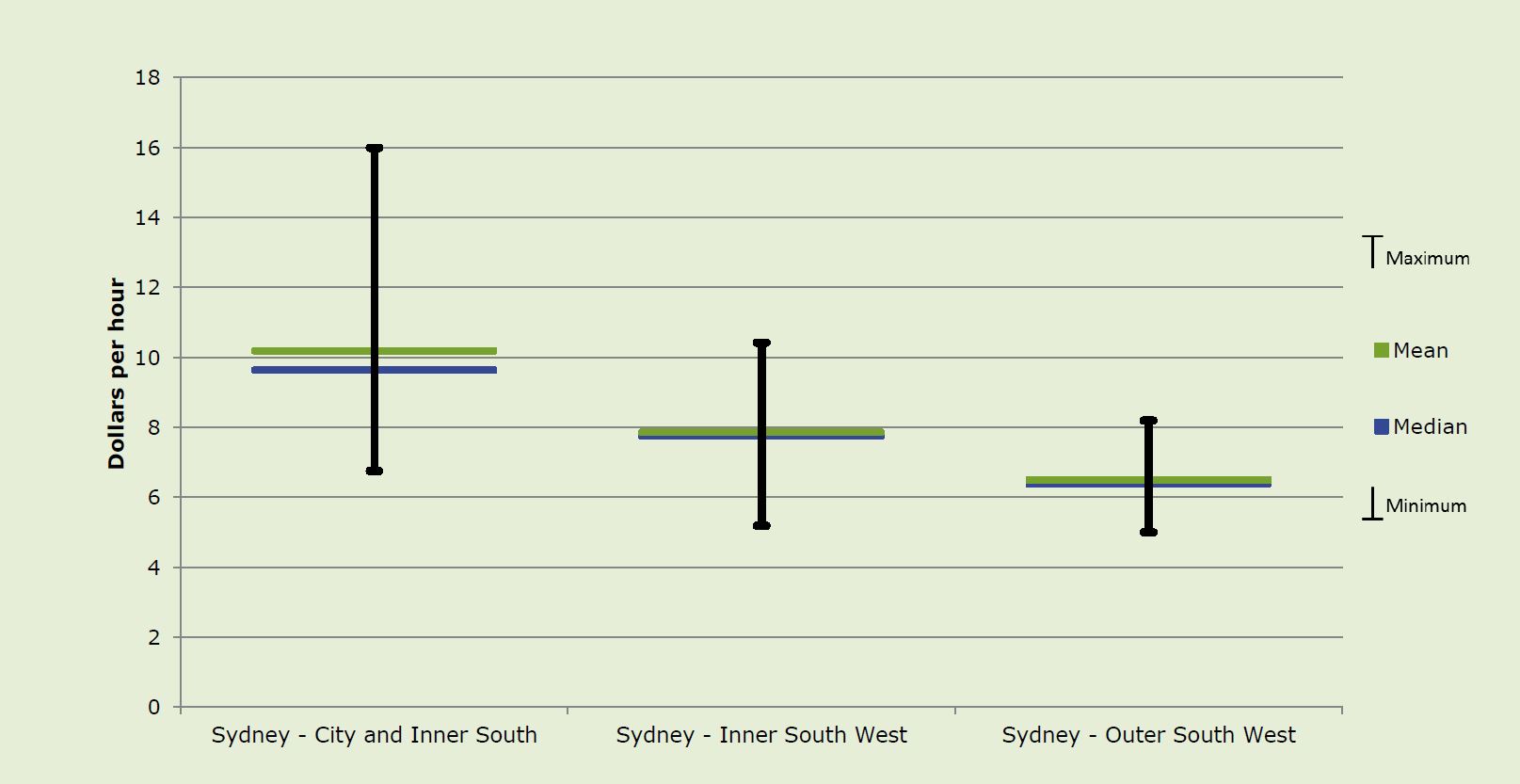
The other issue is the deemed of cost of care – what’s the benchmark going to be? We took the median when we did the modelling for long day care and family day care and after hours school care, and we got more data from the Education Department which gives us the information until the end of the September quarter last year. In the outer south west, it’s just over $6 an hour, and inner Sydney and inner south is round about $10 an hour. We’re in the process now of trying to look more closely at geographic data to see how closely clustered it all is. One of the real challenges is that if we have low income people who have to have high cost childcare because of where they live, and they don’t have alternatives for their children. That’s the area we’re really quite worried about.
So what do we have left to do? Well, we’ve put out a draft report, we’ve had public hearings, we’ve run a bunch of round tables and meetings trying to get more data, submissions are rolling in that we’re still counting, and online comments. We shall present our final report to the government by the end of October. The government has 25 parliamentary sitting days in which to respond. They’ve said they want to do things for next year’s budget so we’ll see what happens. The government is not obliged to respond they can ignore it but we all hope they won’t.