
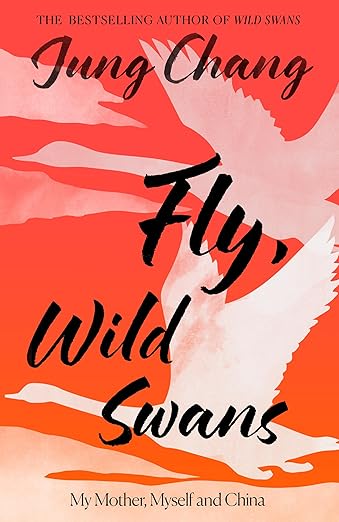
 FLY, WILD SWANS
by Jung Chang
HarperCollins Publishers Australia – 2025
ISBN: 9780008661083; ISBN 10: 0008661081
RRP: $37.99 PB, E-book $19.99
“CONSCIOUS OF WRITING ABOUT PURE EVIL”
Chinese-born writer Jung Chang is perhaps best known as the author of Wild Swans – Three daughters of China, first published in 1991, which has sold millions of copies worldwide. On one level, Wild Swans was presented as a family history, that of the author, her mother and grandmother who lived throughout much of the of the twentieth century in China. But it was also a vivid testament to the turbulent and frequently violent times which these three women experienced.
Jung Chang’s grandmother was born in 1909, just two years before the fall of the last Emperor of China and the birth of the republic founded by Sun Yat-Sen. Chang’s grandmother was a concubine of a warlord during the republic but her parents joined the Chinese Communist Party (CCP) – her father in 1938 and her mother in the second half of the 1940s. This was before the Communist Party’s victory in the civil war against the Kuomintang in 1949.
Jung Chang herself was born in 1952 and therefore experienced the events of the second half of the twentieth century under CCP rule – including the famine induced by the mis-named “Great Leap Forward” of 1958-61 and the bloody violence of so-called Cultural Revolution of 1966-76.
During the Cultural Revolution, Chang’s parents were denounced as class enemies and imprisoned despite being, or because they were, CCP officials against whom Mao’s campaign was directed. Jung Chang was a student during this period and briefly joined the Red Guards. She travelled to Beijing with other students to attend mass parades at which Mao was idolised.
The narrative of Wild Swans ends shortly after the death of Mao which brought about the end of the Cultural Revolution, the arrest of the Gang of Four – on whom the excesses of the ten years of Mao’s madness was blamed – and the initial liberalisation of the CCP regime under Deng Xiaoping.
The last chapter of Wild Swans – titled Fighting to take wing – records Jung’s success in winning a scholarship to study in the United Kingdom. Fly, Wild Swans – My Mother, Myself and China takes up her story (and continues that of her mother) up to the present time.
Jung Chang managed to stay in the UK and did not return to China to live. After ten years residency in Britain, she applied for and was granted UK citizenship in January 1989. After a first, unsuccessful, marriage she married Jon Halliday, an Irish historian. It was while in the UK and when she had relatively unfettered access to communication with her mother, that Chang wrote Wild Swans.
Jung Chang describes her first book as a “personal story”. This is true in a sense, but it was also a vivid account of the madness of the Cultural Revolution seen through Chang’s own eyes and through the treatment meted out to her parents.
Since it was presented as a personal story it did not necessarily represent a challenge to Communist Party rule. This appears to be a deliberate strategy of the author. But every reader can draw the obvious conclusions from the facts of the story revealed. The personal and eyewitness account of the events of the Cultural Revolution was particularly evocative and powerful.
Your reviewer studied Chinese politics at university in the early 1970s while the Cultural Revolution was raging in China and it is abundantly clear that Western academics had absolutely no idea what was actually happening in China or were simply parroting a party line. Jung Chang’s account was, to me, riveting in its frankness and revelatory nature, as it must have been to a myriad of other readers in the West.
While Chang was able to research Wild Swans in China on visits to her mother (as detailed in this new memoir), the Chinese government never allowed it to be published in China. It was published in English in the UK and in Chinese in Hong Kong. Initially copies could be brought into China by travellers. Chang condemned the Tiananmen Square massacre which occurred in June 1989 under the “liberal” rule of Deng. This, she said, ended her relationship with the Chinese embassy in London, but not her access to China.
After the success of Wild Swans, Chang embarked on an even more ambitious project – a biography of Mao Tse-tung. This she did in collaboration with her husband Jon Halliday. It was a 12-year project – an enormous undertaking. Surprisingly, Chang (and Halliday) were allowed to conduct research and interviews for the book in China. She notes that the 1990s documents relating to Mao’s rule were still available in China. Other researchers also gained access to these records, especially including Frank Dikotter who produced a brilliant three volume history of Communist rule in China from his base in Hong Kong.
Chang was also able to conduct interviews with former CCP officials and/or their wives and children still living in China, albeit under the close watch of state security. Some interviewees, however, refused to speak to Halliday, a foreigner, for fear of being accused of revealing “state secrets” to a non-citizen of China.
Research and interviews were also conducted around the world with key players. Halliday speaks and reads Russian and was able to do research in archives in Moscow and elsewhere in Russia. The Soviet Union was a significant force in establishing and financing the CCP and supporting Mao himself in the internal power struggles within the CCP prior to its success in 1949.
Chang’s technique in her interviews in China for the biography was again to concentrate on asking interviewees to establish the facts about key events. She did not ask them to draw conclusions or express political viewpoints which, she knew, would cause them in difficulty.
Historians E H Carr and Arnold Toynbee may have argued that “facts” are not history and that they “do not speak for themselves” and thus require interpretation. Nevertheless, the technique of assembling relevant facts via interviews with survivors as described in detail in this memoir served Chang and Halliday well. it is remarkable that they were able to conduct so much basic research in China itself during the 1990s. The list of interviewees in mainland China alone detailed in the biography covers nearly five pages and includes relatives of Mao himself.
The publication in 2005 of Mao – the unknown story was a major achievement. At 650 pages of text and a further 150 plus pages of footnotes, bibliography and, in particular, lists of people interviewed, it is a phenomenal piece of historical research and writing.
While Chang and Halliday have been at pains to present this as a record of historical facts about Mao’s life, rule and the effect of his rule on the Chinese people, in Fly, Wild Swans she cannot help but draw some conclusions about the Mao and his rule. Remembering, of course, that her parents knew Mao and other senior CCP officials and that her parents suffered during the Cultural Revolution, Chang writes that before she began her work on the biography of Mao, she “knew he was bad, but not that bad” but that during her research and writing she “became conscious that I was writing about pure evil”.
Mao, she notes and which is supported by other accounts, including Dikotter’s, was responsible for the deaths of 70 million Chinese people or more. In her latest book, Chang is particularly critical of Western apologists for China. Among those people she includes Henry Kissinger, whom she interviewed for the book. Kissinger helped clear the way for Nixon’s visit to China in 1972. While Nixon’s visit may have had important geo-political reasons behind it, Chang notes that:
Nixon’s visit to Beijing in 1972 brought Mao, hands dripping with the fresh blood of the Cultural Revolution, to centre stage as a benign and wise leader and a star with an incomparable allure…
Kissinger, Chang says, promoted Mao in the mainstream West and on the right of politics, much as C P Snow had done for the left in the late 1930s with Red Star over China. Kissinger, not surprisingly, did not like the book, in company with other apologists for Communist rule in China. The biography has not been published in China.
Australia is not immune from this charge of ‘Mao-washing’, either. Gough Whitlam’s visit to China as Opposition Leader in 1971 pre-dated Kissinger’s visit by just a few days. Whitlam met with Mao – a visit which is briefly and critically mentioned by Chang and Halliday in Mao. After the ALP won government in late 1972, Australia switched its recognition from Taipei to Beijing and Whitlam visited again as PM in 1973. Liberal Prime Malcolm Fraser’s first overseas visit in 1976 was to China (and Japan). Fraser did not meet Mao due to the latter’s poor health. When Mao died in September 1976, Fraser, as PM, moved an obsequious, cringe-worthy motion of condolence in the House of Representatives.
Today, Chang writes, Mao’s face, and only Mao’s, is on every banknote in China and his portrait still adorns Tiananmen Square. There has never been a denunciation of him like Khruschev’s denunciation of Stalin in 1956. Any errors have been blamed on others, such as the Gang of Four (actually a Gang of Five, says Chang, the fifth being Mao, of course). Mao has not been put in the place where he belongs, that is with Hitler and Stalin, the other mass murders of the twentieth century.
Chang sees the current CCP paramount leader Xi Jingping, as the “true successor” to Mao, unlike his immediate predecessors. She writes that the regime has never turned its back on Mao despite his murderous record and that Xi wants to implement Mao’s vision for China as the pre-eminent or dominant power in the world.
In October 2007 after the publication of Mao, Jung Chang applied to visit her mother in China. For the first time, her application was denied. While a visa was subsequently granted it came with strict conditions. Her visits home to see her mother became increasingly difficult to arrange and her freedom to meet with others more restricted. Her books can no longer be published in Hong Kong and the Chinese editions now have to come from Taiwan.
Jung Chang last visited her mother – who at the time of publication of Fly Wild Swans was still alive – in 2018. Xi Jinping was now President for life. The CCP had now declared that “slander or insult to martyrs” was punishable by imprisonment. Given Chang’s biography of Mao, she concluded that a visit to China now carried with it the risk of detention and imprisonment, despite her UK citizenship. Chang’s mother has apparently come to the same conclusion and has told her daughter not to visit.
While Jung Chang believes that it is Xi’s ambition to fulfill the aims of Mao by China becoming the number one nation on the globe, she does not believe he will achieve this goal. While her reasons for optimism are not clear, for the sake of the Chinese people and the rest of the world, we can only hope that she is right. Your reviewer’s confidence in her belief is not high.
Fly Wild Swans is a personal and literary memoir. It lacks the immediate and forceful impact of her earlier books (Chang has also written others) and covers some of the same ground. However, it is an important testimony and reminder that the trend in China under Xi is not in the direction of liberalisation and opening up. It is in the opposite direction.
Two asides
Jung Chang’s perspective on China and the West is sometimes intriguing and unexpected. Arriving in the United Kingdom in 1978, she initially concluded that England was “wonderfully classless”! To a reader in an English culture this seems to be a remarkably inaccurate conclusion. Chang acknowledges that she later changed her view as she understood more about the UK, but the reason for her initial impression is evident. Chang had not grown up in a class-free society. Quite the opposite.
As her parents were senior Communist Party officials, the family lived in a party member only compound guarded by security forces. Her life – at least until the Cultural Revolution – was one of “privilege and hierarchy”. What you had, what you could do, how you could travel, what you could buy, your level of medical care, etc, was all determined by your grade and status within the Communist Party.
In London, it seemed to Chang, anyone could go into any shop or travel wherever they liked on apparently equal terms with anyone else. By comparison with China, Britain was classless.
Medical and hospital care in the UK is covered by the National Health Service. While this has been and remains under stress, Chang notes that in the ‘people’s republic,’ medical care is “cripplingly expensive” and a major illness could – and still can – bankrupt a family.
Keith Harvey is a non-factional member of the Victorian ALP. His Memoirs of a cold war warrior [2021] detailing his work in the trade union movement is available from Connor Court Publishing as is his biography of former Independent Senator Brian Harradine [2023].