
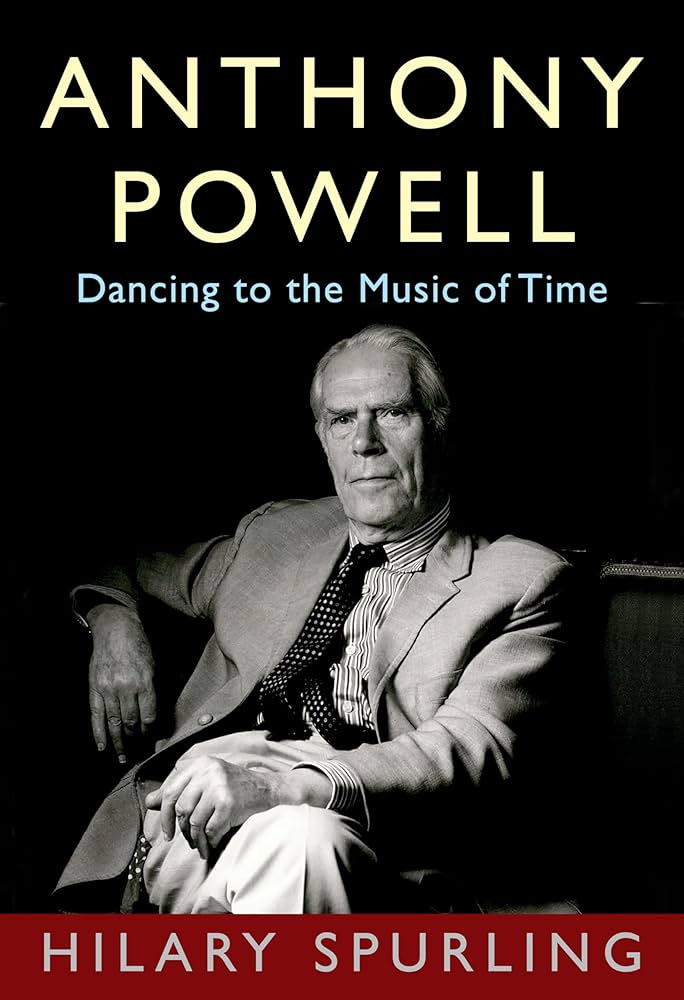
 DANCING TO THE MUSIC OF TIME
ANTHONY POWELL by Hilary Spurling
Hamish Hamilton 2017
ISBN: 978 0 241 14383 4
RRP: $55 (hb)
Reviewed by Anne Henderson
“What are you reading?” was the query from an academic friend with a law degree and doctorate. “A biography of the writer Anthony Powell,” was my response. A blank stare came back, indicating “Okay. Who was he?” A brief explanation from me and not much interest from my friend followed. One of Britain’s most accomplished writers seemed to have vanished down history’s black hole – left to be gathered up in the memory of a niche market of followers.
For those who value the great legacy of English literature and have no knowledge of Anthony Powell, it is imperative they get a copy of Hilary Spurling’s Anthony Powell and read it from cover to cover. Like Jane Austen, whose work vanished for a century and more, Anthony Powell’s creations, a sardonic and piercing view of a generation centred on Europe and emanating from Britain, were by the 1960s criticised as coming to stand for “everything dull, conventional and socially exclusive to a younger generation who had never read him”.
In fact, the art of Anthony Powell is dependent on staying with his text as acclaimed writer Ian Rankin eventually did after dismissing AP’s work without a serious read of it as “elitist, class ridden, an English upper-class comedy of manners written by a snob”. On reading the entire twelve novels of AP’s iconic work A Dance to The Music of Time, Rankin reversed his judgement and became one of AP’s greatest admirers saying, “Reading it is like a great creative master-class. I re-read it every couple of years.”
Hilary Spurling has brought Anthony Powell back to life in her biography of one of England’s finest writers. In a searching and revealing work, Spurling recasts Powell’s fictional characters in an intimate study of his life and his craft. Her exhaustive knowledge of A Dance to The Music of Time is reversed in a biography replete with the real people and experiences that made possible the fictional work of decades.
Anthony Powell was born in 1905 to middle class gentry. His mother Maud was 15 years older than 21-year-old Phil Powell when they married. As a child, Anthony Powell led a secluded life. His father Phil was an army officer who moved base often. Maud followed him devotedly, suffering from a shyness that came from accusations of cradle snatching, a shyness which she passed on to her son. In their succession of boarding house residences, AP became an avid reader, comfortable with his own company. Sent to board at New Beacon school in Kent, at a young age, AP suffered bullying and came through only with the help of his friendship with Henry Yorke (later known as Henry Green the novelist) the son of an industrialist, who took him home for visits and gave AP experience of a happy family with its easy intimacy.
Phil Powell did not adjust easily to post World War I life and his career suffered. His mood swings at home caused tension with his son. Yet, there were sufficient funds for AP to enter Eton after he won a place there allowing him to join the society of England’s aristocracy. At first a loner at Eton, AP was saved by being allocated to Goodhardt’s House where rules were slack and he had the opportunity of joining drama and drawing classes that suited his artistic sensitivities. He became part of the Eton Candle magazine club and won a place at Balliol College.
At Oxford, AP encountered and was dismayed by the snobbery and its emphasis on money. He had not known that at Eton. He would record later, “How little I liked being at Oxford. I longed to get it over and go down.” Oxford don Maurice Bowra became an important mentor but never could accept AP’s alienated view of Oxford life. For all that, there were friends and acquaintances that evolved – many who would reappear as characters or parts of characters in Dance. Matched with his better off colleagues, AP enjoyed holidays in Europe, often driving in their cars, conscious that he could not spend up at bars and cafes like those he was with. In time, it would all go into the Dance. He meanwhile was gulping down “the Russians” – Dostoevsky, Chekov, Turgenev – and Proust.
Released from Oxford with a third, AP was saved from penury by a job at the publishing firm Duckworths – founded by Gerald Duckworth who was Virginia Woolfe’s half-brother. The job kept AP in sparse lodgings in London’s raffish Fitzrovia and over time offered him quality experience of publishing houses and their identities and leave him not only with endless material for his writing but also the view published more than half a century later that, “All publishing houses are scenes of violent internal struggles for power.” He might have been commenting on today’s world of television companies or film studios.
At Duckworth’s, while opining his social life was “arid”, AP continued to move on the edges of upper class circles invited by his friends’ mothers to parties where he despaired of most of the women he met. He was snubbed by the famous hostess Ottoline Morrell and Sitwell matriarch Georgia but became close to the younger Sitwell family writers, all published by Duckworths, and developed a close friendship with a rising Evelyn Waugh. In his dedication in AP’s copy of Decline and Fall, Waugh wrote, “Tony who rescued me from worse than death.”
His first grown up affair at 22 was with artist Nina Hamnett who introduced him to the London’s artistic set after which AP underwent what Spurling describes as what “Tony needed at this stage” – in other words “a liberal education”, gained as Spurling puts it, from “the peculiar underworld inhabited by painters, writers, poets and performers, a scavenging crowd, initially as hard to penetrate as the debs’ lists.” Soon, AP was moving between opposing worlds, “sometimes changing into white tie and tails halfway through the evening so as to commute straight from one world to the other”. As he would write much later of these balls and debs parties, “I do not regret (from a writer’s point of view) having served my turn there.”
Spurling’s account of Powell’s quietly growing circle of notable friends is so replete with the names of burgeoning writers and artists, at times it requires a look back a page or two just to recall here and there the context and link to AP of a character developing in another step in the story. Powell may have started as a loner but increasingly he gathered talented friends and became confident in his artistic milieu. As a loner observer, he had stored years of experience from which he had the talent to pour into fiction. His first novel Afternoon Men – published in 1931 – is a comical tale from the viewpoint of a museum clerk amidst the “company of giddy-heads, afternoon men” – those men who spent their mornings recovering from the hangover of the night before. The unrequited love of the hero can be seen as reflecting AP’s inability to win Enid Furminger, a woman “who could not enter a room or a restaurant without turning heads”.
Between 1931 and 1939, AP published five novels, the last What’s Become of Waring suggestive of his greater work in the Dance. The war would interrupt AP’s writing at that point, albeit giving him valuable experience in Belfast, in Intelligence, in officer training and at the War Office, all of which would eventually feed into the Dance. More importantly for AP’s future in these years was his marriage to Lady Violet Pakenham in 1934. Violet was the second youngest in a family of six children and a daughter of the 5th Earl of Longford. The match came suddenly after AP had spent some days with the Pakenhams at the family estate in Ireland known as Pakenham Hall. AP proposed to Violet and was accepted within days of the visit. Violet’s niece Antonia Fraser claimed that “no one was dull in Violet’s company”. AP reflected decades later that there was never any other he might have considered marrying.
Apart from the compatibility of the couple, the Pakenhams delivered AP into aristocratic society, with its connections broadening AP’s circle of acquaintances and friends enormously. Years later, at the Powells’ celebration of their silver wedding anniversary, over 100 guests joined them. Violet, working in journalism, had an inquisitive and industrious mind, was gregarious with a wide circle of friends and her partnership with AP would prove vital in the work that produced the Dance. AP often suffered depression, and his choice of bride would become fundamental to his literary reputation and achievement. After they bought their country home Chantry in Somerset in 1952 – following a legacy from AP’s aunt – it became a powerhouse where the volumes of Dance evolved. In time, Violet developed her own writing career and younger son John was witness to the back and forth of critique each parent offered the other. As Spurling records it:
Violet’s phenomenal memory for plots and people had been as invaluable to Tony as his professional experience now proved for her. Their son John once accidentally interrupted a session in the library when Tony was taking Violet’s latest book to pieces: “I never heard anything so excoriating in my life,” he said afterwards. “You wait until I get going on your father’s,” Violet replied sternly.
Hilary Spurling’s Anthony Powell is a feast of characters and literary observations. Powell was a close friend of many greats in his day from George Orwell to Robert Conquest to V S Naipaul to Malcolm Muggeridge to Graham Greene to Kingsley Amis to Philip Larkin along with many others esteemed in literary circles. He spent time with Scott Fitzgerald in Los Angeles and was possibly the last subject painted by Augustus John. None of which saved him from some harsh reviews of parts of the Dance in later years from Muggeridge and Naipaul, along with distinct hostility from Waugh’s son Auberon.
AP’s need to earn a living while writing rather than enjoy an allowance from a wealthy family meant he broadened his life experiences in ways that fed into his books. He reviewed for years at Punch and The Times Literary Supplement. He worked for Warner Brothers and spent time living in Los Angeles. He and Violet travelled widely whenever they could afford it – educational tours mostly. Spurling also notes that AP had the gifts of Wodehouse in his satirical take on figures in society but where Wodehouse dealt in the Arcadia, AP tackled real types and figures from everyday experience while the backdrop, as Arthur Schlesinger once reflected:
The great historical happenings of the time – depression, Nazism, Communism – are persistent off-stage presences without distorting or violating the fabric of the narrative.
The world of the middle class that Anthony Powell captured in his work has long since gone. For the moment, the subtlety of his writing and its acute take on the people of that time – the first half of the twentieth century in Britain and Europe – and their milieu, connections, achievements and failures can seem remote in a world of technological revolution, a world of the moment that does not often look back. Yet, like Austen, the world Powell created is awaiting a revival – people of talent, their legacy and their record of a moment in time at the centre of Western society.
Novelist Jocelyn Brooke caught the tone and genius of AP’s writing early, opining of a Powell novel:
It wasn’t Stein and Hemingway so much as Mr Eliot who seemed to be lurking in the background. The laconic, curiously empty dialogue, with its deliberate repetitions, achieves a compulsive interior rhythm … Birth, copulation and death … the theme is never stated but it is implicit in every paragraph.
Hilary Spurling’s Anthony Powell is a gem of a biography from a writer who is deeply immersed in her subject. She has more than done justice to the memory of one of England’s greatest writers as well as stirring a new focus for modern generations on the legacy and relevance of Anthony Powell.
Anne Henderson is Deputy Director of The Sydney Institute and author of Menzies at War, which was shortlisted for the 2015 Prime Minister’s Award for Australian History