
 HIGHLIGHTS OF THE MENZIES ERA IN AUSTRALIAN POLITICS
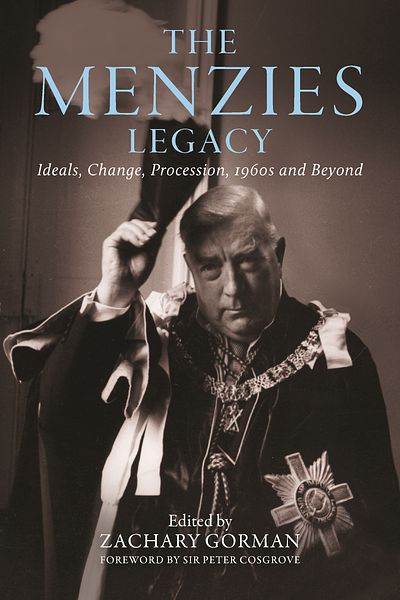
THE MENZIES LEGACY. IDEALS, CHANGE, PROCESSION, 1960S AND BEYOND – editor Zachary Gorman
Melbourne University Press 2026
ISBN-13 9780522881905
RRP: $50 (HB)
Reviewed by William Coleman
This most recent volume of Menzies studies by the Robert Menzies Institute provides an opportunity to revisit the commonplace punch and counterpunch of the left and the right regarding the Liberal prime minister.
To the left, Robert Menzies was merely an Anglo-Australian echo of the past; the man who revelled in being made Warden of the Cinque Ports by Queen Elizabeth II; a lady who, of course, he did but see passing by but would love until he died. The right counterpunch frames Menzies as the overseer and accessory of the inrush of modern Australia in the post-war period; the Prime Minister who launched the massive expansion of universities, broke the century old taboo on funding Catholic schools, normalised immigration from southern Europe, and signed an ANZUS pact omitting Britain.
There is an alternative conception of Menzies which, without actually denying the truth of these takes of the left or right, nevertheless sees him, I think, truer: Menzies, as neither the voice of the past nor herald of the future, but as, thoroughly, a man of his times. I have it on the late John Nethercote’s authority that Menzies was a great fan of Danny Kaye, and would pal around with him when passing through the US. Neither the left nor right would find this image very resonating with their visions of Menzies, but it chimes with the conception favoured by this reviewer: Kaye’s act of crooning, cavorting and novelty songs would hold little appeal to contemporary taste, but it was “immensely popular” with the 1950s world, Menzies included.
In his contribution, “Menzies and the Adoption of Decimal Currency” Selwyn Cornish provides matter supportive of the conception of Menzies as a man of his times. It was Menzies who, on 29 October 1958, announced the decimalisation of the Australian pound, a measure that had been mooted since 1902. Yet, for all its modernising aura, Menzies’s decision was thoroughly attuned to the times; South Africa, India, Pakistan, Cyprus and later New Zealand and the UK all decimalised in this period. But if decimilisation wasn’t a matter of ‘catching up’, the left moves too fast in trying to pin on Menzies an outmoded Anglophilia on account of his favour “the royal”, rather than “the dollar”, as the new currency’s name. As Cornish notes, “The minutes of the Cabinet meetings when various names were considered do not support the claim that M was the principal advocate of ‘royal’.” It was, in fact, William McMahon who led the running for Royal, backed by Harold Holt and several other ministers. When the unpopularity of the proposal became apparent, Menzies easily conceded (defended, in fact) a free vote of Coalition members on the issue.
Neither is Menzies’ nomination in 1961 of Lord De L’isle and Dudley as Governor-General great grist for the left’s mill of convicting Menzies as anachronistic Brittanicism. In “Recommending an Appointment to the Sovereign” Damien Freeman and Dean Smith carefully review the evolution, over Menzies lifetime, of the process for appointing Australia’s Governor-General. They note that the next time Menzies had occasion to nominate a Governor-General, in 1965, Menzies’ choice fell on Richard Casey. Freeman and Smith point out that this was the first time a right of centre government had nominated an Australian as Governor-General. Their point might be developed. If we put to one side the appointment of James Mitchell as Western Australia Governor in 1948, I believe it is true that prior to Menzies’ appointment of Casey no Australian had ever been chosen as Governor by any right of centre state government. And I believe it is equally true that since the appointment of Casey, no Briton has ever been chosen as Governor by a right of centre state government. Menzies could be seen as a modernising trendsetter. Or perhaps he was simply exactly reflecting the mood of the centre right of his day.
This review’s conception of Menzies is further corroborated by Andrew Carr and Peter Dean’s contribution, ‘The ADF Menzies Built’, which suggests that the Menzies government was well-adjusted to the realities of his day. They emphasise that the major equipment choices of the early 1960s – the French built Mirage and the US F-111 were neither a sentimental cultivation of the British connection, nor a self-conscious rejection thereof; they were an attempt at a rational judgement of cost and benefit. ‘The Menzies Defence Legacy; Wise, Brave and Enduring”, by Tom Lewis, allows one to make the same point with respect to the Navy. The Royal Australian Navy was, of course, entirely the flesh and blood of the Royal Navy. It was in the Australian navy, if anywhere, that the rule of sentimental ties would have favoured acquiring British equipment. Yet the Menzies government chose US made Charles F Adams (“Perth Class”) destroyers, not to mention US made Orions, Skyhawks, Trackers and Neptunes. There was every “willingness to look for the best if not British”.
Anne Henderson’s “The Menzies Government, B.A. Santamaria and the Beginning of State Aid” also underlines that the major policy rupture of State Aid was more an idea whose time had finally come, rather than some singularity of Menzies: she observes that in 1962 the NSW Heffron Labor government was on the verge of giving state aid but decided not to implement it. Part of those “times” was a prestige of applied science: it is well-known that state aid came first in the form of school science laboratories, and Jennifer Clark, “Menzies and Science Education” expands on the centrality of science in his education policy. But what could be more characteristically Early Post-War than an enthusiasm for developing a scientific capability? In “Menzies and Australia’s Communications Golden Age”, Michael Percy observes that the CSIRO’s budget increased from £2.7m in 1950 to £9.6m in 1960, an amazing inflation-adjusted increase of three and a half times. But this sort of leap was seen elsewhere: government finance for R&D exploded in the UK in the 1950s.
This reviewer’s attempt to present Menzies as a man of his day might be dismissed as a truism: surely, all successful politicians are of necessity of their time? They, like their electorate are cut off from the past by the mythologisations and the very real caesuras of their age; and they, like their electorate (and its “experts”), can make out the future only very indistinctly. (“In Menzies and the Vernon Report” John Hawkins points out that the Report, heroically, attempted to forecast the growth rate of exports between 1962/3 and 1973/4: it forecast 53 percent; the actual came in at 106 percent). And yet, for all its necessity, the fact of a successful politician being trapped in own time remains. In his interesting rebuttal of Menzies being narrowly Anglophile (in “’Robert Menzies, Travel, Nationalism and Peace in the 1960s”) Joshua Woodward rightly notes that Menzies was the first incumbent prime minister to visit Japan. But it must be allowed constitutional constraints would have made it impossible for any pre-war prime minister to have done so.
This reviewer’s attempt to present Menzies as of his times might also be censured as badly underestimating him: suggesting, it seems that it would have made no difference if he were not Prime Minister. But there is a difference between being merely fashionable, and harmonising with your age. The first is imitational and trivial, and Menzies was definitely not merely imitational. What, in the early 1960s, could have been more merely imitational, and more trivially fashionable, than his government adopting exact and optimistic GDP growth targets in the name of “planning”? But Menzies was perfectly happy for Treasury to spike the Vernon Report’s favour of such targets. To harmonise, by contrast, is to act so as to make the best of your period.
David Furse-Roberts, in “The Menzies Government and Housing Policy”, provides evidence of Menzies’ capacity for harmonisation. A massive expansion in home ownership was very much part of the underlying fundamentals of the post-war, reflecting full employment, “confidence”, and perhaps a relatively modest demand for capital by business and the government. Christopher Beer, in a carefully quantitative study of home ownership, “Urban and Electoral Politics in Western Sydney, 1961-66”, computes the increase in the proportion of dwellings owned by their occupier for each of nine Sydney suburbs between 1947 to 1961. The median (not the maximum) increase took place in Ashfield, from 41 percent of the total to 60 percent; a remarkable shift in 14 years. But my point is that this shift was accommodated by Menzies’1955 legislation, highlighted by Furse-Roberts, that permitted Commonwealth-financed public housing to be bought by private owners. Labor, would, surely, have been quite incapable of passing it. Here Menzies was acting to make the best of his times. Obviously, a political advantage would accompany such harmonisation: Beer notes that in 1961 the ALP did win the seat of Evans, where Ashfield is located, by the narrowest of margins, but lost it in 1963, in a 6.7 per cent swing against them.
To strike a harmony with the fundamentals of your times, rather than just dart after its fashions, is perhaps the greatest achievement of the practical politician. And that achievement brings praise; not by those not responsible for it, but by those who benefitted from it. In “Australian Reaction to Menzies Retirement” Frank Bongiorno and Matilda Hatcher examine three boxes held by then National Library containing messages sent to Menzies on his retirement. One of these messages is from a certain “Veronica”, who wrote to Menzies thus:
… [as] an ordinary housewife and mother, you have given us everything we have today, the best of them is happiness, when I say happiness I mean just that, for 17 years you have given us employment and good wages and without these things we could not have happiness, as in most families if there is a shortage of money their [sic] are arguments and quarrels [sic] .. but since you have been our leader this has not been the case
A more eloquent eulogy for a politician in a democratic, Australian society could hardly be hoped for.
I must note that my remarks on The Menzies Legacy above have, regrettably, fallen way short of spanning the sweep of the volume, containing as it does 24 contributions and 28 authors. So, it behoves me to record that its 392 pages deal with just about every topic of “the Menzies legacy”. With one exception: Menzies’ effective creation of modern Canberra. It was thanks to Menzies that the Lake was saved from Treasury cheese-paring; and it was under him the post-Griffin Canberra of “satellite cities” suddenly emerged.
I must also underline the high scholarly quality of all the chapters to which I have referred, and the great bulk of those I have not; they would easily be published in properly refereed academic journals. Which is to say that The Menzies Legacy is of definitely higher quality than the typical “conference volume”, to the distinct scholarly credit of its editor, Zach Gorman, and its progenitor, the Robert Menzies Institute.
I conclude by taking up a remark on Menzies scholarship made by Geoffrey Blainey in his contribution. He judges A. W. Martin’s biography of Menzies to be “one of the best biographies ever written in Australia”. But he also adds that Martin’s account of Menzies’ first twenty years, is “surprisingly small and often, I think, very inaccurate”. Since Martin’s biography there has been considerable research on the “young Menzies”, including a volume by the Menzies Research Institute. What the reader misses is Blainey’s judgement as to whether Martin’s omissions and errors have been substantially corrected by such work, or whether a biographical treatment of Menzies before attaining his “majority” may yet be usefully done. Does a further useful task of the Institute beckon here?
William Coleman is an author and academic, who has written extensively on political economy, the history of economic doctrine and Australian economic history. He is currently researching a biography of Sir John Robertson.