
 HOW WRONG CAN AN AUTHOR BE? THE ERRORS ABOUND IN REMEIKIS’ BOOK ON HOWARD
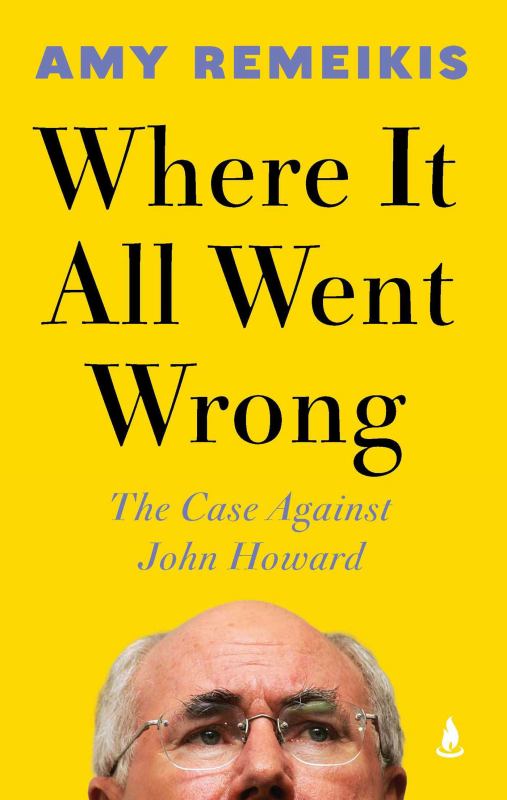
WHERE IT ALL WENT WRONG: The Case Against John Howard
By Amy Remeikis
Scribner Australia/Simon & Schuster, February 2026
ISBN: 9781761822117
RRP: $29.99
Reviewed by Gerard Henderson
Question: Where did it all go wrong? Answer: At the very beginning. The reference is to Amy Remeikis’ book Where It All Went Wrong: The Case Against John Howard (Scribner Australia/Simon & Schuster, 2026).
Amy Remeikis is the chief political analyst at the avowedly leftist The Australia Institute and a contributing editor for The New Daily which was founded by Industry Superannuation Holdings. Industry Superannuation funds were set up by trade unions. Before joining the leftist Australia Institute (executive director Richard Denniss) Remeikis was the political reporter for The Guardian Australia – another avowedly leftist organisation. And she was a regular panelist on the ABC TV Insiders program.
In view of this, it would be expected that a publishing company like Simon & Schuster would have ensured that, however strong the author’s political opinions, the text required a considered thesis and to be carefully fact-checked. This was not to be the case. Instead, Remeikis wrote a sneering, hyperbolic, leftist polemic replete with errors.
I first drew attention to the errors in Where It All Went Wrong in my column in The Weekend Australian on 14 March 2026 and followed up with other howlers in my Media Watch Dog blog on 20 March and 10 April.
In my Weekend Australian column I mentioned that the author got the year of the 1998 election wrong – placing it in 1999. If this was just a typo, it would have been an unfortunate error. But it was more than that – since it was part of the author’s case for the John Howard prosecution. This is what was written at Page 214.
The myth that Howard was popular and unchallenged during his 11 years as prime minister is largely aimed at keeping his legacy intact. The truth is that Howard only just flopped over the line in 1999 [sic] and lost the popular vote for the two elections after but won government.
This is hopelessly wrong. John Howard led the Coalition to victory in 1996 (with a two-party preferred vote of 53.6 per cent), 2001 (51 per cent) and 2004 (52.7 per cent). In 1998, the Coalition scored 49 per cent of the two-party preferred vote but this was attained after going to the election with a proposed new consumption tax. A considerable achievement in itself. Also Pauline Hanson’s One Nation party obtained 8.4 per cent of the primary vote in 1998 with just 53.7 per cent of its preferences going to the Coalition. Since many One Nation voters in 1998 would have voted for the Coalition in 1996, the presence of One Nation on ballot papers in 1998 would have reduced the Coalition’s two-part preferred vote. One Nation’s vote propped to 4.3 per cent in 2001.
What Remeikis was saying is that the Coalition under John Howard’s leadership only won the popular vote – as measured in Australia by the two party preferred vote – at his first election. And not in 2001 and 2004.
It’s an attempt to downplay Howard’s political achievement, in order to support Remeikis’ thesis that Howard destroyed Australia. This despite the fact that Australia was a prosperous country during John Howard’s prime ministership from March 1996 (when the Coalition defeated the Paul Keating-led Labor government) and November 2007 (when Kevin Rudd led the Labor Party victory). It is two decades since Howard was prime minister. Yet according to this book, he is totally responsible for the nation’s contemporary “mess”.
Since this is Remeikis’ thesis, it’s no surprise that Where It All Went Wrong is essentially a leftist rant. It’s the kind of polemic which you might expect The Australia Institute to publish. But not Simon & Schuster. Yet clearly the publisher initially embraced the work.
On the cover, Simon & Schuster describes the author as “the highly informed voice of these dispossessed generations; in showing us where it all went wrong, she illuminates the path to a better future”.
The back cover contains an endorsement from Sean Kelly, who writes a column for The Age and Sydney Morning Herald and once worked for prime ministers Kevin Rudd and Julia Gillard: “A powerful account of the stories John Howard told this country and the grip they exercised over collection imagination.”
In fact, Remeikis is not “highly informed” and her book is littered with stories which she just made up. Here we go:
▪ At Page 21 Amy Remeikis writes:
Howard’s rallying cry to enshrine mateship as one of the defining notions of Australian character was tied to his obsession with “ordinary Australians”. “Howard’s battlers” very quickly evolved into his “forgotten people”, and decades later morphed into Scott Morrison’s “quiet Australians”.
It was Robert Menzies (not Howard) who popularised the term “The Forgotten People” in his book of the same name which was published in 1943. It would seem that Menzies got the idea from US president Franklin D. Roosevelt who popularised the phrase “The Forgotten Man” – most notably in his address at Albany on 7 April 1932.
▪ At Pages 24-25 Comrade A.R. writes:
Howard also elevated January 26 to a national loyalty test, taking it from a long weekend to a flashpoint in the culture wars…. Ask anyone older than forty and they’ll tell you about seeing the sudden shift in how Australia Day was celebrated, from a lazy end-of-summer long weekend which heralded the coming school and work year, to a jingoistic day with flags wrapped around cars and burnt shoulders – a day so sacred that moving a radio song countdown to a different date almost brought the nation to a halt.
This is absolute bunk. In the modern era, Australia Day was usually celebrated on the Monday closest to 26 January. This changed in 1990 when Prime Minister Bob Hawke and NSW Premier Nick Greiner decided that Australia Day should be celebrated on 26 January. The other States and Territories agreed. All this occurred before Howard became prime minister.
▪ Page 25. A.R. writes that the Howard government’s “citizenship test infamously asked who was Australia’s greatest cricketer ever” – migrants had to answer questions about Don Bradman, with a near-native level of English”. Not so – this question was only part of an illustration of what the citizenship test might contain.
▪ Page 30. A.R. writes that “in the 2017 plebiscite the Australian community overwhelmingly declared itself comfortable with gay marriage”. What took place in 2017 was a postal ballot – not a plebiscite (where there would have been compulsory voting). There have been only three plebiscites in Australia – 1916, 1917 and 1977.
▪ Pages 52-53. A.R. writes on the basis of what she concedes is speculation that Lyall Howard (John’s father) was a member of the New Guard in NSW in the early 1930s. She describes the New Guard as a “fascist movement”. There is no evidence whatsoever that Lyall Howard was a New Guard member and it is an exaggeration to describe the organisation as fascist.
▪ Page 73. A.R. writes about John Howard “becoming Opposition leader” in 1988. He became the Liberal Party leader and Opposition leader on 5 September 1985.
He was defeated in a Liberal Party room ballot on 9 May 1989 and resumed the position on 30 January 1995.
▪ Page 114. A.R. criticises the Howard government’s decision “to sell public assets like Telecom”. But no mention is made of the Labor government’s decision to sell public assets like the Government-owned AUSSAT (Australian satellite organisation), the Commonwealth Bank and Qantas. The Howard government only privatised Telstra.
▪ Page 117. A.R. throws the switch to sneering and calls the Liberal Party deputy leader Peter Costello “the deputy good boy”. In fact, Costello was one of the most important reformist treasurers in Australian history.
▪ Page 123. A.R. writes that “budget surpluses should also be considered as money the government hasn’t spent on people”. A big spending socialist, it seems. Also, A.R. seems unaware that spending is financed by taxation and/or borrowing.
▪ Page 139. A.R. writes that “by 2003” the drought of the late 1990s and early 2000s was “recognised as the worst drought on record”. Not so – the most destructive drought since 1788 was probably the Federation Drought at the end of the 19th century and beginning of the 20th century – around 100 years before the Millennium Drought of the late 20th and early 21st centuries.
▪ Page 141. A.R. claims that Howard “could quote verbatim” from the film On the Waterfront. What, all of it?
▪ Page 159. According to A.R., the Coalition of the Willing (United States, Britain, Australia, Poland) went to war with Saddam Hussein over the belief that Iraq had been stockpiling “nuclear weapons”. Not so. The belief was that Saddam Hussein had been stockpiling chemical weapons.
▪ Page 161. A.R. implies that in Australia it is the Governor-General who declares war. She provides no evidence to support this view – which is contrary to the situation in September 1939 when Prime Minister Robert Menzies said that because Britain was at war, Australia was also at war. Also, in 1941 Prime Minister John Curtin declared war on Japan before any formal action by the Governor-General.
I was not the only person to pick up errors in Where It All Went Wrong. The April 2026 issue of the Australian Book Review carried a review by the left-of-centre academic Dominic Kelly. This is how it commenced:
The thesis of this new book by political reporter Amy Remeikis is a simple one. “You can trace almost every major societal issue Australia is facing today to Howard and his vision,” she asserts. “He was either at the centre of it or laid the foundations for it. If you want to know the answer to who f–ked millennials and gen Z, the answer is easy: Howard.” The book’s target market, then, is the younger generations who have little or no memory of John Howard’s prime ministership, though the argument is also designed to appeal to older leftists and progressives who still bear the mental scars of Howard’s political success. Alas, Where It All Went Wrong is an almost complete failure. It is repetitive, lazy, error-riddled, and ignorant of Howard’s place in history and the broader currents of conservative thought. It reads more like a rambling blog post than a well-structured, thoughtful piece of political analysis. At best, it might be acceptable as a first draft, but the publisher has failed its author profoundly in neglecting to edit and fact-check the manuscript to an acceptable standard.
For a writer seeking to explain how the past impacts the present, Remeikis’s historical knowledge is deeply lacking, leading her to imply that Howard acted almost alone in dragging Australia to the right. There is no discussion of the international neo-liberal movement that emerged in the postwar era and became dominant in the 1980s, nor the debates between moderate “wets” and neo-liberal “dries” that preoccupied the Australian right during this period. Howard was on the side of the dries; but he was a follower, not a leader. Remeikis shows no understanding of wider political movements and how they achieve change through concerted campaigns over decades, instead assigning all agency to one malevolent man.
That’s correct. As someone who was involved in the call for industrial relations reforms in the early 1980s (see, for example, my “The Industrial Relations Club” in Quadrant, September 1983) and who worked for John Howard between January 1984 and December 1986 – it is a myth to put John Howard at the front of the economic reform debate in the early 1980s. If Remeikis has read John Howard’s Lazarus Rising: A Personal and Political Autobiography (HarperCollins, 2010) she would know that Howard wrote he had commenced his ministerial career with anything but a strong commitment to economic rationalism. He added that he had “by the time of the Fraser government’s budget in 1982 gone through something of an epiphany”.
Dominic Kelly’s review was reported by the CBD column in The Age and Sydney Morning Herald and by Michael Bailey in the Australian Financial Review on 9 April (which referred to my Weekend Australian article of 14 March). Both reports indicated that Simon & Schuster had advised that errors in Where It All Went Wrong would be corrected in any further edition. However, the publisher has not released a formal statement to this effect. For its part, The Australia Institute has said nothing.
It’s not clear how Remeikis’ book can be corrected without a total re-write. Sure, errors can be remedied. However, the more substantial the errors, the more difficult the task without affecting pagination.
Amy Remeikis concludes her rant with the claim that Howard “gutted the nation’s soul” – channelling Malcolm Turnbull’s claim (after the failure of the 1999 referendum about whether Australia should become a republic), that Howard was “the man who broke this nation’s heart”. This is nonsense. In his political retirement Howard remains popular.
The essential problem with Comrade Remeikis’ rant is that she assumes that, almost two decades after Howard’s time as prime minister, Howard is somehow responsible for the condition of contemporary Australia. This is just delusional.
Amy Remeikis concludes her sermon by stating:
Howard might have owned our immediate past, but he is irrelevant in our future. Our next battle? Convincing those who have the power to make the necessary changes to believe it.
Which raises the question. If John Howard is so “irrelevant in our future” why write a book about him? Amy Remeikis is young and a good communicator. Somewhere along the way, someone should have told her that her book was no more than an error-filled polemic. Including Sean Kelly. But, most of all, Richard Denniss, The Australia Institute’s executive director. There are others.
Here’s how the author commenced her Acknowledgements section in Where It All Went Wrong:
The depth of research, thought and triple checking involved in this project would have sent me screaming if not for the amazing work of friends, family, colleagues and the hopeful, who held me together with caffeine, compassion and chocolate to make sure it became a reality. Thank you to Ben Ball and Shannon Grey and all those at Simon & Schuster for the idea, the faith and the push. You’re right – we do need more reflective conversations. Immeasurable thank yous to Isaac….
There follows a list of some 63 others who are referred to by their first name. Including “Laura” and “Niki”. Could that be Laura Tingle and Niki Savva? Alas, we do not know. But we do know that someone or other could have told the author that she needed to re-write and fact-check.
The final page of Where It All Went Wrong contains a call to arms:
And to anyone who wants something better, who feels left behind, frustrated, angry and motivated. You matter. We know what the problems are. Here’s to solving them. A x
So there. Any reader who made it to Page 246 gets a printed “x” – as in kiss. I purchased an autographed copy of Where It All Went Wrong at a bookshop. It contained a hand-written note from Amy Remeikis which read:
What a time, huh? So much of it is this man’s fault. AR xx
The reference was to John Howard. What a time, huh? So much of the problems with Where It All Went Wrong, is the author’s fault. G.H. xxxxxxxxxxx.
Gerard Henderson is executive director of The Sydney Institute, a columnist with The Weekend Australian and a weekly commentator on Sky News’ The Media Show. His Media Watch Dog blog is published by Sky News every Saturday. He is the author of a number of books of Australian history and politics.