
GERARD HENDERSON’S MEDIA WATCH DOG
ISSUE – NO. 755
21 November
* * * *
The Latest – Sally Sara blames Tony Abbott for CSIRO cuts in 2025
Can You Bear It? – Sarah Ferguson in pointed finger and fact-checker mode; James Massola fantasises about the republic; Annabel Crabb’s conservative-free Civic Duty
An ABC Update – Linton Besser finds only ABC supporters to debate the merits of the ABC reporting
A Snobbish Moment – Nine’s Anthony Dennis sneers at mere tourists
History Corner – Malcolm Fraser’s “notoriously fallible” memory, the media and The Dismissal
* * * *
THE LATEST
Sally Sara blames Tony Abbott who was PM in 2014 for CSIRO job cuts in 2025
This is how ABC Radio National Breakfast presenter Sally Sara introduced her coverage of the forthcoming job cuts at the CSIRO:
Sally Sara: It’s unclear what research will be lost at the CSIRO after the national science agency announced it will slash up to 350 jobs, the organisation is grappling with long term financial challenges as government funding has failed to keep pace with rising costs. Alex Hawke is The Shadow Minister for Industry and Innovation, and joins me now. Alex Hawke, welcome back to Radio National breakfast. Good morning. Sally.
Sally Sara: How concerned are you about these cuts at the CSIRO?
Alex Hawke: Yeah, very concerned….
It seems that CSIRO will cut between 300 and 350 jobs – on top of some 800 cuts in the last 18 months. However, its funding has not been reduced – which suggests that its organisation is badly managed.
However, Comrade Sara had another answer. She threw the switch to Blame-Tony- Abbott mode. Let’s go to the transcript:
Sally Sara: You’re talking about the Coalition’s record with the CSIRO. Is it important to note also that in the May 2014 budget, the Abbott government announced cuts of $110 million, and staff levels were reduced by 20 per cent. The chair of the CSIRO at that time, and Australian of the Year, Simon McKeon said that the organisation had been cut to the bone. Is that correct?
Alex Hawke: 11 years ago, yeah, I think there was, you know, in that budget, a different context. I think now, since then –
Sally Sara: What, what was the different context?
And so it went on.
Sally Sara: Some Coalition MPs have criticised the integrity of the CSIRO, for example, by diminishing the findings of the GenCost Report. Have some members of the Coalition been responsible for eroding some of the stature of the institution of the CSIRO?
Hawke: I don’t think so….
Turn it up. Comrade Sara is blaming CSIRO cuts in 2025 on what Tony Abbott did as prime minister in 2014. And she reckons that CSIRO’s job cuts can be related to the criticism some Coalition MPs have made about some of CSIRO’s economic assessments about energy. This despite the fact that the Albanese government has a huge majority in the House of Representatives.
These days, ABC journalist Melissa Clarke gets a right to comment on what each and every interviewee has to say. Guess what? Comrade Clarke also blamed the Coalition for the tax cuts. This is how it started off:
Sally Sara: And we also heard from the Shadow Minister for Industry and innovation, Alex Hawke, on these cuts to the CSIRO, which are likely to result in around 350 jobs gone.
Melissa Clarke: Look, this is an interesting one, because it’s difficult ground for the Coalition to argue on because their own record on support for the CSIRO is far from stellar. If we look at how this is playing out now, there are questions to be answered…
So, there you have it. Two left-of-centre journalists, Comrade Sara and Comrade Clarke, declared that the Coalition is somehow responsible for CSIRO’s job cuts. Not the CSIRO. Not the Albanese government for failing to kick in more taxpayer funds to the CSIRO. But the Coalition in general and Tony Abbott in particular.
And the ABC claims to be fair and balanced in its reporting.
You be the judge. See the relevant transcript here.

Sarah Ferguson again presents herself as a fact-checker of others
On 17 November, ABC TV 7.30 presenter Sarah Ferguson interviewed Opposition leader Sussan Ley about the Coalition’s recently announced energy policy which includes the abandonment of the net zero emissions by 2050 target. This has upset a number of ABC presenters such as Sarah Ferguson (7.30), Sally Sara (Radio National Breakfast) and Sabra Lane (AM) and more besides. All three are eco-catastrophists who belong to a modern day version of the-end-of-the-world-is-nigh (unless we reach net zero by 2050) club. This despite the fact that recent resignations from the club include Tony Blair and Bill Gates.
Media Watch Dog counted 29 interruptions of Ms Ley by Comrade Ferguson – Andrew Bolt on Sky News’ The Bolt Report counted 35. It was difficult to number them since Ferguson’s hostile interjections were so frequent in what was an 18-minute interview. In other words, they ran at about one every 30 seconds.
At times, Comrade Ferguson even waved a pointed finger at the Opposition leader. And the 7.30 presenter wound up with this unprofessional remark:
Sarah Ferguson: [interjecting] I think we are going to leave it there. But I will come back for the sake of all of our viewers with a fact check on the nature of the breakdown of the energy bills [in Australia]. But thank you very much for coming in and arguing the case on the policy you have just landed on. Thank you, Sussan Ley.
Sussan Ley: Thank you.
So, once again, Sarah Ferguson has set herself up as a fact-checker of others. This despite the fact that her ABC TV Four Corners three part-series “Trump-Russia”, – which commenced in June 2018 – and which the ABC presented as the “Story of the Century”, is littered with falsehoods and misinterpretations – but they remain uncorrected on the ABC’s website in desperate need of a fact-checker.
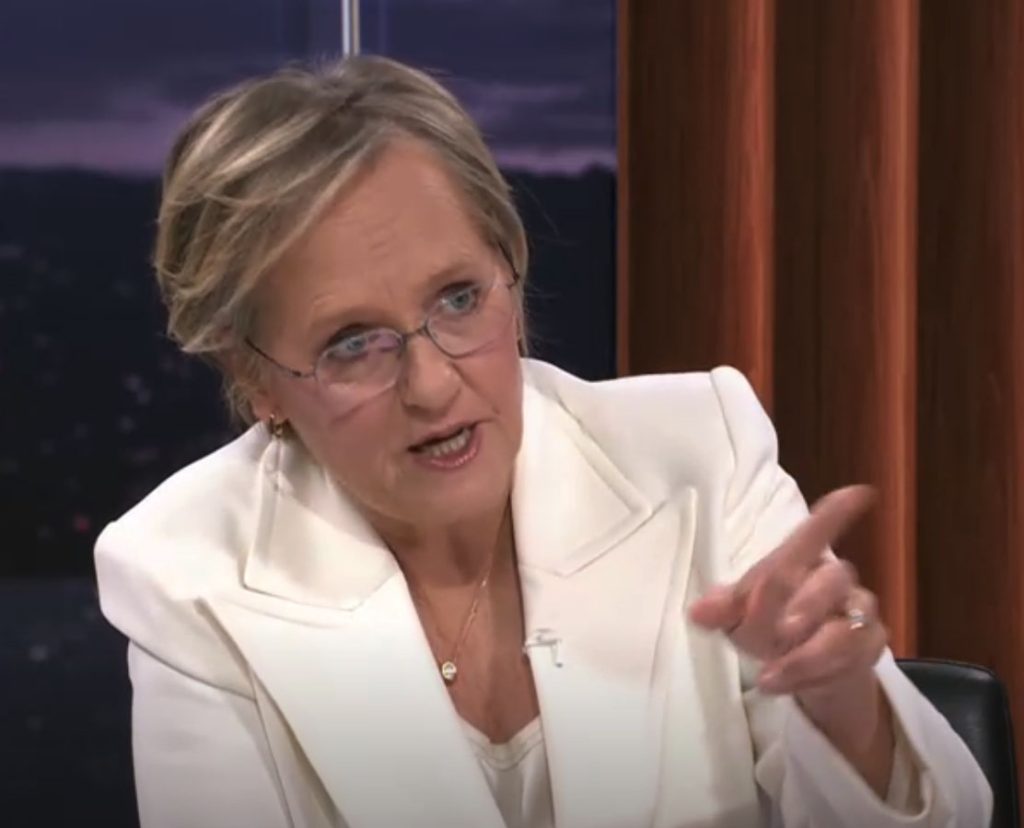
And then, as mentioned above, there is this angry, President Trump-like, pointed finger into the face of someone with whom you disagree. Just imagine what the left (especially the feminist left) would have said if, say, Andrew Bolt had pointed an angry finger at Julia Gillard during an interview when she was prime minister. But, according to ABC management, Comrade Ferguson is an excellent presenter. Can You Bear It?
Nine’s James Massola fantasises about the republic
On Insiders last Sunday, Nine’s national affairs editor James Massola fantasised about Australia becoming a republic during the Final Observations segment. This is what he had to say:
James Massola: I want to give a shout out to a poll that we ran in The Age and the SMH a day or so ago, looking at King Charles, Prince Andrew and the –
David Speers: Former Prince Andrew.
James Massola: Former Prince Andrew, I’m still – and just how significant it was. So, 43 per cent of Australians now support a republic. Only 28 per cent opposed. That’s like the biggest gap we’ve seen in in I think, well, as long as we’ve been polling in Resolve…So maybe Anthony Albanese was a bit hasty in getting rid of his Minister for the Republic.
David Speers: Oh, there you go. Good point.
What a load of absolute tosh. For a referendum in Australia to succeed, a “Yes” case needs to at least start at 70 per cent early in the debate. For example, in 2023 the “Yes” case for inserting an Indigenous voice to parliament commenced at 60 per cent in the polls but ended up at 40 per cent when the referendum was held. If support for a republic is, say, at 43 per cent at the start of a campaign – there is scant hope of the “Yes” case on the republic succeeding. James Massola is into wish-fulfillment. Can You Bear It?
[Quite so. Obviously Comrade Massola was using his Insiders appearance to put in a (free) plug for the Resolve Poll that appears in The Age and Sydney Morning Herald.
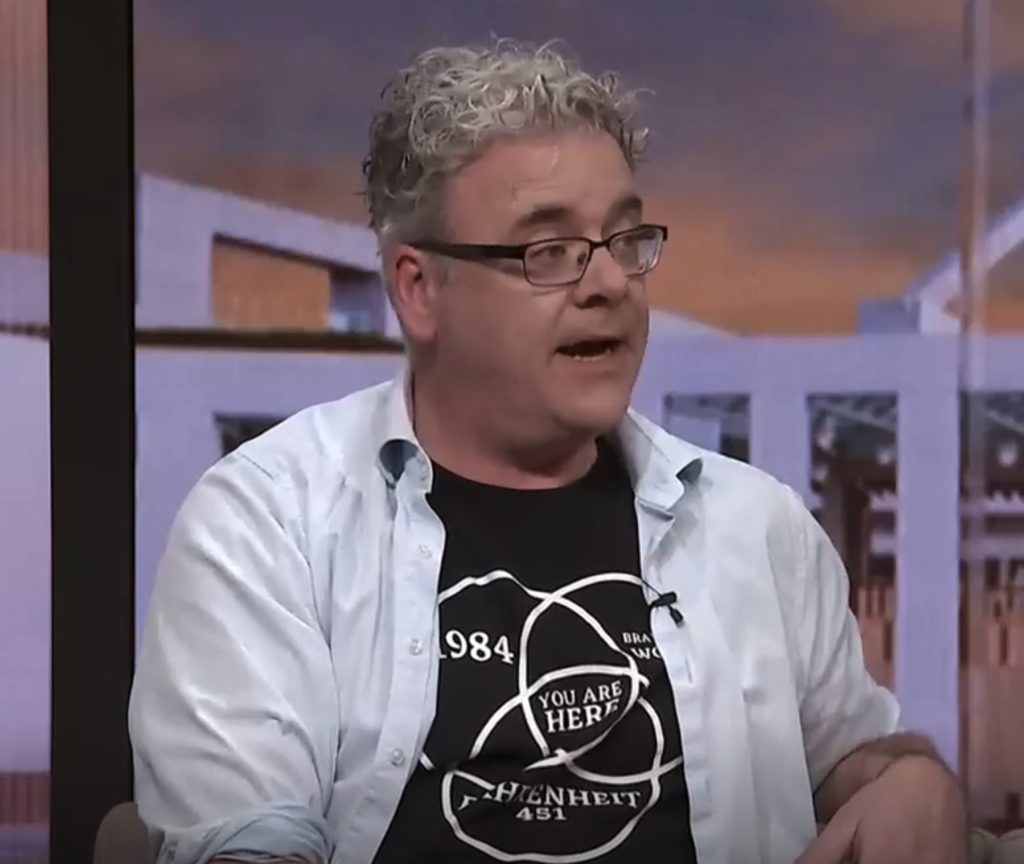
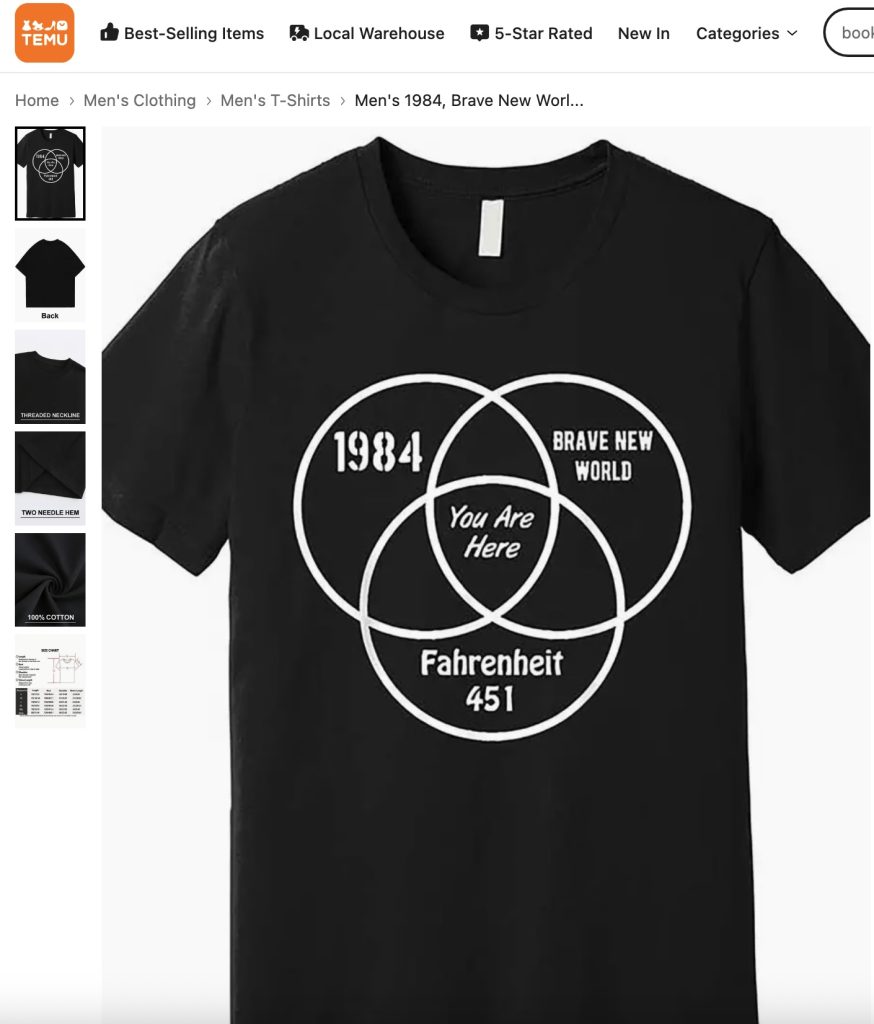
MWD notes that James Massola donned a shirt depicting a Venn diagram of George Orwell’s 1984, Aldous Huxley’s Brave New World and Ray Bradbury’s dystopian novel Fahrenheit 451 – the joke being that our current world is an overlap of multiple dystopian scenarios. Your man Massola thought this shirt was funny enough for Insiders. Perhaps he was hoping to receive compliments like “cool shirt dude” from young ABC employees. If any MWD readers are interested in owning this shirt, it is available on Temu and Amazon – or Walmart for our American fans.
Annabel’s Civic Duty is a conservative free zone
There was enormous interest in last week’s segment on Annabel Crabb’s ABC TV Civic Duty program – which is supposed to be about Australian democracy but managed to get Comrade Crabb a trip to the United States. By the way, she is both presenter and executive producer. In the first segment, Comrade Crabb found it necessary to travel to the Virginia/Tennessee border to learn about Australian democracy.
MWD will return to this topic next week – after watching the third program in this series.
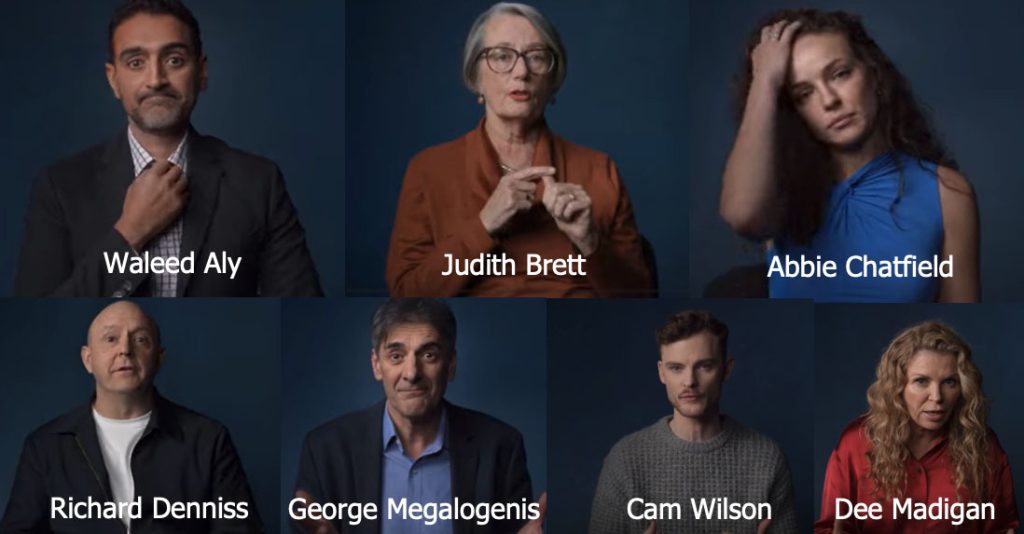
However, of special interest to MWD in Civic Duty, is the absence of conservative commentators. Comrade Crabb, who is an intellectually fashionable left-of-centre type, interviewed the following Australian commentators – Waleed Aly, Judith Brett, Abbie Chatfield, Richard Denniss, Dee Madigan, George Megalogenis, Jonathan Swan, Cam Wilson and Clare Wright. Not a conservative among that lot. It would seem that Dr Denniss (for a doctor he is) got his gig as part of the ABC/Australia Institute Axis.
In the second segment of Civic Duty (which aired last Monday), Annabel Crabb made it to Washington DC [Well done. MWD Editor]. There, for some reason or other, she interviewed the conservative Turning Point USA’s Monica Paige Baldwin. Let’s go to the transcript:
Annabel Crabb: But see you sound like a campaigner now, I saw yesterday when you were delivering questions to President Trump – he said: “Oh I love that question”.
Monica Paige Baldwin [to President Trump]: On the southern border, you’ve had record low numbers for the month of May. What do you attribute that success to?
Donald Trump: I like you. Who are you with?
Monica Paige Baldwin: Turning Point USA, sir.
Donald Trump: Very good Turning Point.
Annabel Crabb: The journalist in me goes, “Oh my God, that’s a disaster”, because I don’t want a politician ever to love a question that I ask them. So how does that work as a journalist for you?
Note that Foreign Affairs Minister Penny Wong seemed to love Annabel Crabb’s soft question which took place later in the program. Let’s go to the transcript:
Annabel Crabb: What has the disruption of reporting around politics in particular done to your ability to project and win political arguments?
Penny Wong: It’s made change harder….
This suggests that it’s okay to ask Senator Wong a question which she loves if you are a left-of-centre journalist – but not President Trump, if you are a conservative journalist. Can You Bear It?
Annabel Crabb only interviewed left-of-centre commentators for her Civic Duty program. Here they are.

ABC’s Linton Besser defends the ABC by inviting two ABC supporters to defend the ABC & excluding the opinion of any critics
Quelle Surprise! – as the saying goes. On 17 November long-time ABC journalist Linton Besser, who presents Media Watch on ABC TV, devoted the entire program to defending the ABC against criticism from Sky News presenter Chris Kenny of The Kenny Report.
What’s the difference between the ABC and Sky News? Well, the ABC is funded by compulsorily acquired taxes. In other words, Ellie’s (male) co-owner helps fund the taxpayer-funded public broadcaster. However, he voluntarily pays to subscribe to Sky News.
But Media Watch Dog digresses – once again. Guess what? In order to obtain support for Comrade Besser’s defence of his employer and mates against the criticisms of Chris Kenny, he went to two sources. “Name the names!” MWD hears avid readers cry.
Well, first up was Peter Meakin whom Comrade Besser described as “someone who spent decades as the director of news and current affairs variously for channels Seven, Nine and Ten”. Besser did not mention that Meakin’s last job at Ten involved supervision of The Project – a leftist dominated talk show that was junked this year due to its high cost and poor ratings.
And then, wait for it, Besser and his executive director sought an opinion from Margaret Simons, who was described as a journalist and academic. Well, she is both. But Comrade Simons is a left-wing academic journalist.
Let’s go to the transcript:
Linton Besser: Journalist and academic Margaret Simons, said vested interests “predictably … are trying to make [the BBC crisis] a strike against the ABC. They should chill. The ABC is certainly not perfect, but it has clean hands in this case.” – Email, Margaret Simons, Journalist and Academic, 14 November 2025.
How about that? Media Watch only reported the views of Peter Meakin and Margaret Simons. No critic of the ABC was heard. And Comrade Simons (in full headmaster/headmistress tone) told the ABC’s critics to “chill” in this instance. No other view was heard.
Then, later in the program, Besser evoked the view of Comrade Simons once again. Let’s go to the transcript as Media Watch ended on 17 November:
Linton Besser: So, what of the bigger picture? What lesson might Australia draw from the BBC crisis? Margaret Simons says it’s about protecting the ABC’s independence and not allowing its board to be stacked by ideologues:
Margaret Simons: There have [also] been times in the ABC’s past when its board has included political activists … hostile to the ABC … Public broadcasters deserve scrutiny, but should also be treated as a key national asset.
– Email, Margaret Simons, Journalist and Academic, 14 November 2025
Linton Besser: After the usual critics used the BBC blow up to turn their blowtorches on the ABC, we at Media Watch have not been able to forensically examine the entire output of the organisation on these three very big and very tricky areas of reporting. But notwithstanding the gaps in transgender coverage, from what we found there was nothing which might suggest, as The Australian did, that resignations might be called for at the ABC – not even close. Rather, it seems, this was a naked attempt to draw the ABC into a public broadcasting crisis 17,000 kilometres away, which smeared without foundation some of the ABC’s finest reporting.
This is (more) fake news. It is true that, over time, the likes of Richard Brunton, Michael Kroger, Janet Albrechtsen and Keith Windschuttle received a five year term on the ABC Board. Each took one position in a Board of around ten. None were “political activists”. Also, this quartet was not hostile to the ABC – they wanted a more balanced ABC.
Moreover, as Besser and Simons should know, the ABC Board does not determine the ABC programming. That’s the role of the managing director and editor-in-chief. Currently Hugh Marks – who is appointed by the Board.
As to Besser’s claim that ABC critics have been involved in a “naked attempt to draw the ABC into a public broadcasting crisis of 17,000 kilometres away” – well, that’s just hyperbole. How does anyone engage in a “naked attempt”? And here’s another question: Can You Bear It?
[I remember that in her book The Content Makers: Understanding the media in Australia, published in 2007, Margaret Simons stated that she had said in February 2006: “Rupert Murdoch will be dead soon”. However, two decades after Dr Simons’ (false) prophecy, Rupert Murdoch is still in our midst. Perhaps MWD’s avid readers would like to read more about this next week. Just a thought. – MWD Editor.]
A SNOBBISH MOMENT
Starring Nine’s Anthony Dennis
The date was 29 September 2025. It is easy to remember because on that morning Ellie’s (male) co-owner was awakened by a louder than usual noise as the printed newspapers landed on Ellie’s kennel. Why louder than usual? – avid Media Watch Dog readers might ask. Well, the SMH edition of that very day was covered by a four-page lift-out titled “Here’s to reason”.
Under the heading was printed: “Sydney is a city of many individual views and perspectives. But we all believe in reason”. Really? The lift-out was all dark – and contained white print on top of a black background. There were some photos of men and women standing in the dark looking ahead for no apparent reason. And there were individual hard-to-read pretentious comments by such SMH stars as Jacqueline Maley, Peter Hartcher, Jordan Baker and Kate McClymont advising readers (if readers there were) about how reasonable they are. Or something like that.
Why is MWD raising this now? – readers may well ask. Well, this comment is inspired by the editorial of Anthony Dennis in the 15 November issue of Traveller which is a section of Nine’s Sydney Morning Herald and The Age. Throwing the switch to unreasonable snobbery, Anthony (“The Traveller”) Dennis had this to say:
The spread of overtourism is making the differences between a traveller and a tourist more obvious and acute. The true traveller, it could be argued, is now more likely nowadays to be walking in the opposite direction of the archetypal tourist en route to a city’s tick-a-box sights, if only to give such over-visited sights some much-needed stress relief. Some obvious, over-trammelled attractions can include famous thoroughfares, including Paris’ Champs-Elysees and Barcelona’s Las Ramblas. Alternatives to these and others is the theme of this week’s cover story, “Streets wiser” by Kerry van der Jagt and Katrina Lobley.
Famous streets have become bywords, as our writers point out, not only for excessive crowds but also for petty crime, tourist touts, global brands and fast food outlets. So it’s better then to direct ourselves, and our attention, to those quieter, more authentic streets favoured by locals and canny travellers.
But if you still feel compelled to visit a Champs-Elysees or a Las Ramblas, do so early in the morning or late in the evening, when the tourists and touts are still in bed or have long gone.
How snobbish can a travel editor get? – you might ask.[Er, you just did. MWD Editor.] So there you have it. Your man Dennis regards himself as a traveller and looks down on mere tourists. Moreover, he advises readers of Nine’s Traveller section how to get away from the mere tourist mob, whom he has linked to “touts”, and other members of the hoi polloi. So it would seem that The Age and Sydney Morning Herald now equate travel (as distinct from tourism) with being considered and reasonable. How reasonable is that?
Verily, a (journalistic) Snobbish Moment – with SMH’s Anthony Dennis.
HISTORY CORNER
Malcolm Fraser’s “notoriously fallible” memory, the media & the Dismissal
There are two central criticisms of Governor-General Sir John Kerr’s action in dismissing Gough Whitlam, Labor government on 11 November 1975. Firstly, that Kerr did not consult Whitlam about his intentions to dismiss him. This is covered by Gerard Henderson in his article in The Weekend Australian on 15 November 2025 and in his book Malcolm Fraser: A Personal Reflection (Connor Court, 2025). Secondly, that in a phone call at around 10 am on 11 November 1975, Kerr effectively tipped off Fraser about his intention to dismiss Whitlam to the benefit of Fraser.
Paul Kelly is a fine political historian whose books include a number on the Dismissal. However, he has been a Kerr antagonist for half a century. Claire Harvey pointed this out in her article on Kelly in The Australian on 5 November. Kelly had this to say on Sky News’ The Dismissal: 50 Years On, which first aired on 11 November 2025:
Paul Kelly: This phone call at 9:55am on the morning of the 11th of November, when Kerr rings Fraser, is one of the epic events in the entire crisis. And we only found out about this many years later. The Governor-General calls Fraser and says, “I’d like to know, if you did receive a commission as prime minister, would you be prepared to recommend an election immediately? Would you be prepared to recommend a double dissolution election? Would you obtain supply immediately, and would you agree not to have any investigations into the record of the Whitlam government?”. And surprisingly, surprise, surprise, Malcolm Fraser says yes to every question. So, this is, this is an extraordinary phone call. It’s a call of betrayal. It’s a call made by the Governor-General betraying the Prime Minister and tipping off Malcolm Fraser that he’s likely to be commissioned as prime minister that very day.
Well, what is the evidence for this serious allegation? It’s pretty thin. Until 1987, it was understood that, on the morning of 11 November 1975, Kerr made two phone calls.
First up, Kerr called Whitlam and asked whether he was still intent on refusing to call an election for the House of Representatives (to resolve the blocking of supply by the Opposition) and still intent on advising a half-Senate election instead. The Prime Minister replied in the affirmative. As Kelly has always maintained, a half Senate election would not have resolved the problem.
Then, according to Kerr’s Matters for Judgment (Macmillan, 1978) he phoned the Opposition leader and asked whether the Opposition was still intent on blocking supply. To which, Fraser replied in the affirmative.
Subsequently, soon after midday at Government House, Kerr dismissed Whitlam and appointed Fraser as caretaker prime minister pending a double dissolution election on 13 December 1975. The Coalition won in a landslide.
All was relatively quiet on the Dismissal Front until the publication of Philip Ayres’ Malcolm Fraser: A Biography in 1987. Ayres wrote that, during the phone call after Fraser had confirmed the Opposition’s intention to continue to block supply, Kerr “proceeded to ask Fraser four questions…the answers to which Sir John needed to know before he dismissed the prime minister”. But did he? As Kelly indicated on the Sky News documentary, it was obvious that Fraser would say “yes” to every question. After all, Fraser had been advocating for months that the Whitlam government be dismissed if it did not advise an election – so he was not likely to say “no” to any such conditions. Therefore, Kerr’s questions did not need to be asked. However, Fraser told Ayres:
He [Kerr] can’t go to the end of the road with Whitlam and find that he’s got an unacceptable situation as far as I’m concerned. But he made it very plain in the conversation that no final decisions had been made, that all he was seeking to do was to clarify his own mind so that he would know as much as possible of the total situation before that decision was made. I don’t think that conversation has ever been written about.
Quite so. The conversation had never been written about before because Fraser had never said this before – and nor had anyone else. Fraser was going from his memory because, as he told Paul Kelly in 1995, he had misplaced the note. In view of this, it is likely that Fraser or Ayres consulted Kerr’s book to recall the conditions. The note turned up sometime after 1987 – and before Kelly’s new book November 1975 which was published by Allen & Unwin in 1995.
The actual note was first published as a photograph in Malcolm Fraser: The Political Memoirs (MUP, 2010) which Fraser co-wrote with the left-wing academic Margaret Simons. As I demonstrated on Sky News’ The Dismissal: 50 Years On – and in my Malcolm Fraser: A Personal Reflection – the writing at the top of the note is dramatically different from the signature, date and time at the bottom of the document. The document reads “9.55 11 Nov 1975” – but the “7” appears to be written over an “8”. Moreover, Fraser’s signature at the bottom seems to commence with a word beginning with “J” and is followed by a word commencing with a capital “F”, followed by a small “r”. Bear in mind that Fraser’s full name was John Malcolm Fraser.
And then there is the fact that the signature “Malcolm Fraser” on a censure motion dated 11 November 1975 is dramatically different from the signature on the back of the note. Both were (allegedly) written at around the same time on the same day. Likewise, Fraser’s signature on a formal letter when appointing a new minister on 12 November 1975. This has been provided by a MWD reader. See photo below.
The clear evidence is that, when he found the note sometime after 1987, Fraser backdated it to cover his phone call circa 10 am from Kerr on 11 November 1975.
As previously pointed out, Malcolm Fraser: The Political Memoir was co-authored by Fraser and Simons. The only part of the book written by Fraser alone is at Page 754. Dated 17 October 2009, Fraser wrote “Memories can be, as I know myself, notoriously fallible”.
Which raises the question. Why should the likes of Paul Kelly and Troy Bramston – in their co-authored book The Dismissal in the Queen’s Name (Viking, 2015) – and former Labor Senator John Faulkner among others believe someone who confesses to have a “notoriously fallible” memory?
The facts are as follows. Kerr had a contemporaneous note written on 16 November 1975, just after the Dismissal. Kerr’s handwritten note reads:
“…I decided on Sunday that if the leaders came to no agreement on Tuesday I would terminate Mr Whitlam’s commission immediately provided that he assured me that his position was the same and that he intended to continue to govern without supply. He told me he did. This happened by telephone just before the Remembrance Day ceremony. He said he would carry on and have half Senate election. I had expected this to happen because both sides had made their position clear publicly before the meeting. I rang Mr Fraser to find out whether it was true that they [Whitlam and Fraser] had got nowhere and whether it was the Opposition’s intention to continue to refuse Supply. His answer to both questions was “Yes”.
On 11 November 1987 Kerr issued a statement to Gerard Henderson in which he wrote: “This is the sole reference, in my notes of 16 November 1975, to the conversation between Mr Fraser and myself which took place on the telephone between 10 am and 10.30 am on the morning of 11 November 1975.”
Kerr’s note of 16 November 1975 is contemporaneous. As documented in Malcolm Fraser: A Personal Reflection, Simons told Henderson after a discussion with Fraser: “Malcolm put the time and date on the note later – he believes after the Joint Party Meeting that immediately followed the call”. That is, around 10.30 am on 11 November 1975. Simons’ email to Henderson, dated 23 February 2010, is published in Malcolm Fraser: A Personal Reflection.
Kerr wrote on 16 November 1975 about the events of 11 November 1975. Fraser’s note was dated 11 November – but the timing and date “9.55 11 Nov 1975” was clearly added later, probably in the late 1980s or maybe later. This is consistent with Kerr’s statement that Fraser’s note records their conversation at Government House after Whitlam was dismissed around 1.15 pm – and not during a phone call that occurred at around 10 am the same day.
Memory is highly fallible. Some individuals have good memories, some lie and some have clear “recollections” of events that never happened. Kelly and Bramston rely on the memory of Reg Withers and Vic Garland who were in Fraser’s office when Kerr phoned. They wrote that in 2015 “Garland was the only one of three Liberals in Fraser’s office who is still alive”. But Bob Ellicott (1927-2022) was also in the office and he told Gerard Henderson that the Kerr/Fraser phone call was too brief for Fraser to have taken notes.
Paul Kelly believes what Malcolm Fraser told him. But Malcolm Fraser had a “notoriously fallible” memory. And his book The Political Memoirs is literally scattered with serious errors along with an account of a meeting with (then) Vice-President George H.W. Bush which literally could not have happened – see Malcolm Fraser: A Personal Reflection. Fraser and Simons did not correct most of the errors in subsequent editions of The Political Memoirs including the false claim that Fraser won 4 elections – he won 3.
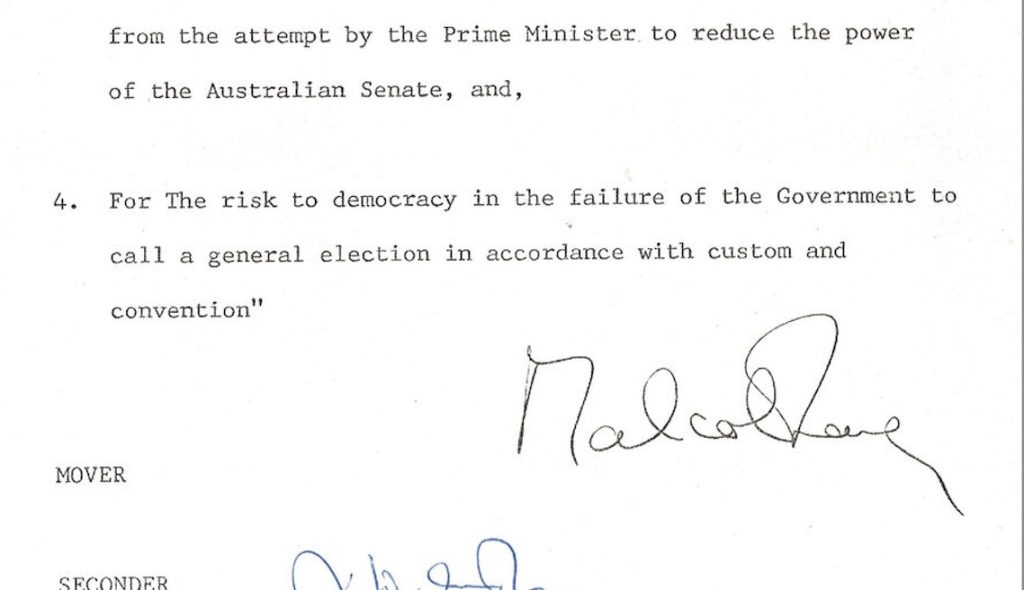
Fraser’s signature on a censure motion note which he dated as 9.55 am on 11 November 1975.
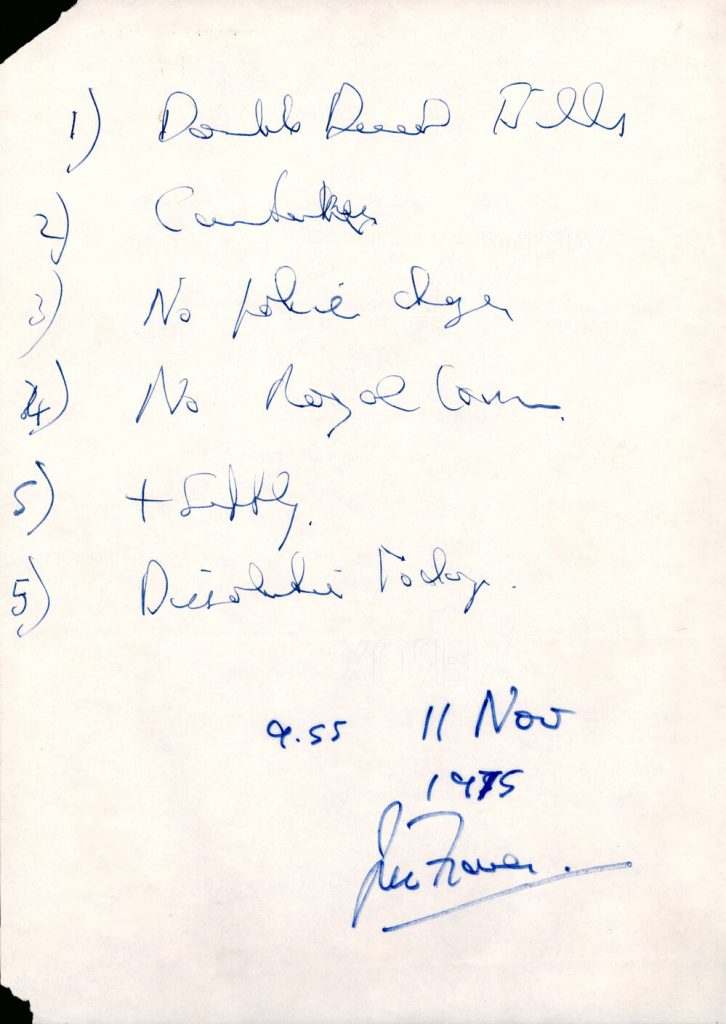
Fraser’s signature on a handwritten note which he dated as 9.55 am on 11 November 1975
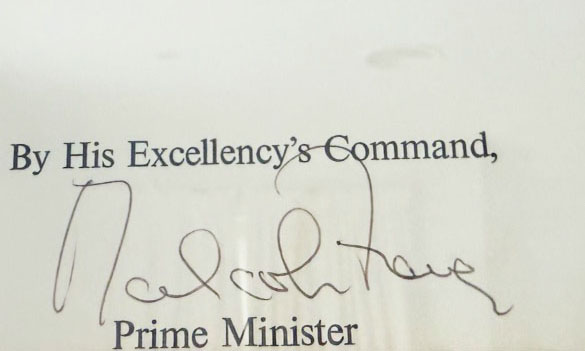
Fraser’s signature on a letter appointing a minister to his caretaker government dated 12 November 1975
* * * *
Until next time.
* * * *