
GERARD HENDERSON’S MEDIA WATCH DOG
ISSUE – NO. 782
10 July 2026
* * * *
The Latest – Sarah Ferguson fails to land a blow while interviewing a supporter of the Iranian regime
Can You Bear It? – Mark Kenny dismissed Angus Taylor’s criticism of Labor as “blah, blah, blah”; Niki Savva on Tony Abbott as “alleged” Liberal Party president; Sally Sara goes soft on the PM’s shag/marry/date moment
A John Lyons Moment – Comrade Lyons’ account of the start of the USA-Israel-Iran War is contradicted by Jonathan Swan
Top Media Interrupter of the Week – Patricia Karvelas spends 11 minutes of a 12-minute interview repeatedly asking Senator Sarah Henderson about calling 000
A Note to Avid Readers re Robert Menzies
Documentation – Andrew Dodd, Matthew Ricketson & David Marr on Rupert Murdoch
Correspondence – Gerard Henderson to Matthew Ricketson
* * * *
The Latest
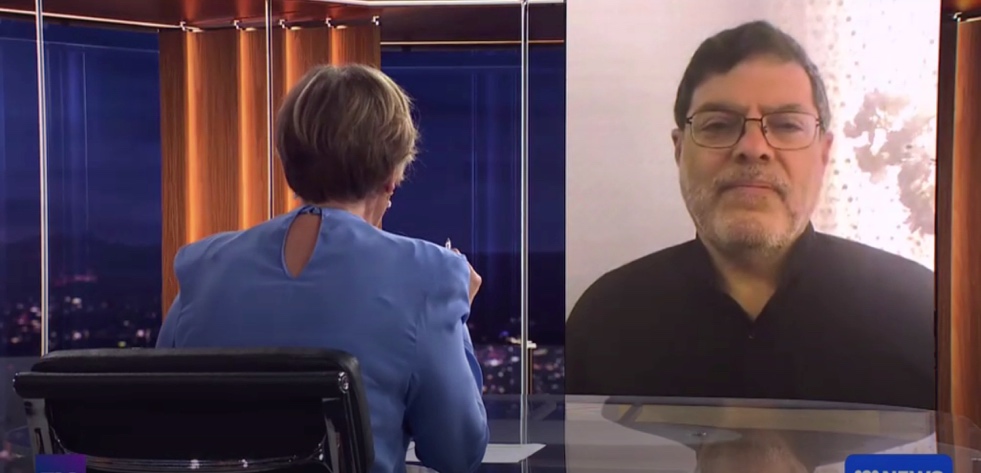
Sarah Ferguson fails to land a serious blow as supporter of the brutal Iranian dictatorship is allowed a rant on the ABC.
On Thursday 9 July, Sarah Ferguson interviewed Mohammad Marandi on the ABC TV 7.30 program. He was presented as a supporter of the Iranian leadership and a professor at the University of Tehran. It was a pre-recorded interview. So ABC executives made a conscious decision to show the interview, in full knowledge of its content.
Now if Marandi had been an Iranian-born critic of the United States, Israel and Australia that would be okay. But he is a vehement supporter of the Iranian regime – which includes the Islamic Revolutionary Guard Corps. The very regime which slaughtered unarmed protestors in Iran as recently as last January – children, women and men alike – and which fires missiles at its neighbours.
Comrade Ferguson made no reference to this. Instead, she focused on the fact that Iran is holding the rest of the world to ransom by preventing oil shipments passing through the Strait of Hormuz and the appalling state of the Iranian economy. It’s not so long ago that Ferguson interrupted Opposition leader Angus Taylor on 34 occasions during an interview. But there were few interruptions when the Islamic Revolutionary Guard Corps’ supporter railed against Israel, the US and Australia. Even though Ferguson said, politely, on one occasion: “If I may, that’s a long answer”. It sure was, and there was more to come.
In short, Ferguson allowed a supporter of the brutal Iranian regime – which is waging war not only on Israel but the Gulf states and even Jordan plus its own citizens – an opportunity to rant at length. In response, she hardly landed a blow. All this brought to you by the taxpayer-funded public broadcaster.

An emotive David Marr admits to his political prejudices – while the ANU’s Mark Kenny describes Angus Taylor’s criticism of the Labor government as “Blah, blah, blah”
ABC Radio National Late Night Live, presented by the left-of-centre David Marr, mainly invites left-wing commentators to cover politics in Australia, Britain and the United States. On Monday 6 July, David Marr interviewed Mark Kenny – currently an academic at the Australian National University, former staffer to a Labor Party socialist left MP in South Australia and former ABC and Sydney Morning Herald journalist. You get the picture.
Both men criticised the Liberal Party in general and its leader Angus Taylor and president Tony Abbott in particular. Comrade Kenny, at one stage dismissed the Opposition leader’s criticism of the Labor Party’s economic policy as “Blah, blah, blah”. Apparently, such phrases pass for sophisticated political analysis at the ANU.
It was not so long ago that the learned professor said that the Liberal Party should move to the left because it was losing votes to the “progressive” Teals. Now he’s saying that the Liberal Party should move to the left because it’s losing votes to the right-wing One Nation. Work that out if you can.
Comrade Kenny criticised former Liberal Party leader John Howard and Peter Dutton before fanging Angus Taylor for saying (allegedly) that the Liberals are a working class party. Which raises the question – What’s wrong with the workers? And another question – When did Mr Taylor say this?
And so the discussion on what Ellie’s (male) co-owner classifies as the ABC’s lack of viewpoint diversity – with David agreeing with Mark and Mark agreeing with David and David agreeing with himself.
At the end of the interview, discussion turned to Tony Abbott’s recent speech in London which was condemned by both comrades. This is how an emotional David Marr wrapped up the interview:
David Marr: But it’s strange. Because, you know, after that spray about Muslims and people who don’t share the Anglo-Celtic culture, he [Tony Abbott] delivered an aria about the beauties of immigration. It’s very strange. But Mark, I’m exhausted by laying out my own prejudices here from beginning to end. I mean, you’ve been lucky to get a word in edgewise, as far as I’m concerned. Thank you so much for joining us on the show.
Yes, it’s lotsa thanks to Comrade Kenny who, in fact, spoke at considerable length which would suggest that your man Marr was not listening to the ANU academic. [For a good reason, don’t you think? – MWD Editor.]
For the record, MWD does not mind David Marr laying out his own prejudices on Late Night Live. It’s just that he never seems to interview conservative commentators about Australian, British or American politics. This is yet another example of the lack of viewpoint diversity on the taxpayer-funded public broadcaster which is a conservative-free zone. Can You Bear It?
Nine’s Niki Savva refers to Tony Abbott as “allegedly” the Liberal Party president
Niki Savva writes a column for The Age and Sydney Morning Herald and appears regularly on ABC TV’s Insiders. This is what she had to say on the program last Sunday in her familiar mode as a Tony Abbott antagonist:
Niki Savva: .. you only have to look at what is happening at the moment inside the Liberal Party and outside it about One Nation. The federal president, allegedly, of the Liberal Party —
David Speers: Allegedly? Pretty sure he is the president.
Niki Savva: Hah, I’ll expand on that. Has said he is prepared to do deals with One Nation….
Comrade Savva is one of those Canberra-based journalists who believes that it’s okay for there to be a Liberal Party government – provided it is led by someone like Malcolm Turnbull. So her comments on Nine’s The Age and Sydney Morning Herald about Tony Abbott, Angus Taylor and the like were oh-so-predictable.
Sure, Savva dislikes Abbott with an intensity. However, it’s ridiculous for her to claim that Tony Abbott is “allegedly” Liberal Party president. At least Insiders’ presenter David Speers picked up this piece of hyperbole. But Comrade Savva did not present any evidence that Angus Taylor is “prepared to do deals with One Nation”. MWD is willing to publish next week any evidence that Savva can produce to support her assertion with written or oral evidence. In the meantime, Can You Bear It?
Sally Sara goes soft on Anthony Albanese’s shag/marry/date moment
There has been considerable comment, in certain sections of the media, about Prime Minister Anthony Albanese’s statement, when talking to a podcaster Nikki Osborne at The Lodge, that he would like to “shag, marry [and] date” Kylie Minogue. In that order, apparently.
Ellie’s [male] co-owner has been advised that the usual question with respect to members of the opposite sex is Shag/Marry/Kill. But Comrade Osborne was not likely to ask Australia’s prime minister who, out of the Kylie Minogue/Nicole Kidman/Rhona Burchmore trio he would kill. So she presented a softer alternative.
Now, as someone who was educated by the Christian Brothers at what is now called St Mary’s College in Sydney, it would have been somewhat less controversial if the Prime Minister had requested that the question be re-phrased to Date/Marry/Shag.
The story of the Osborne/Albanese podcast discussion first broke on News Corp’s tabloids – The Daily Telegraph, Herald Sun and Courier Mail on Saturday 4 July. The Prime Minister’s office issued an apology on the morning of Monday 6 July.
Moreover, the ABC and Nine Entertainment’s newspapers have gone soft on the Prime Minister – despite the fact that the Albanese/Osborne exchange has received international coverage. For example, The Age and Sydney Morning Herald did not report the story until Tuesday 7 July.
Deputy Prime Minister Richard Marles spoke for the government to ABC Radio National Breakfast on 6 July – shortly after the PM had issued a brief apology.
After an excerpt from the podcast, presenter Sally Sara asked two soft questions of the Deputy Prime Minister. First up, there was this:
Sally Sara: The Prime Minister’s office has released a statement this morning saying that the Prime Minister, quote, apologises unequivocally for those comments. Did he need to make an apology, in your view?….
Then, when Richard Marles said that the Albanese government has a good record with respect to women, there was this:
Sally Sara: In that way, if you’re talking about the government’s record, in your view, in that regard, does that make these comments out of place?
Richard Marles, as would be expected, responded in the negative. And that was it. After the Deputy Prime Minister’s response, the ABC presenter moved on. Can you imagine what a left-wing ABC feminist like Sally Sara would have said if such a comment shag/marry/date had been made by, say, Tony Abbott, Scott Morrison, Peter Dutton or Angus Taylor? And here’s another question: Can You Bear It?
A John Lyons Moment
John Lyons contradicted re Israel by Jonathan Swan
Avid readers will recall the controversy earlier this year, concerning comments made by ABC Americas editor John Lyons at the outset of the joint Israeli-United States military operation against Iran.
In a 1 March 2026 appearance on ABC TV News, Lyons accused Anthony Albanese and other members of the Australian government of spreading disinformation and propaganda re Iran. And he caused particular controversy by alleging that the decision to go to war was being “driven by Israel” and that President Donald Trump was being “played” by Israeli Prime Minister Benjamin Netanyahu.
These comments were widely criticised at the time, though predictably the ABC ombudsman found that there had been no breach of impartiality standards. Such is usually the case when the ABC investigates itself.
Listeners to ABC Radio National Breakfast on Thursday 9 July may have been surprised to hear a more nuanced account of the decision by President Trump to go to war.
Joining presenter Sally Sara on the program was Australian-born journalist Jonathan Swan (the son of ABC lifer Dr Norman Swan no less). Although originally from Sydney, Swan has long since relocated to Washington DC, where he currently reports on the second Trump administration for the New York Times. He has recently co-authored the book Regime Change: Inside the Imperial Presidency of Donald Trump (Simon and Schuster) with fellow Times reporter Maggie Haberman.
Haberman has a long history covering Trump, having joined the New York Times during the 2016 presidential campaign. For his part, Swan the Younger made international news for a contentious 2020 Axios interview with Trump at the height of the COVID pandemic.
Although Trump has claimed their book is “mostly made up, Fake News, mostly fiction”, Haberman and Swan are clearly both deeply knowledgeable about the inner working of the Trump White House. Certainly more familiar with the Trump administration than John Lyons, who had been serving as ABC Americas editor for around a year at the outset of the war.
Here is how Jonathan Swan described to Sally Sara on RN Breakfast the process by which Trump decided to launch a war against Iran:
Jonathan Swan: The Netanyahu episode was astonishing. You know, I’m not aware of a precedent for a foreign leader to come down to the White House Situation Room. Trump leaves his normal place at the head of the table, sits opposite him, and Netanyahu gives an audio-visual presentation, he’s got a screen behind him, he’s got the head of Mossad beaming in on the screen, generals. And he pitched Trump on this regime-change war.
But, you know, a lot of people read that scene in our reporting and come to, I think, a wrong conclusion. That I don’t think, if you read the full context of our reporting in the book, you don’t come away with. But this conclusion that Netanyahu kind of puppeteered Trump into this war. It’s true, Netanyahu campaigned very aggressively to draw America into the war and was very persuasive. It’s also true that Trump himself was much more hawkish on Iran, and has been for a long time, than many of his own team.
And what happened after that meeting is actually, in some ways, even more interesting. So, Netanyahu leaves, and overnight the CIA does an analysis of his presentation. And the presentation, you know, included like a video montage of potential future leaders of Iran, Reza Pahlavi, the son of the last Shah, Ahmadinejad. It had a scenario where the Kurds came across and helped overthrow the government.
Anyway, so the CIA comes back and gives their analysis, and the CIA Director, John Ratcliffe, the next day, tells Trump in the Situation Room that Netanyahu’s regime-change scenarios were direct quote “farcical”. And then [Secretary of State Marco] Rubio uses even stronger language, he says they’re bullshit.
And so, Trump absorbs all of this. It’s not like he wasn’t warned. He listened to all of this, and he said, you know, maybe they are, maybe they’re not, but he thought it was worth going ahead with the operation anyway. That it was worth trying. And at a very deep gut level, I think Trump, based on all the reporting that we have, all the people we’ve spoken to, Trump really seemed to believe that this would be a fast war. That Iran was a paper tiger, that they would collapse quickly, that all the scenarios he’d been warned about, the closing of the Strait of Hormuz, America running out of long-range weapons, none of that would bear out, because the war would be over so quickly.
So, it’s more nuanced. Bibi Netanyahu played a significant role, but so did Trump’s own hawkish instincts and his own hubris and overestimation of the capacity of the US and Israeli militaries.
So, there you have it. Even Jonathan Swan and Maggie Haberman of the New York Times, neither of whom profile as big fans of Donald Trump or Benjamin Netanyahu, disagree with the simplistic explanation offered up to ABC TV viewers by John Lyons. By the way, when Lyons was first appointed as ABC Americas editor he told ABC TV News Breakfast viewers that his job would be to “translate the Trump Presidency to an Australian audience”. It seems something got lost in translation.
As documented by MWD in the past, Lyons is a long-term strident critic of Israel and of Israel’s Jewish supporters in Australia. In his role as the public broadcaster’s Americas editor, he would better serve the audience by offering considered analysis, rather than rushing to judge Israel responsible.
Verily, A John Lyons Moment.
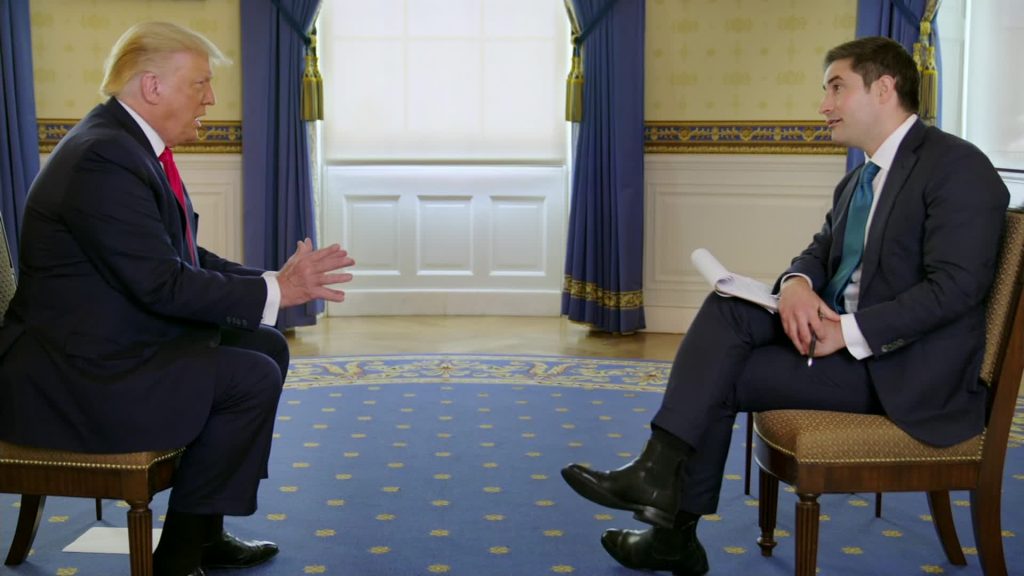
Jonathan Swan’s infamous interview with Trump for Axios in 2020

Patricia Karvelas – media interrupter of the week – following interview with Coalition front-bencher Sarah Henderson
On Wednesday 8 July, ABC TV Afternoon Briefing presenter Patricia Karvelas interviewed Sarah Henderson, the Opposition Shadow Minister for Communications, concerning the Telstra outage that morning.
The interview ran for 121/2 minutes – 11 minutes of which was focused on Karvelas’ opposition to the fact that Henderson had phoned the Triple Zero line to check whether the emergency call system was functioning.
Here’s how the interview commenced:
Patricia Karvelas: And Shadow Communications Minister Sarah Henderson is with me now. Welcome to the program.
Sarah Henderson: Patricia. Good afternoon.
Patricia Karvelas: You called Triple Zero during the outage twice. That’s an offence under the law. In fact, you could face jail time. Do you apologise?
Sarah Henderson: Well, Patricia, firstly, let me just say that’s an outrageous claim. The law relates to those who make hoax calls or vexatious calls….
Karvelas, in hostile mode, asked Henderson a dozen questions on the same topic – and received essentially the same response. The final two PK questions invited Henderson to criticise Opposition leader, Angus Taylor, for the comment that the outage might have been a cyberattack. Then, the interview ended. Next time, PK should interview herself.
[Good idea. I note that Comrade Karvelas seemed more interested in Senator Henderson’s behaviour on 7 July than in the carnage throughout much of Australia due to the Telstra outage. – MWD Editor.]
A Note to Avid Readers re Robert Menzies
There was considerable interest in last week’s item titled “In late 1939, Robert Menzies was a fighter against Nazi Germany not an appeaser”. This followed the comment by Labor frontbencher Pat Conroy that Liberal Party founder Robert Menzies was a “Nazi appeaser”.
MWD acknowledged that Menzies was an appeaser for a time in the 1930s. But added that so was Labor leader John Curtin. In the event, the Menzies government deployed Australian forces to fight Nazi Germany, fascist Italy and Vichy France in the Middle East, northern Africa and parts of South-West Europe. The Curtin opposition, on the other hand, opposed the deployment of the Second AIF to the Northern Hemisphere.
MWD readers have requested more information. This will be provided next week in a segment titled “The Australian left and the Second World War”. It was not the Labour Movement’s finest hour – especially in the years 1939-1941. Stay tuned.
Documentation
Professor Andrew Dodd and Matthew Ricketson talk to a somewhat sceptical David Marr about the Murdoched experience
There was enormous interest in last week’s Media Watch Dog segment titled “A Late Night Left Moment” featuring David Marr and two (learned) professors – to wit, Matthew Ricketson and Andrew Dodd. The reference was to the interview conducted by Lord David (“I’ve got a Pymble accent”) Marr concerning the co-authored book of the two academics on ABC Radio National’s Late Night Live. The date was 25 June. The book’s title is Getting Murdoched: How Murdoch’s Media Wields Power and Punishment (Hardie Grant (2026) – a Murdochphobia-driven rant authored by Ricketson and Dodd.
What MWD found so interesting was that the journalist Marr – a vehement critic of Rupert Murdoch – was more sympathetic to Murdoch than his two academic interviewees. Here are some examples:
• When Marr put it to the co-authors that “Murdoch is a genius”, Dodd replied, “Well, yes – we have given him that accolade, in a sense” for which he deserved “some credit in that he built a global media empire”. It was damning with faint praise – as the saying goes.
• When Marr suggested that “bullying media proprietors” are as old as the “printing press” and suggested that Murdoch was “just Beaverbrook Down Under”, Ricketson responded, in effect, that Murdoch was the bully-in-chief, unlike Lord Beaverbrook. Really.
• Then Marr suggested to Andrew Dodd that the co-authors seem to be arguing for some kind of legislative brake on the Murdoch Empire. Let’s go to the transcript:
David Marr: All right now, look, there’s an issue you raise in the book that troubles me a great deal. You seem to be arguing for some kind of legislative brake on the Murdoch Empire and its, and its strategies and ambitions. What kind of legislative regime, do you have in mind?
Andrew Dodd: Well, I think actually what we’re arguing is that that’s been very difficult to accomplish in the past, and that the Murdoch press pushed back so vehemently against it that the odds of that happening realistically are pretty small.
David Marr: Okay, but what is it that you can imagine protects free speech and makes a news empire the most controversial of all things fairer?
Matthew Ricketson: Well, that’s a very difficult question. I don’t think anyone has actually come up with a really strong answer. I don’t. I agree with Andrew.
How about that? Professor Dodd spoke about what he thinks he argues – suggesting that he doesn’t really know. And Professor Ricketson said that he agreed with Professor Dodd. How’s that for breaking news? A co-author agreed with his fellow co-author.
• Subsequently, David Marr urged his professorial comrades to praise ABC TV’s Media Watch program (which Marr once presented). They did so immediately. Quelle Surprise!
Then the following exchange took place:
David Marr: Matthew, we’ve got about a minute left. And I reckon we should give due praise to The Australian newspaper when it was first conceived and published, and the, and its role in transforming serious journalism for the better in this country.
Matthew Ricketson: Very, very happy to do that. I mean, I worked on the paper in the 1980s as you know, and I would agree with that. It has had some periods during its long history now where it has been a really good, strong national voice for debate and discussion. And I think one of the tragedies is that there, it’s now a kind of a broadsheet newspaper, primarily engaged in tabloid newspaper tactics, and that’s to the diminution of the newspaper, in my view, and also to all of us who read it and engage with it.
David Marr: And Andrew, would you agree with me that one thing [Murdoch’s] tabloid newspapers can give us are headlines that are fabulously clever.
Andrew Dodd: Yeah, it’s funny. I have this debate with others, and I’m not really enamoured by pun-written headlines. They just don’t –
David Marr: Not just puns, not just puns. I mean, I think they’re the source of the most astonishing public poetry a lot of the time.
Andrew Dodd: Sometimes they are. That’s true. Yeah look, if you need me to agree with you on that, David, I will, just for the sake of civility.
Matthew Ricketson: Can I, can I disagree with you on that, David.
David Marr: Matthew, please.
Matthew Ricketson: All right, you’re probably alluding, you’re trying to nudge us towards talking about the famous New York Post headline “Headless Body in Topless Bar”.
David Marr: It was pretty good.
Matthew Ricketson: Yeah, great headline. I would urge you and your listeners to go and track down the history of that headline, the kind of shenanigans that went on in the newsroom. Both to twist the story so that they could run the headline, and then a squabble in the newsroom. You’ll be surprised to hear that, about who would claim glory for it. And then go and look at the actual crime that was being described. It is gruesome and horrific, and it’s almost entirely absent from both the headline and the story.
David Marr: Was it a topless bar? Yes or no?
Matthew Ricketson: It was a topless bar.
David Marr: Was it a headless body? Yes or no?
Matthew Ricketson: Yes.
David Marr: Thank you, Matthew, for your contribution…
So, there you have it. Professor Dodd and Professor Ricketson do not believe that the headlines in such NewsCorp Australian newspapers as The Daily Telegraph, Herald-Sun, Adelaide Advertiser and The Mercury in Hobart plus the NT News in Darwin are sometimes very funny. Likewise their British and United States equivalents. As for the New York Post headline “Headless Body in Topless Bar” of recent memory, that was not really funny either to the professorial duo. How humourless can a pair of so-called progressive professors get?
* * * * *
MWD has glanced through Getting Murdoched. It’s so boring. No photos but just words in long paragraphs targeting Rupert Murdoch – to make the point that Murdoch’s newspapers target others. MWD’s favourite take from this oh-so-turgid work is Comrade Dodd’s account of his one experience with the News Corp’s executive chairman.
It turns out that Comrade Dodd once confronted Murdoch in the 1990s (no date supplied). Dodd related that when working for the taxpayer-funded public broadcaster, he attended a “lavish dinner” which Murdoch addressed, in one of Melbourne’s major hotels (no name supplied). Let your man Dodd take up his story:
I was given a seat at a table somewhere on the side to listen as he [Murdoch] told the audience about his company’s global successes. At the end of his talk, the MC asked for questions. I stood up and to my surprise was picked to ask the first one. I said, “I hope you won’t mind me asking you a tabloid question, Mr Murdoch. But then again, if there’s anyone in the world I can ask a tabloid question of it would be you”.
There was a collective intake of breath, I seem to remember, as about 300 people began paying close attention. I realised I had no option but to continue. “I would like to know how you respond to the playwright Dennis Potter, who recently named his cancer `Rupert’, because it seems to me that what he was saying was that you, more than anyone else on the face of the planet, have polluted the world’s media?”
I stood there, microphone in hand, before the attendant snatched it back, somewhat aghast at the words that had just come out of my mouth. The funny thing is that while three decades on I can still remember my question, I can’t recall the finer points of Murdoch’s answer. Perhaps I zoned out, mentally preparing my CV for an imminent career change.
Turn it up. Comrade Dodd in Getting Murdoched wrote with authority about a question he asked some three decades ago but was so “zoned out” that he “can’t recall the finer points of Murdoch’s answer”. Which raises the question: Can your man Dodd accurately recall the major points? It would appear that Dodd’s memory may relate to a speech made by Murdoch after 5 April 1994 – when Potter made the “Rupert” comment on Channel 4’s Without Walls program. Potter died soon after. MWD is not aware that Dodd’s recollection has been previously reported.
Needless to say, Dodd did not get fired by the ABC for criticising Murdoch. Perhaps he received a promotion. Moreover, later, when Dodd applied for a job at The Australian he saw fit to disclose the question he asked Murdoch in the 1990s. And, he got the job. Clearly, this was an occasion when to be “Murdoched” had a positive outcome for Comrade Dodd. Fancy that.
[Not really. By the way, to stay awake in order to read this co-authored literary sludge, I tried a Gin & Tonic plus a steroid. It worked for me. – MWD Editor.]

This overwhelmingly popular segment of Media Watch Dog usually works like this. Someone or other thinks it would be a you-beaut idea to write to Gerard Henderson AC (aka Always Courteous) about something or other. And Hendo, being a courteous and well-brought-up kind of guy, replies. Then, hey presto, the correspondence is published in MWD – much to the delight of its avid readers.
There are occasions, however, when (the late) Jackie’s (male) co-owner decides to write a polite note to someone or other but does not receive a response.
Nevertheless, publication of this one-sided correspondence still takes place in MWD. For the record – and in the public interest, of course.
Gerard Henderson to Matthew Ricketson
It’s as if there are not enough books bagging Rupert Murdoch and News Corp. How else to explain the recent effort by two former journalists and now university professors Andrew Dodd and Matthew Ricketson? They have just written a book published by Hardie Grant titled Getting Murdoched: How the Media Wields Power and Punishment.
Flipping through the tedious 414 pages of this tome, Gerard Henderson noticed that he received a mention. He sent off an email to Matthew Ricketson with whom he had correspondence previously. See MWD Issues 582 and 583. If there is a reply, MWD will let avid readers know. Now read on, S’il vous plaît.
Gerard Henderson to Matthew Ricketson – 8 July 2026
Good morning Professor Ricketson
As you may or may not know, I made reference to Getting Murdoched: How Murdoch’s Media Wields Power & Punishment (Hardie Grant, 2026) in my Media Watch Dog blog last Friday. I assume that you, or your co-author Professor Andrew Dodd, did read it since you devote a part of Chapter 8 of your book concerning MWD – along with some three endnotes (one of which is extremely long). By the way, it’s great to have avid readers of MWD, especially of the professorial kind.
On 3 July, there is a segment titled “A Late Night Left Moment”. Media Watch Dog commented on your claims (re The Australian’s columnist Janet Albrechtsen) made in an interview with David Marr on ABC Radio National Late Night Live on 25 June. See here. I made the point that you focused on one part of what Dr Albrechtsen had written about Brittany Higgins – but not the other part.
I regard this as poor scholarship coming from a professor of journalism at Deakin University (Ricketson) and a professor of communications at the University of Melbourne (Dodd).
On Page 143, you write with respect to Albrechtsen:
To the best of our knowledge she has still not given [Brittany] Higgins a right of reply. We gave Albrechtsen that opportunity but did not hear back from her.
An unpleasant double standard, to be sure. You criticise Albrechtsen for not taking the opportunity of a right of reply to your comments about her in Getting Murdoched. However, you did not offer any such opportunity to me to respond to your comments about me in your book. This in spite the fact that you have my (readily available) email address – having previously spoken at The Sydney Institute.
In response to what you wrote about me in Getting Murdoched, I make the following comments – along with some general points:
● You wrote this about ABC journalist Louise Milligan on Page 217:
… the work Milligan has now done, in two books as well as on television, on the issues of rape and child sexual abuse has been the subject of sustained attack by The Australian. The reports by Milligan that drew the newspaper’s ire concerned allegations that Cardinal George Pell had sexually abused young boys in the 1970s and 1990s….
In July 2016, 7.30 broadcast Milligan’s interview with men who complained of abuse by Pell. She followed up these disclosures with a book, Cardinal: The Rise and Fall of George Pell, which won a Walkley Award. The book was published six weeks before Pell was charged with historical child sexual offences against two teenage choirboys at St Patrick’s Cathedral in Melbourne in 1996….
As you know, the Walkley awards involve journalists voting for their journalistic colleagues. I do not take them all that seriously. If you have read my book Cardinal Pell, The Media Pile-On & Collective Guilt (Connor Court – third edition 2023) you would know that Milligan said this on the ABC TV News Breakfast program on 16 May 2017:
When I did the first story for 7.30 about the allegations, he [Cardinal Pell] came back the next day. And, you know, denied them all emphatically – you know, accused me of perverting the course of justice by collaborating with Victoria Police, which I have never done. And I stress that all of this [the case advanced in Cardinal] has come from the complainants’ point of view.
In other words, in 2017, Milligan did not claim that her book Cardinal was objective – rather she acknowledged that Cardinal was written from the complainants’ point of view. That is, Milligan’s argument was one of “a barrister who has a brief” – something which you condemned when talking about Janet Albrechtsen on Late Night Live on 25 June. Milligan’s role in arguing the case against Pell was that of an advocate engaged in activism – something which you ignore in your book. Instead, you quote her self-serving comment to you that her “work for Cardinal and the ABC was nuanced and meticulous”. So, you quoted, with approval, Milligan praising Milligan. Quelle Surprise!
• On Pages 166-167 of my Pell book, I list the names of some 140 journalists who took part in the media pile-on concerning Pell. Some 40, including Milligan, were ABC employees. Not one criticised anything I wrote nor sought a correction in the five years since the book was first published. I note in passing that you do not refer to my book in Getting Murdoched, thus depriving readers of being able to check for themselves what I wrote about Milligan and other journalists involved in the Pell pile-on.
As mentioned above, Milligan did not respond to any correspondence from me. She only took part in soft interviews with journalists, mainly on the ABC, and spoke at writers’ festivals in front of sympathetic audiences. Milligan was never involved in a debate on Pell with one of his supporters, or even with a neutral figure who was knowledgeable about the case. The latter could include someone like Melbourne Law School professor Jeremy Gans. On 14 January 2023, Professor Gans posted this about Milligan on X with respect to an article she wrote on Pell:
…It’s a recurrent problem with Milligan’s journalism. If there are facts that don’t help her argument, she doesn’t tell her readers. She just leaves them out.
The fact is that Milligan has never explained how Pell could have assaulted two boys immediately after a Solemn High Mass at St Patrick’s Cathedral in the presence of literally hundreds of parishioners/priests/altar servers/choir boys/tourists/locals etc. In her book Witness (Hachette, 2020), Milligan all but ignored the unanimous decision of the High Court of Australia in Pell v The Queen which quashed Pell’s conviction (in a second trial) of sexually assaulting two boys at St Patrick’s Cathedral – despite the fact that Pell was mentioned in a third of the chapters. Clearly, Milligan does not agree with the High Court’s decision – but she has never written a critique of it. She just believes what she wants to believe.
• In Getting Murdoched you had this to say:
An analysis of the ABC in late 2022 found that The Australian had mentioned Milligan in sixty-four articles in the past year. One of her fiercest critics is Gerard Henderson, who edits Media Watch Dog, writes regularly for The Australian and, like News Corp in general, is a trenchant critic of the ABC. An analysis of Media Watch Dog issues between 2010 and 2021 reveals all but one of many articles on the topic defend Pell and the church. Milligan discovered in 2019 that since her 2016 reports for 7.30 Henderson had mentioned her name – mostly in connection with Pell – in his columns 446 times, or about ten times a month.
This comment is misleading. I write every week for The Weekend Australian – not “regularly”. My weekly column is about 1,000 words. Media Watch Dog is not a “column” – as you assert. It is a blog of circa 5,000 to 8,000 words – which gives me plenty of words with which to discuss one of Australia’s most important criminal law cases. I would have published Milligan’s responses in MWD – but she never wrote to MWD to contest my views or correct alleged errors. However, she did abuse me online.
You focus on Milligan’s complaint that I mentioned her too many times. This overlooks the fact that, unlike Milligan, I have been de-platformed by the ABC. I only had recourse to the written word. Whereas Milligan had numerous interviews with her ABC comrades, along with appearances before adoring audiences at writers’ festivals. As well as presenting her views on such taxpayer-funded public broadcaster programs as 7.30 and Four Corners.
In your obsession with word counts you overlook one central fact. In time, it became evident that my views on the Pell Case were consistent with those of Justice Mark Weinberg KC in the Victorian Court of Appeal and all seven judges of the High Court of Australia in George Pell v The Queen. Weinberg KC was the most experienced criminal law judge in the Victorian Supreme Court at the time. Virginia Bell SC was the senior criminal law judge when the High Court of Australia heard George Pell v The Queen and acquitted him. All seven High Court judges stated that it was evident that there was a “significant possibility that an innocent person has been convicted”. This was an unusually strong statement by the High Court in a criminal law case – which rarely refers to “innocence” when overturning a conviction.
By the way, retired High Court judge Michael Kirby AC CMG had this to say about Cardinal Pell, The Media Pile-On & Collective Guilt:
A very good read. Even if one did not study more than the time interval taken to cross the Cathedral, a very serious doubt was raised as to Cardinal Pell’s guilt. Thank you for writing this book. It is an important contribution to the efforts to establish a Criminal Cases Review Commission – as in the United Kingdom, New Zealand and Canada. Effective protections against miscarriages of justice in Australia must be there for all serious cases, even for a cardinal.
• On Page 219, you write this re the Royal Commission into Institutional Responses to Child Sexual Abuse:
The next month [after Pell’s acquittal], the redacted sections of the royal commission’s report were released, and they were scathing of Pell’s behaviour, finding that he had either known about or should have known about a number of priests accused of child sexual abuse, and had done nothing about them. Pell’s dismissal of its findings are reported prominently in The Australian. Since then, the newspaper has barely mentioned the redacted report even as it has intensified its attacks on Milligan. It should be mentioned, because Pell’s response to clerical child sexual abuse allegations is as important as allegations against him as an individual.
The fact is that the Royal Commission produced no documentary or witness evidence that Pell had known, or should have known, about a number of priests committing acts of child sexual abuse and took no action. Rather, the Royal Commission found that Pell’s evidence was, variously “implausible”, “unlikely”, “not tenable”, “inconceivable” and so on. And that Pell “could” or “should” have done something or other. These are opinions only, unsupported by evidence – because there was no evidence. Also, the Royal Commission’s findings contain errors and contradictions with respect to Pell. These are documented in my book.
• On Pages 219-220 your comment continued:
Pell’s response is emblematic of how the Catholic Church as an institution dealt with the issue. The royal commission conducted more than 8000 private sessions with people who said they had been abused in institutions, including schools and the Australian Defence Force, and found 62 per cent of them had been in Catholic institutions. Milligan’s Cardinal had detailed Pell’s response to complaints and reported the harrowing accounts of victim-survivors in those cases. The royal commission also acknowledged the low conviction rates in child sexual abuse cases….
This statement is hopelessly wrong. When Pell was appointed Archbishop of Melbourne in 1996, this was the first occasion on which he had authority with respect to an archdiocese or diocese. As documented in my book, Pell set up The Melbourne Response in late 1996 to deal with child sexual abuse by clergy and a number of Catholic priests were stood down.
Clerical child abuse in the Melbourne Catholic Archdiocese effectively ceased from that date. By the way, it took the Victorian Government a quarter of a century after 1996 to set up an inquiry into sexual abuse of children by adults within government schools.
Also, the 62 per cent figure referred by you covers only religious institutions – not secular ones (such as the Australian Defence Force). What the statistics demonstrated was that 62 per cent of all cases of historical child abuse in religious institutions were in Catholic institutions. However, at the time of offending, around 80 per cent of all religious institutions would have been Catholic. This suggests that children in Catholic religious institutions were safer than those in non-Catholic religious institutions. As you should be aware, between the early 1960s and late 1970s, when most of the clerical abuse took place, the Catholic Church ran its own school system. This was not the case with other religious institutions.
By the way, the Royal Commission did not undertake a case study with respect to pedophilia within government schools. Not one. In recent years evidence has emerged of widespread cases of pedophilia in government schools – especially in Victoria, Tasmania and more recently Western Australia.
Conclusion
I will cover other parts of Getting Murdoched in my Media Watch Dog blog in future issues. A case study of Chapter 8 indicates that it is the work of two taxpayer-subsidised academics who have done selective research and failed to live up to their own standards with respect to contacting people about whom they are writing or to checking facts.
Best wishes
Gerard Henderson
PS: I am surprised that you have apparently fallen for Louise Milligan’s claims that her work was criticised by me and others because she is anti-Catholic, a former journalist with The Australian, a woman, etc. I criticised her on the poor quality of her journalism and her tendency to believe what she wants to believe. What’s wrong with that?
I also note that, towards the end of this segment in which I am mentioned, you refer to Louise Milligan having been “vindicated” by an adjudication of the Australian Press Council dated 8 June 2021. You fail to mention that the APC’s finding – with respect to Milligan – made no reference to Cardinal Pell or to myself.
****
Until Next Time.
****