
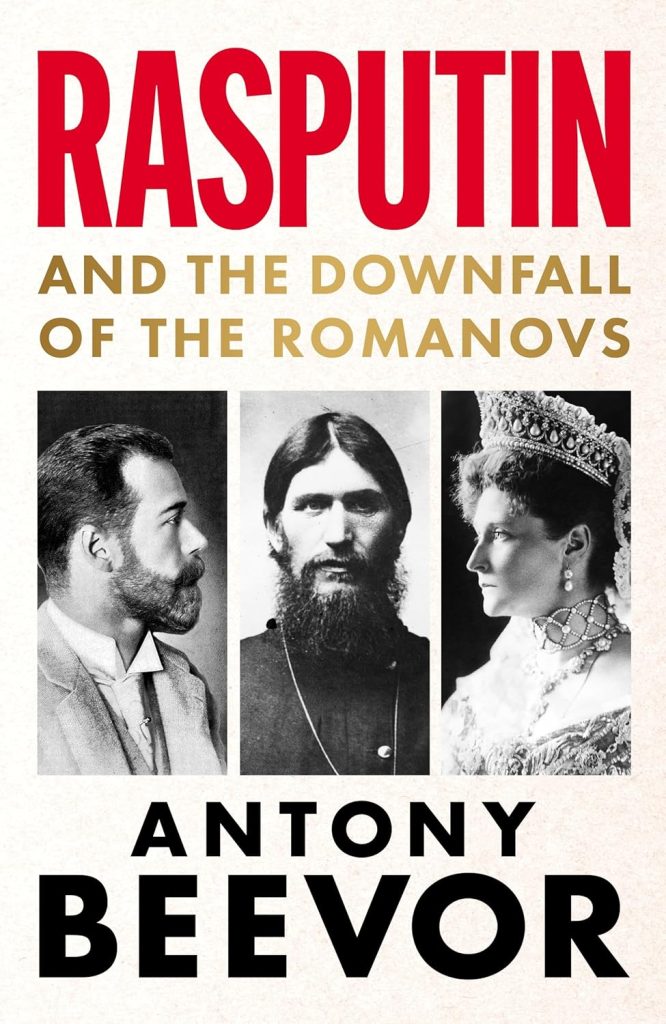
 MYTH AND HISTORY – SEEKING THE END OF THE TZARS
RASPUTIN AND THE DOWNFALL OF THE ROMANOVS
By Antony Beevor
Weidenfeld & Nicolson 2026
ISBN- 978 1 3996 1762 8
RRP: $55 (HB)
By Anne Henderson
Increasingly stories and events of the past are being rewritten or revamped as the modern era of 24/7 media drains our imagination for fresh ideas. Déjà vu is the mood of today. We have heard it all before.
So it is that renowned historian Antony Beevor (author of Russia: Revolution and Civil War, 1917—1921) has now offered his own retelling of Russian history’s most significant upheaval in his recently released Rasputin and The Downfall of the Romanovs. The history behind the end of the Russian royal family and the beginning of the murderous turmoil that engulfed Russia for decades after.
Beevor’s challenge is to retell a history, so much written and rewritten, in a way that it is captured anew. And he does, with his meticulous research, his pace setting prose and the myriad of characters drawn as engaging as any dramatic work of fiction. There is a TV series in this book.
Rasputin and The Downfall of the Romanovs takes a behind-the-scenes perspective getting up close and personal among the dissipated court of the last Tsar, his aristocratic circles, the Tzarista and so many inbred families and, not least, the mysterious, corrupt charlatan at the centre of imperial relations in the decade before 1917 – Grigori Rasputin.
In his introduction, Beevor queries the role of Rasputin in the fall of the Romanovs, pointing to the weakening authority of the Tzar and his regime even before Rasputin arrived on the scene. In fact, it could be argued that Rasputin was a symptom rather than a cause of the end of the Romanovs. Beevor writes:
The imperial officer corps was so demoralised by the exaggerated accounts of political and financial corruption, to say nothing of the totally untrue stories of Rasputin’s debauchery with the Empress and even her daughters, that when the February Revolution broke out in 1917 hardly a single sword was raised in defence of the Tsar.
As historian, Beevor is also fascinated by the way events are pushed along not just by real causes but also by rumour and conspiracy. His mission is to get to the facts and expose fictitious gossip and fraudulent self-promotion: “The myths and the lies which swirled around him [Rasputin] were the fake news of their day. Rasputin himself was partly responsible for them through boasting of his connections with the imperial family … rumour and conspiracy theories can produce more powerful effects than reality.”
For all that, the effect on the imperial family of the Tsarista’s eventual emotional reliance on the imagined powers of a fraudulent holy man in Rasputin was to prove disastrous – whether a symptom or a cause of the collapse of the Romanovs. Beevor’s rich tapestry of the Russian imperial court and its machinations, in the last years of the reign of Tsar Nicholas II and his empress Alix of Hesse, is forensic in its search for how such a powerful dynasty came crashing to an end.
Alix of Hesse, a grand daughter of Queen Victoria, came to the imperial court of Russia as Nicholas’ bride in late 1894. They were second cousins and the marriage a love match. While, initially, Alix had hesitated to agree to marry Nicholas on account of her need to give up her Lutheran religion, very quickly as a member of the Russian Orthodox Church, Alix became more devoted to that faith than any Russian. Religion was her guide in all things.
Alix’s faith in the official Russian religion, however, was set against a backdrop of a vast country of superstition and myth. Her close friend Lili Dehn would in time describe Russia and its people as “a race apart, our country is one of extreme mysticism and superstition. It is a land of miracles, where holy pictures are believed to shed tears”.
In this environment, numerous alternative religious sects had spread with wandering preachers gathering in followers. Many were believed to have special healing powers. Writes Beevor, “No Christian country had as many religious sects as Russia, largely because of the savage attempts of Ivan the Terrible and Peter the Great to bring their reluctant subjects to heel.” Within this backdrop, the imperial court would be introduced to a holy man who would in time convince the imperial couple that he had powers of healing for their only son and youngest child Alexei who was born with haemophilia. Rasputin’s increasing influence at court after 1905, was at first dismissed by senior officials since the best of fashionable Russian homes had their personal mystic. As Beevor writes: “Mysticism had completely taken over Russian society.”
Rasputin, born in 1869, grew up and married in the village of Pokrovskoe in Siberia. The couple had three children. At around the age of 30, Rasputin had a vision while ploughing his fields and became a wandering holy man, his wife Praskovya providing him with a pouch of simple food for the journey. He had come under the influence of a hermit who urged the illiterate peasant to learn to read and study the scriptures. Rasputin would touch base occasionally with his family in the years that followed but for the rest of his life he would wander. Eventually he did so with the patronage of the imperial couple, becoming a notable, if controversial, figure at court.
Beevor deals with the reign of Nicholas II as a description and analysis of an autocratic regent matched with an increasingly involved and imperious wife. Alongside this, Beevor regales the connections, personalities and malcontents that surrounded the royal couple. Alix clearly took on her role with aplomb, ostentatiously displaying herself heavily bejewelled from the vast Romanov collection. Her display of grandeur was evident even during the couple’s visit to Balmoral to visit Queen Victoria to show off baby Olga their first born. “Now, Alix, don’t get too proud,” murmured Victoria as she noted how her favourite grand daughter had become so self-important. This hauteur would soon make enemies in St Petersburg.
It is in dealing with the increasing debauchery and notoriety of Rasputin, however, that Beevor gets to the heart of the destructive forces at work in imperial Russia prior to the 1917 revolution. Rasputin was an explosive mix of seduction and influence all in the cause of his own empowerment. His personal habits were often grotesque, his semblance of a holy man a mask, his drunken exploits excused while being the height of hypocrisy considering his religious demeanour and his bawdy and licentious use of women not just vulgar but hugely damning for the imperial family. Beevor slaps it onto the page alongside the scenes of adoration for Rasputin felt by significant women, including the Tsarista’s closest friends. Meanwhile, a number of palace insiders saw an urgent need to eliminate this horrendous monk. Gossip was on fire.
In the midst of the development of such an autocratic and closed off aristocratic bubble, Russia underwent a war with Japan that delivered a disastrous defeat. The great European power was humiliated by a far eastern alien. Immediately after, in 1905, riots, civil disruption, mass protests and a violent increase in anti-Semitism forced Nicholas II to agree to a Duma of representatives from across the empire. The body would be entirely advisory and meet very rarely. Even so, after he signed the manifesto, the Tsar broke down in tears.
The stage, then, was set for tragedy as an increasingly autocratic Nicholas II, surrounded by an indulgent and even treacherous court, came more and more to lean on his empress who became ever more dependent on her holy man Rasputin. Added to this was the faith the empress had in Rasputin’s power to heal her sickly son Alexei. Beevor’s task is to add flesh onto these bones of human weakness and historical drama.
It is Beevor’s conclusion that “the myths surrounding Rasputin had as great an effect on Russian history as the facts of unfolding events”. Among unfolding events was the disastrous failure of Russian forces to sustain their part on the eastern front in World War I. At the imperial palace, surrounded by jostling egos, Nicholas II would often be persuaded by advice from his wife which in turn she would have relayed from Rasputin.
In August 1915, after listening to his wife, Nicholas took command of all land and naval forces and removed the Grand Duke Nikolai Nikolaevich to viceroy of the Caucasus. Immediately, rumours went wild that the Grand Duke had been killed. And the Empress and Rasputin were to blame. Such was Alix’s interference from then on in decision making with the Tsar, he often avoided her presence to help silence his critics. As the war dragged on with huge losses to the Russian forces, opposition to the Tsar grew.
Inevitably, Beevor must cover the assassination of Rasputin on 16 December 1916 in St Petersburg. Here the tale is a wonderful mixture of incompetence and unexpected comedy for those hearing the tale, albeit ending in the body of Rasputin being tossed from the Petrovsky Bridge into the frozen river. In spite of being a meticulously plotted scheme, to be carried out late at night at the home of Prince Yusupov, the attempts to kill Rasputin came very close to failure. At one point, shooting Prince Yusupov’s borzoi wolfhound in the snow there was an idiotic attempt to cover the blood of the victim with that of the wolfhound. Poison and a bullet failed to kill Rasputin until Yusupov battered Rasputin’s head with an Indian club coated in rubber.
As if to complete the story of a night of aristocratic bumbling, Beevor writes:
The Grand Duke [Dimitry Pavlovich] stayed by his automobile while the others lifted the bundled corpse and carried it onto the bridge. They balanced it on the parapet above the hole in the ice then pushed it. A few moments after the dull splash they remembered that they had forgotten to attach the weights and chains to drag the corpse to the bottom of the river. There seemed nothing else to do but throw them in after the body along with Rasputin’s fur coat, as well as one of his boots.
Rasputin’s body would resurface and be buried in a small church just south of St Petersburg. His presence in history would haunt the legacy of the last Romanovs. For Beevor, his demise would herald the end of the Russian dynasty. For all that, Beevor’s meticulous search for the truth of Rasputin’s part in the family’s fall suggests that he was more a symptom than a cause, even as he played a huge role at the end.
Anne Henderson is Deputy Director of The Sydney Institute and author of Menzies at War, which was shortlisted for the 2015 Prime Minister’s Award for Australian History.