
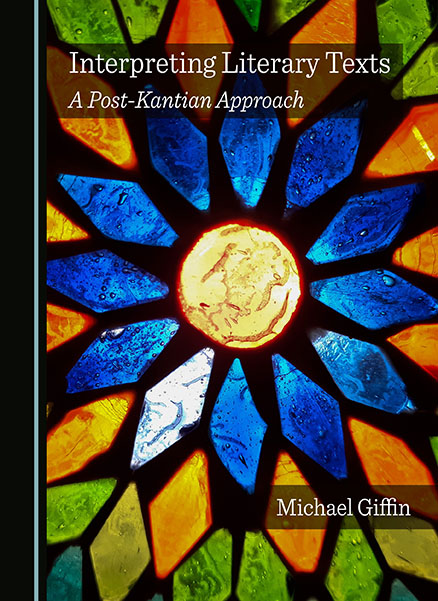
 TAKING ON THE MASTERS OF CRITICAL THEORY IN LITERATURE
INTERPRETING LITERARY TEXTS – A POST-KANTIAN VIEW
By Michael Giffin
Cambridge Scholars Publishing 2024
ISBN: 978 1 0364 1050 6
RRP: £69.99 (HB)
Reviewed by Anne Henderson
Scholars continue to debate the impact of German Enlightenment philosopher Immanuel Kant (1724-1804) on the way we see ourselves, our civil society and groundbreaking works of art. So, it is refreshing to now have Michael Giffin’s Interpreting Literary Texts – A Post-Kantian View which offers a deeply analysed yet most accessible analysis of literary works from Jane Austen to Margaret Attwood and Graham Greene, along the way discussing William Wordsworth, Samuel Taylor Coleridge, George Eliot and Patrick White among others, in a post-Kantian mindset where determinant moral codes face off against the freedom of the human mind. This book should be standard reading for all undergraduates studying Western literature, its genres and some of its iconic writers since the eighteenth century.
Giffin is empirical in his analysis rather than didactic leaving his readers to make up their own minds in any understanding of the writers/texts examined. He surveys and considers numerous literary critics’ assessments offering a range of opinions of the works considered. It is a sumptuous offering, engaging and challenging. He makes clear in the introduction how interpreting texts is about power and control – the critics are the “gatekeepers of whatever is hegemonic at the time”.
One example Giffin chooses is Eve Sedgwick’s essay “Jane Austen and the Masturbating Girl”, which he uses to illustrate how modern readings in the context of contemporary debate and sexual liberation jar with the context in which an author created works in earlier generations. Sedgwick imposes a context that did not exist in Austen’s consciousness. As Giffin puts it:
Interpreting texts is not about making the text mean what the reader wants it to mean … Sedgwick lives in a world that, having experienced the sexual revolution, believes anyone can do anything – sexually – without negative consequences for self, family or society. Austen did not live that world.
In considering interpretations of E M Forster, Giffin examines how Forster’s representations of India in the 1920s are not seriously political as they might have been if set in the later years towards Indian independence. To see Forster as remiss in his presentations of characters in his pre revolutionary India is not to find his creations in any sense flawed. He is not – as Edward Said opines – “evasive and patronising”. He is doing what he does in Howard’s End – simply producing a world as he saw it where individuals fail, for numerous different reasons from class to ethnicity, to connect.
Writes Giffin: “We overlook Forster’s relevance if we blame him – as a dead white male – for our inability to read closely.” As Giffin explains, in a close reading of A Passage to India, Forster interrogates Christian, Muslim and Hindu horizons as he understood them. The Said/Sedgwick interpretations of Austen and Forster respectively are what Giffin finds to be “prejudices”. Others clearly do not agree and it is left to a reader to decide. But, for Giffin, such critics have spun their interpretations to suggest the two writers are complicit in crimes – Forster for the “crime” of colonialism and Austen for heterosexuality.
Giffin’s book is strictly divided into sections for discussion of interpretations made of various works under six headings – classical, romantic, modern, post-modern along with a section on two Catholic authors – Graham Greene and Muriel Spark – followed by a section on two Protestant writers – Marilynne Robinson and Douglas Wilson.
As the sole representative of Giffin’s classical section, Jane Austen is examined with a particular question in mind – “whether the contemporary tension between what is socially constructed and what is biologically determined ought to be projected onto Austen”. Giffin considers Austen’s use of dramatic structure and the hero concept before closely considering interpretations of her six major novels. Giffin notes that Austen can be compared with Shakespeare in that both influenced how the dramatic arts developed. Austen’s structure is paramount in her novels, and Giffin notes that while Camille Paglia’s notion of feminism as exceeding its proper mission is derived from Friedrich Nietzsche, Austen’s notions of female power are derived from Aristotle. He writes: “In an Austen novel, the denouement (resolution) depends on both male and female protagonists achieving a proper balance of reason and feeling on which a proper perspective of the structure of reality and the nature of truth depends.”
In his examination of interpretations of various romantic streams, Giffin looks at critics Camille Paglia, Andrew Klavan, Isiah Berlin and the work of Mary Shelley and Robertson Davies. For Paglia, romanticism is a sexual metanarrative, for Klavan it is a Judeo-Christian attitude to logos as in reason, word and account and for Berlin it is a denial of all truth. Looking at Klavan’s approach to the work of Wordsworth, Giffin analyses how he develops a theory that Wordsworth matured in his writing and in his drive to become the new Milton creating a rival to Paradise Lost. For Klavan, when semi-atheist Wordsworth met devout Christian Samuel Taylor Coleridge, these two writers “began to reconstruct the moral imagination of the West”.
As the sole writer examined in the chapter designated as modern, Patrick White can be seen as something of a conundrum with Giffin offering a forensic investigation into the interpretation of his work, that of his critics and his legacy. Beginning with the idea that existentialism very much frames the modern – the notion that God is dead – Giffin immediately notes that for Patrick White “God exists and life has telos [an end or fulfilment].” Giffin writes of White’s maturing themes:
With the success of The Tree of Man and Voss, he [White] was now an ambiguous public figure in the broader ambiguity of Australia’s national consciousness, the focus of contradictory expectations he could not possibly meet.
In analysing White’s novels, Giffin concludes that too often a focus on his work relies too much on him as the artist than on his art in general. There is a contest in examining White between seeing his work as part of the shock of the new while it also exhibits a romantic modern style. Reflecting on White’s 1973 Nobel Prize for Literature and its citation that his work had “introduced a new continent into literature, Giffin writes: “What is this new continent in literature? Is it a new way of thinking about national identity, human nature, the human condition? If White holds up a mirror, what does it reflect?”
Then there is the question of White’s homosexuality and how it has been misused in reflecting on his art. Giffin takes exception to the different ways critics have handled this from Leonie Kramer’s antagonism to those who transformed “the vice of homosexuality into the virtue of queerness”. In fact, White’s work has long since suffered from the analyses produced by Cultural Marxism in contemporary times, with his writing being judged against trends that move the idea of a national identity to the dictates of the “victim/oppressor” mentality – “White’s texts were only of interest insofar as they reveal the sins of sexual repression and the crimes of British colonialism.” Giffin quite obviously disagrees.
With Margaret Attwood and a consideration of post-modernism, Giffin is in his element. The real Attwood is not what she creates – her creations are women who are victims, their identity continually undetermined. In her Handmaiden’s Tale, she reverses Islamic fundamentalism to Christian conservatism in a familiar attack on Western culture. Giffin sees her identifying as a sharman – preaching/teaching on female perspectives, offering her own priesthood in a godless world. Giffin concludes: “Attwood is now fixed in the public mind as the author of female victimhood par excellence, a feminist linked with identity politics, an activist in the culture wars.” As master, she has influenced a generation or two of young women readers. Giffin writes:
Stories with moral messages about female identity require a villain who prevents women from realising their full potential. In the West the villain is always the trope of Christian conservative … Their shallow understanding of freedom makes Christian belief seem irreconcilable with women’s emancipation.
Giffin’s close reading of many of Attwood’s works covers a wide range of discussion on feminism and its effects not only on critical analysis but its own ongoing evolution. Attwood, Giffin demonstrates, entered a dangerous writing world where with her open-ended finales she continued to contrive fictional crises, as Giffin puts it:
Many are convinced Attwood is a prophet. Her dystopias exploit their anxieties about the end, though there is no difference between the crisis she prophesies and any other crisis in history. The world is full of false prophets and it will always be immoral to conflate Iran with the United States.
As Giffin concludes, Attwood sees womanhood freed by a welfare state that no longer knows what a woman is. Whether her creations will survive the passing of time – as Jane Austen’s have – is yet to be determined.
As both an Anglican priest (high church) and a member of the Third Order of St Francis, Michael Giffin concludes his close reading discussion with analyses of Catholic and Protestant writers who, in contemporary times, have produced significant works of literature where themes of morality are depicted against a background of Christian teaching. Giffin admits that readers of the twenty-first century must find this divide hard to understand now that Christian life is such a weakened influence in what has become a predominantly Western secular society.
For all that, these writers deserve close reading. But the academy is not currently on their side. While Graham Greene won his spurs creating characters and plots that challenged the Catholic Church’s resistance to change in a pre-Vatican II era, Murial Spark, who would become one of the twentieth century’s most important novelists, had to fight off what Giffin describes as “a new generation of academics who controlled the academy and used Critical Theory to manoeuvre the semiotic levers of interpretation”.
It is Giffin’s conclusion, however, that Catholic and Protestant novelists face similar obstruction as many others in the rise and dominance of Critical Theory – what has become the master of interpretation. As he puts it:
In that culture, any attempt to represent believing loyalty to the God of Israel risks being interpreted as religious fundamentalism. This is because most readers – like Attwood – do not nor cannot distinguish between the fundamentalism pejoratively attributed to Bible believers in the United States and the fundamentalism that appeared in Iran after the fall of the Shah in 1979. If fundamentalism is homogenised in this way, fundamentalists are everywhere, next to the reds under the bed.
Anne Henderson is Deputy Director of The Sydney Institute and author of Menzies at War, which was shortlisted for the 2015 Prime Minister’s Award for Australian History.