
 TALES OF TWO POLITICIANS: A FRACTION TOO MUCH FACTION?
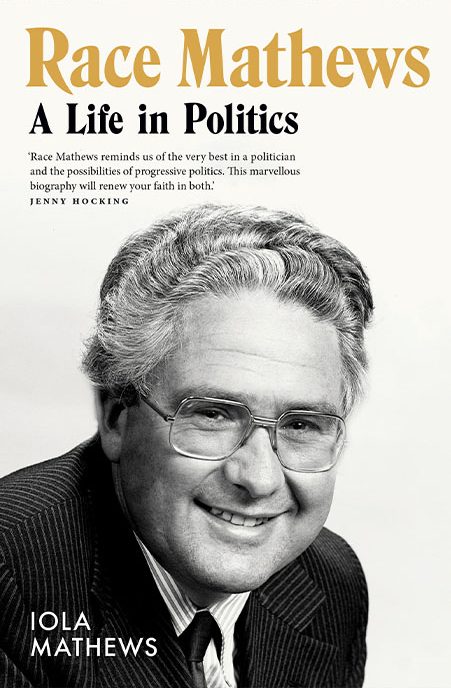
RACE MATHEWS – A LIFE IN POLITICS by Iola Mathews
Monash University Publishers 2024
ISBN: 9781922979810
RRP: $36.99 (pb)
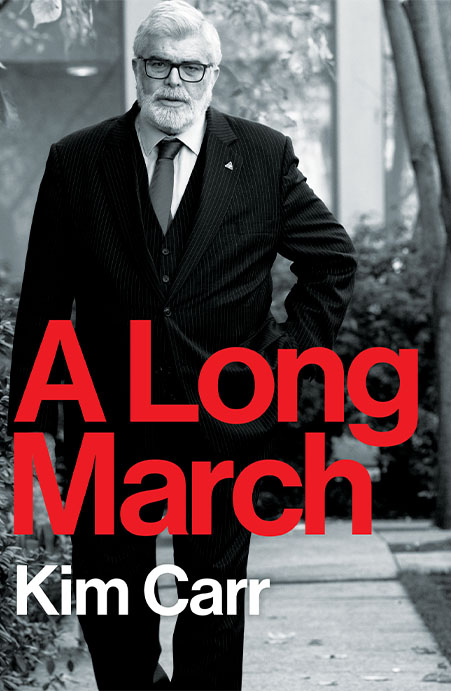 A LONG MARCH by Kim Carr
Monash University Publishers 2024
ISBN: 9781922979872
RRP: $49.99 (hb)
Reviewed by Keith Harvey
Late in 2024, two books recording the political lives of two Victorian ALP politicians were published. The first – Race Mathews: A Life in Politics – is unusual in its own right. Conceived as a memoir, its writing was interrupted by Race Mathews’ failing memory and a diagnosis of Alzheimer’s disease in 2022. As a result, the book was completed by Mathews’ wife, Iola.
The first four chapters of this book were written by him (and edited by his wife) and the remainder by her, using a variety of sources, but including an oral history interview with Race previously recorded by the National Library. Iola Mathews is a former journalist and an author in her own right. Her memoir Winning for Women – A personal story was published in 2019.
Race Mathews first came to national prominence as Principal Private Secretary to Gough Whitlam before he became prime minister (during which time Mathews had a relationship with Ainsley Gotto who had the equivalent post with then Prime Minister John Gorton). Mathews was elected as federal member for the Victorian seat of Casey in 1972 but lost in the anti-ALP landslide in 1975. During the 1980s and until 1992, he was a member of the Victorian Parliament in the Cain Labor Government, holding a number of ministerial portfolios.
The second memoir is A Long March by former MP Kim Carr who was a Victorian senator and prominent member of the Socialist Left faction in the Victorian Branch and, at times, convenor of the national Left in the federal parliament. Carr took his Senate seat in April 1993 and was a senator until June 2022 – a stretch of nearly 30 years.
In many ways, these two political lives could not have been more different. Mathews was, without doubt, a “conviction politician”, someone seeking policy ideas and the means to implement them. He was for many years the driving force in the Australian Fabian movement, a tendency within the labour movement seeking inspiration from their English equivalents and seeking to reform society in a socialist direction, but gradually.
Mathews was a constant campaigner for democracy within the ALP but, unlike Carr, was not factional. After a youthful schoolboy interest in communism, initiated by books he found in the library of the elite Melbourne Grammar School, of all places, he joined the Victorian ALP in 1956. This was post the Labor Split and thus in the period when the hard left Trade Union Defence Committee (TUDC) exercised total control over the Victorian ALP. Mathews naively even applied to be ALP Victorian Secretary, but the TUDC dominated executive gave the job to a West Australian, Bill Hartley, who became Gough Whitlam’s nemesis when he became federal leader.
In 1954, prior to joining the ALP, Mathews said (in a chapter written by him) that he was aware of the tensions in the Labor Party between the left wing led by the party’s leader, “Doc” Evatt and the right wing “influenced by the Catholic leader, B A Santamaria”. “I admired Evatt, I was on his side,” says Mathews.
Methews later supported the so-called “Participants” which sought to broaden control of the Victorian branch but was not a member of this group as such. The “Participants” – whose support Mathews had expected – had become the Independents faction but it became firmly allied to the Socialist Left for preselection and other purposes.
Mathews supported Whitlam in his efforts to reform the Victorian branch after he became federal leader in 1967 and while serving as Principal Private Secretary to Whitlam until Mathews stood for and won the seat of Casey in 1972 which he would lose at the 1975 election.
After Whitlam’s defeat in 1975, Mathews was active in seeking to gain a Victorian seat but, despite being a principal private secretary to Victorian ALP leaders Clyde Holding and Frank Wilkes, he struggled to gain factional support until the seat of Oakleigh became available in 1979 which he then won. Mathews held a variety of ministerial roles in Victoria in the Cain Government but eventually was dropped from the ministry when the factions wanted a ministry position for one of their own. Being non-factional had its consequences.
Unlike Mathews, Carr was known as a factional warrior with a reputation as a hard man of the left, sometimes nicknamed “Kim Il Carr”, in reference to the North Korean Dictator, Kim Il Sung. (There is a suggestion of Carr’s pro-China views in the title of his memoir.) However, as can be seen from his book, Carr eventually became a victim of the factional system he helped maintain and, under pressure – allegedly in the name of the need for generational change – he lost factional preselection and was replaced as the Socialist Left’s Senate candidate by Linda White for the 2022 election. Carr notes that White was really of the same generation as himself and, diplomatically, does not make the observation that Senator White died in office in early 2024, less than two years into her six-year term.
Carr joined the ALP in 1975 as a result, he says, of the dismissal of the Whitlam government by Governor-General John Kerr. As a Senator and minister in the Rudd and Gillard governments, Carr was most interested in industry policy. He had been a fan of the Prices and Incomes Accord under the Hawke/Keating governments which, he says, brought together the disparate factions within the ACTU. Like Mathews, Carr was interested in policy development and adoption, which he saw as an essential element of good governing. He laments what he perceives as the replacement of policy by polling as the basis for governing.
As a minister, Carr prioritised working closely with industry to maximise outcomes for both workers and employers in the national interest. He suggests that this was also in the interest of social and worker justice. Industry policy remains a much-debated project. Carr remains convinced of its social justice benefits but also, in the wake of the COVID pandemic, as a crucial element of national economic and industrial security. Governments around the world are now striving to ensure national economic self-sufficiency in key industries, abandoning some elements of globalisation.
But Carr’s account of his decades in politics reports few major policy interests outside of industry policy. As convenor of a faction known as the Socialist Left, there is a remarkable absence of discussion of policies or programs that in any way might lead to any greater degree of social influence over the economy or any particular industries.
Industry policy – whatever its merits – is an extremely limited expression of social or worker influence over the operations of business and no threat at all to the fundamentals of the capitalist system. In the past, policies and measures such as those supported and promoted by Carr in government would have been – and were – robustly condemned by the left as “making capitalism work”.
This may not be a bad objective but is now indicative of an almost complete absence of ideas on the left of politics about a more radical critique of modern capitalism or any practical proposals to “socialise” the economy. Following the collapse of the Soviet Union and the abandonment of communism in China in favour of State capitalism, the left in Australia and elsewhere is bereft of new economic ideas. The left, and perhaps the Labor Party as a whole, just wants to be a better economic manager, notwithstanding the serious and, for this reviewer, the welcome efforts of the Albanese government to level up the countervailing power of workers in an era a declining unionisation rates of unionisation among workers.
Ironically, perhaps, Race Mathews had much more radical ideas on worker involvement in enterprises than any policies expressed by the one-time leader of the Victorian Socialist left faction. Mathews took a particular interest in encouraging more social control of the economy, especially through the example of the cooperative movement. It is remarkable that a moderate non-Catholic Fabian Socialist developed such a passionate interest in promoting co-operatives – an interest dismissed by Whitlam himself as “a deplorable idiosyncrasy and departure from reality”, according to Mathews.
Mathews became intensely interested the successful operation of worker cooperatives, and especially those in the Basque region of Spain affiliated to the Mondragon Cooperative Corporation which Mathews visited several times and about which he wrote and spoke extensively.
Mathews is one of those rare individuals who could recognise and embrace a promising idea even if it came from a source about which he had doubts. There are two chapters in the book which detail Mathews’ interest in the Mondragon cooperatives (as well as numerous other references). He was told about Mondragon by Shirley Williams, Secretary of the UK Fabians and a minister in the Wilson and Callaghan Labour governments, leaving later to form the Social Democratic Party, later the Liberal Democrats. Mathews read the information sent to him and said:
I was astonished. This was the “society of equals” that I’d been looking for all my life. I’ve always had an interest in and enthusiasm for the cooperative movement, as an integral part of the labour movement mind-set…the trade union movement and the Labor Party are by-products of the cooperative movement. It is the root of the whole thing, rather than an appendage. (page 248)
Later, Iola Mathews records, Race Mathews
“…discovered that the cooperative movement was linked to the Catholic social justice movement. At first, he was dismissive because he associated the teachings of the Catholic Church with B A Santamaria, who had done so much damage to the Labor Party. But Race’s attitude changed:
I was in the Monash [University] bookshop one day and among the books for sale was a collection of essays about G K Chesterton. I bought it on impulse, and it opened up a new perspective for me. I came to see that he, along with another Catholic writer, Hilaire Belloc, originated the notion of Distributism, which I came to see as the philosophical core of Mondragon.” (page 275).
Chesterton and Belloc were prominent members of the Catholic intellectual revival in the UK in the early years of the twentieth century, developing the ideas that became known as Distributism, arguing that both concentrated capitalism and state socialism or communism removed all ownership and workplace influence from individual workers. What was needed, they argued, was a more broadly distributed amount of economic ownership. Worker cooperatives (there are other types) vest full ownership and control in an enterprise’s workers. Chesterton and Belloc were fiercely opposed by the English Fabians of the time, such as Sidney and Beatrice Webb, George Bernard Shaw and the like.
In Australia, however, the prominent Fabian Race Mathews became the single most prolific researcher, writer and proponent of the Mondragon (and other cooperative) models of economic organisation. He wrote two books devoted to cooperativism and Distributism (while still managing to blame Santamaria for the failure of these ideas to take root in Australia). They are Jobs of Our Own and Of Labour and Liberty, the latter reviewed here: https://thesydneyinstitute.com.au/blog/g-k-chesterton-hilaire-belloc-and-distributism-down-under/
Mathews’ life in politics was a constant search for the development of policy ideas through his interest in the Fabian Society. He was an early advocate of changes to the ALP’s policies on schools funding (the Victorian ALP was firmly anti “State aid”) to non-government schools, including poorer Catholic systemic schools.
He campaigned tirelessly in favour of internal party democracy, although he would acknowledge that his efforts in this regard were largely frustrated by the entrenched factions, no matter how much they have split into sub-factions which tax the brain power of all but the keenest observers to keep track of. Factionalism hindered Mathews’ career, ending it prematurely.
Since this volume is co-written by Mathews’ wife of many years, there could have been a tendency towards hagiography in this account. This has been avoided. The book is frank about Mathews’ political successes and his failures. He was particularly disappointed that his premature exit from his ministerial roles in Victoria led to the failure of a bill on co-operatives to be pushed through the parliament. His successors did not share his enthusiasm.
Both books are worth reading. Even though it is sub-titled A Life in Politics, there is a significant and revealing flavour of Mathews’ personal life in the book including reflections by a spouse of an active (hyperactive?) politician, academic and ALP activist. This comes through clearly in Iola Mathews’ account of their married life.
Their marriage was Mathews’ second. His first wife died young, leaving him a widower with three young children. He then met and married Iola – it was her first marriage – while he was still Private Secretary to Whitlam prior to the 1972 election. Their honeymoon was short and mainly spent in Canberra. They returned to Melbourne to live but after one weekend together he returned to his Canberra job, leaving his new wife with his three children who had been looked after by Race’s parents after his first wife died.
You can imagine the transition this new life involved and can feel it in the text. In a number of places, Iola describes her feelings of resentment at the lack of family time and opportunities for private conversations with her husband. The couple had two children together and the marriage has endured despite the difficulties described. Iola Mathews was a cofounder of the Women’s Electoral Lobby and describes herself as a feminist. She was also employed for some time as an Industrial Officer by the ACTU.
Carr’s memoir is a strictly political account and is equally worth reading. His personal life does not feature at all. It might be described as a “who/whom” account, that is an account of who was doing what to whom and when in the Federal ALP caucus in the years in which Carr was a member. It suggests a little of the adage: if you like to eat sausages, don’t ask how they’re made. It is not a particularly attractive process.
Carr largely writes generously of others but records many disappointments with his colleagues, culminating in his early departure – as he sees it – from the Senate. An outsider may find remarkable the many personal animosities on the left of politics. A recurring theme is the lack of loyalty from colleagues all jockeying for positions in a swirling world of intrigue in Canberra.
It is worth noting that while the book is well written, it contains no references. Carr makes a number of statements about historical events and people for which we have only his word. This detracts from his account. His memoir is not a “tell-all” account nor is he dumping relentlessly on his colleagues, but his many disappointments with his side of politics feature regularly. The final one comes with his removal from parliament. There was, it appears, no secret in the fact that he and Prime Minister Albanese did not get on, despite both being on the left of the party.
In the months leading up to the 2022 election, all Victorian lower house MPs were guaranteed pre-selection (the ALP National Executive was in control of the Victorian Branch after “revelations” of endemic branch stacking). But not the two leading senators, Carr and Labor Unity’s Kimberley Kitching. While not factionally aligned with Kitching, Carr has obvious sympathy for Kitching who died suddenly while her preselection was under a cloud. But it was Carr’s own faction that ultimately did him in. A fraction too much faction ended his parliamentary career.
Carr has some parting advice for the Albanese government as it faces re-election in 2025. He frankly suggests that the Labor Party is moving away from its working-class base in favour of “identity” politics and a failure to address the industrial needs of workers – although Carr lays the blame for this largely on the Rudd/Gillard government’s industrial legislation only partly winding back the Howard government’s WorkChoices laws. He does not comment on the industrial legislation of the Albanese government.
Carr cites the referendum on an Indigenous Voice to parliament as an example of the party – and particularly its leader – not listening closely enough to its traditional supporters. Of course, this might just be some gratuitous advice and a parting verbal whack at the person Carr holds responsible for his premature exit from politics.
But the voters and interests Carr is talking about are equally cohort of interests and people that the leader of the Opposition is seeking to appeal to – blue-collar, outer urban voters. Carr notes strong swings against the ALP in the traditional Labor strongholds in Melbourne’s north and west in the last federal and state elections. The Labor Party would be wise to note Carr’s advice, gratuitous or otherwise.
Keith Harvey is a non-factional member of the Victorian ALP. His Memoirs of a cold war warrior (2021) detailing his work in the trade union movement is available from Connor Court Publishing as is his biography of former Independent Senator Brian Harradine (2023).