Speaker
Mark Johnston
Speech Date
June 26, 2018
Issue
Issue 43
Dr Mark Johnston is an Australian historian, teacher and author. He is currently the Head of History at the Scotch College in Melbourne. He has written several publications about Australian history, most recently An Australian Band of Brothers. Telling the stories and events of a conflict like the Second World War is a big canvas. Mark Johnston has chosen another path by concentrating his big picture on the lives of three Australian men of the 9th Division – the Division that sustained more casualties and won more medals than any other Australian Division with seven of its members receiving the Victoria Cross, Australia’s highest award for gallantry. To discuss his book and more Mark Johnston addressed The Sydney Institute on Thursday 26 April 2018
THE AIF HEROES OF TOBRUK, EL ALAMEIN, NEW GUINEA AND BORNEO
MARK JOHNSTON
One of the protagonists of my book, An Australian Band of Brothers, a man called John Lovegrove, was on leave in Palestine in December 1942 with two other sergeants. Together they took a taxi to Bethlehem, where they visited the Church of the Nativity. To John the most striking feature of the multicultural throng at the church was quote “that everyone smelt highly of ‘BO’”. Later that evening a British officer took exception when the three sergeants did not salute him. In John’s words, “he of course received a good mouthful of back-country Aussie retaliation”. John and his mates then visited a brothel recommended by their taxi driver, but found the girls “too filthy”, in John’s words. John had a better experience the following day when, at a soccer match in Jerusalem, he and his mate Ron Smith met two Canadian nurses who invited them back to the lavish King David Hotel for a meal. It was an officers’ only hotel, but the girls persuaded someone to let them in and, despite the complaints of a British padre, they ate, surrounded by the “Brass”. They then spent a night with the “girls”. They were happy to meet the ladies’ request for a rising sun badge and a slouch hat as souvenirs.
Later that evening a British officer took exception when the three sergeants did not salute him. In John’s words, “he of course received a good mouthful of back-country Aussie retaliation”.
I’ve started with that story because it corresponds with some of the stereotypes of Australian soldiers in World War II, and indeed both world wars, and in this talk I want to discuss the degree to which those stereotypes are real and the degree to which they define the Australian soldier. When John Lovegrove sent me his expanded wartime diaries in the late 1980s he apologised quote “for his spelling lapses and typographical errors”. But the critical sentence was the last one: “However, it is what it is ‘warts and all’.” That warts and all quality attracted me to his diary, for he didn’t shy away from topics I’ve just mentioned, as well as ones relating to front line service, such as poor leadership and soldiers unable to cope. My philosophy is that the historian’s duty is to tell it as it was. That may sound banal, but Australian military history is an area where there is a great deal of gilding the lily.
That warts and all quality attracted me to his diary, for he didn’t shy away from topics I’ve just mentioned, as well as ones relating to front line service, such as poor leadership and soldiers unable to cope.
In 1988, I began researching a PhD at Melbourne University on the experience and outlook of Australian front-line soldiers in the Second World War. I was inspired in this project by reading Bill Gammage’s wonderful book The Broken Years. Bill Gammage was one of the examiners of my thesis and, partly as a result of his encouragement, I saw the thesis through to publication in 1995. Since I first began gathering material for that thesis, I have been reading, thinking and writing about Australian soldiers in the Second World War. My latest book, An Australian Band of Brothers is, above all else, a worthwhile story, but it also reflects my current thinking on Australian soldiers. It revolves around John Lovegrove, whom I mentioned, but also the company, battalion and division of which he was part – namely Don Company of the 2/43rd Battalion of the 9th Division. It also focuses especially on two other soldiers, Allan Jones – a former motor painter from Renmark – and Gordon Combe, who on the outbreak of war was a clerk in the South Australian parliament.
Let’s start by unpacking the elements of John’s story. You’ll remember he mentioned the filthy locals and the smell of BO. That was a typical observation. I’ve read it time and time again. Bill Gammage says that in World War I, Australian light horsemen “to a man” hated the Arabs. In World War II, that was only partly true of Australians, for many expressed a good deal of sympathy with the difficulties of local people, and especially children. Many soldiers in the battalion that features in this book declared one of their best days in the army to be one when they put on a fair for the local children in Borneo soon after its capture in 1945.
Bill Gammage says that in World War I, Australian light horsemen “to a man” hated the Arabs. In World War II, that was only partly true of Australians, for many expressed a good deal of sympathy with the difficulties of local people, and especially children.
Another of John’s stories was the backcountry swearing at the British soldier who didn’t like the failure to salute. British officers did often complain about Australian indiscipline, and with some reason. Australians didn’t like saluting, and their approach to their officers was quite different. Australians tended to call their officers by first names, and to salute only when they had to – for example, at a famous parade of the 9th Division at Gaza airport in December 1942 when the British General Sir Harold Alexander praised the division to the hilt for its recent involvement at Alamein. Others who praised the division included British General Montgomery, who had commanded the British 8th Army in the battle and who said that “we could not have won the battle in 12 days without that magnificent 9th Australian division”. Similarly, at Tobruk, British officers had praised the Australians, mainly of the 9th Division, for quote “consistently brilliant patrolling” and for the efforts of the so-called “bush artillery”. Lieutenant Dick Hamer, the 2/43rd Battalion Intelligence Officer, and of course later a distinguished politician, wrote a story in his diary on 24 April 1941, early in the siege. It features a British Forward Observation Officer, batman and sanitary corporal:
at Tobruk, British officers had praised the Australians, mainly of the 9th Division, for quote “consistently brilliant patrolling” and for the efforts of the so-called “bush artillery”.
Tonight, we achieved our crowning triumph when we scored over the RHA. Their FOO was directing the fire of his guns, situated a long way back, on to some enemy vehicles and dispersed infantry, but his shots were falling short, and eventually he gave up; whereupon the sanitary corporal announced that he was going to “have a go”. The FOO raised eyebrows and laughed a little. “OK, plonk one in,” shouted the sanitary corporal. With much alacrity a 94-lb shell was “plonked in”. “What’s the range?” shouted Gunner No 1 (my batman). “Give her a couple of turns.” The breech was closed, the so foot lanyard jerked and the shell screamed off. “Five hundred metres more elevation, 4 degrees right,” advised the kindly voice of the FOO. This was translated into the language of the Bush Artillery: “Cock her up a bit Joe, and two telephone poles to the right.” A second loud explosion, a sheet of flame and a cloud of dust, and the amazed voice of the FOO: “Bai Jove, you’ve hit a vehicle!” And a vivid red flame and black smoke testified. The Bush Artillery is making history. The CO is very keen.
No wonder that, in July, another Australian recorded meeting a British artillery officer who said of the bush artillery, ‘‘Gawd-blimey, we fellows think the world of you chaps and the work you do – you’re the top-line with us!” More generally, the British in Tobruk admired the courage of the Australian infantry. Similarly, another Australian infantryman reported being told by one Englishman “You Hostralians are a wonderful bunch of chappies, although you are all mad!”
Some jingoistic commentators have played up the tension between Australians and British officers in the siege of Tobruk. That ignores the fact that the good relations between the two groups were the key to the successful defence. The Australians could not have sustained the siege without British support, and they acknowledged it at the time. Several months into the siege, one Australian private said: “We are with English and Indian troops here and they are a dam fine crowd. If I ever hear any one running down the Pommy soldier it will mean a row, they are the goods.” Allan Jones said “we rated Poms second only to the Kiwis” as fighting soldiers.
Several months into the siege, one Australian private said: “We are with English and Indian troops here and they are a dam fine crowd. If I ever hear any one running down the Pommy soldier it will mean a row, they are the goods.”
To suggest that Australians always had it in for the British is also stupid because most of them were of British heritage and many of them were themselves “pommies”. Allan Jones says the many “Poms” in the 2/43rd’s ranks were treated with “respect and affection”. One of John Lovegrove’s best mates was “Pommy” Langstreth, who shared a tent with him and fell dead next to him at Alamein. That’s not to say that the Australians in the Middle East did not notice differences between their own all-volunteer army and the British mainly conscript army. Allan was often scathing about British discipline, saying for example:
As though being conscripted to serve was not enough, those with authority in the British forces seemed to exert great effort to punish conscripts for the most trivial infraction of stupid rules designed to make life as unpleasant as possible for them.
He believed from observation that the British requirement that men obey orders without question made for less effective operational performance than the Australian system where other ranks liked to know why orders were given and were often told. Yet the main theme of British and Australian relations at Tobruk is unity of purpose and mutual respect.
Some British officers did see Australians as undisciplined. Were they right? As Allan Jones said, the number of “really wild types” among the more than 2000 who went through his battalion would not have reached double figures. Figures from the whole army back that up. In January 1943, only one per cent of those who had joined the AIF to that point were in gaol, unaccounted for, or illegal absentees, that is, absent without leave for over 21 days. In the very period that John Lovegrove and his mates were on leave, in my opening story, the British major-general in command of the Cairo area lavished praise on the 9th Division’s men for their recent exemplary behaviour on leave.
In the very period that John Lovegrove and his mates were on leave, in my opening story, the British major-general in command of the Cairo area lavished praise on the 9th Division’s men for their recent exemplary behaviour on leave.
One of the stereotypes of Australian soldiers said they were ill-disciplined behind the lines but disciplined in action. As I’ve just said the indiscipline one doesn’t really stack up. What about the disciplined in battle argument? This one has a lot going for it. The AIF seemed to have a remarkable capacity for self-discipline. In a book about the 9th Division in New Guinea, John Coates refers to more than 50 cases in the division’s history when privates commanded platoons in action, and more than 20 where NCOs led companies. Two of the protagonists of this book, Sergeant John Lovegrove and Corporal Allan Jones, themselves led their platoons brilliantly on several occasions. Allan was impressed by the men’s own courage and battle discipline. A working-class man with a good degree of scepticism about patriotism, when his unit had to advance in daylight on German positions in July 1942, he was nevertheless quote “stirred with a feeling of emotional pride at the sight of these men in their resolute advance with no men faltering, no unsteadiness, and no panic”.
The third main person in the book, Lieutenant Gordon Combe, who for a time commanded the platoon that John and Gordon were in, also commented on this bravery. After his first major involvement in an attack, a night raid at Alamein in July 1942 he wrote to his wife that he was “immensely proud of [his men], most of them are just plain common people it might be said, but they were gallant and heroic in this action”. Ten days later, after they had advanced in the open in daylight on enemy guns he said: “[T]he infantry are often classed as the dregs of the army because it takes a minimum of grey matter to be a private soldier – it was nothing short of a miraculous revelation to see these brave young men plodding steadfastly forward through a rain of bullets and shells bursting overhead and on the ground.”
Combe himself was a fine leader, and this was expressed in the Military Cross he won at Jivevaneng in New Guinea. He personally led an assault across open ground against enemy machine-gun and mortar fire. He fired his Owen gun at the Japanese until wounded in the chest and refusing medical treatment, he joined the forward platoon and encouraged his men by moving among them right across the front. An official account said that “in the face of severe frontal and flanking fire, this officer displayed outstanding leadership, coolness and courage”. George Lush, a young officer in the same battalion, saw Gordon after the battle, a bandage across his chest and explaining the battle to his commanding officer by using his rifle like a pointer in the classroom. Lush thought Gordon looked like a Jaggers statue.
He fired his Owen gun at the Japanese until wounded in the chest and refusing medical treatment, he joined the forward platoon and encouraged his men by moving among them right across the front.
Leadership was tremendously important to soldiers, as expressed by John Lovegrove after Tobruk. When asked to speak to recently arrived Australian reinforcement officers in Palestine in 1942, he said soldiers were always “looking eagle-eyed towards their N.C.O. or officer for guidance and perhaps above all for example”. John had been a fine patroller there and had managed the stress well. Others hadn’t, such as the man who a short while into one patrol began sobbing uncontrollably. Eventually, John resorted to slapping the man’s face to bring him to. It worked. He told the reinforcements:
To control a man who “cracks” when on patrol close to enemy defences [he suggested] the Leader’s reaction must be instantaneous. Either of a couple of alternatives usually has the desired effect. (a) a sharp hit between the shoulder blades or on the jaw with a rifle butt – but he will most certainly cease cryng noisily, stifle his sobbing and regain control of himself. (b) a firm open-handed left and right slap to the face can achieve similar results.
When we’re talking about warts, we have to confront the fact that some men did not cope. This book includes other examples, such as a boastful reinforcement suddenly falling to the ground in New Guinea and crying. Like men coming to an officer, Lieutenant George Lush, in tears and begging not to have to go on. That applies also to officers. George Lush, whom I just mentioned, was a former dux and school captain of Carey Grammar and later a Supreme Court judge, and his brilliant and biting memoir of his time with the 2/43rd includes an account of his captain falling to the ground before an attack late in the New Guinea campaign and telling Lush, “I can’t go on – I can’t go on.”
Like men coming to an officer, Lieutenant George Lush, in tears and begging not to have to go on. That applies also to officers.
John Lovegrove felt that two of his lieutenants in succession were poor and struggling to maintain their composure. Allan Jones told of how soldiers in his platoon could carry on their own “gentle officer training”. The platoon had at least ten commanders in the war, and he told of one who had the task before Alamein of deciding what to do with a solitary bottle of lime cordial issued to be divided among 30 men. The new lieutenant immediately said, “I’ll have that”, to which his Platoon Sergeant responded firmly, “We draw lots when there isn’t enough to go round, SIR.” Yet the men could only push so far. When John Lovegrove complained to higher authorities about one of his lieutenants he was rebuked and narrowly avoided a court martial. Now a lot of this talk is not very brotherly is it? Neither was the fact that the tall boastful reinforcement, whom I mentioned lying on the ground crying, was spat upon as he lay there. It hardly seems appropriate in a book called Band of Brothers, does it? So, is that a Misnomer?
Although there were good reasons for soldiers to collapse in tears, to become inward-looking or selfish, they generally stuck together remarkably well. The usual response to seeing men fall apart was not anger or abuse but sympathy. John Lovegrove saw the reinforcement who was spat upon and wrote that he “had heartfelt pity for him and the stress he must have gone through”. He reflected too that this inability was “extremely rare” and that it was important to remember that this soldier, like all members of the Australian Imperial Force, were volunteers.
Although there were good reasons for soldiers to collapse in tears, to become inward-looking or selfish, they generally stuck together remarkably well. The usual response to seeing men fall apart was not anger or abuse but sympathy.
One unifying force was good leadership, and it’s no exaggeration to say that junior officers like Gordon Combe developed a genuine love for their men, though he would not have put it that way. Moreover, as Barton Maughan, one of the official Australian army historians and a 9th Division veteran said, “Good leadership is impotent if there is not a shared belief in the validity of the common purpose.” A belief in defeating the Axis was undoubtedly part of their purpose, and these Australians often expressed their admiration for the commitment of the British, the Poles – whom they met in Tobruk – and the Russians. But there was also a certain cynicism about politics, expressed at one extreme by Allan Jones when he said: “Looking at Eighteen Platoon, I could not see any of visible heroic stature. They were all nice ordinary fellows, steady and reliable I would expect, but not tough brutal killers who had sworn an oath to die fighting for Bob Menzies.”
“Looking at Eighteen Platoon, I could not see any of visible heroic stature. They were all nice ordinary fellows, steady and reliable I would expect, but not tough brutal killers who had sworn an oath to die fighting for Bob Menzies.”
What drove them to something akin to brotherhood were their shared experiences. Gordon, Allan and John each lived five years of army life, including nearly 1000 days overseas for Allan and John and nearly 1200 for Gordon. Their food and accommodation were at best Spartan, often much worse. Life was always regimented: they were told what to do, when to do it and where to go. Possessions were essentially what one could carry in one’s brown canvas bag with name and number stencilled on it. Before and between campaigns, there were early rises to a daily grind of army discipline, parades and training. There was little rest, but long periods of tedium. Except on their brief leave periods, the company they kept was male, macho and stoic, and there was no privacy.
On campaign, they lived with a daily grind of marching and digging. In the Middle East they lived in dugouts, plagued by flies and fleas or mosquitoes, in great heat and always surrounded by sand and dust. In the Pacific it was mud and dense jungle, well suited to hiding a brutal human enemy and another insidious enemy in the form of the mosquito.
Allan, Gordon and John risked their lives for their comrades, and had no time or opportunity to grieve adequately or openly for dead mates. They saw brutality at a level they had never witnessed before, and came under shell and artillery fire, led night patrols, faced the threat of ambushes, minefields, tanks, air raids, the fear of being overrun, the confusion of battle, and sometimes incomprehensible decisions by those directing them. There was the overarching psychological strain of wondering whether you would be killed or wounded, the need to hide that fear from your comrades, as well as knowing how damaging such an outcome would be for wives and families. Worries about the wellbeing and activities of those people at home were present too. The physical demands of the job of soldiering were also often considerable. Gordon and John were both wounded twice and all three were badly affected by tropical disease. They accepted all of this, and obeyed their leaders, whether or not they trusted and admired them. An upshot of this was that they developed a tremendous loyalty to and pride in their units, from the 2/43rd Battalion down to their companies, platoons and sections.
Allan, Gordon and John risked their lives for their comrades, and had no time or opportunity to grieve adequately or openly for dead mates. They saw brutality at a level they had never witnessed before
To come back to the group I started with, on that Christmas 1942 leave, it’s noteworthy that John Lovegrove had a few months earlier been wounded leading an attack at Alamein, and would be wounded again, more seriously, in 1943. His mate Sergeant Ron Smith’s brother Eric had been killed at Alamein, and the third sergeant Fred Turner, was one of the battalion’s finest patrollers and would fight in all four of the battalion’s campaigns. They remind me of this group. Allan Jones told a story of leave taken in Tripoli, Syria, one Sunday in January 1942. They went without permission and one of them, a former Kalgoorlie miner and a larrikin, got quite drunk and trouble seemed likely. Allan reflected that they could have left this man to his own devices, but the platoon’s shared experience and identity prevented them: “We did not merely belong to Eighteen Platoon, we were Eighteen Platoon, and mutual support, without even much notice, had become a habit.”
Allan reflected that they could have left this man to his own devices, but the platoon’s shared experience and identity prevented them.
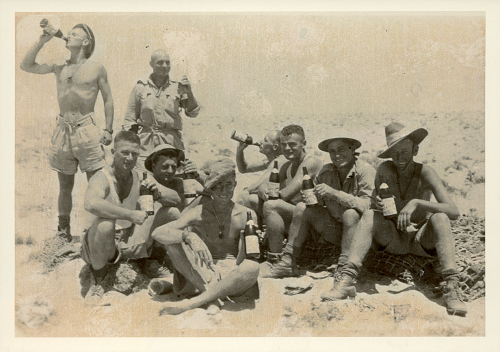
They all got back to camp unnoticed, with their bonds of mateship tightened. The pictured group are from another battalion, the 2/48th, photographed soon after the Australians’ arrival near Alamein in July 1942. At first sight this is Australians at their worst, drinking on the job with Canadian beer they’ve “scrounged” from somewhere. The Germans’ propagandist Lord Haw-Haw sought to exploit British criticism by applying the epithet “Ali Baba and his 20, 000 thieves” to the Division. Yet there is much more to these men, members of 9 Section, 12 Platoon, B Company, 2/48th Battalion. Two of them had been wounded in Tobruk. In the forthcoming campaign at Alamein, all would be wounded except Bowen, at far right. He would be killed in New Guinea. No wonder the survivors felt a bond.
Every battalion had its stories of men making sacrifices for their mates: in the 2/43rd there was Private Arthur Grayson, who while firing from a weapon pit with two others, intentionally placed his foot on an enemy mortar bomb that landed among them. Though seriously wounded, he thus enabled the others to fight on. Another member of the battalion caught wounded in no man’s land in New Guinea reportedly chose, on seeing a mate coming to try to rescue him, to kill himself with a grenade rather than let his cobber risk all for him. That would not have happened in the desert, and another theme of this book is the relatively chivalrous nature of the desert war as compared to the war without mercy in the Pacific.
Caught wounded in no man’s land in New Guinea reportedly chose, on seeing a mate coming to try to rescue him, to kill himself with a grenade rather than let his cobber risk all for him
When each of the three protagonists in the book became separated from their units, they wanted to return. Allan asked rhetorically, why: “Is it a death wish,” he asked rhetorically, “thirst for blood, glory with decorations, or for ‘their country’?” He felt it was none of these things, but instead “the desire to be with their kind, such bonds being unique”.
The company that this book revolves around was very successful. It reached its objective on nearly every occasion, or took terrible casualties trying. It played a vital role in all four of its campaigns. Why they were able to do so, it seems to me, has no simple explanation. A higher goal, leadership, esprit de corps: each is insufficient explanation by itself but part of the answer. The fear of showing fear and the fear of letting down your mates were exceptionally important too and hinted at in the continuation of the earlier quotation by Maughan, who went on to say: “How did they recover…Respect.”
In a way, fear was the key, as John Lovegrove recognised. He wrote in his diary, “The experience of temporarily losing one’s nerve can happen to anyone” and spoke of “the constant deep-down battle of the combat soldier to control the ever present nauseating fear…we all feel when in very close proximity to the enemy”. The fact that it could happen to anyone was widely recognised in the war, though men still did all they could to hide their fear or indeed other deep emotions like grief. If they were brothers, they had to be masculine ones. But the term “Band of Brothers” does make sense when applied to the 2/43rd Battalion, and its Don Company and 18 Platoon. They had a kind of brotherly love. In researching the book I’m currently writing, about another part of the 9th Division, I read just the other day a man’s comment that “In the smoke of battle I have seen the only example of ‘Brotherhood of man’”.
The Australian’s Paul Kelly, whose father Joe made a great contribution to the 9th Division’s efforts at Alamein, wrote of the Australians of this time as the “greatest generation”:
Paul Kelly, whose father Joe made a great contribution to the 9th Division’s efforts at Alamein, wrote of the Australians of this time as the “greatest generation”
Apart from suffering economic hardship they won a war, bet the Germans, beat the Japanese, changed the world, backed their mates, returned home, raised families and contributed to their society. They didn’t beat their chests, didn’t say how great they were didn’t seek media attention, didn’t ask what their country was doing for them, didn’t behave like nacissists or declare how extraordinary they were – when they had claims to being extraordinary. Noy only that, they did not boast about their achievements. Often, they refused even to talk about them. How remarkable and huble was that?
I concur with that fine tribute, but I’ll conclude with what I see as the main theme of this book and all my work. That is, the theme of “humble or ordinary Australians doing the extraordinary”. Perhaps to some extent, it’s a case of men having greatness thrust upon them, but these volunteers certainly achieved greatness. The 2/43rd Battalion had about 100 men who won medals for bravery. Only one other battalion in the 9th Division surpassed that. But the other 2600 men who served in the battalion were also crucial to its success. Gordon Combe was well aware of that balance. Superb leader that he was, he gave due credit to his men. After the fighting at Jivevaneng where he won a Military Cross, he told his wife his “men were unspeakably magnificent” and that, “No praise will ever be adequate.” That seems to me a suitable epithet for this Australian band of brothers.