
Speaker
Phillip Bradley
Speech Date
20190423
Issue
Issue 47
The capture of Lae was the most complex operation for the Australian army in the Second World War. In many ways it was also a rehearsal for the D-Day invasion of France, with an amphibious landing combined with the first successful large-scale Allied airborne operation of the war. Phillip Bradley is an historian and author – most recently of D-Day New Guinea. On Tuesday 23 April 2019, Phillip Bradley addressed The Sydney Institute to give a gripping account of the highlights of the battles to rescue Lae from the Japanese.
THE BATTLE FOR LAE AND THE PACIFIC WAR
PHILLIP BRADLEY
As a successful exercise in complex operational planning, “it is difficult to think of a better example than Lae,” the Australian Chief of Army, Lieutenant General Peter Leahy noted on the 60th anniversary of the operation in 2003.
Lae was the main port and airfield on the New Guinea mainland north of the Owen Stanley Range and had been captured by the Japanese on 8 March 1942. An airbase was soon established to provide air cover and a staging base for air raids on Port Moresby. Local militia withdrew into the hinterland and were joined in June 1942 by Australian commandos, which led to the Japanese also reinforcing their strength around Lae.
The first plans to recapture Lae came in October 1942 after two US infantry regiments had flown across the Owen Stanley Range from Port Moresby and landed at a bush airstrip at Wanigela airstrip to take part in the battle for Buna. “After Buna comes Nadzab and Lae,” General George Kenney, the US air commander told his commander General Douglas MacArthur at the time.
“After Buna comes Nadzab and Lae,” General George Kenney, the US air commander told his commander General Douglas MacArthur at the time.
With the imminent loss of the Papuan beachheads at Gona, Buna and Sanananda in January 1943, the Japanese command decided to reinforce the Lae-Salamaua area which now became the front line in New Guinea. Japanese plans suffered a severe setback in early March 1943 when a major supply convoy to Lae was sunk in the Battle of the Bismarck Sea. From then on, the Japanese garrison at Lae was limited by the lack of supply which now had to come via barge or submarine.
Growing Allied airpower not only halted the Japanese supply convoys to Lae, it also led to the closure of Lae airfield as a major Japanese airbase. A new Japanese airbase complex, comprising four airfields, was constructed at Wewak on the north-west New Guinea coast, out of range of Allied medium bombers and fighter escorts. This Japanese airpower build up needed to be neutralised before any operation against Lae could be attempted.
This Japanese airpower build up needed to be neutralised before any operation against Lae could be attempted.
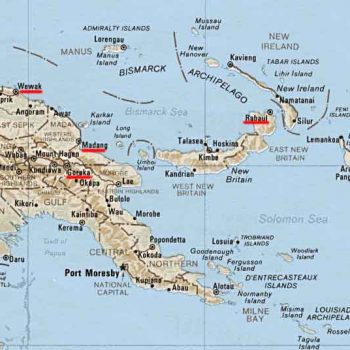
What Kenney needed was an airfield on the north side of the Owen Stanley Range closer to Lae and Wewak. In June 1943, a suitable site was found in the wilderness south of the Markham River at Tsili Tsili and a US airborne engineer unit flew in to build an airbase. The airborne engineers worked 24 hours a day to build the airfield and accompanying revetments.
The airborne engineers worked 24 hours a day to build the airfield and accompanying revetments.
Soon after midnight on the morning of 17 August, 50 USAAF heavy bombers struck the Wewak airfields. That day, 26 Mitchells headed for But and Dagua but only three made it due to issues with the new disposable fuel tanks. Nonetheless, 17 enemy aircraft were claimed destroyed on ground at those two airfields. Another 29 Mitchells attacked Wewak and Boram airfields and 60 more Japanese aircraft were claimed destroyed. The next day, 62 Mitchells returned to continue the attacks. During all these attacks fighter aircraft refuelling at Tsili Tsili provided vital fighter cover. The air threat from Wewak to any operation against Lae was now neutralised.
General MacArthur also needed an ocean-going amphibious capability to capture Lae let alone to return to the Philippines.
General MacArthur also needed an ocean-going amphibious capability to capture Lae let alone to return to the Philippines.
The landing took place 25 kilometres east of Lae on the morning of 4 September 1943. It was the first amphibious landing by Australian troops against a hostile shore since the landing at Gallipoli in 1915. The landing craft carried the Australian 9th Division in their first operation since returning from the Middle East. Peter Hemery watched as “the slowly clearing darkness split with light as flame stabbed from the warship’s guns”. Kiichi Wada was a Japanese naval gunner in Lae. “Suddenly, there was a booming sound from the sea,” he wrote, “Where would the huge fleet land … Aren’t they, in fact, landing right here in Lae?” The Lae garrison had been given orders to fight to the death and Wada thought, “If I must die, I will fight with courage and die like an imperial navy man without shame.”
The Lae garrison had been given orders to fight to the death and Wada thought, “If I must die, I will fight with courage and die like an imperial navy man without shame.”
The main Japanese response to the landing came from the air when two LCIs were damaged by an air attack on Red Beach. Nine men from the 2/23rd Battalion were killed including the battalion commander, Lieutenant Colonel Reg Wall. Two LSTs were also damaged by an air attack from Rabaul with 34 men from the 2/4th Independent Company killed along with seven US Navy crewmen.
The second phase of Operation Postern involved an airborne landing by the US 503rd Parachute Infantry Regiment with a two-gun detachment of Australian artillery attached, dropped from 82 transports. “It was all over so quickly,” the war correspondent Merv Weston wrote, “that all one was left with was of a vision of parachutes billowing briefly, and then a big concentration on the ground that looked like so many sheep.” RAAF Boomerang pilot Alex Miller-Randle watched the drop from well above. “I saw below me dozens of DC3s and the parachutists tumbling from open doors and floating down like little mushrooms” he observed.
As soon as the parachute drop had taken place the Australian 2/2nd Pioneer Battalion crossed the Markham River using a pontoon bridge constructed by the engineers of the 2/6th Field Company. They then commenced work clearing the airfield so US Airborne Engineers could be flown in to make the airfield suitable for flying in the Australian 25th Brigade. On 7 September, 66 aircraft flew in the first troops from the 7th Division including the Divisional Headquarters, the 2/25th Battalion and 25-pounder guns from the 2/4th Field Regiment. On the same day at Port Moresby, a USAAF Liberator bomber taking off from Jacksons airfield crashed into five trucks full of troops from the 2/33rd Battalion waiting to fly to Lae. The fiery crash resulted in 62 Australians being killed and 89 wounded alongside the 11 US aircrew.
The fiery crash resulted in 62 Australians being killed and 89 wounded alongside the 11 US aircrew.
On the next day, 8 September, the 2/25th Battalion began the advance down the road to Lae and made the first contact with the Japanese on 10 September. By 13 September the Australians had reached Whittaker’s Plantation with the 2/25th Battalion on the left of the road and the 2/33rd on the right. During the 2/25th advance Private Richard Kelliher attacked an enemy machine gun position with grenades and then used a Bren gun to silence it. Kelliher then rescued his wounded corporal and he was later awarded the Victoria Cross. By 15 September the 2/31st and 2/33rd Battalion had captured Edwards Plantation, the last enemy defensive position west of Lae.
Meanwhile the 9th Division advanced on Lae from Red Beach with the 24th Brigade reaching the major barrier of the Busu River on the coastal flank. Scouts from Lieutenant Colonel Colin Norman’s 2/28th Battalion tried to cross at the river mouth but the Japanese were waiting for them, killing one and deterring any further crossing attempt at that point. Norman then decided to get his battalion across further upstream where there was an island mid stream. When the men tried to cross the main channel beyond the island, they were swept off their feet and many lost their weapons. However, after forming human chains and entering further upstream they managed to get across. The companies went across in line “as though on parade until the current hit them”. During the crossing, 30 men were lost, 13 of whom drowned but despite the losses, the battalion had a beach head.
During the crossing, 30 men were lost, 13 of whom drowned but despite the losses, the battalion had a beach head.
On 10 September, a crossing using rope and rubber boats failed and over the next two days attempts to construct a log crossing failed when the river rose during the night, snapping the logs in half. On 13 September an extended box girder section was brought forward and used to bridge the main 30-metre gap. On 14 September, a third bridging section was added and the first troops crossed that morning and the advance to Lae recommenced. On 16 September, both the 7th and 9th Division entered Lae only to find it was deserted, “just an evil smelling rubbish heap”.
After initially ordering the Lae garrison to fight to the death, the Japanese command had decided to save the troops by retreating from Lae via a precarious route, across the Saruwaged Range to the north coast. From 10 to 15 September, 8650 Japanese army and naval troops retreated from Lae in four groups. “We fled as if in a night runaway,” Kiichi Wada wrote. “It was as though there lurked tigers in the back, wolves on both sides, and serpents in front.” However, the route and timetable of the retreat was immediately thrown into confusion on the outskirts of Lae due to the commandos of the Australian 2/4th Independent Company blocking the only bridge across the Busu River. The retreating Japanese were all diverted further upstream along the south bank of the Busu looking for a place to cross.
The retreating Japanese were all diverted further upstream along the south bank of the Busu looking for a place to cross.
For three days, from 17 to 20 September, the Japanese were held up at the Busu River while their engineers tried to build a log bridge. The first eight logs couldn’t withstand the force of the river but the ninth log held. The log bridge was of two spans joined at a midstream boulder and fixed in place by bayonets hammered into the wood like huge nails. Kiichi Wada could hear “a torrent flowing with deep, booming noise, which gripped us by fright … an entrance to Hell.” Wada watched as a “sick man had to cross crawling on all fours” and another “toppling midway, plunging into the rapids and vanishing downstream in no time.” Meanwhile the Australian command was slow to move to stop the Japanese retreat and though many stragglers were later killed and captured, the main Japanese force moved north into the Saruwaged Range, the precipitous terrain their only enemy.
“For ten days on end,” Hiromasu Sato wrote, “mountain and valley reappeared again and again in front us.” He watched as “the bodies of those who simply could not go on started to pile up on both side of the path”, as he approached the final climb to the top of the range. “Then we began to tackle wisteria vines clinging over an almost vertical cliff,” Sato wrote. Sato made it across but 25 per cent of the 8,650 troops who had left Lae never made it. Nonetheless it was something salvaged from the loss of Lae.
Sato made it across but 25 per cent of the 8,650 troops who had left Lae never made it. Nonetheless it was something salvaged from the loss of Lae.
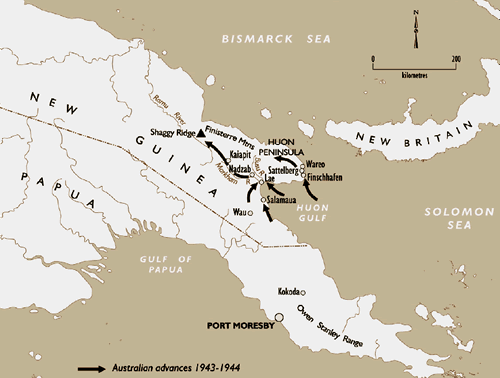
For the Australians and their American allies, Lae was the first of a decisive series of operations in New Guinea. Within days of the fall of Lae, the 2/6th Independent Company was flown further up the Markham Valley to capture a forward airfield at Kaiapit. Days later, the 21st Brigade was flown in and rapidly advanced up the Markham Valley into the Ramu Valley. Meanwhile, new airfields were built at Nadzab and Gusap for US air operations against Japanese bases further afield.
Further east of Lae the 9th Division landed at Finschhafen on 22 September and, after some hard fighting, the area was secured by early December. With the western side of the Vitiaz Strait in Allied hands, US forces landed at Arawe and Cape Gloucester on New Britain later in December thus securing the eastern side. With the northern coast of New Guinea now exposed to US amphibious landings, a landing at Saidor took place in January and the Admiralty Islands were secured over the following months. On 22 April 1944, US forces landed at Aitape and Hollandia and thus within eight months of the landing at Lae, New Guinea had been bypassed.
US forces landed at Aitape and Hollandia and thus within eight months of the landing at Lae, New Guinea had been bypassed.