
 THE PARADOXES OF WAR
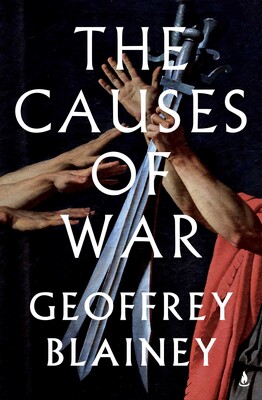
THE CAUSES OF WAR (Fourth Edition)
By Geoffrey Blainey,
Scribner 2025
ISBN13: 9781761635236
RRP $49.99 (HB)
Reviewed by Geoffrey Lehmann
Geoffrey Blainey’s The Causes of War, was first published in 1973. Now in its fourth edition in 2025, it has been updated for the wars in Ukraine and Gaza. A new preface advises: “New questions are asked, new theories considered.” On its back cover Hugh White suggests the book’s “messages have become even more important today as the risk of major war increases in the contemporary world. Few Australian works have shaped global thinking about international affairs so profoundly . . .”
Bearing in mind Professor White’s commendation, I explore at the end of this review how a policy maker (perhaps in Washington, perhaps in Ulaanbaatar) might use Blainey’s book as a “do it yourself manual” to measure the increasing risk of major war, and if it is a risk, to determine what type of war might this be.
Mistakes and truths about war and peace
This book could well have as its title “The Paradoxes of War”. In his conspectus of wars of the last 300 years, Blainey discusses many popular “truths” about war that turn out not to be truths at all, when we examine the evidence. The first “truth” he punctures is that “international peace . . . is the normal state of affairs”. Blainey points out that the American sociologist Pitirim Sorokin, writing in 1937, estimated that Russia had been at war 46 of every 100 years since AD 901, and England had been at war, since William the Conqueror, “somewhere in Europe or in the tropics for 56 of each 100 years”. For Spain the number of war years per century was even higher.
If war is so “normal” – perhaps in the way that we regard peace as “normal” – we may need to see war and peace as two sides of an equation. This is what Blainey finds, and suggests that “a severe treaty of peace was more likely to prolong the peace” and “a decisive victory tends to promote a more enduring peace.”
Four examples demonstrate that outbreaks of peace and war are related. France’s decisive defeat in the Napoleonic wars was followed by the Concert of Europe – a long period of general peace in Europe, extending with only a few warlike interludes from 1815 until 1914. Again, the decisive defeats of Germany and Japan in 1945 have made both of those nations exceptionally war averse – even 80 years later. These three examples contrast with the indecisive defeat of Germany at the end of World War I, followed by World War II two short decades later, which again demonstrates the truth of Blainey’s general proposition.
Blainey systematically dismantles some popular theories about war and peace. I dogeared many pages of my review copy, so I could readily locate his critiques of particular myths. Then I found they were all summarised in a final chapter – “Conclusions”. I’ll quote liberally from that.
One canard Blainey dismisses is that war is often “accidental”. Blainey doesn’t refer to Christopher Clark’s 2012 book The Sleepwalkers, about the start of World War I. Clark’s text may suggest something more complex, but his title implants in many readers the impression that this war was an accident. If enough sleepwalking leaders had woken up, World War I would not have happened. Blainey’s evidence from contemporary documents is explicit. The leaders were all awake and believed they were playing a game of chess when it was dice they were holding. As Blainey says: “No wars are unintended or ‘accidental’. What is often unintended is the length and bloodiness of the war. Defeat too is unintended.”
Unfortunately, in 1914 as Blainey points out, policy makers ignored the six volume treatise on war of Ivan S Bloch, a Warsaw banker. Published from 1897 to 1898, it was translated into English in 1899. Eerily Bloch, “a businessman” as Blainey emphasises, opposed the prevailing opinion of military experts that industrialised wars would be short. Instead, Bloch proposed they would be “long and murderous”. Gunfire would be so rapid and accurate, that soldiers would have to hide in trenches along enormous front lines. Bloch wrote: “It will be a great war of entrenchments. The spade will be as indispensable to a soldier as his rifle. The first thing every man will have to do, if he cares for his life at all will be to dig a hole in the ground.”
Blainey also dismantles “the Manchester theory”, espoused by 19th century “Manchester liberals” such as John Bright and Richard Cobden. They proposed that free trade and increasing commercial contacts between nations promoted peace. Their theory was shattered when World War I started right at the peak of a boom in world exports. According to our World in Data (not a source Blainey quotes) trade as a percentage of world GDP was 8 per cent in 1839 (a relative high point for early the 19th century). By 1913 this percentage had risen to 14 per cent, a level not reached again until 1974.
The “scapegoat theory” is another seductive explanation for wars Blainey exposes as false. It proposes that foreign wars are often started by rulers “as a diversion from domestic ills”. This theory has been favoured by many experts. Examples cited, which cannot be sustained, Blainey points out, are Napoleon III’s supposed motive for entering the Crimean War, and an alleged statement by V K Plehve, Russian Minister of the Interior at the start of the 1904 Russo-Japanese War that “we need a little victorious war to stem the tide of revolution”. The theory also fails for a structural reason. If there is national disunity, war may exacerbate this division.
Disunity at home makes leaders less optimistic, and less likely to choose war. Originally seen as a heresy, but it has since “won favour”, Blainey proposed in 1973: “most nations entered wars with an unjustified degree of optimism. Each of the opposing leaders expected victory – a result which was obviously impossible.”
A classic example of unjustified optimism is Vladimir Putin’s expectations at the start of his 2022 invasion of Ukraine, which he designated as “special military operation” or спецопера́ция, indicating it would all be over in a matter of weeks.
I would quarrel with few of the 49 conclusions in Blainey’s final chapter, except perhaps Conclusion 12. This states: “The idea that one nation can be emphatically blamed for causing a war is as erroneous as the idea that one nation can be emphatically praised for causing the end of the war. Most current explanations of war, however, rest on those errors.”
This conclusion is too broadly stated. Blainey does not mention his Conclusion 12 in the context of the current war in Ukraine. We can ignore the International Criminal Court’s arrest warrants against Putin and Maria Lvova-Belova, which are for the illegal deportation of children, not for initiating the war. But it is almost impossible not to “emphatically blame” this war on the psychopathic Putin and his coterie. John Mearsheimer’s eccentric claim on 16 June 2022, in the fourth month of Putin’s war, that “the United States is principally to blame for the Ukrainian crisis” is simply bizarre.
The recommendation for even-handedness in Conclusion 12 is more relevant in regard to the Russian annexation of Crimea in 2014. There was no expectation that Russia and Ukraine would ever be separate national entities, when in 1954 Nikita Kruschchev impulsively decided to transfer the Crimean Oblast from the Russian Soviet Federative Socialist Republic to the Ukrainian Soviet Socialist Republic. Crimea was not historically part of Ukraine.
The Ukrainians displayed insouciance regarding Russian sensitivities about Crimea. My friend, the late Rear Admiral Andrew Robertson visited post-Soviet Crimea as a tourist, while it was still part of Ukraine. The Sevastopol submarine berths had become a tourist attraction. Andrew was shocked. He was concerned about the reactions of his Russian counterparts and the potential loss of Russian classified naval information.
Geoffrey Blainey’s book has become a classic and is a deeply researched and sceptical historical meditation on the causes and outcomes of particular wars and episodes of peace over the last 300 years. Readers will be astonished by how many wars he refers to, and his attention to detail. He takes nothing for granted. What does his book not do?
Are women as bellicose as men?
Blainey (perhaps wisely) limits himself to an historical account, He does not discuss war as a sociological phenomenon. The first thing a sociologist would notice about war is that it is fought by coalitions of men. One Hindu concept of the universe allegedly explains that it is “turtles all the way down”. A sociological explanation of war is that it is “men all the way down”, except many victims at the bottom are women and children.
Blainey comments (at page 282): “Some argued that male aggression was the main cause of war and that if women ruled the world there would be international peace, but that theory wilted when women became the rulers of India, Israel and Britain and did not prevent their nations engaging in wars.” Contra Blainey, if we examine these three instances they may not prove very much at all about the bellicosity of women leaders.
In 1971, Indira Gandhi led India at the time of the Indo-Pakistani War, which occurred after the Pakistani military committed atrocities against civilians in East Pakistan. There was a mass exodus of refugees from East Pakistan into India. Rather than host millions of refugees, Gandhi decided to support the East Pakistan liberation movement. The conflict lasted 13 days, East Pakistan became Bangladesh, and in 1972 India gave back to Pakistan territorial gains it had made in the west.
As a dictatorial female, Gandhi distinguished herself from her male counterparts. On 25 June 1975 – now officially designated as “Constitution Murder Day” – she notoriously declared a state of emergency, which lasted 21 months, and then she herself ended it – something few dictatorial male leaders would do.
Golda Meir was Prime Minister of Israel on 6 October 1973 when Egypt and Syria invaded Israel, starting the Yom Kippur War, which lasted 20 days. When learning about the surprise attack before it happened, Meir controversially decided against a preemptive strike and avoided alienating the United States.
In 1982, Margaret Thatcher was Prime Minister of the United Kingdom when Argentina invaded the Falkland Islands. In what The Guardian has since described as “a reckless project at such a distance”,[1] her government dispatched a naval task force and the Argentinians surrendered after 74 days of undeclared war. Her decisiveness, when many others would have wavered, helped precipitate the fall of the Argentinian military junta and in 1983 the first free general election in Argentina since 1973.
Blainey’s three instances of female leaders’ positive involvement in wars do not demonstrate very much at all about how the active involvement of women in government may play out in the longer term. Indira Gandhi’s Indo-Pakistani war arose in response to a humanitarian crisis, and the Yom Kippur War and Falklands War were both wars of aggression, with female prime ministers responding to an invasion.
Perhaps more significant are two instances where women ended apparently unstoppable cycles of killings by coalitions of males. Esther Mookini has written an account “Keōpūolani, Sacred Wife, Queen Mother, 1778-1823”, recording how two queens of Hawaii, who were widows of King Kamehameha, ended what is technically known as a “ranked society” in the Hawaiian islands and the cycle of inter-tribal warfare. When the period of mourning after their king’s death ended, the first step the two queens took was to insist that women should be able to sit and eat with men, and eat the same foods as men – foods such as coconut, bananas and pork, rather than dog-meat. There was a mass demolition of temples and a brief period of violence, as some men objected. Hostilities ceased and a few months later Christian missionaries arrived, with a new faith to replace the old warrior culture.[2]
The second instance is the Good Friday Agreement of 1998 which ended “the Troubles” in Northern Ireland that persisted from the late 1960s to 1998 and killed 3,532 people according to Malcolm Sutton’s An Index of Deaths from the Conflict in Ireland. The evidence for women stopping this apparently unstoppable cycle of killings is less direct than for the role of the two queens in Hawaii. It is set out in Monica McWilliams’ 2022 book Stand up Speak Out.
An intervention in 1998 may have been decisive. Mo Mowlam was the first female Secretary of State in Northern Ireland. She spoke to the loyalist (ie Protestant) prisoners in the Maze Prison to get the peace talks back on track. The Guardian next day reported, “Mo Mowlam’s audacious gamble in going to the Maze to address loyalist prisoners succeeded last night when they reversed their opposition to the peace process. The decision means that the Ulster Democratic Party will take its place at the negotiating table when talks resume on Monday.”[3]
The role of Mowlam and other women seems to have been pivotal. Until women became involved, the men’s attempts at peace over 30 years went nowhere. Typical was Ian Paisley Jr hollering, “Moo, Moo, Moo”, while McWilliams was speaking.[4]
Are men innately warlike?
Blainey’s Conclusion 8 proposes that an innate human “love of fighting” has no more validity than “an innate love of peace” and “cannot be carried far as an explanation of war”. This is true if we limit ourselves to a historical perspective. If we expand our perspective to other species of mammals can we get a better understanding of the human propensity for war? A study by José María Gómez and others, “The phylogenetic roots of human lethal violence”, examined 1,024 species of mammals and found that only 40 per cent of mammalian species killed members of their own species (conspecifics).[5]
Humans are therefore among the delinquent 40 per cent! Yet we are supposedly the most intelligent mammal. Something here doesn’t add up. But just how bad are we, compared with other mammalian conspecific killers? Not so bad really. A phylogenetic perspective predicts that as a great ape species about two per cent of human deaths would be caused by interpersonal violence. That’s a much lower level than for some other mammals. If you are a cute little meerkat, the likelihood of being killed by another meerkat is more than 19 per cent
Some years ago, I wondered if there was a magic key explaining why some mammals killed other members of their species. I surveyed the top 30 mammalian conspecific killers – a group where the likelihood of being killed by another member of your own species is about 10 per cent or more. They truly were a varied lot with not much in common at all. They included some bears, bats, felines, canids, primates, rodents, gazelles and sea lions. They had all sorts of dietary preferences – some carnivorous, some not. Some were solitary, some were not. Some were territorial, others were not. Some were monogamous. Some weren’t. Some formed families. Some didn’t. With some species, the males were bigger than females; with others they were about equal in size.
The sheer variety of the top 30 killers of conspecifics did contain a message. This is that there is no message – something Geoffrey Blainey might approve of. Actually, it’s a cheerful message. The senselessness of war. There’s nothing in particular that seems to make wars inevitable. We have an instinct for war and an instinct for peace – Blainey’s Conclusion 8. But we’re among the delinquent 40 per cent
What can other great apes teach us about our propensity for war?
Let’s get more specific about the type of species we are, to see if we can find further insights. We are a great ape species. How do we compare with them? There are five species of great apes: orangutans, gorillas, chimpanzees, bonobos and us.
With perhaps one recorded exception, orangutans don’t kill other orangutans. They are semi-solitary, yet often stay in auditory contact with each other as they travel through the canopy. When they become sexually mature, only some males develop flanges – wide colourful cheeks – and pouched throats, and pack on weight. A flanged male often makes long calls to let other orangutans know where he’s heading. After they give birth, females with an infant are not sexually receptive for about six or seven years, but like to travel through the canopy not too far from a flanged male who may be viewed as protective. The flanged males have savage fights to establish dominance, but the defeated male then avoids the victor and may travel silently. Orangutans have developed high levels of self-control which may explain why they avoid conspecific killing.[6]
Gorillas kill other gorillas. In particular a male taking over a harem kills his male predecessor’s infants. Sexually mature male gorillas lacking a harem may be solitary or travel with a small group of other “bachelors”. Group killings by gorillas have been identified.[7]
Chimpanzees live in hierarchical groups in which an alpha male becomes dominant by aggression and intelligence, forming alliances with other males. Chimpanzees are patrilocal, which means males stay with the group of 20 or so, but females leave when they become sexually mature and join another group. Females form no alliances with each other. They have been observed killing and eating each other’s infants, out of sight of the alpha male who might prevent this. Chimpanzees exhibit little self-control and bicker continually. Females may be picked on by a male and hit as often as once a day. This increases male mating success. Females mate promiscuously when in oestrus (but are not receptive at other times). Although chimpanzees are smaller than us, male chimpanzee testicles are more than three times as large as ours. Their sperm have to compete with other males’ sperm. The ability of male chimpanzees to form coalitions seems to explain why groups of male chimpanzees go on expeditions to kill other groups.
Bonobos are also patrilocal. They shared a last common ancestor with chimpanzees about 1.3 million years ago, subject to occasional cross-breeding since then. Although males bicker and are aggressive and bigger than females (about 10 kilograms heavier), the females form coalitions, causing females to become dominant over males. Some mothers form alliances with their sons (which limits the ability of males to form alliances with each other). Males do not form coalitions with other males. Unlike Aristophanes’ Lysistrata, the females do not exploit sexual receptivity to achieve dominance. Female coalitions are the sole explanation.[8]
Bonobos’ female dominance is unique among great apes, and unlike chimpanzees, bonobos do not kill members of their own species (with one possible recorded exception). Nor do coalitions of bonobos fight with other bonobo groups.[9]
It would be remarkable if the uniqueness of the orangutans’ and bonobos’ temperaments and social organisation was not enabled and accompanied by some unique physiological attributes. With orangutans their development of self-control may be exhibited in their “bi-maturism”. Some sexually mature orangutans mysteriously become flanged, while other sexually mature males stay unflanged and pester the females.
The bonobos exhibit self-domestication, when compared with chimpanzees, and are slightly smaller and their heads are more gracile. While perhaps being driven by female mating choices, a disputed biological explanation for self-domestication was first proposed in 2014 as “the neural crest/domestication syndrome hypothesis” – this proposes that domestication arises when fewer neural crest cells migrate in the foetus.[10]
Why autocrats fear women. Will their fear result in war?
I apologise for this long excursus into zoology and primatology. It may explain our human propensity for war. Joyce Benenson and the Harvard primatologist Richard Wrangham have shown how humans “exhibit a striking sex difference in the patterning of cooperative relationships”. Men form “male-male alliances” in a way that women don’t. Alliances are likely to defeat mere “gregariousness among females”.[11] We share our propensity for male coalitions and war with our closest great ape relative – the chimpanzees. This propensity to form coalitions of men killing other coalitions of men has persisted remarkably probably over millions of years, despite our having developed self-control such as orangutans demonstrate – the literature shows an association between the development of language and self -control – and self-domestication similar to that exhibited by bonobos (for example, our heads are gracile).[12]
However this remarkable persistence of the male warrior ethos may not be for long. A final tipping point may be women’s novel ability, starting in about 1960, to control their reproductive cycle allowing them (1) to participate in the political process, thereby weakening male coalitions, and (2) to have fewer babies which may cause the male war machine to run out of bodies that it can process.
Do we see any manifestations of changes such as this happening in the world now? Yes, we do.
However, I’ll concentrate on the opposition to this possible change, as this is more relevant to the concerns raised in Geoffrey Blainey’s book. Just as some Hawaiian men resisted the two Queens’ revolution in 1819, we see a male backlash worldwide, which may conceivably lead to war:
- In the United States we see a spectrum of resistance including MAGA, the Pro-Life movement and religious fundamentalism, gun lobbyists and even Elon Musk’s “pro-natalism” – Musk currently has perhaps 13 acknowledged children with names such as Exa Dark Sideræl and Techno Mechanicus.
- Orban in Hungary and Erdogan in Turkey and many on the far right in Europe have a bromance with Putin. India has extensive links with Russia.
- Iran’s “Axis of Resistance” is currently active in Iran, Iraq, Lebanon, Houthi Yemen and the Palestinian territories, but is now past tense in Syria. A feature of Axis of Resistance countries is the strength of clans, ie male coalitions. Although perhaps not part of this Axis, Afghanistan and some other Muslim countries also have powerful male-dominated clans.
- Broader than Iran’s Axis of Resistance there is what we might call a “Band of Brothers”, consisting of autocratic countries that cooperate across borders. This is headed by the “no limits friendship” of Xi Jinping’s PRC and Putin’s Russian Federation, and includes Kim Jong-un’s North Korea, Maduro’s Venezuela, and Lukashenko’s Belarus, as well as Iran. As already pointed out, in some of these countries structured male coalitions are still active. Not widely understood in the West are China’s male-dominated Confucian clans, of which there are about 50,000, many with printed genealogies and constitutions lodged in libraries, such as the Shanghai Library. The Chinese Communist Party has more than 100.27 million members, but it has an arcane, autocratic structure not dissimilar to a Confucian clan, and its constitution reads like the constitution of a Confucian clan.[13]
The predominant power of males in the Band of Brothers is self-evident. No member of Xi Jinping’s politburo is female. At the start of the Ukraine War in 2022, I looked at the Kremlin website and found photographs of only three female ministers, all good-looking blondes, holding minor ministries.
Anne Applebaum has another name for the Band of Brothers: “Autocracy Inc”. In her book Autocracy Inc: The Dictators Who Want to Run the World, she has described the threat they pose:
Nowadays, autocracies are run not by one bad guy but by sophisticated networks relying on kleptocratic financial structures, a complex of security services . . . The members of these networks are connected not only to one another within a given autocracy but also to networks in other autocratic countries, and sometimes in democracies too.[14]
Grievance narratives are entertained by the Band of Brothers, binding them together. Each has his own preferred story. With Putin it is his famous claim that “the collapse of the Soviet Union was a major geopolitical disaster of the century” (the Kremlin’s translation, and not “the biggest geopolitical disaster of the century” which was a mistranslation promoted in the West and made Putin look silly).With the Chinese Communist Party it is China’s “Century of Humiliation”, which has been “the driving force in China’s push for greater status and a means to further Chinese foreign policy objectives”.[15]
There is a risk of male coalitions becoming lethal. Although “the scapegoat theory” does not hold water (Blainey’s Conclusion 4), men seem to be more inclined than women to invent enemies and entertain conspiracy theories.[16] Joyce Benenson has hilariously described how boys create enemies: “So enemies can be anything . . .sharks, tigers, whatever it is, and boys are doing this”. She compares them with girls “at age three . . .the girls are interested, from my perspective, in survival. So they’re interested in cooking, cleaning, keeping babies alive.”[17]
The Band of Brothers and their sympathisers are facing a crisis. Their women, like women elsewhere in the world, are refusing to have babies. Fertility rates per woman for Band of Brother countries currently are: Russian Federation, 1.4; Belarus, 1.2; Iran, 1.7; North Korea, 1.8; Venezuela, 2.08; and China, 1. Should we be worried about the falling birth rate crisis facing the Band of Brothers? Yes, we should, because they may be conscious of time running out. This seems to be a concern of autocratic politicians worldwide: stop the birthrate fall.
War, oppression and misery may encourage women to have more children. According to the UN sponsored World Happiness Report for 2025, Afghanistan is the world’s unhappiest country. Its fertility rate is 4.8 births per woman.
A policy maker’s “do it yourself manual” for decisions about war
Is there an increasing risk of a more general war, as Hugh White suggests, and how might it come about? Imagine you are a policy maker, perhaps in Washington, perhaps in Ulaanbaatar in 2025. How might you use Blainey’s conclusions as a “do it yourself manual” to make decisions?
- Blainey’s Conclusion 29 states: “A civil war was most likely to develop into an international war when one side in the civil war had ideological, racial or other links with an outside nation.”
- Conclusion 28 begins: “A general war or a world war began usually as a war between two nations and then became a series of wars which were interlocked and were fought simultaneously . . .”
- Conclusion 27 states: “Wars confined to two nations were fought usually on the geographical fringes rather than near the core of world power.”
- Conclusion 13 states: “If it is true that the breakdown of diplomacy leads to war, it is also true that the breakdown of war leads to diplomacy.”
If we combine the insights from these four conclusions, we should note that at present there are two wars in places that are “near the core of world power” and are not “on the geographical fringes”: wars in Ukraine and Gaza. Both are wars where the combatants have “ideological, racial or other links with an outside nation” – many such nations in fact, when we take into account the “ideological” links to liberal democracies on one side and strong-man autocracies on the other side, and the wide ranging racial, religious, trade and financial links, which Ukraine, Russia, Hamas and Israel have with other countries. All of this is creating a risk in “the breakdown of diplomacy” which could lead to a more general war.
But there is also a possibility in the case of both Ukraine and Gaza, that the attritional nature of either war could lead to “the breakdown of war” which will lead to diplomacy. The problem is that we need a “breakdown of war” in both Ukraine and Gaza. How likely is a double breakdown of war?
In addition to Ukraine and Gaza, there is a third area of tension, perhaps far more dangerous for world peace than either Ukraine or Gaza. This is Taiwan. Taiwan is also “near the core of world power”. There are also numerous “links”, similar to, and also different from the links bedevilling the Ukraine and Gaza wars. Nor should we reassure ourselves that China’s integration into world trade, travel and education will preempt a war over Taiwan. Blainey’s Conclusion 8 says that the evidence for the Manchester theory “is not convincing.”
So, we may need a maintenance of diplomacy regarding Taiwan, combined with a double breakdown of war in regard to Ukraine and Gaza, to avoid a more general war. Satisfying this triple requirement is by no means impossible, and realistically may be at least a 50 per cent possibility.
In particular, what makes a more general war less likely is Conclusion 19 which sets out the calculus of success leaders must undertake before embarking on war (or peace). Blainey lists the 8 factors to be considered. Over the next five years this calculus of success is likely to be extremely problematical. If you can’t calculate your likelihood of success, you are likely to do nothing. So, we’re probably OK. Just. But a triple requirement for diplomatic solutions sharply increases war risk. Risks multiply rather than add linearly.
If a failure of the triple requirement leads to a more general war, what sort of a war is it likely to be? Conclusion 30 states: “A general war was . . . usually a long war. Even in the era of nuclear weapons a general war – if it occurs – will possibly be a long war.”
A general war is likely to be a long war. That means it will be expensive in lives and money. Also relevant is Conclusion 48: “Probably a new technology of warfare will arise, outdating nuclear weapons. That innovation will not necessarily be more lethal. There is a slight chance it might arise in a smaller than a mighty nation.” We see this already in the Ukraine War, with tanks and nuclear submarines, superseded by swarms of arial and marine drones and artificial intelligence.
Geoffrey Blainey’s preface to his fourth edition concludes: “Since about 1990, when the Cold War ended, climate change has been widely viewed as the mightiest threat to humanity. But in the hierarchy of threats we face, is a Third World War still more dangerous?”
Perhaps our policy maker in Ulaanbaatar would be suggesting to a policy maker in Canberra that defence expenditure is now a higher priority than climate.
Geoffrey Lehmann is a retired tax lawyer, writer and poet. He was the first Australian poet to be published by the leading English poetry publisher Faber & Faber, and his Spring Forest was shortlisted for the TS Eliot Prize. His Poems 1957–2013 (UWAP 2014) won the Prime Minister’s prize for poetry.
- Simon Jenkins, “How Margaret Thatcher’s Falklands gamble paid off” The Guardian (9 April 2013) ↑
- Esther T Mikooni, ““Keōpūolani, Sacred Wife, Queen Mother, 1778-1823” The Hawaiian Journal of History, vol 32 (1998) ↑
- John Mullin, “Mowlam visits the Maze” The Guardian (11 January 1988) ↑
- Monica McWilliams, “Stand Up, Speak Out: My Life Working for Women’s Rights, Peace and Equality in Northern Ireland and Beyond”, Blackstaff Press (2022) at 161 ↑
- Gómez, J., Verdú, M., González-Megías, A. et al. The phylogenetic roots of human lethal violence. Nature 538, 233–237 (2016). https://doi.org/10.1038/nature19758 ↑
- Bioruté Galdikas, Reflections of Eden: My Years with the Orangutans of Borneo (1995) ↑
- Potel H, et al, “Lethal combats in the forest among wild western gorillas”. iScience. 2024 Mar 6;27(4):109437. doi: 10.1016/j.isci.2024. ↑
- Surbeck, M., Cheng, L., Kreyer, M. et al. “Drivers of female power in bonobos”. Commun Biol 8, 550 (2025). https://doi.org/10.1038/s42003-025-07900-8 ↑
- Wrangham R.W. “Evolution of coalitionary killing” Am. J. Phys. Anthropol. 1999;110:1–30. doi: 10.1002/(sici)1096-8644(1999)110:29+<1::aid-ajpa2>3.3.co;2-5 ↑
- Wilkins AS, Wrangham R, Fitch WT. The neural crest/domestication syndrome hypothesis, explained: reply to Johnsson, Henriksen, and Wright. Genetics. 2021 Aug 26;219(1) ↑
- Richard Wrangham, Joyce Benenson, “Cooperative and Competitive Relationships within Sexes” from Chimpanzees and Human Evolution, Bellknap Press, Harvard (2017) ↑
- <ichael Price, “Early humans domesticated themselves, new genetic evidence suggests”, Science (4 December 2019) ↑
- For a more detailed discussion of many of the issues in the later part of this review see my Evolutionary Geopolitics: The Road To Human Egalitarianism (2024) (789 pages) available on Amazon ↑
- Anne Applebaum, Autocracy Inc: The Dictators Who Want to Run the World, Allen Lane (2024) ↑
- Tom Harper, “How the Century of Humiliation Influences China’s Ambitions Today” Imperial & Global Forum (11 July 2019) ↑
- Cassese EC, Farhart CE, Miller JM. Gender Differences in COVID-19 Conspiracy Theory Beliefs. Politics & Gender. 2020 Jul 9:1–10. (But note the authors’ recommendation on “the need for work in this area”.) ↑
- https://the billwaltonshow.com/videos/ warriors-and worriers-with-with-joyce-benenson/ ↑
* * * *