
Speaker
Bruce Wolpe
Speech Date
September 16, 2024
Issue
Issue 63
With the US Presidential election just weeks away, The Sydney Institute hosted a discussion on where it all was headed. Bruce Wolpe, Senior Fellow (non-resident) at the United States Studies Centre, joined Tom Switzer, Executive Director, Centre for Independent Studies on Monday 16 September to flesh out the polls and the personalities of the two presidential contestants – Donald Trump and Kamala Harris. In a year of unique surprises from the Democrats change of nominated candidate from President Joe Biden to Vice President Kamala Harris to the near assassination of Donald Trump, the discussion concluded the race was too close to call.
THE US PRESIDENTIAL ELECTION – TWO VIEWS
BRUCE WOLPE
Good evening. It’s an honour to join Tom Switzer for our discussion of the US elections in November.
At the outset, I want to present simply the state of play in the election right now: where it stands and what are the drivers of the election campaigns. First, the state of the head-to-head competition between Kamala Harris and Donald Trump. The latest New York Times-Siena College poll has it deadlocked: Trump 48, Harris 47

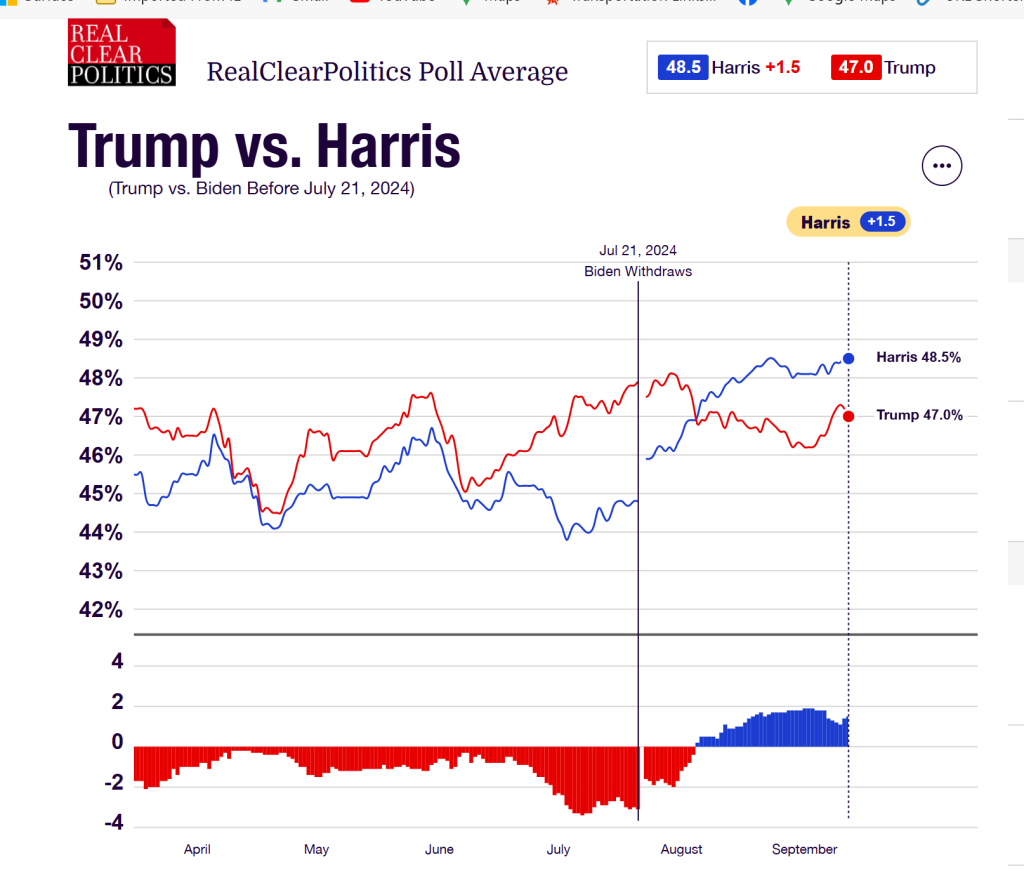
Real Clear Politics aggregation of polls also has it virtually ties: Harris 48.5, Trump 47.
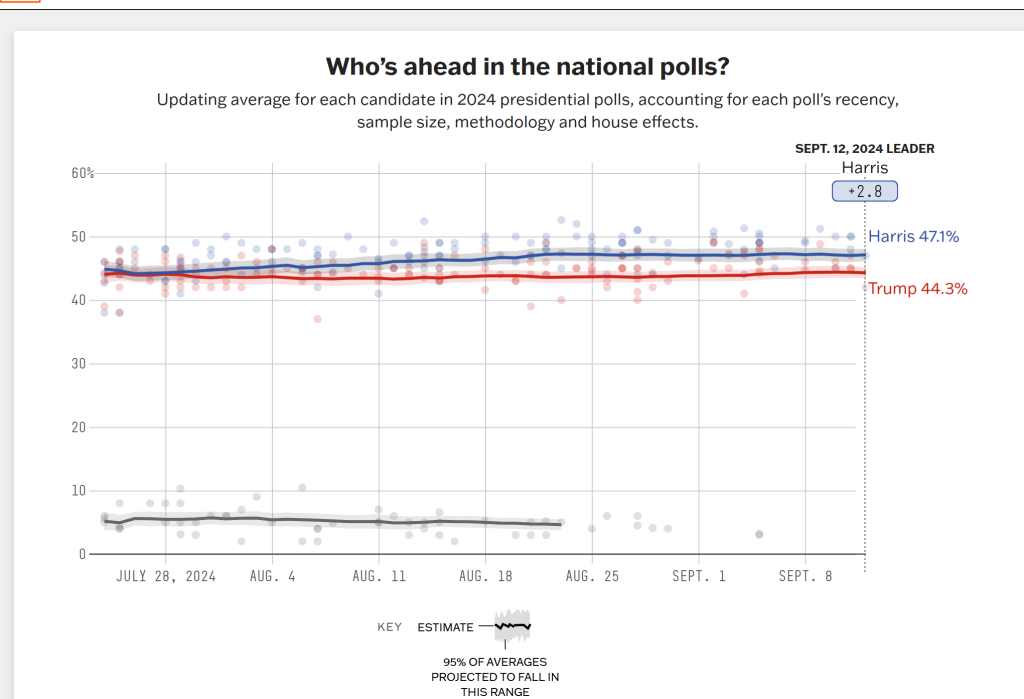
The 538 aggregation of polls also has the national vote evenly split. Harris 47.1, Trump 44.3 – but all within the margin of error.
As I’m sure you know from 2016 election of Trump v Hillary Clinton, and the 2000 election between Al Gore and George W Bush, the true winner is the person who carries the electoral college. This year, there are 7 states in true competitive play. The other 43 states have very consistent voting trends that lead the political experts to conclude that we know how they will vote.
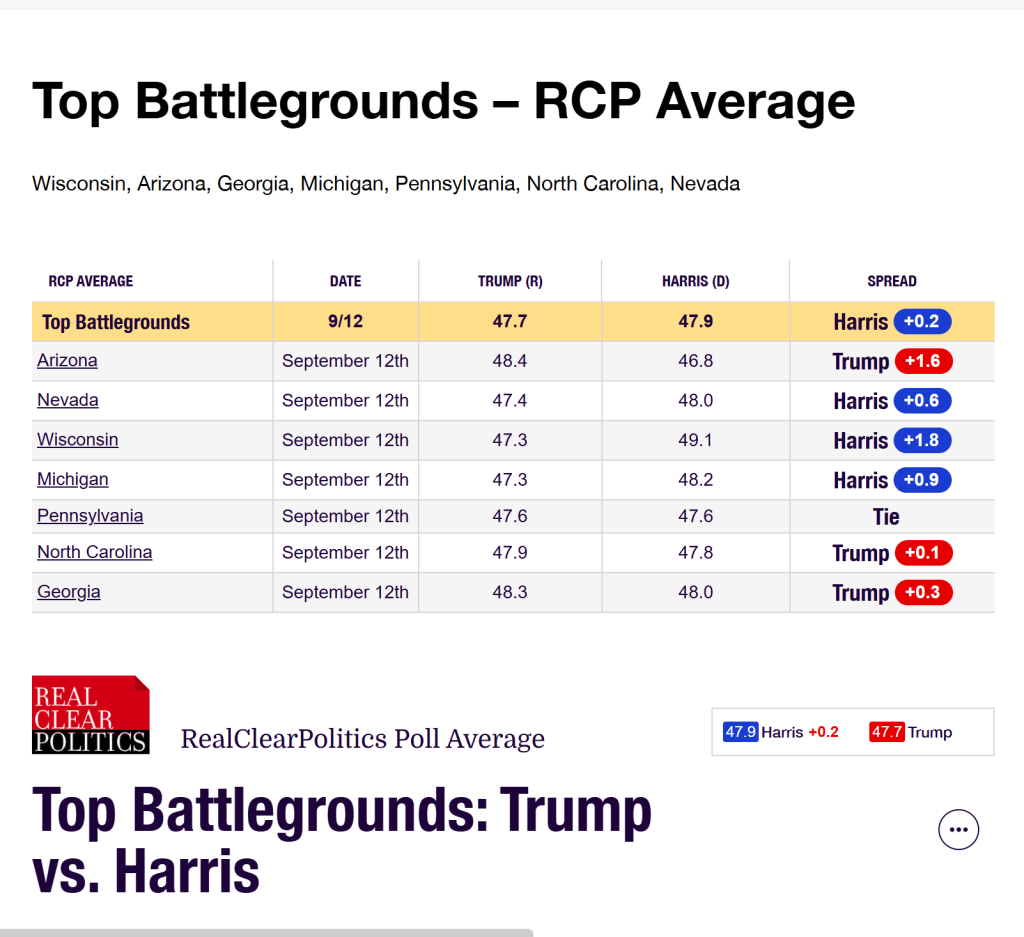
So we have 7 states that will decide this election: The industrial Midwest states of Pennsylvania, Michigan and Wisconsin. And the sunbelt states of Nevada and Arizona in the West, and Georgia and North Carolina in the South. As you can see, all 7 competitive states are virtually tied and deadlocked at present.

Fox News is showing the same deadlock in all these states.

Real Clear Politics has the same
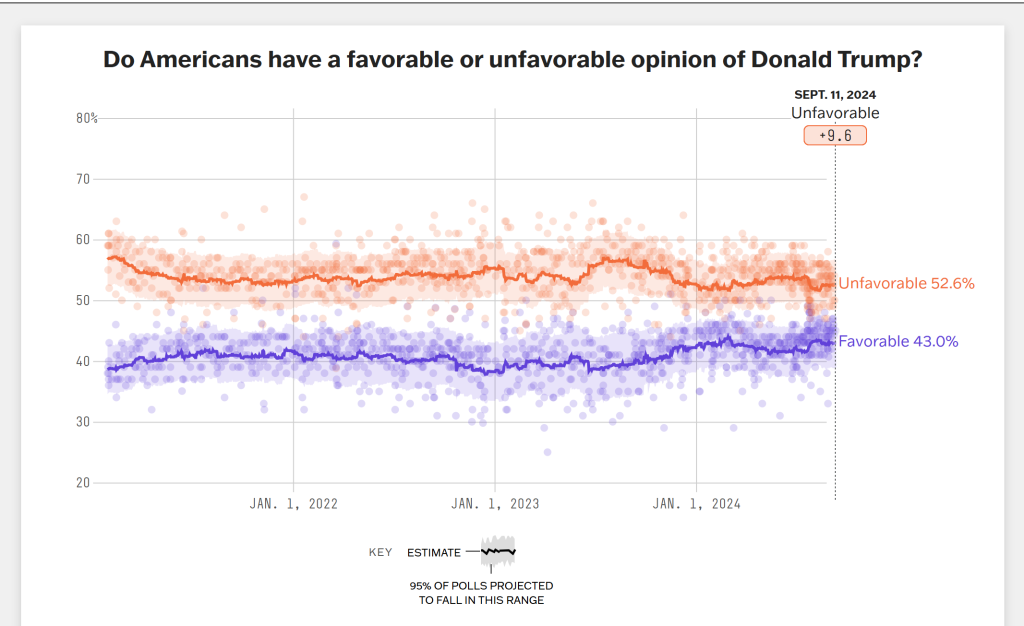
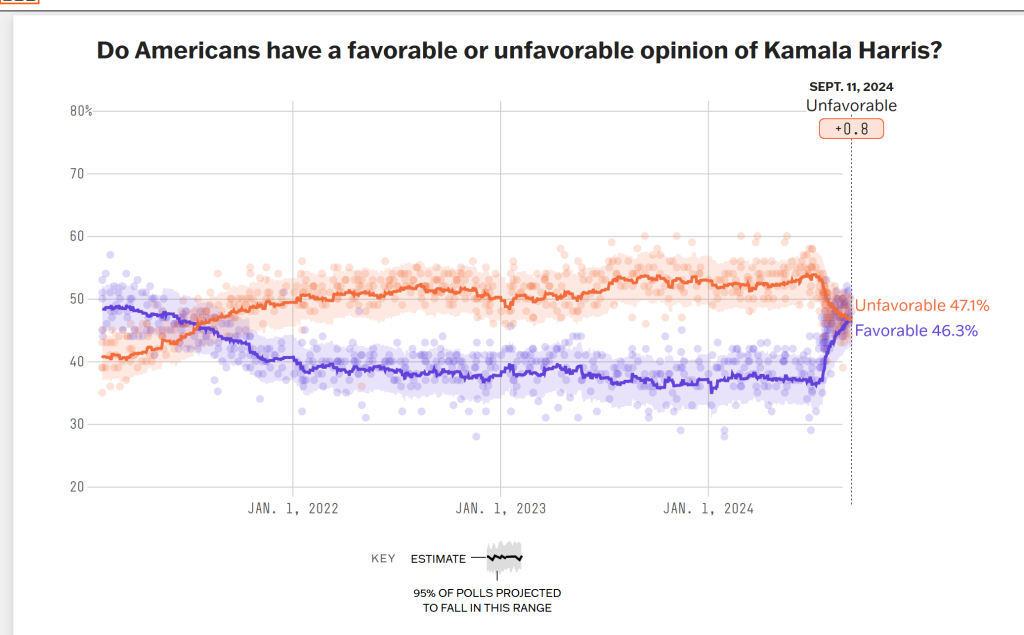
I now want to turn to a key factor in this race. How are Trump and Harris viewed in terms of their favourability? For Trump, he is in negative territory: 43% favourably, 52% unfavourably. Trump has never cracked 50% favourable. His negative ratings reflect the view of many that he alienates many voters, especially on character and temperament issues – is he fit to return to office?
Harris on the other hand is now virtually even on favourable / unfavourable. This is a high point for her. On the left hand side of the graph, you can see her favourable rating in decline from when she took office with Joe Biden. Biden’s ratings are virtually the same. Where the two lines cross, early in the Biden presidency, is the withdrawal from Afghanistan. Biden has never returned to 50%+ favourability. But Harris has – because of the unity of the Democratic Party in backing her and her exuberant style and presentation to the public in her debate with Trump
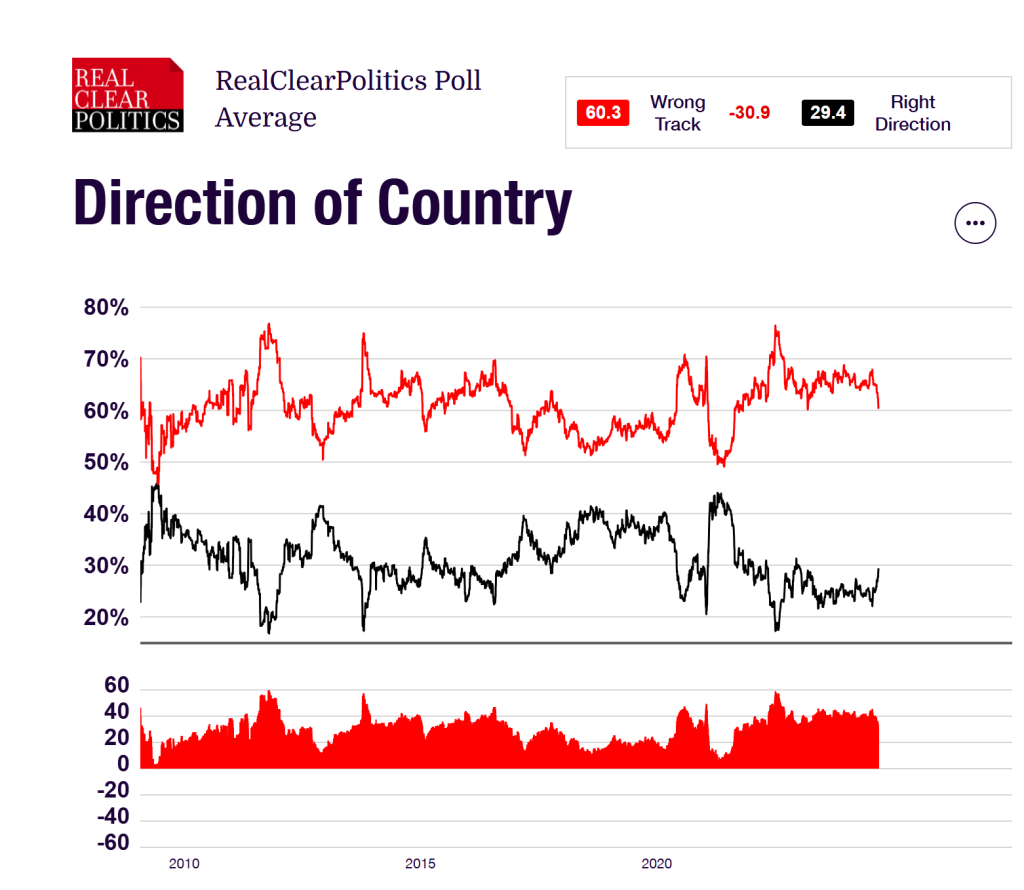
Another key factor in how the election plays out is in the direction of the country. A classic polling question is: Is the US on the wrong track, or is it moving in the right direction? As you can see, “Wrong track” has been as high as 70 per cent under Biden-Harris, and is now about 60 per cent. “Right direction” is held by just 30 per cent.
This is a signal that most voters want change. But I want to suggest that not all the desire for change comes from Trump supporters. Some of these numbers reflect voters that have had enough of Trump. So while Trump does have a strong showing of being the change candidate for most voters, Harris is also, for some voters, a change candidate after 8 years of Trump being in public life.
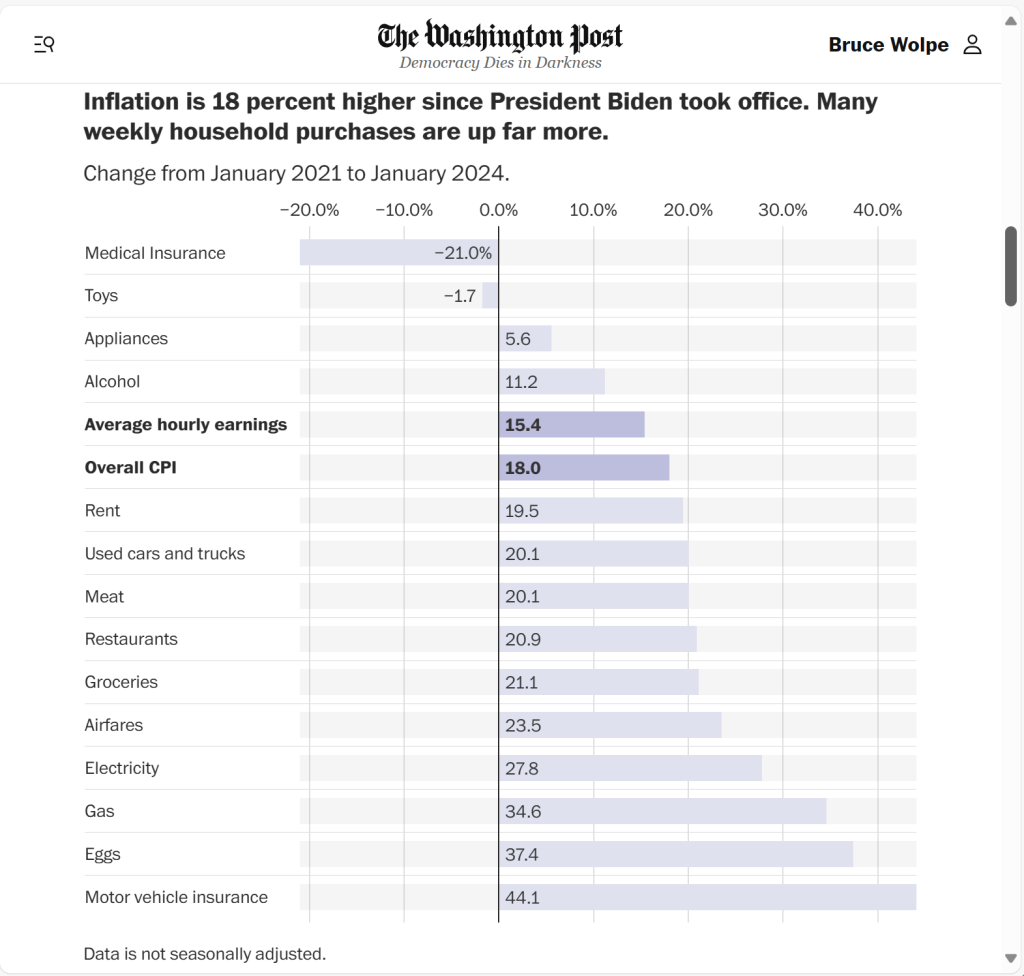
Aside from Trump and Harris as leaders and candidates for president, there are three major issues in this campaign. First, inflation. As you can see, prices for a basket of common consumer goods and services have gone up between 10 and 30 percent since Biden took office compounded by the highest interest rates in 30 years. People are really hurting. The same has happened in Australia. These high prices and interest rates are a big driver in voter unhappiness with the economy. This explains the drag of the economy on the standing of Biden and Harris – and here in Australia, on Prime Minister Albanese.
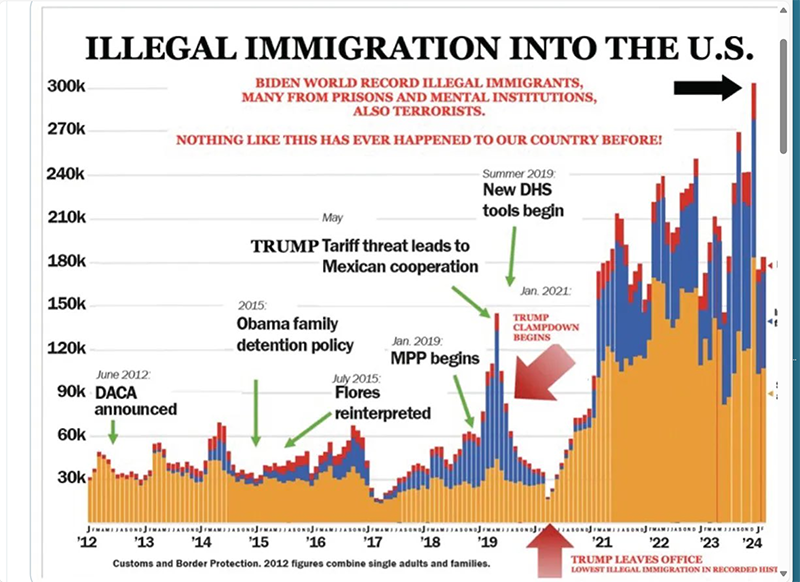
The second big issue is immigration. This chart shows the numbers that have poured across the southern border. This is a very potent and emotive issue – I hardly need to tell that to an Australian audience. These numbers feed the view that there is no security at the border in the US
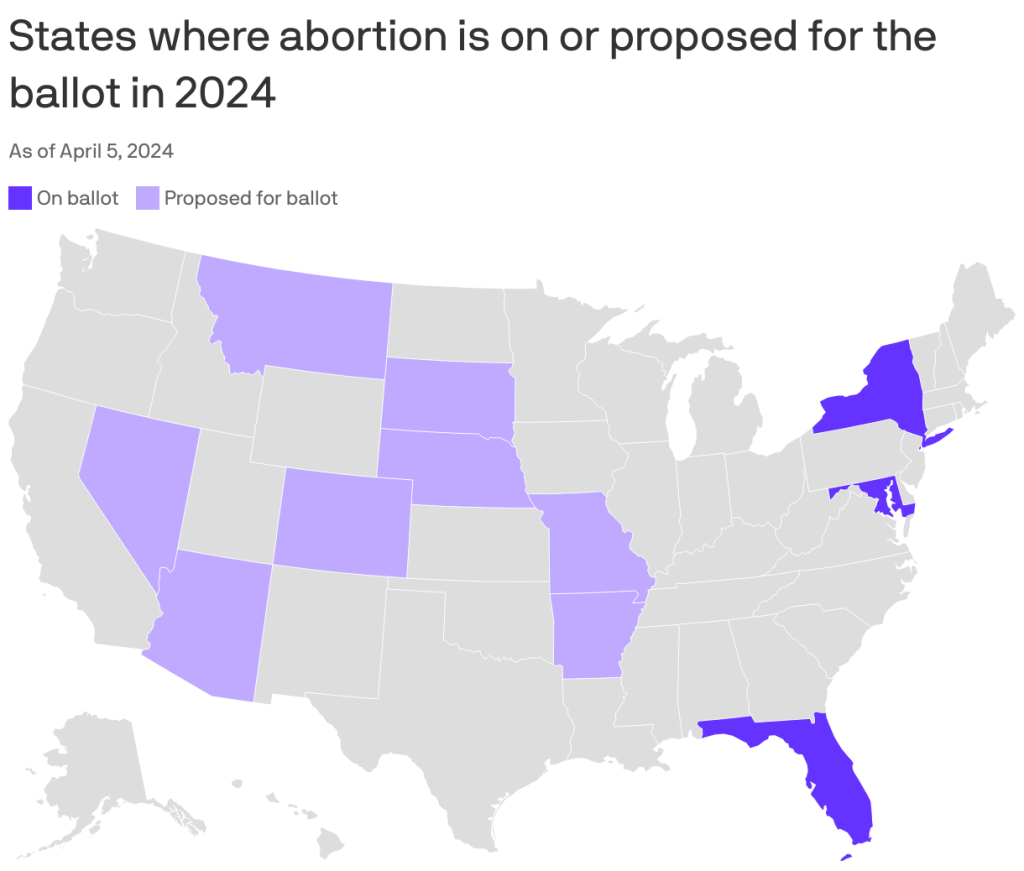
The third major issue is abortion. The repeal by the Supreme Court of Roe v Wade has triggered a wave of antipathy among American women, their families and associates. Most Americans – 65 per cent – want abortion rights restored. The Supreme Court judgment returned the issue of legislating on abortion rights to each state. There have now been several referenda in states with restrictive abortion laws to overturn those restrictions. These measures have passed in overwhelming numbers, even in conservative states like Ohio, Kansas and Indiana. This November, abortion rights measures are on the ballot in Nevada, Arizona and Florida among others. Arizona and Nevada are swing states. This could help support for Kamala Harris, who has been a champion on this issue. The vote in Florida on abortion might also carry into the presidential race – we will see.
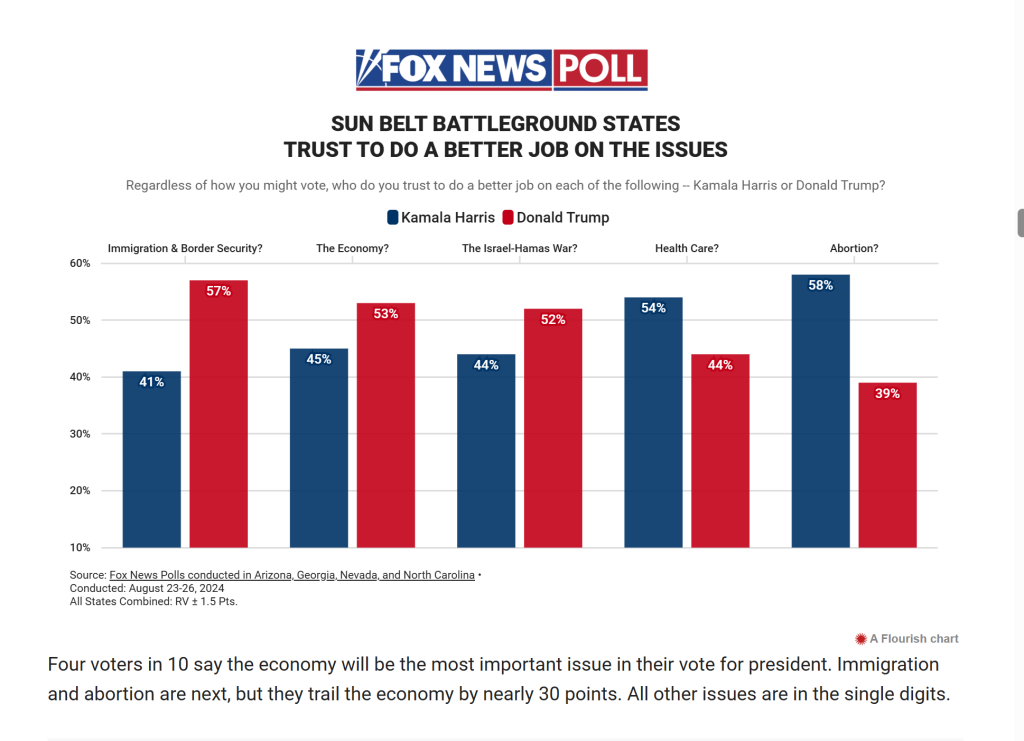
The next driver of the issues and how voters assess the election is: Who is better at managing these issues? As you can see, on the economy and immigration, Trump is strongly seen as the better manager of these two issues. This can be very helpful to him.
The Pew poll shows the same judgment about who is better on these issues. There are also some character issues assessed in this poll.
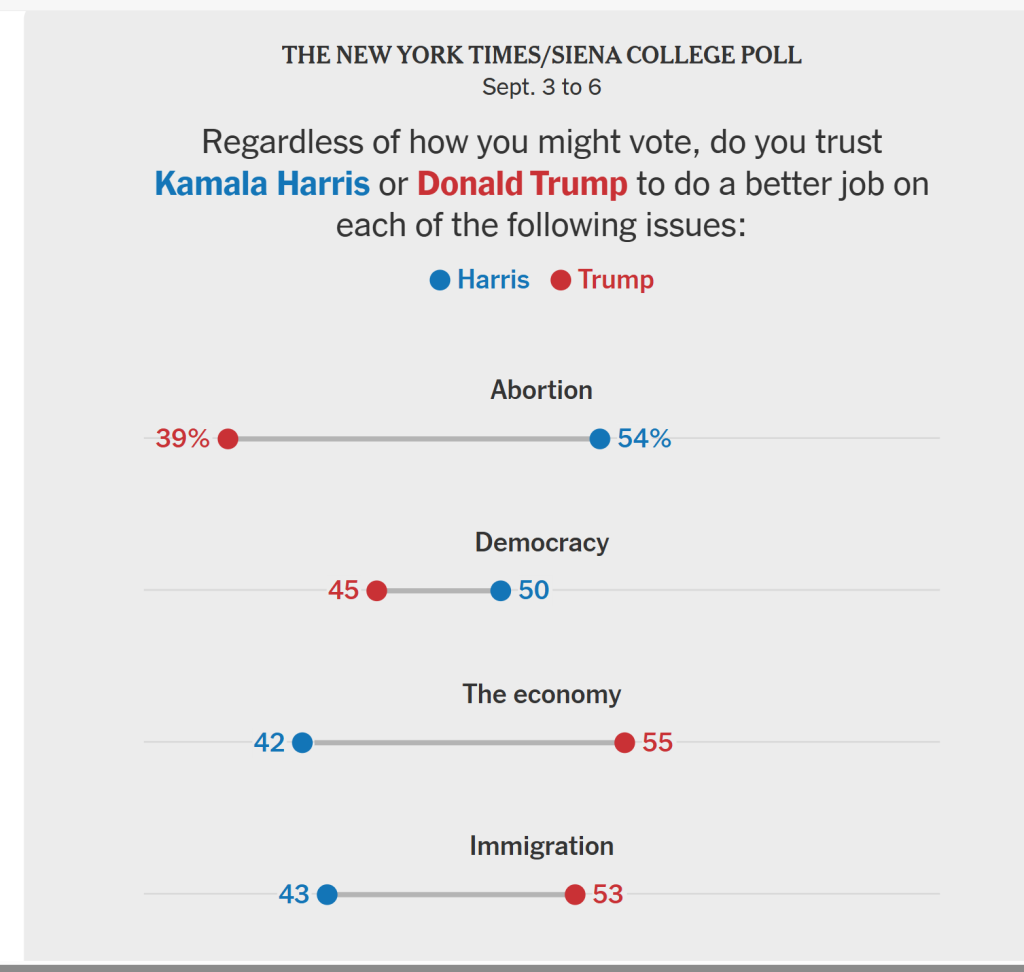
Ditto with the New York Times – Siena.
All of this is significant because, as is the case here, the economy is almost always the #1 issue of importance to voters as they make up their minds. And this year, immigration is a very hot button issue. So these judgments help Trump.
The next question is: Okay, we get the issues and who is better in managing them, but how much are voters enthusiastic about this election. And what is clear is that Trump has high enthusiasm from his base. But Harris is enjoying a massive burst of enthusiasm from voters who were decidedly unenthusiastic about Joe Biden but are ready to jump in for Kamala. See especially the blue trend line from 2020 to today.

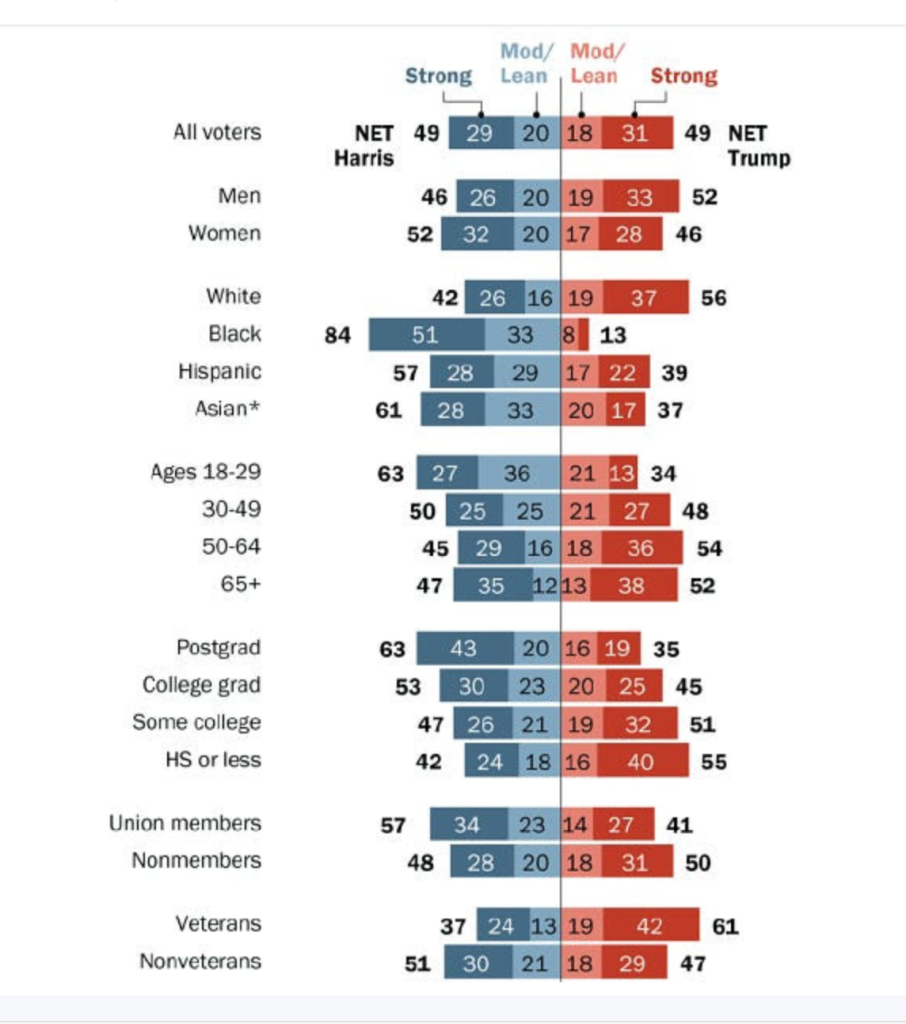
We now turn to the voters broken into demographic groups. Trump’s base is mostly white working men with less education and skewing older. There is a huge gender gap breaking for Harris from women. She has strong support from people of colour, and younger voters. But she is still short in certain segments of voters who were for Biden in 2020 and who carried him to victory over Trump. She is not yet at Biden’s numbers with Black voters, Hispanic voters and younger voters. She is clearly gaining in all three categories, but is not there yet.
All of these polling measures get reified into the state of play across the country – and the undecided states. This is the Electoral College map from Larry Sabato and the Center for Politics at the University of Virginia. You can see the Blue Democratic states and the Red Republican states. And in yellow are the 7 swing states. And you can see how the Electoral College stands between Democrats and Republicans. It takes 270 electoral votes to win. There are 93 tossup electoral votes in those 7 states.
With this map you can play political math on how to get to 270.
For Harris, if Pennsylvania, Michigan and Wisconsin go blue, she gets to exactly 270 – and wins.
For Trump, if he can carry just one of those 3 industrial states, and all of the sunbelt states, he wins.
But Harris, even if she loses one of the industrial states, say Pennsylvania, can make that up by carrying Georgia or North Carolina plus one of Nevada or Arizona.
The thinking right now is that Harris has more paths to 270 than Trump.
There is no clear favourite right now.
All of which is to say, the state of this election today is exceptionally tight.
