
 TIANANMEN SQUARE AND ITS AFTERMATH – 35 YEARS ON
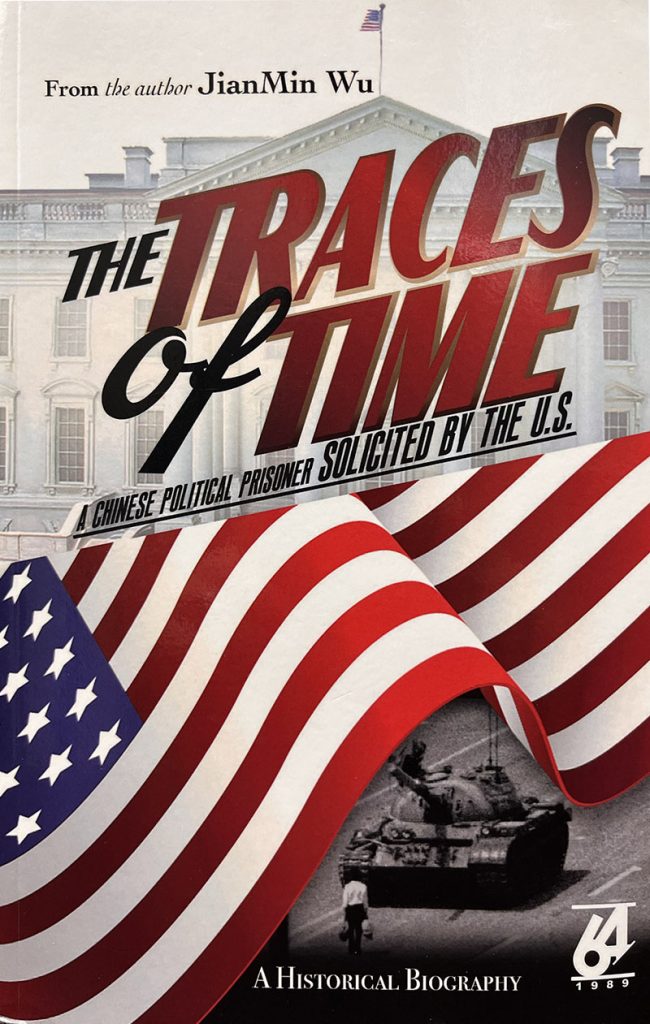
THE TRACES OF TIME – A CHINESE POLITICAL PRISONER SOLICITED BY THE US, by JianMin Wu [Wu Jianmin].
Bouden House, New York
RRP: $US38.00
Reviewed by Keith Harvey
The 2024 US Vice-Presidential candidates debate between J D Vance and Tim Walz was broadcast live into mainland China – except when the subject of Walz’s presence or otherwise in China during student protests in Tiananmen Square came up for discussion. Suddenly, the broadcast was replaced by a screen which declared: “No signal, please stand by.”
This was not true, of course, but was simply the actions of Chinese Communist party censors continuing to block any reference to the massacre which occurred in Tiananmen Square on the morning of 4 June 1989, now 35 years ago.
Generations of young Chinese have grown up knowing either nothing of these events or only the Chinese Communist Party’s untruthful propaganda slandering the youthful pro-democracy activists who flooded the Square in May-June 1989 seeking reform and change in the country following the death of former CCP General Secretary Hu Yaobang. Students thought that commemorating his life might assist campaign to end political corruption and move China towards democratic reforms.
The year 1989 was an epochal time in European history with the collapse of Communist rule in Eastern Europe. Perhaps this could be true in Communist China as well?
The Traces of Time is a personal account of one student democracy advocate – Wu Jianmin (not to be confused with a Chinese diplomat of the same name) who was not in Tiananmen Square on the morning of 4 June.
Wu was a student in the central Chinese city of Nanjing, an ancient capital of China, some one thousand kilometres to the south of Beijing. Wu was a “second Red generation” person, the son of a CCP cadre, and who had, prior to attending university in Nanjing, served in the Peoples Liberation Army. Notwithstanding his background, he became a student democracy activist in Nanjing in May 1989, wishing to support the student protestors in Beijing.
Wu now acknowledges that the hopes of the student protestors were naïve – there was never any possibility of the CCP reforming itself and relaxing its grip on power. The only possibility of real change in China lies in the removal of the Party from power and the introduction genuine participatory democracy. Interestingly, from today’s perspective, Wu and others hoped that the accession to power of Xi Jinping as paramount leader in China would lead to an official change in the regime’s attitude to the 4 June events. This too proved to be naïve – the opposite has been true and repression, which eased slightly in the 1990s, has returned with even more force since Xi took office in 2012.
Nevertheless, Wu and his student colleagues were determined to support their fellow activists in Beijing and, when the campaign in Nanjing began to flag, Wu proposed that the Nanjing students combine and embark on a “North March” to Beijing. Wu’s idea was to gather other student supporters and gain media attention on a long march of 1000 kms on foot towards the capital.
The march began only in late May, not knowing what was about to happen in Tiananmen Square. By the evening of 3 May, the Nanjing students had only made it to Chuzhou in Anhui Province, about 60 kms from their starting point. Wu was abducted by security forces – returned forcibly to Nanjing and only allowed to return to the marchers if he promised to persuade them to return. He went back, but did not keep his promise.
On 4 June, the local authorities were aware of what had happened overnight in Beijing and were emboldened to stop the Nanjing march as well. Wu, and other leaders of the movement were placed under restriction and investigated for “anti-revolutionary activities”. Oddly, the investigation ran well into 1990 before he was finally arrested and – despite promises of leniency for students – was sentenced to 10 years in prison in 1991.
Wu did not take the opportunity to escape from China, believing that continuing political activity in China was the only way to bring about reform. He thought it unlikely that he would be able to lead a successful life outside China, thinking himself to be a small fish in the Chinese democracy movement. He was unaware that US Secretary of State James Baker (under President George Bush, Snr) had visited China in 1991 seeking the release of a number of democracy activists and that Wu’s name was on his list. This is the meaning behind the book’s subtitle “A Chinese political prisoner solicited by the US.” Wu was not released.
Like many other democracy activists, Wu was shocked to see how quickly Western countries normalised their relations with China after the Tiananmen Square massacre.
Wu served most of his sentence in jail. This is perhaps the most evocative chapter in his book, although Wu, if anything, tends to downplay the severity of his treatment and that of other prisoners in Chinese jails. Wu was beaten, but this is just mentioned briefly once or twice. He details the system by which prison authorities kept the inmates under control.
In just one shocking sentence Wu notes what happened to prisoners who were executed (usually just before a national holiday). All that was required of their families, Wu says was for them to “go to the funeral parlour, collect the ashes and pay for the bullets”. Yes, the Chinese State requires families to pay for the cost of the bullets with which their loved one has been killed.
Wu became a skilled worker in the prison factory in which he was incarcerated. He describes that work in some detail without saying what the end products were, but this account is enough to remind us that buying products from China always carries the risk that they may have been made with forced prison labour.
Wu’s father had advised him always to fail the regular medical examinations. Initially, Wu was surprised by this advice and the interest that the prison authorities took in the health of the inmates. However, he came to realise that this interest stemmed from the equally horrific practice of “organ harvesting”. When senior Party officials needed organ transplants, healthy prisoners were often the source and they were “transferred to Xinjiang” and never heard of again.
Wu failed his regular medicals by pricking his finger and making sure that there was blood in his urine sample. Since he was otherwise a young and healthy prisoner, he believes that in this way he avoided the fate of many others.
Wu was released from prison in 1997 after a special reduction in his sentence but one which he believes was related to China wishing to improve its image at least temporarily to assist negotiations regarding its accession to the World Trade Organisation.
While he was released, he was not allowed to live in his hometown of Nanjing but forced to live elsewhere. Amazingly, he became a successful businessman, even holding elected office in the local Chamber of Commerce. He was still on the Government’s watchlist – the CCP wanted him to sign a declaration of loyalty to the Party, which he consistently refused to do, even at the cost of personal happiness (a fiancé’s family refused to accept him as a son-in-law unless he did so, fearing reprisals).
Wu lived in China until 2015. In the preceding years he had, under strict restrictions, managed to secure a passport and a visa to enter the United States (under the Clinton administration). Fortuitously, his passport, which was normally held by the security authorities came into his hands. Wu learned that as part of a new crackdown on dissidents or people previously convicted of “anti-revolutionary” activities, he was now again subject to arbitrary arrest and detention.
Wu and his wife and children quietly left China in 2015 and now live in the US State of California. His autobiography ends at the point of his departure for the United States but his work continues. Wu is active through his YouTube Channel “Tear Down the Wall with Jianmin” – which appears to be entirely in the Chinese language.
His book is full of detail – his recall of names is extraordinary – and, in places there is perhaps too much attention to detail for Westerners not familiar with China. The book is well illustrated and important documents are pictured in the original but also translated into English. It is published by Bouden House which specialises in Chinese language publications.
The book is not readily available in Australia but may be purchased via Amazon US. A Google Books eBook version is also available but the sample is in Chinese. Scroll down this page until you find the listing: https://boudenhouse.com/tu-shu-books/home-3/
Wu’s story is a simple but profound one: one person’s struggle to achieve democratic reforms in his home country – and the price he paid. Wu well achieves his purpose of showing what the student activists were seeking to achieve in May-June 1989 and to tell the current generation of China about these events.
Wu shows by his life that reform of the Chinese Communist party is not possible – and that fundamental change will only come about when the CCP is no longer in power. So far, under Xi Jinping, the trend is further tightening of the Party’s grip on power. No relaxation is in sight. This has implications for the Chinese people – and for the world. Co-existence is not possible.
Keith Harvey worked in the trade union movement for nearly 40 years and is a non-factional member of the ALP. His memoir Memoirs of a Cold War Warrior was published by Connor Court in 2021.