
 TO THE TWENTIETH CENTURY HEROES OF STALIN’S TERROR
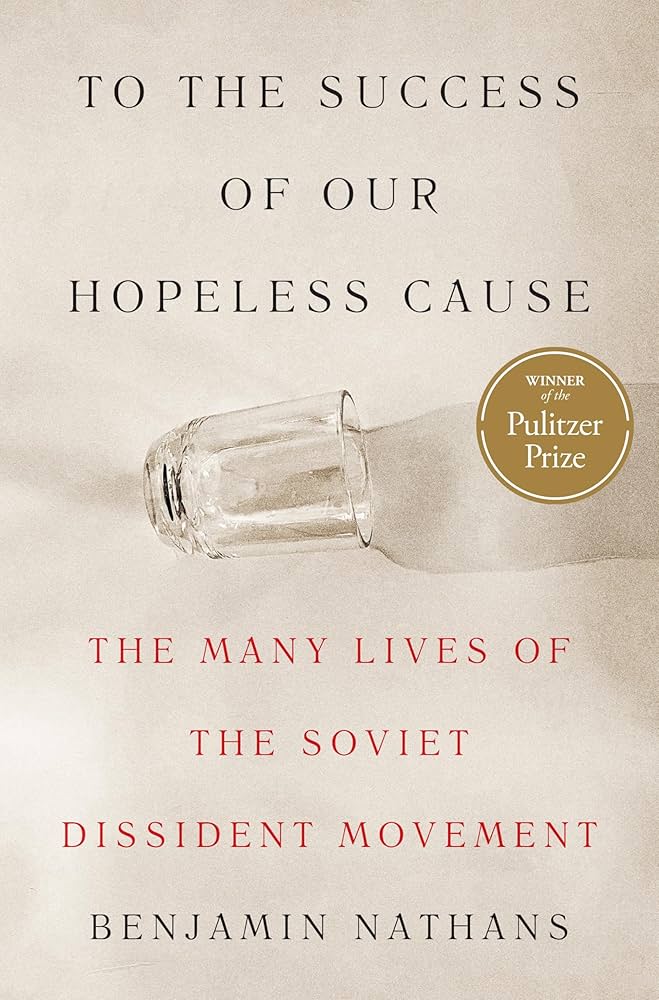
TO THE SUCCESS OF OUR HOPELESS CAUSE, THE MANY LIVES OF THE SOVIET DISSIDENT MOVEMENT
by Benjamin Nathans
Princeton University Press, 2024
ISBN: 9780691117034
RRP: $79.99 (HB), eBook AUD $27.99
Reviewed by Keith Harvey.
To the Success of Our Hopeless Cause: The Many Lives of the Soviet Dissident Movement by Benjamin Nathans thoroughly deserves its 2025 Pulitzer Prize award as the General Non-fiction book of the year (as well as its other awards).
As he researched and wrote this book, Nathans was told that he was wasting his time and talents on this subject. After all, critics said, the movement he was writing about failed in its objectives and the movement and the individuals who comprised it appeared to have little or no impact on the demise of the Soviet Union or any role in post-Soviet Russia.
Their cause was, in effect, hopeless and unsuccessful. The movement involved only a few individuals and was comprehensively suppressed by the KGB.
But this story is important and Nathans’s account is deeply researched, reflective and analytical. This account tells the story of the movement as a whole and provides biographies of its key figures. Once involved with the story the reader feels compelled to continue to the end of this long book (640 pages of text plus another 130 pages of Notes and an extensive Bibliography).
The author’s research for this book was described as “prodigious” by the Pulitzer citation and this is almost an understatement. Nathans carefully describes his sources, including about 150 memoirs and other accounts by Soviet dissidents, interviews with former dissidents now living in the West, samizdat publications but also documents from KGB archives.
The last source includes Russian KGB archives but, where these were or became unavailable, Nathans discovered that KGB files on the dissidents were often also held in former Soviet republics which are now independent countries and were available to him.
As a result, the book contains excerpts from transcripts of interviews conducted by the KGB with arrested and detained dissidents as well as KGB analysis of the overall movement and the extent of its activities. Some of its members were unaware of each other until they met in prison.
The Soviet dissident movement emerged following “The Thaw” that occurred after the death of Josef Stalin in 1953. It could not exist beforehand because of the random terror directed by Stalin and what Nathans refers to as the “participatory dictatorship” imposed by Stalin. Those arrested by Stalin’s secret police confessed to the most fanciful crimes and implicated others in an ongoing orgy of arrests, imprisonment, and judicial and non-judicial death sentences.
Under Nikita Khrushchev and his successors, the random terror ended but this did not mean the end of totalitarianism or suppression. But it did allow a small window for a dissident movement to emerge. But this is not to say that it was tolerated by the Communist Party.
It is important, argues Nathans, to understand what the movement was and what it was not. Firstly, although he feels the need to use the term, the word “dissident” itself was not a Russian term. Rather, it was a term applied by Western media seeking to give a collective name to a movement it did not fully understand.
Leading figures in the movement in the USSR preferred other terms, especially “other thinkers” and “rights defenders”. For reasons explained shortly having a view different to that of the dominant political class – “other thinking” – was unusual and difficult not just because of the totalitarian nature of Soviet communism but also because of traditional Russian political culture and society. The idea of a “loyal opposition”, it would seem, does not have much traction in Russia and is again absent today from Putin’s Russia.
Between 1956 and 1991, the “participatory dictatorship” of Stalin – in which all citizens were expected to take part in repression – was replaced by “lip service” totalitarianism – in which citizens could think what they liked in private but all public actions and utterances required conformity with the prevailing Party line. Thus “other thinker” were not tolerated if they expressed their views in any way.
The notion of “rights defenders” is equally important and goes to the heart of the dissident movement’s strategy. This is the key to Nathans’s account of the movement.
What rights did the dissidents seek to defend? Firstly, they sought to defend the rights Soviet citizens had on paper in the provisions of the Constitution and Soviet law. The 1936 Soviet Constitution and much Soviet law pretended that Soviet citizens had many legal rights and protections, like those that existed in Western legal systems.
But these rights were of course a charade, a façade that was used for window dressing and pretence. In reality, what happened in the Soviet Union – at all levels of society – was whatever the Communist Party determined. Courts imposed pre-determined sentences decided on the by KGB and the Communist Party. Penalties by way of dismissal from jobs could be implemented through local Communist Party cells leading to charges of “parasitism” – that is not being gainfully employed which in turn led to imprisonment.
Thus, the initial strategy of the Soviet “rights defenders” was simply to try to demand that the Soviet civil authorities apply and abide by their own laws. Considered by some to be a naive and slightly ridiculous claim, it nevertheless was an important demand.
The strategy was first proposed by Alexander Volpin, who by the early 1960s had already been in and out of prison, psychiatric hospitals, and exile multiple times for “other thinking”. Other notable dissidents had received the same treatment, including Vladimir Bukovsky, Andrei Amalrik [subsequently the author of Will The Soviet Union Survive until 1984], Joseph Brodsky and others
In September 1965 Andrei Sinyavsky and Yuli Daniel were arrested and were to be put on trial for ‘anti-Soviet’ activities. Volpin and others issued a “Civic Appeal” to organise a public “transparency meeting” in Moscow’s Pushkin Square calling for an open trial – as provided by Soviet law. The date set was 5 December 1965 – chosen because it was “Constitution Day”.
This modest activity – which largely consisted of unveiling banners or placards calling on authorities to “Respect the Constitution” – was the first such unauthorised public gathering since 1927 in the USSR. It was immediately broken up by Soviet authorities and all participants detained. The ironies are obvious.
This event became an annual affair although attended by only a small number of people each year. But it operated according to the tactics enunciated by Volpin: the demand that authorities should respect their own laws, that citizens should act as if they actually had the rights provided for in the fundamental laws of the USSR and that there should be “unauthorised” (but legal, according to the Constitution) public demonstrations in support.
Put another way, the “dissident” movement was not dissenting – it was not a movement of civil disobedience as might be understood in the West but actually a demand for “civil obedience” – by everyone but especially by the authorities. It was also a demand for “transparency” – a significant word in late Soviet political history since the Russian word is “glasnost” – and this became one of the themes of Mikhail Gorbachev’s failed attempt to reform Soviet communism.
The limited aims of the Soviet “rights defenders” were matched by the limited size of the movement. At no time, says Nathans, did it seek to become a mass movement – which would have been repressed immediately anyway. Rather, it was a very loose collection of individual “other thinkers” held together by the “weak bonds” or personal relationships. Dissidents were mainly intellectuals or professionals and sought not contact with the mass of Soviet citizens or workers. It was not a broad social movement.
The dissidents developed no alternative set of political arrangements or ideology. They did not necessarily oppose socialism. They were non-political, in a sense, although many became political prisoners. The movement did not promote strikes or work stoppages – both of which were illegal. It avoided giving the appearance of being a “non-Party” organisation – it did not want to change Soviet laws but to organise social and political life in accordance with the promises of the existing laws. It eschewed becoming an organisation at all.
There were exceptions to this stance, of course. Alexander Solzenhitsyn – who was not a joiner of committees or indeed movements – correctly identified the central problem as Communism. This had to be removed for there to be any chance of the freedoms provided by law being realised in practice. There was never any chance of the Soviet Union respecting its own laws in a Bolshevik totalitarian dictatorship in which the Communist Party was never going to relinquish its monopoly on power.
In several instances loose committees were formed but they largely had no structures, no meetings and kept no minutes. The only real “mass activity” of the dissidents was samizdat publications of which there were many types. These included unofficial records of trials of dissidents and other repressive actions by authorities as well as publication of works of fiction and non-fiction which were not allowed to be published in the USSR. One of the most significant samizdat publications was The Chronicle of Current Events which, Nathan writes, had hundreds of contributors and distributors and thousands of readers in cities and towns across the USSR.
Samizdat was the most successful activity of the dissidents as it was frequently smuggled abroad and published in Russian and in translation in the West where it had significant impact – along with works by Soviet dissidents directly published in the West such as Solzhenitsyn’s Gulag Archipelago.
The modesty of the aims and methods of the dissident movement did not save its members from severe action by the Communist Party. The KGB was tasked with supressing the movement and had an escalating series of techniques for supressing it.
These were – in ascending order:
- Calling in dissidents for a “conversation” with the KGB – these invariably included threats of arrest, expulsion from school or university or loss of a job. Young dissidents in particular were shown a very gloomy picture of their future in a society where the Party/State controlled every aspect of political life, society, and employment prospects.
- Exile – either internal or external exile either by persuasion or involuntary expulsion from the Soviet Union. In 1980, Andrei Sakharov was exiled to the closed city of Gorky – out of the reach of foreigners. Since he was a nuclear scientist, it was considered unwise to expel him from the Soviet Union. Solzhenitsyn was expelled from the USSR in 1974. Vladimir Bukovsky was “exchanged” in 1976 in a swap for a Chilean Communist Party official jailed by the Pinochet regime. Nathans writes that 100 known dissidents were persuaded to leave the USSR between the late 1960s and 1985. Those “choosing” to leave were all given permits to go to Israel, whether or not that was their preferred destination – the implication being that they were Jewish – another category of “other” in the USSR.
- Conviction in a trial and sentencing to periods in prison or the labour camps of the Gulag – which continued to exist – followed by periods of internal exile.
- Involuntary confinement in a psychiatric hospital – which did not require a trial public or otherwise – coupled with drug treatments designed to psychologically and mentally impair the dissident and making all other options seem more attractive. Nathans notes that between 1960 and 1974 alone, there were 674 cases of involuntary confinement of dissidents in a psychiatric hospital.
The initial concentration of Soviet dissidents in demanding that their existing domestic civic rights be respected later broadened into a demand for the recognition of broader human rights, such as those set down by the UN Declaration of Human Rights (adopted in 1948) and codified in subsequent Conventions which the USSR signed into law.
Dissidents appealed to the UN Commission on Human Rights, only to have their appeals go unacknowledged and unanswered. It transpired that all the Commission did with complaints was refer them back to the government of the country in question! At one time, a Moscow chapter of Amnesty International was established and Amnesty International itself played a key role in publishing samizdat materials in the West. Two chapters of Nathans’s book are devoted to the role of Amnesty International and its local Moscow group.
In 1975, the Helsinki Accords were adopted. Primarily, these recognised the post Second World War boundaries of Europe and this was a key policy objective of the USSR. The Accords also contained pledges that signatories would respect human rights in their territories. This provided another opportunity for dissidents to campaign on human rights, establishing the “Public Group to assist in Implementing the Helsinki Accords in the USSR” – known in short as the Moscow Helsinki Group.
By the end of 1976, this group managed to produce 15 dossiers on human rights violations in the USSR and distributed them to the 35 countries party to the Accords. Helsinki groups were also established in several Soviet republics.
The Soviet Union’s commitment to the Helsinki Accords did not protect the members of the Moscow Helsinki group. In the lead up to the first Helsinki follow up conference in Belgrade in 1977, ten Moscow Helsinki Group members were arrested. Over the following two years the number of arrests doubled until nearly all its members were in prison. Long prison sentences and periods of exile were imposed – some of which would have lasted beyond 1991 when the USSR ceased to exist.
By September 1982, the KGB had succeeded in forcing the Moscow Helsinki Group to close as it had too few members to continue its work. The Moscow chapter of Amnesty International closed for similar reasons.
Thus, by the early 1980s, the dissident movement had been comprehensively defeated by the KGB and the Communist Party. Was it all in vain? Was the cause hopeless, as the dissidents’ toast suggested?
Nathans notes:
The wonder of the dissident movement is how so few people with so few resources managed to discredit so profoundly the USSR’s claim to be a modern, lawfully governed country.
Of course, as it now a matter of history that less than a decade after the dissident movement ceased to function, the USSR imploded and ceased to exist. Did the dissidents have a role in this demise? The evidence for this is not strong but it is worth noting that Gorbachev’s call for glasnost or openness reflected one of the earliest demands of the dissidents. And, as it turned out, Soviet communism could not survive in the open.
But change in the Soviet Union did come eventually from within the Communist Party – not from without. It took Gorbachev’s reforms and Boris Yeltsin’s break with the Communist Party to achieve this. But there was another model of effective dissent – in Poland, a Soviet satellite state, intellectual dissidents combined with a powerful workers movement and the Catholic Church to force the first break in the Soviet bloc. That combination of forces proved to be stronger than intellectuals on their own – and to be a winning strategy.
Interestingly, few of the dissidents played any significant role in post-Soviet Russia. Unlike Czechoslovakia where Vaclav Havel became President and indeed in Poland, Russian dissidents were few on the ground after 1991. Many had been expelled from the country. Bukovsky returned to Russia in 2007 to run against Daniil Medvedev (when he swapped places for a term with Vladimir Putin) but was barred from running.
Of course, in today’s Russia of Putin (who learnt his “skills” in the KGB) dissent is again not tolerated. Those human rights groups that did operate for a time in the Russian Federation have also been shut down by Putin. Nathans concludes:
Should Russians find their way to political pluralism and the rule of law, they too will need a usable past. The story of the Soviet dissident movement will be waiting.
This is a powerful book, well researched and written. It is highly recommended to those with an interest in the sorry history of Soviet Communism but also with lessons for the present. Potential readers can view a moderated discussion with the author here, courtesy of the US based Kennan Institute:
(399) The Long View #005 – To the Success of Our Hopeless Cause with Ben Nathans – YouTube
Keith Harvey is a non-factional member of the Victorian ALP. His Memoirs of a cold war warrior [2021] detailing his work in the trade union movement is available from Connor Court Publishing as is his biography of former Independent Senator Brian Harradine [2023].