Speaker
Alastair Wilson
Speech Date
March 3, 2011
Issue
Issue 11
Alastair Wilson is the Chief Executive Officer of the School for Social Entrepreneurs, based in the United Kingdom. He was also the Development Director of the SSE Network of Associate Schools and Founder and Manager of Homeless Direct. Alastair addressed The Sydney Institute on 3 March 2011.
SOCIAL ENTREPRENEURS AND THE BIG SOCIETY
ALASTAIR WILSON
I wonder if many of you have heard of the concept of the “big society? I see a few nods, a few shakes of the head. In the UK, there is a new Coalition Government which is led by the Conservatives, with the Liberal Democrats in the minority. The “Big Society” was a flagship policy of this new coalition government. What they were saying was, “Over to you guys. Government can’t manage these social issues; they can’t grapple with them and get them right. We want to empower communities to come forward with solutions that they understand and can bring to the fore.” The Big Society really is quite a radical vision, but there’s been a bit of struggle since the new government came to power in terms of truly understanding what the term means and how to engage with that.
First let me tell you a little bit about the School for Social Entrepreneurs. We support social entrepreneurs in bringing solutions to social problems to the fore. Some of you might have heard of Michael Young. He was a serial social entrepreneur who throughout his life (Michael died about 6 years ago) started some 40 national and international social enterprises. He invented everything from the Open University to Education Extra and the School for Social Entrepreneurs. As well as Which? magazine, over here called Choice magazine, and the translation services Language Line which internationally is called “TIS”.
He was a serial social entrepreneur who throughout his life (Michael died about 6 years ago) started some 40 national and international social enterprises.
Michael Young was a remarkable man. I was lucky enough to work with him for a number of years. One small story illustrates how he worked. We were based in Bethnel Green in East London. One day, Michael was mad keen for a cup of tea, and popped the kettle on. But the kettle had been boiled dry. Somebody had broken it. He went straight to the electrician’s shop, bought a kettle, brought it back, filled it with water and pressed go. It was a very slow boiling kettle. Now Michael was a man in a rush; he had plenty things to do. He went straight back to the electrician’s shop and bought a second kettle, but he didn’t take the first one back. He bought a second kettle. Then there were two kettles, side by side. He filled them both with equal quantities of water and pressed go and measured the boiling time of both kettles.
After this small experiment, Michael wrote on a document “Which?” – or Choice? if you’re an Australian – “Which? Edition 1: Which Kettle? The boiling times of two kettles”. Then he called a press conference in a Park Lane hotel to launch Which? magazine. He was quite surprised at a fairly good turnout. He returned to Bethnel Green. The next day a black cab pulled up at the office. A black cab wouldn’t come to the East End in those days. A fellow in a pin-striped suit got out and entered the office to ask for a copy of Which? magazine. This was 1950. Michael had nothing more than a carbonated handwritten copy of the boiling times of two kettles but he gave the man what he had and then asked where he had come from the man replied, “I’m from Marks and Spencer, Baker Street in London.” Michael knew then that, if he had the retailers worried, he was onto something.
Michael knew then that, if he had the retailers worried, he was onto something.
Which? magazine had 800,000 subscribers pretty much overnight. Its dividends and profits went to the Consumer’s Association to action fights on behalf of the poor for things like access to basic bank accounts, basic utilities, and so on. They refused grants or sponsorship because they wanted an independent voice to fight on behalf of the poor. So that was Michael Young. And I could tell you many other stories of how Michael Young started his various institutions. Basically, he often just tried something or tested something and if it worked (he had many ideas that didn’t work) he would scale it and try to grow it.
For Michael Young, entrepreneurship (social entrepreneurship) was a doing word.
For Michael Young, entrepreneurship (social entrepreneurship) was a doing word.
Michael Young believed that entrepreneurship, the most important hurdle or difficulty for people who were trying to start something new from scratch, could not be taught. Take confidence or legitimacy or attitude or mindset or behaviour or persistence – you can’t teach these qualities as a lecturer with content. But you can learn them by having a go and starting your thing. By getting a bit more confident. And also by learning from your peers, the other 20 people in your cohort who are trying to start as social entrepreneurs. Along with hearing from other people who’ve started things.
So, we bring in what we call witnesses. These are social entrepreneurs who’ve started from scratch. That means whole load of social innovation agencies. They tell their story, warts and all. The difficulties. Our students use this to get a handle on how they’re going to behave and how they’re going to push forward and pilot and make their organizations successful.
That’s the perspective I’m coming from. Now, we’ve had good people doing amazing, innovative things forever and a day. Social entrepreneurship is a bit of a rebrand of this. Social entrepreneurships take up the idea of trading and redeploying excess finance to better social work. And that idea has been around forever and a day. So, in terms of these new terminologies, let me try and orientate you as to how it looks in the UK right now.
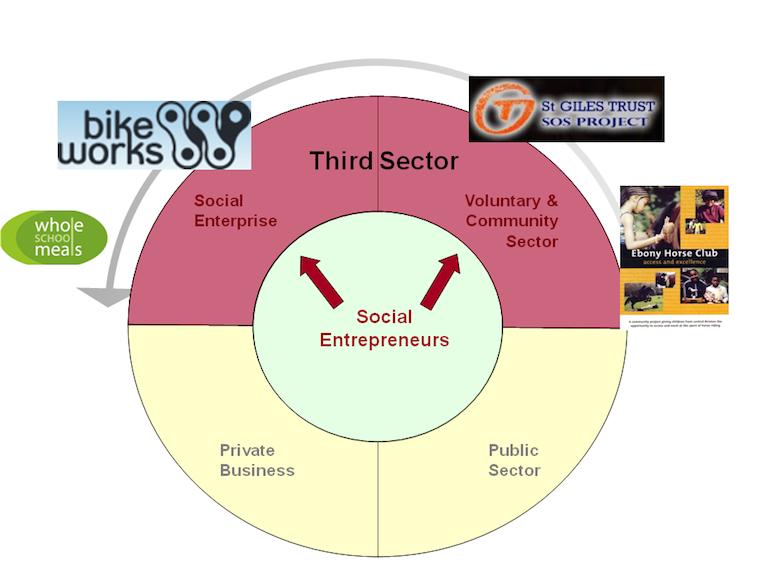
In the old days, it was very clear that we understood what it all meant – private sector, public sector, and voluntary community sector or charities. We had three distinct sectors. But about 10 or 15 years ago in the UK people started speaking about the social enterprise sector as a kind of structural term.
About 10 or 15 years ago in the UK people started speaking about the social enterprise sector as a kind of structural term.
Where do social entrepreneurs operate? If you start an idea from scratch, you don’t have a legal form so you are not in any of the boxes. You come with an idea to the School for Social Entrepreneurs, an idea from scratch, a new idea, an innovative idea. Most tend to pick a legal structure as they go through the year and end up in one of two boxes.
To give you an example, Ros Speeding lives in Brixton in South London. In her local school, loads of boys were being excluded for bad behaviour. They were ending up in her housing estate causing mayhem – trouble on the stairs, drugs, knives and gangs, and so on. Ros had a great idea around horse riding. She started something called the “Ebony Horse Club”. This engaged the boys on the estate who began seeing the way they could achieve things. It flowed from this to attainment, passing exams, turning up on time. They became more confident, more able to re-engage. As a result, in terms of these young people getting back into the mainstream schooling system, the outcomes are absolutely remarkable.
As a result, in terms of these young people getting back into the mainstream schooling system, the outcomes are absolutely remarkable.
So that’s Ros. The next example is Junior. Junior started up something called the SOS Gangs project. Junior was involved in gang problems in South London. As a result, he spent 12 years in prison. When he was released, it was impossible for him not to re-engage with all the old mates that he had. This was a direct route into re-offending and back to prison. The SOS Gangs project works intensively with prisoners prior to release and meets them at the gates on release to try to prevent them from re-offending. Again, a remarkably successful project. Junior’s had over 100 people through his ranks. The re-offending rate (within two years ) for young black men in London between the ages of 18-24 is 72 per cent. Junior’s got that down to 17 per cent.
The re-offending rate (within two years ) for young black men in London between the ages of 18-24 is 72 per cent. Junior’s got that down to 17 per cent.
The next one Bikeworks. This is an amazing story as well. Thanks to a guy named Dave, the Metropolitan police donate all their stolen bikes to Bikeworks. Then people who’ve had severe mental health troubles are trained to refurbish the bikes. They sell them in a big retail shop and all the money goes back to getting more people into employment. They run three groups on a Saturday and Sunday, huge groups involving a 100 people or more, which are volunteer led. They have three primary care trusts in East London who give prescriptions for depression, not tablets but cycling and group cycling. A load of volunteers go about on a Saturday morning and knock up people who are depressed at their homes. They urge them to go out for the day for a mammoth cycling tour. And Bikeworks gets money from the NHS for doing that. It’s hugely successful because loneliness and isolation are two of the big problems that people who are depressed face. So again, another very innovative, very local project. The organisers have matched stolen bikes, meaningful occupation, groups of people, and volunteerism. These are all illustrations of what the concept or notion of a big society is.
It’s hugely successful because loneliness and isolation are two of the big problems that people who are depressed face.
My last example is Whole School meals. This is an incredible one. An amazing woman called Stephanie is behind it. Primary school meals in Britain are pretty shocking. Stephanie’s county council in Kent county decided to outsource all school meals. A pool of private companies tendered for the contract. And Stephanie, with other parents, decided to tender for it. She got the shock of her life when the email came up on her screen saying they were successful, that they’d won the contract. They had to provide, for five years, school meals to nine primary schools. Stephanie’s project is about local sourcing from local farmers, and providing decent food for the kids. It’s been very popular, hugely successful and of course they apply all the profits straight back into improving the quality of the meals and to growing a bigger project among more schools. They are now helping a group of parents in Manchester to do the same thing, to join Whole School meals as a kind of social franchise if you like.
These are just four examples in the spectrum. Ros, if you like, is completely grant dependent with her horse club – grants from people like the big lottery and government grants, no earned income, no social enterprise element. Junior gets things called Social Impact Bonds which is a new innovative finance tool which says: “If you manage to keep this person out of prison for two years, we will pay you the money that it cost you to run that service and a bonus dividend.” He gets independent financiers to stump up the finance. They get their money back from the government, so long as that person stays out of prison. Junior is trading with his clever little mode. He’s one of the Social Impact Bond pilots. Bikeworks is obvious as a trading project. Whole School meals has a huge contract for school meals and doubtless Stepahine will win the re-tendering. All this is called the third sector, what this government is trying to encourage. It’s not new in a sense and we’ve been doing it for a long time at the School for Social Entrepreneurs. But it’s in its infancy as a national project which the government wants. They want this to be provision of services up and down the land.
They get their money back from the government, so long as that person stays out of prison. Junior is trading with his clever little mode.
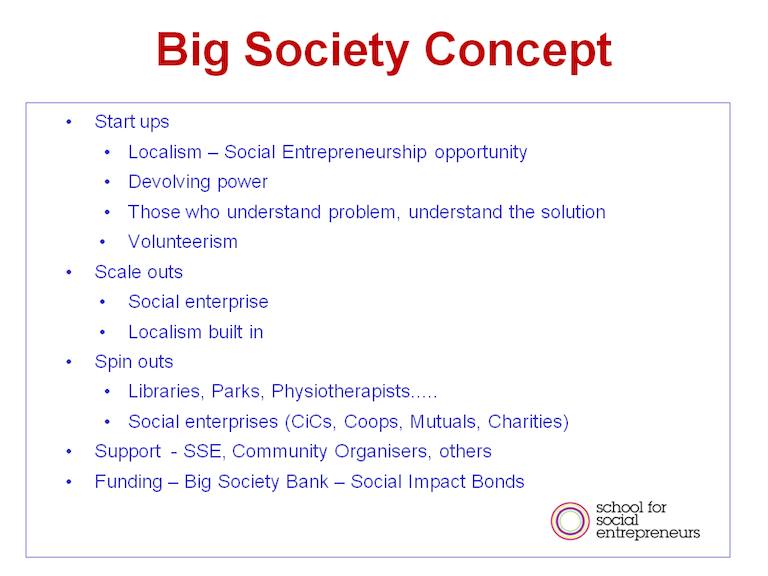
The concept is about localism, about saying that bureaucrats in offices will not understand the needs of people living on housing estates in Brixton where the issue are poverty and crime and so on. How can such bureaucrats design public services to meet the needs of such families? The idea is to empower local citizens to come to the fore. They’ve got vested interests, it is their kids, their neighbours, their community, their family. So why don’t we empower them to come to author solutions, and scale solutions, that work for their communities? It really is compelling to see the results of what can be done. It’s actually saying not “big government” but “big society”, handing over to the people who are motivated and aware. Let’s not have business schools training people in entrepreneurship, that’s a mug’s game. You learn it by doing and you learn it from practitioners. So let’s use action learning as a tool to support them. It’s about devolving power, about volunteerism.
In the UK, we are facing the biggest public service cuts for probably 100 years. People cannot contemplate the change that’s going on in the UK at the moment.
But all this has coincided with an enormous crash in public finances. So it stands to reason people are cynical and see the move as a way to scale back public services for private responsibility. The good story is being clouded by the cynicism, and people imagining hidden agendas. But the state has failed – and this is a way to put the agenda back into the voters hands. So let’s try and give it a bit of weight.
The idea of charity with the old guard is deeply unfashionable. The idea that it encourages dependencies, that it’s Victorian, keeps people in crushed down positions. The new way is social enterprise – trading, earning income and reapplying that for a social mission. That’s all very good and well if you live in Dorset and you have a motivated community that have plenty money and you can leave it to do a bit of philanthropy. But if you try and open up a community café in Brixton while benefits are being cut, particularly if you’re using people maybe who have down syndrome or mental health difficulties to run that café and nobody has any money in that community, social enterprise is not a nirvana. If the market is broken, people in that community don’t have enough money to buy that cappuccino, or whatever it is. And that café will struggle. But social enterprise can make it happen.
The Coalition government has issued huge contracts for welfare.
These are massive, and there’s not one charity or social enterprise in the UK that could manage some of these contracts.
There is one further point to consider. Imagine you’ve got a Bikeworks or an Ebony Horse club or a Whole School Meals and you want to open 20 of them around the country. The problem with social enterprise structures like community interest companies or company limited by guarantees or charities, is that you have no equity or stake holding to give out. You can’t go to the market for capital because you can’t give ownership to people. And we’re being encouraged to think around creative models to try and bring capital in so that we can scale what works and scale what’s good. That’s difficult because the general public’s trust of social enterprise and charity is weak.
A member of the public might choose to buy Café Direct tea, which is fair trade tea, or Divine Chocolate which is fair trade chocolate, or choose to buy a bike from Bikeworks because they understand there’s fairness written into that trading equation. They understand there’s not a leak in the bucket in terms of dividends going out. This movement in the UK to grow social enterprises is very exciting. Deals with financiers or with the private sector mean we can scale what works. But are we playing with our USP or our differential? Social enterprises are owned by either no one or owned by everyone by way of a co-op or an employee owned partnership. All this offers real debates and challenges.
The jury’s out on the big society in the UK. There’s a call for it to be more tangible. Ultimately, if you want a big society to flourish, and you want all these innovative ideas to come to the fore, they need some sort of money. It can’t be completely unsupported by government. There’s a missing piece in the jigsaw as yet, as to what that’s going to look like.