
Speaker
Andrew Low
Speech Date
August 1, 2012
Issue
Issue 17
Andrew Low is the CEO of Redbridge Grant Samuel and has just published the Global Sydney report which lays out a strategy for Sydney to restore its place as the most liveable and competitive city in Australia and to step up to a leading position as a globally competitive hub for services, tourism, education and the arts. Jacquelyne Willcox is Head of Public Affairs at Weber Shandwick – a leading public relations agency in Sydney. She is busy selling Sydney and can see what the problems are, from the business perspective. On Wednesday 1 August, Andrew Low and Jacquelynne Willcox addressed The Sydney Institute to discuss ways to revitalise Sydney.
SYDNEY AS A GLOBAL CITY
ANDREW LOW
As many of you may know, I’ve spent much of the last eight years living and working in Asia. This experience emphasises is how truly unique and precious our city of Sydney is and that that we need to be passionate about protecting the clean, safe, transparent and creatively vibrant environment we have here.
cities like Singapore, Seoul and Shanghai – with none of the natural advantages of environment, lifestyle and climate – and even Melbourne, are overtaking Sydney in many areas
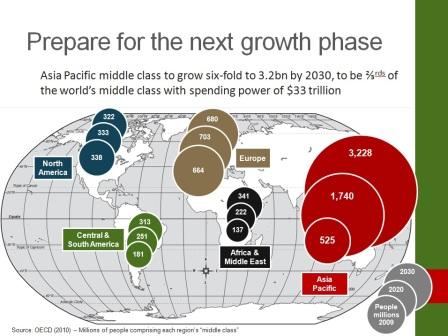
At the same time, a close up view of Asia also brings home how quickly our world is changing. That the era of shipping coal and iron ore may be peaking, while the half a billion middle class people in our Asian neighbourhood will grow to more than three billion before kids born today graduate from High School. And cities like Singapore, Seoul and Shanghai – with none of the natural advantages of environment, lifestyle and climate – and even Melbourne, are overtaking Sydney in many areas through better governance, collaboration of stakeholders and strategic planning.
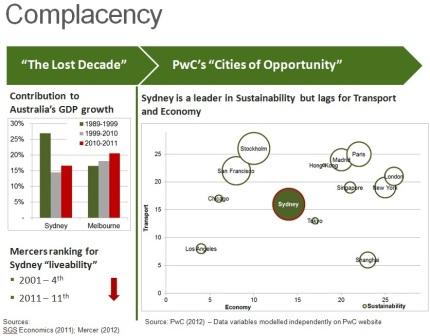
An objective analysis of Sydney’s position, relative to other cities, supports the view that we’ve become complacent since hosting the Olympics in 2000. A fall in our contribution to Australian GDP growth from almost 27 per cent to less than 17 per cent and, in Mercers Liveability index, steadily down from 4th to 11th place. If we aren’t investing wisely in our hard and soft infrastructure, this relative decline will continue.
The inner city, global Sydney, drives the rest of the city and, to a large extent, the whole of Australia
A PwC analysis shows that Sydney rates at or is close to the top for “Sustainability” but most of our competitor cities rate higher for “Economy” and almost all rate higher on “Transport”.
The focus should be on the City of Sydney council area because this core global gateway generates a quarter of the state’s GDP and is where our major educational and cultural institutions are. It’s where the bulk of Sydney’s 30 million visitors come annually and where most of the large Australian and global companies are based. The inner city, global Sydney, drives the rest of the city and, to a large extent, the whole of Australia.
 *
Council Revenues have grown by 41 per cent over the last eight years and the Council now takes in more than $500 million each year and has net assets of over $6.7 billion. This is not the small local council that public perception, and extent of business engagement, would suggest.
Our analysis indicated that the Council could easily underwrite substantially more than $1 billion over the next five years to kick-start transport, infrastructure and urban renewal and still have a AAA credit rating
There is now surplus cash and liquid investments of almost $520 million and at least $1.5 billion of real estate that is not used for services – things like the Burberry building on Martin Place, the QVB, Customs House, gyms, theatres and dozens of other properties rented out to different bodies.

Our analysis indicated that the Council could easily underwrite substantially more than $1 billion over the next five years to kick-start transport, infrastructure and urban renewal and still have a AAA credit rating, with no impact on service provision.

While there are many worthy reports on specific projects and single-purpose strategies, we believe ours is the first report to outline an integrated plan that connects the sectors likely to grow jobs with the infrastructure and transport needed to link these sectors and the strategic urban development that would have best “bang for buck” to support them. And how to pay for and execute it.
advantages of a light rail spine down George St are the ability to remove up to 400, often half empty, buses from this street and to make it a more attractive place for walking and shopping
We should start with transport and infrastructure. There is a growing consensus around light rail but it needs to be implemented in a way that doesn’t make traffic congestion even worse.
The key advantages of a light rail spine down George St are the ability to remove up to 400, often half empty, buses from this street and to make it a more attractive place for walking and shopping. Some consequential changes to traffic lanes and on-street parking can ensure that car owners aren’t ignored.
Light rail should be free down George Street. The success of public transport is driven by patronage and there are practical advantages (around modal interoperability, compliance cost savings and “future proofing”) as well as more strategic ones (for instance, productivity boost from greater connection between offices and higher education and tourist earnings).
In an economy dominated by services rather than smokestacks, we no longer need to choose economic growth versus quality of life
The operating costs of free light rail are pretty modest and can easily be covered by a small peak access charge for cars on six key entry points to the East and North of the city. This will also substantially reduce congestion for those who still have to travel by car. In fact, we estimate that the combination of this peak access charge, fully hypothecated to make light rail free, and some increased lane capacity on streets like King, Clarence etc. will actually reduce traffic congestion in the city by more than 20 per cent from the status quo.
Our second set of recommendations is around Ten Strategic sites whose rejuvenation would have multiplier effects on the economy and liveability of the city. This is sometimes called the “Guggenheim effect” after the impact on Bilbao of Gehry’s museum and has been on show recently in Singapore with an almost one per cent GDP pick up from the Marina Bay development.
Iconic architecture and an inspiring aesthetic environment, supported by the right traffic and infrastructure make the City an internationally desirable place to work and live. In an economy dominated by services rather than smokestacks, we no longer need to choose economic growth versus quality of life. They actually reinforce each other.
We have started at the north of the city with the proposal to build a new Arts Ribbon Train Station at Dawes Point. From a practical point of view this takes pressure off Wynyard which will become acute once Barangaroo is up and running. But it also makes a statement about the Arts Ribbon itself that stretches from Barangaroo and Walsh Bay around the Rocks to Circular Quay and the Art Gallery. We should unleash the creativity of our artistic community on the design of the station and it can also be a hub for visitors to get “same day” tickets to artistic events throughout the precinct.
We know there are top Asian five star hotel chains like Mandarin Oriental, Peninsula and Raffles considering Sydney but are being put off, among other reasons, because they can’t find compelling sites
Other sites shown on this slide include “mixed use” redevelopments of the rundown Wynyard and Town Hall Square, opposite the current Town Hall, including a tall thin residential tower, green space with a public square and bus interchange, preferably underground.
There are heritage-quality Education, Lands and Lands Title buildings in city centre currently used to house state bureaucracy and archive filing. We know there are top Asian five star hotel chains like Mandarin Oriental, Peninsula and Raffles considering Sydney but are being put off, among other reasons, because they can’t find compelling sites. Our existing five star hotels are bursting at the seams.
Why don’t we have a top Asian hotel chain that can put Sydney on the global map for their wealthy Chinese clients in these buildings in place of, say, the Land Titles files? And why not have an Asia-Pacific postgrad campus of something like Harvard’s Kennedy School of Government in the Education building with public service jobs relocated to other parts of the city or Parramatta.
The next challenge is the fish markets, which are still attracting copious visitors even in their current shambolic state
Lower Oxford Street is a good pilot site to try a more business and resident driven approach to flexible zoning and council regulations which are currently very rigid. It made sense to separate chemical factories and people’s houses but the world has changed. You will only support a retail sector in Sydney if you have residents, offices, coffee shops and retail all in the same buildings.
The next challenge is the fish markets, which are still attracting copious visitors even in their current shambolic state. A few million dollars separates the bid and ask to resolve the current standstill with lessees. If we get this right, it will be one of the most popular and exciting attractions that Sydney has to offer our largest tourist markets.
At Central Station, there should be iconic residential towers and green space. Sydney has one of the lowest residential densities of any major city, a counter intuitive result for a CBD constrained on three sides by the harbor. Although Sydney’s centre is not Manhattan, it does have similar topography – but a quarter as many people living in each square kilometre. So perhaps it’s no wonder the theatre, retail and arts are livelier in New York on weekends.
Our proposal is to empower an existing entity, the Central Sydney Planning Committee, which is currently a reactive body dealing with developments worth more than $50 million
There is also scope for residential accommodation at other Council owned property at Goulburn Street and lower Oxford streets. The Green Square development is an excellent one but has taken more than 20 years to come to just the start of building. We shouldn’t have to wait yet another 20 years for its completion
Of course the “how” is just as important as the “what” when it comes to issues of planning, especially given the chequered history in NSW. Our proposal is to empower an existing entity, the Central Sydney Planning Committee, which is currently a reactive body dealing with developments worth more than $50 million.
The CSPC would take a proactive role as “one stop shop” for Council and NSW government in engaging the private sector. Within one year of the Council election the body should have called for private sector proposals for the 10 sites and would have a timetable to break dirt by the end of the four year term.
Government departments and authorities like Transport, Roads, Planning & Environment and the like would have time to register their views with the CSPC, but the CSPC would be empowered to make the final decisions
It’s worth considering use of “citizen juries” to support the aesthetic judgement of designs for these key strategic sites. Importantly, their decisions have greater public legitimacy and justify a more expedited approval process. Government departments and authorities like Transport, Roads, Planning & Environment and the like would have time to register their views with the CSPC, but the CSPC would be empowered to make the final decisions.
The final section of our Five Year Strategy is about ways to promote the clustering of businesses and cultural groupings within the City of Sydney, based on sectors that offer the best potential for interesting and meaningful jobs in the twenty-first century.

These “Centres of Excellence” will be hubs for Arts & Creative Industries, Finance & Professional Services, Education & Health, Hospitality & Entertainment, Design & New Media, Asian Food & Culture, Retail, and Environmental & Other Technologies.
There is a City Council election on 8 September. Ours is a non-partisan plan and we are not recommending any specific candidates. But we do see the Report as a blueprint to be adopted by some or all of the contenders to lead our city, as well as by the State Government whose co-operation is essential.
We know that other cities in the region are acting on this right now. The opportunity is there for Sydney to match, indeed to exceed them
As our region gets richer, there are more and more people prepared to pay a premium for services, shopping and entertainment – ie for the novel, high-end and creative experiences that can be found only in the world’s greatest cities.
We know that other cities in the region are acting on this right now. The opportunity is there for Sydney to match, indeed to exceed them. But it requires clear, firm action that connects specific and considered initiatives and mobilises all the stakeholders.
If we can shake off our complacency and make these investments, then the next decade will establish Sydney’s reputation as a truly vibrant, competitive and great global city.