
Speaker
Babette Smith
Speech Date
February 16, 2026
Issue
Issue 33
One of Australia’s most significant colonial artists was S T Gill. His output was prodigious. Gill’s sketches and paintings are a glimpse of early European settlement in the south eastern colonies of Australia and he has left an invaluable record of life in the latter half of nineteenth century Australia. Babette Smith is an author and historian – most recently of The Luck of The Irish and also A Cargo of Women and Australia’s Birthstain – who has researched colonial Australia over decades. In her work, she has come across documents that may give the lie to Gill’s history in Australia as beginning in 1839 – in fact it may be that Gill was transported as a teenager and covered up his past with the arrival of his family. Babette Smith addressed The Sydney Institute on Tuesday 16 February 2016 and revealed her most persuasive findings.
S.T. GILL – RESPECTABLE COLONIAL PAINTER OR CONVICT FORGER?
BABETTE SMITH
The topic tonight is a work in progress. Frankly, I’ve run into such a wall of obstruction and hostility that I decided to put what I’ve found on the public record including the direct evidence from Gill’s artwork that supports my argument he was a convict.
On the Victorian goldfields in mid-nineteenth Australia, artist Samuel Thomas Gill struck gold without touching a spade. Frequently known as STG, his lively, humorous paintings of life on the diggings were widely published. Everyone wanted a copy of his work. Suddenly, the artist was a roaring success.
Gill is traditionally presented as a free settler who emigrated to South Australia. Yet, the truth about STG is so much more complex. It is also a case study in Australia’s shame about its convict origins and an example what we lose by covering them up.
Samuel Gill was the eldest son of Reverend Samuel Gill, a Baptist minister. Born in Perriton, Devon in 1818, he spend his childhood moving with his family around Devon, Cornwall, Wales and finally in Plymouth where he attended his mother’s school followed by Dr Seabrook’s Academy. There’s evidence to support these details.
Gill is traditionally presented as a free settler who emigrated to South Australia. Yet, the truth about STG is so much more complex
Tradition says that, aged 21, Gill sailed with his parents, younger brother John and his sister as emigrants to Adelaide. He is said to have arrived with them on the ship Caroline in December 1839.
In March 1840, an advertisement in the South Australian Register announced Samuel Gill, artist, was available for commissions. We know he had been painting since a boy, taught by his father who was a talented amateur. The advertisement claimed he studied with famous artists in Plymouth and at the Hubard Gallery in London.
No one doubted this story until … trawling through the convict archives one day, I stumbled across a Samuel Gill. Disbelieving, I looked at the crime – which was forgery. The same passport to Australia as many other colonial artists. The Australian Dictionary of Biography repeated the standard details – that the artist was….son of a Baptist minister, arrived in the ship Caroline etc. It added, however, that he was born in 1818. Bingo. The age of respectable Gill matched that of convict Gill.
I stumbled across a Samuel Gill. Disbelieving, I looked at the crime – which was forgery. The same passport to Australia as many other colonial artists
Next, I read everything ever published about the artist. It became obvious that the same few facts had been recycled to sketch a biography. Facts were often interpreted to “fit” the artwork, sometimes embellished with unsubstantiated assumptions. However, the two most rigorous authors were sceptical. Keith Macrae Bowden’s book on Gill was published in 1971 and Ron Appleyard, a curator at the South Australian Art Gallery, collaborated with two colleagues Barbara Fargher and Ron Radford, later Director of the National Gallery, to produce a comprehensive book entitled S.T. Gill, the South Australian Years which was published in 1986. This work ventured much further than just South Australia and included a forensic analysis by Appleyard of the variations and dates of STG’s signature. In the mid 1980s, the two authors corresponded. Bowden wrote to Appleyard “I have always felt that there is much more to bring to the surface.”
My research in the British criminal registers revealed two Samuel Gills who were convicts. One was a solicitor’s clerk tried in Birmingham in 1832. The other was convicted in Derbyshire the same year. Further research revealed that the Derbyshire man died of cholera on the voyage out, leaving just one: the boy whose age was the same as S.T. Gill.
Bowden wrote to Appleyard “I have always felt that there is much more to bring to the surface.”
Research in Britain revealed that Samuel Gill the convict was 13 when he absconded with forged cheques from the solicitor for whom he worked. After cashing the cheques, he fled across Britain until they caught him at Liverpool. Tried at the assize in 1832, young Samuel was sentenced to death – subsequently commuted to transportation for life. Firstly, he was sent to the boys’ hulk moored on the Thames near London. A year later, he sailed for Botany Bay.
Britain until they caught him at Liverpool. Tried at the assize in 1832, young Samuel was sentenced to death – subsequently commuted to transportation for life
In New South Wales, Samuel was assigned to landowner Alexander Berry. For five peaceful years he worked on Berry’s farm as a clerk. Then, suddenly in 1839, he absconded.
Tracking him through the archives, I found he was charged with being “out after hours and dishonest conduct”. His punishment was twelve months in an iron gang which must have been a very harsh encounter with reality for a gentleman’s son. When he ran from the iron gang, he was caught again and, for the first time, flogged with 50 lashes. By 1841, he was in a gang on the Blue Mountains road working out of the stockade at 20 Miles Hollow (present day Woodford). When he absconded a third time, he was regarded by the authorities as incorrigible. Charged at the Quarter Sessions with stealing, he protested that he took “just a pair of boots” but this time he was sent to Norfolk Island with a sentence of seven years.
Gill spent three years on the island. His one offence occurred in 1842 when he was charge with “insubordinate conduct in his ward and striking his wardsman” for which he received 100 lashes. He was also “ordered to sleep in the gaol until further notice”. In 1844, when Van Diemen’s Land took over management of Norfolk Island, he was sent to Hobart. He landed there on 27 September 1844. The authorities ordered him to a gang at Southport but he never arrived. Sometime around early to mid October he made a run for it again. In December, an official recorded that he “Escaped in a fisherman’s boat. Supposed to have drowned at sea”.
Charged at the Quarter Sessions with stealing, he protested that he took “just a pair of boots” but this time he was sent to Norfolk Island with a sentence of seven years
There’s nothing unusual in Gill’s escape. Historians’ latest estimate is that about 34, 000 convicts, many still serving their sentence, crossed Bass Strait into Victoria and South Australia. And this estimate does not include convicts from Western Australia.
So, the two Mr Gills – convict and free settler – meet at last in Adelaide. Now the challenges loom up. Forensic examination of the evidence for the first and most respectable Mr Gill is required before their stories can be merged.
about 34, 000 convicts, many still serving their sentence, crossed Bass Strait into Victoria and South Australia. And this estimate does not include convicts from Western Australia
Firstly, I suggest the answer to how Samuel the convict got to South Australia (by boat) lies in a newspaper report of a dinner for the artist before he went exploring with the Horrocks expedition. I detect a sub-text in this article, which has traditionally treated very seriously. The usual quote is about Gill being South Australia’s “respected and talented colonist” or praise because he’s going on the Horrocks expedition without pay – but this was a raucous gathering with music and song and much drinking. In that context, a speech by Gill’s friend Mr Wiltshire seems mock solemn as though they’re sharing a private joke. Mr Wilshire told the company that he “had had the pleasure of knowing Mr Gill for some time and unlike some everyday acquaintanceship, his had progressively improved”.
I researched Thomas Wiltshire. No emigrant was listed by that name but I did find a convict, one who was transported as a teenager like Samuel Gill. And a Thomas Wiltshire of matching age to that convict can be found in South Australia. What’s more, he was a mariner. The convict Thomas Wiltshire would have been free when Gill arrived in Hobart. It seems probable that it was he, either as a sailor, or perhaps even master of a fishing vessel, who helped Gill escape.
Mr Wilshire told the company that he “had had the pleasure of knowing Mr Gill for some time and unlike some everyday acquaintanceship, his had progressively improved”
So now Gill’s in South Australia and I must address those topics on which the story of the artist is traditionally pegged.
There are 3 stand-out items to challenge:
- his arrival on the Caroline in December 1839;
- the 1840 advertisement for work as an artist; and
- dates of his early South Australian artwork
When I began, I expected that one or all would bring me down.
Traditionally Gill’s arrival on the ship Caroline. has been regarded as indisputable. Approached with a sceptical eye, however, immigration records are illuminating.
The ship Caroline
The first two stages for an emigrant required no personal appearance by STG, or his father. An application was made (in writing) and an Embarkation Order was issued in return. Some writers have portrayed this process as if STG was a proactive participant. There is no evidence of that.
Traditionally Gill’s arrival on the ship Caroline. has been regarded as indisputable. Approached with a sceptical eye, however, immigration records are illuminating
As chief emigrant, with the capital to buy land, Reverend Gill was entitled to a free passage for dependents, providing they were bona fide servants and workers. His children’s occupations were upgraded to fit this: Samuel becomes a fully fledged painter and gilder, 18 year old John is described as an accountant and a gardener. his daughter is listed as a “sempstress”.
The third document is the passenger manifest, which was compiled by the migration agent in London from the embarkation orders. When the Gills boarded not in London but in Plymouth, the captain might have asked Rev Samuel, “Weren’t you supposed to have two sons?” but if he was told, “He’s not coming”, the Captain is very unlikely to have been bothered or even to have altered the list. The voyage was underway and it didn’t matter, except perhaps to make an extra berth available.
Boarding an emigrant ship could be chaotic, particularly earlier voyages before they refined procedures. On the 1837 voyage of the Lady MacNaghten for example, it was such a mess that the Emigration Agent explained the confusion was due to “…the greater number of passengers” (than listed on the manifest)…the fact that “some people boarded in lieu of others”… and “…much confusion is caused by the lists being incorrect”.
For these reasons the ship’s manifest cannot be taken as 100 per cent proof that someone travelled – nor for that matter can the newspaper report at the end of the voyage.
On the 1837 voyage of the Lady MacNaghten for example, it was such a mess that the Emigration Agent explained the confusion was due to “…the greater number of passengers” (than listed on the manifest)…the fact that “some people boarded in lieu of others”… and “…much confusion is caused by the lists being incorrect”
In Adelaide, before the port was built, ships moored off Glenelg. Passengers were ferried ashore in batches. Dead easy to disguise the fact that one of the Reverend’s children was not actually there. The South Australian Register sent a journalist to ask who was on board. The answer he reported was the “Reverend Gill and family”.
STG’s hospital record, years later, provides a sad footnote to doubts about his arrival. When asked by the doctor how long he had been in Australia, he didn’t take the chance as so many would have, to say “I was a free settler to South Australia” or “I arrived in Adelaide in ‘39”. Instead he replied with the vagueness of someone used to dissembling, “About thirty years”. Even that pins his arrival to 1837 rather than 1839.
The role of Reverend Gill
All of this raises the question of Reverend Gill’s role in establishing a “free settler” reputation for his son. Remember, 1839 was the year Samuel the convict started to abscond. I believe his father expected STG to join them in Adelaide soon after they arrived and it was he who placed the advertisement. He was laying the groundwork to disguise his son’s convict past. Unfortunately, no business records from the newspaper survive to check who placed and paid for that advertisement.
Instead he replied with the vagueness of someone used to dissembling, “About thirty years”. Even that pins his arrival to 1837 rather than 1839
By itself, the ad is not enough to claim STG was in the colony. If he was there during those first years, in that small community he would surely have been mentioned somewhere – in the press perhaps, or in someone’s diary. In fact, Ron Appleyard and I agree that the “flesh and blood” S.T. Gill appears for the first time in mid 1845, which is precisely the date I would expect after his escape in late 1844.
And there’s another point about the artwork – in this case, it’s evidence by absence. Where are the pictures or even just sketches done on the ship? An inveterate scribbler like Gill would not have spent five months without lifting a pencil or a brush. If he did sail as a free emigrant, a cache of work would depict the voyage; pictures of passengers, sailors, life at sea. They would have sold readily in Adelaide. Their absence supports the claim that Gill sailed under duress in a convict vessel.
in this case, it’s evidence by absence. Where are the pictures or even just sketches done on the ship? An inveterate scribbler like Gill would not have spent five months without lifting a pencil or a brush
The Hubard Profile Gallery
Much weight has been placed on that one advertisement. Among other things, it promotes the idea that STG studied at the Hubard Profile Gallery, which sounds grand but was not.
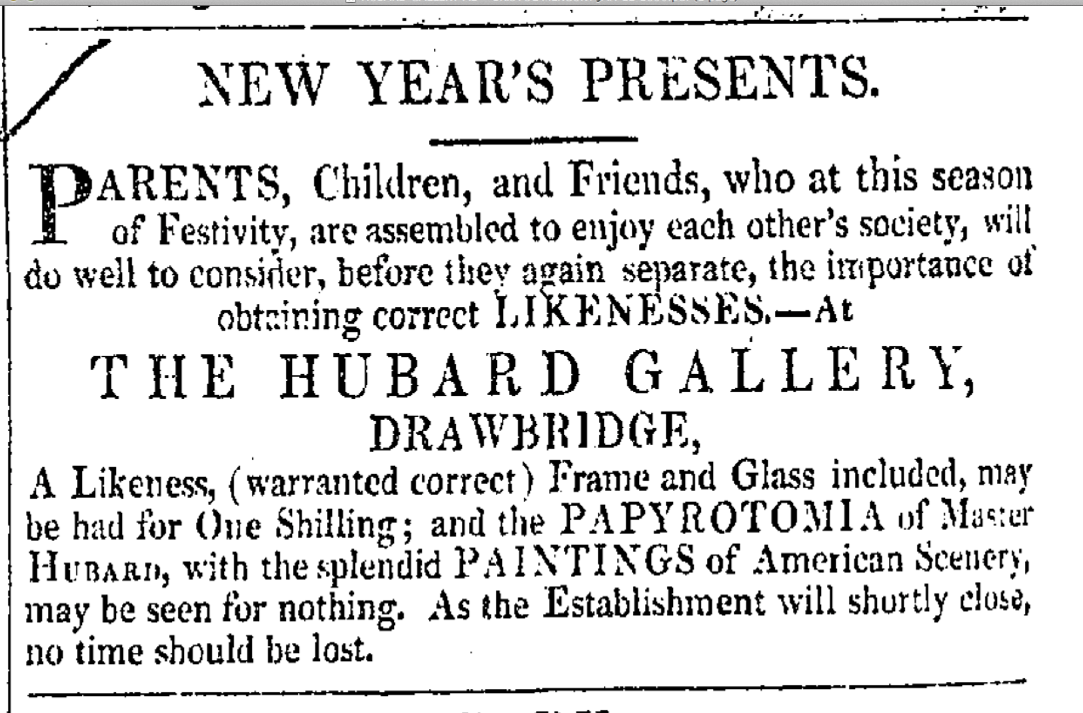
Illustration: Slide 13 – Hubard Gallery for New Year’s presents.
Writers about Gill have never doubted its veracity, yet it quickly falls apart under scholarly investigation. One writer used S.T. Gill to substantiate the existence of the gallery in London. I can find no proof that it was there.
Gill relatives have nothing to add. Mrs Thompson, daughter of John Gill, wrote in her memoir that Gill “studied under leading masters in London”, but [she] had no record to support this claim. In the end, Appleyard concluded that the 1840 advertisement is the only evidence about Gill’s association with the Hubard Gallery.
My research revealed that the Hubard Gallery was a bit like a travelling circus. Its promotion was similar in style to ads blazoning “Come and see a woman with two heads” or “Watch a man swallow fire”.
Appleyard concluded that the 1840 advertisement is the only evidence about Gill’s association with the Hubard Gallery
The so-called “gallery” would bowl into towns all over Britain. Stay for a few weeks, make as much money as possible, then move on. The description “gallery” refers to the exhibition of profiles and not to a building.

Illustration: Slide 14 – Hubard Gallery Must Positively Close.
It’s possible that, entranced by the silhouettes, young STG aged about 12, ran away to join the gallery when it visited nearby Bristol. Reverend Gill reacted as so many fathers would. Regarding painting as more a hobby than a life’s occupation, he packed Samuel off to Birmingham to be apprenticed with the attorney. Family records say the boys’ mother particularly wanted them to become lawyers.
My research revealed that the Hubard Gallery was a bit like a travelling circus
As mentioned earlier, when I started this investigation I expected to be disapproved at every turn. It was the artwork I feared most. I expected work dated 1840, or 1841 or 1843. Amazingly, there appeared to be none. Instead, I found Bowden writing “Gill usually signed his work STG but much of it is undated and bears no title”.
As mentioned earlier, when I started this investigation I expected to be disapproved at every turn. It was the artwork I feared most. I expected work dated 1840, or 1841 or 1843. Amazingly, there appeared to be none
Appleyard and his colleagues found no contemporary record for claims that Gill visited Edward John Eyre in 1842. And Appleyard wrote about pencil drawings by Gill dated 1843: “The style of signature and inscription suggest they may have been written later in his career. The date is therefore unreliable.”

Illustration: Slide 15 – Gawler River
I was even more relieved to discover that Appleyard concluded: “Gill did not begin to date his works until 1844”. He then cites the painting “Gawler River, November 1844”, a date which coincides with Samuel’s escape in late October.
In a world without photography, pictures of events as they happened were valued. An event said to demonstrate STG’s presence in South Australia in August 1844 is his painting of the explorer Sturt’s departure from Adelaide. My heart sank when I first saw it because Samuel the convict was about to sail from Norfolk Island at that time.

Illustration: Slide 16 – Veno – by a nose
Further investigation revealed that STG had a habit of painting events as though he was present when in fact he was not. Nothing dishonourable about the practice, but he was exposed terribly for doing this in Sydney. One newspaper sued another for misrepresentation about a horse race in Melbourne, between the Victorian favourite and a Sydney horse named Veno. STG who was living in Sydney, had done the illustration as if he saw it happen. The prosecuting newpaper Bell’s Life reported gleefully that under cross-examination: “Mr Gill the artist…admitted he had drawn both the horse and the mare from description and was not sure that he had ever seen Veno in his life.”

Illustration: Slide 17 – Sturt’s Departure (drawing)
I looked again at Gill’s coverage of Sturt’s departure. It contained nothing that couldn’t have been any Adelaide crowd farewelling someone. The most notable feature was a bullock dray carrying an upturned boat. Sure enough, the bullock pulling a dray with a boat was reported in the newspaper which means that Gill could have done it from description.
that STG had a habit of painting events as though he was present when in fact he was not. Nothing dishonourable about the practice, but he was exposed terribly for doing this in Sydney
So, artwork depicting Sturt’s departure does not prove STG’s presence in Adelaide in August 1844. Nor was the picture publicly displayed during the following year, so we cannot be sure of the precise date it was finished.
none of Gill’s artwork was publicly exhibited until 1847
In June 1846 a Mr F Nixon, a surveyor, wrote to the South Australian Register claiming Gill’s work was better than paintings by George French Angas which were then on display. In that year, publisher James Allen took some paintings of Adelaide by Gill to England. Otherwise, none of Gill’s artwork was publicly exhibited until 1847.
Pastoralist John Howard Angas, who was a Baptist refers to Gill in his journal dated 29 October, 1844 noting that “Mr Gill the artist” had visited his property in the Barossa. I can’t disprove that reference but neither does it disprove my argument. It is quite feasible that STG, having just landed, needed to get out of town in case he was pursued.
Family history
Family history for the years when young Gill was convicted and transported is inconsistent. Descendants of Gill’s brother, John, described the year 1833 as deeply distressing because two younger sons died of smallpox. They told Keith Bowden that it was a crushing blow from which Mrs Gill never recovered. Bowden repeated the family version, then wrote, “Bent on a career as an artist, when he left school Gill went to London … but the details of this period,” he wrote, “together with other family records, perished in a bushfire in 1948.”
But Appleyard’s doubts about what he was being told are evident in his footnote: “It’s not been possible to confirm the exact sequence of events that are said to have taken place in or about 1833.” He double checked as much as he could, confirming for example the birthdates of four of the five children. But evidence from the Devon Record Office contradicted other details given by relatives.
Appleyard’s doubts about what he was being told are evident in his footnote: “It’s not been possible to confirm the exact sequence of events that are said to have taken place in or about 1833.”
One thing is certain: the period 1831-1833 was a tragic one for the Gill family. The blow of the children’s death would have been compounded one hundredfold by STG’s death sentence and then his fate of transportation for life. Further support for my argument that this devastating period related to STG also, and not just the death of the children, comes from the autobiography of his brother.
John Gill skates very close to the truth when he mentions travelling with his father “very often” at that time. And “seeing” London “when I was ten years of age”, which would have been 1831-1832. John Gill does not mention that Samuel was on these excursions. In a surprising lapse of rigour, Ron Appleyard wrote, “It is assumed that the elder son would have been given the same opportunity.” No such assumption can be made.
Samuel Gill absconded from the attorney’s office in late 1831. We can justifiably speculate that his pursuers would have included not only police but his distraught father and, it seems, his brother. He was tried in March 1832. From May 1832 to June 1833, he was on the hulk near London. Why would Reverend Gill have left his grieving wife if it was not some emergency such as these events involving their eldest son?
In a surprising lapse of rigour, Ron Appleyard wrote, “It is assumed that the elder son would have been given the same opportunity.” No such assumption can be made
Looking for colonial contact between father and son, I found a letter for “Samuel Gill” listed at the Sydney Post Office in 1836. A second letter written early in 1841 would have reached Samuel – eventually – on Norfolk Island. Did learning about the family’s migration prompt Samuel to abscond from Alexander Berry? If it did, he underestimated the danger. Running away brought down the whole weight of the penal system upon him. Nevertheless, with amazing persistence, he pursued family reunion through working in irons, floggings and Norfolk Island.
Did learning about the family’s migration prompt Samuel to abscond from Alexander Berry? If it did, he underestimated the danger
In Adelaide, we know STG did not join the family farm. Based in town, he worked as an artist. He remained unobtrusive but newspapers now confirm that he was actually there. His brother, who had been a solicitor’s clerk in England, repeated the family pattern by working for a lawyer in Adelaide. Their father reportedly became distressed about the “rough” company with whom STG mixed – such as Thomas Wiltshire, no doubt. In 1851, Samuel’s hand was paralysed for months. Unable to paint, he soon became insolvent. Shortly after his bankruptcy was publicised, he left South Australia for the recently discovered goldfields.
He’s said to be in South Australia, yet his early pictures known collectively as the Months and the Seasons depict convict farm labourers
I come now to my latest research where Gill’s artwork intrinsically provides direct evidence that his traditional story is not accurate.
An inherent contradiction exists in Gill’s earliest Australian work. He’s said to be in South Australia, yet his early pictures known collectively as the Months and the Seasons depict convict farm labourers. How did this happen? South Australia is renowned for being “convict free”. The standard biography says Gill did not leave that colony until 1851 when he went to the goldfields.
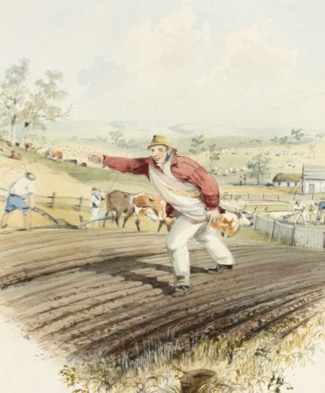
Illustration: Slide 18 – Autumn
The Months and the Seasons are a delicate series of watercolours which have long puzzled art historians. Local foliage and the presence of Aborigines make it clear they were painted in Australia. But when? Although signed “STG” they are not dated. When sold in London in 1932 to the Australian National Library, some were bound in an album dated 1847 – which implied they were painted that year. Art historians have since agreed that they are inherently juvenile work and 1847 is too late. Constrained by Gill’s assumed arrival in 1839, they have dated them 1841-43.

Illustration: Slide 19 – January
The location of the Months and Seasons is also a puzzle. The seller in 1932 believed they were painted in one place but this has never been identified.
Art historians have since agreed that they are inherently juvenile work and 1847 is too late. Constrained by Gill’s assumed arrival in 1839, they have dated them 1841-43
Recently, another puzzle emerged. David Hansen, Associate Professor of Art History at the ANU, focused on STG’s early depiction of Aborigines. With input from indigenous people, Hansen discovered that watercolours, supposedly painted in South Australia, included traces of indigenous culture from the Shoalhaven area.

Illustration: Slide 20 – Summer
These puzzles are all explicable if you accept that Samuel Gill was a convict. In that case the Months and the Seasons were painted in the 1830s when Gill was a teenager and assigned to Alexander Berry at the Shoalhaven. All the activities depicted in the Months and the Seasons occurred there, including harvesting, shearing, sheep-washing, wine-growing, hunting. Local Aborigines “sat down” on the farm when they chose. Some worked for Berry who was sympathetic towards them.

Illustration: Slide 21 – Spring
How do I know that the farm workers are convicts? Recently, I found evidence in convict archives which describe convict clothing during the 1830s. The prisoners wore blue striped shirts. Or red or blue smocks. On their heads were straw hats with a black string round the crown. Just like the farm labourers depicted in the Months and the Seasons.
How do I know that the farm workers are convicts? Recently, I found evidence in convict archives which describe convict clothing during the 1830s
Art historians are very familiar with Gill’s habit of inserting himself into his pictures, often to make a sardonic comment. Recognising the significance of blue striped shirts reveals an unexpected example in the painted version of “Sturt Departing Adelaide”, his first big panorama.
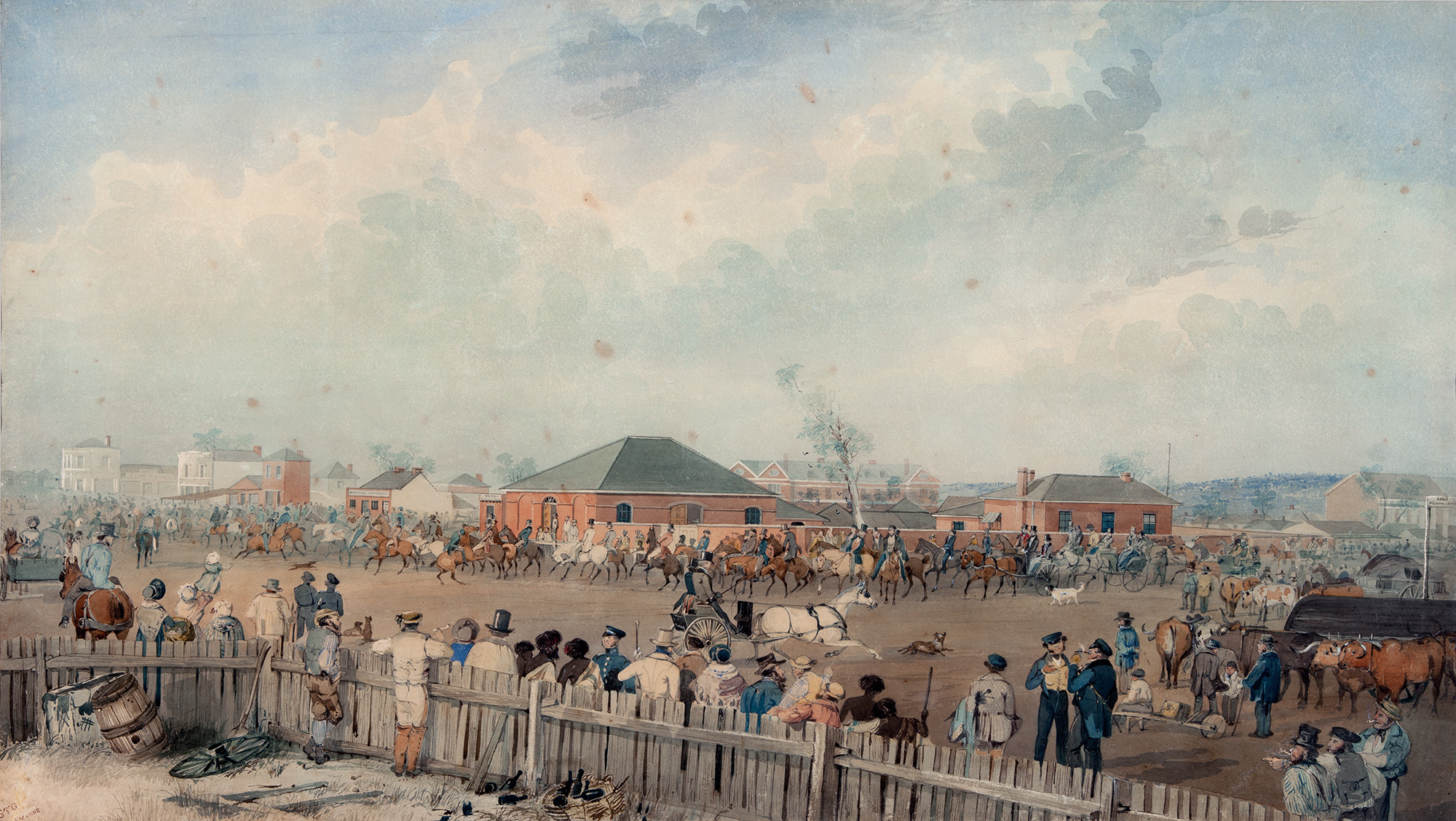
Illustration: Slide 22 – Sturt Departing Adelaide (full size)
You’ll notice that the man who was on the right side foreground in the drawing, has moved to the centre. And he’s been joined by another. In an amazingly provocative and risky gesture STG has placed his doppelganger centrestage: convict Gill in his blue striped shirt stands talking to Gill the free artist who’s wearing a gentleman’s cream suit and a straw hat with a black string around its crown on his head. The picture was painted immediately after Gill arrived in South Australia when he was most conscious of his double identity.

Illustration Slide 23 Gill & his Doppelganger. (cropped close-up)
There’s nothing circumstantial about this. Based on three separate archival documents, it is direct evidence supporting my argument that Gill was a convict.
One who lived in Victoria recorded, “…all his life he was more or less clouded. He always seemed a solitary man about whom nobody knew very much. He was never talked about in the newspapers. His comings and goings were unnoticed…”
Perhaps Gill was always conscious he was an escaped convict. He made money from his art but he was often ripped off by others who appropriated his work to their own name, or reproduced it without permission or payment. Gill never publicly complained. Very likely some of those who took advantage knew that he could not. The appropriation of Gill pictures by George Fife Angas, artist brother of John Howard Angas quoted earlier, is a prime example.
The years of Gill’s success through to his decline and death are just as inscrutable as the earlier ones. Some of STG’s friends found him mysterious. One who lived in Victoria recorded, “…all his life he was more or less clouded. He always seemed a solitary man about whom nobody knew very much. He was never talked about in the newspapers. His comings and goings were unnoticed…” Historically Gill was “written off” as an alcoholic whose later work deteriorated. That he dropped dead on the steps of Melbourne post office in 1880 seemed to confirm this version.
Family denial of a convict ancestors was a common phenomenon as I demonstrated in my book Australia’s Birthstain. My own family was one of thousands who hid their connection to the penal colony. STG left no descendants. Other relatives have not been willing to collaborate, which is a pity because I believe they have a contribution to make and I would welcome their involvement.
Family denial of a convict ancestors was a common phenomenon as I demonstrated in my book Australia’s Birthstain. My own family was one of thousands who hid their connection to the penal colony
Recently, Gill’s artwork has been re-assessed. Now he is described by art historian Sasha Grisham as “arguably the greatest mid-nineteenth century artist working in colonial Australia”. However, no new light has been shed on his life. My investigation seeks the man who produced such significant work.

Illustration: Slide 24 – S.T. Gill 1867
Copyright 2016 Babette Smith.
This research is copyright. Use of the information or reproduction of extracts from it must be attributed to “Babette Smith, S.T. Gill, respectable colonial painter or convict forger? The Sydney Institute, 16 February 2016.”
Scholarly references are available from <babettesmith4@gmail.com>