
Speaker
Vicken Babkenian
Speech Date
May 24, 2016
Issue
Issue 34
24 April 1915 marks the beginning of two great epics of the First World War. It was the day the allied invasion forces set out for Gallipoli; and it marked the beginning of what became the Genocide of the Ottoman Empire’s Armenians. Vicken Babkenian is the co-author (with Peter Stanley) of Armenia, Australia & the Great War which captures afresh the tragic fate of Turkish Armenians during and after the First World War. It is a story repressed for decades by Turkish denial. The number of victims is estimated at between 800,000 and 1.5 million. Now Vicken Babkenian, with Peter Stanley, has unfolded a unique history of how the Gallipoli campaign led many Australians to champion the victims of the Armenian genocide and help in the repatriation of survivors. On Tuesday 24 May 2016, Vicken Babkenian addressed The Sydney Institute to record something of this history.
ARMENIA, AUSTRALIA AND THE GREAT WAR
VICKEN BABKENIAN
On the evening of 24 April 1915, just hours before the Anzac landing at Gallipoli, the Ottoman authorities arrested about 230 Armenian political, religious, educational and intellectual leaders in Constantinople, the capital of the Ottoman Empire. They were taken to police headquarters and then deported into the interior of Turkey. Most were killed without a trace. This marked the beginning of what Henry Morgenthau, the United States ambassador to the Ottoman Empire in 1915, described as a “campaign of race extermination”.
 In almost every town and village in Turkey, the Armenian population was arrested and deported by orders from the central government in Constantinople, under the direction of the minister of the interior, Talaat Pasha. In most cases, the men were killed just outside their towns and villages. A much worse fate awaited the women and children. Uprooted from their homes, they were forced to walk southwards in huge convoys towards the burning deserts of northern Syria. Most would die of starvation, murder and disease. By the end of the war, at least a million Armenians were killed and tens of thousands remained in captivity.
This marked the beginning of what Henry Morgenthau, the United States ambassador to the Ottoman Empire in 1915, described as a “campaign of race extermination”.
For the Armenians, 24 April 1915 signifies the beginning of the Ottoman Empire’s campaign to exterminate its Christian Armenian population. For many Australians, 25 April 1915 signifies the beginning of a military campaign, which would help forge Australia’s national identity. These two events have more in common than just a co-incidence of dates and geography; they are also linked together by a humanitarian bond which began in 1915 and lasted for more than a decade.
My presentation will explore the largely forgotten story of Australia’s response to the Armenian genocide.

For the Armenians, 24 April 1915 signifies the beginning of the Ottoman Empire’s campaign to exterminate its Christian Armenian population. For many Australians, 25 April 1915 signifies the beginning of a military campaign
Armenians are an ancient people who have inhabited the highlands of today’s eastern Turkey and the Caucasus for thousands of years. Armenia became arguable the first nation to adopt Christianity as a state religion in the early decades of the fourth century. Throughout its long history, Armenia has been repeatedly invaded by regional powers. By the fifteenth century most of Armenia had been absorbed by the Ottoman Empire.
While the Ottomans’ Islamic political system required the protection and toleration of the “People of the Book” – meaning Jews and Christians – non-Muslims faced discrimination, including extra taxes, judicial inequality and a prohibition on bearing arms. In the late nineteenth century, Armenian demands for reform were met with repression by the Ottoman authorities. Tens of thousands of Armenians were massacred in pogroms between the years 1894 to 1896.
By the early twentieth century, while most of the two million Armenians lived in their historic homeland in today’s eastern Turkey, Armenian communities were scattered throughout the Ottoman Empire including the Gallipoli peninsula. The Gallipoli Armenians, who numbered about 2,000, had a neighbourhood named after them which contained the Saint George church and two Armenian schools. They were mainly occupied in trading, fishing and crafts. Two weeks before the Anzac landings, the Ottoman authorities deported the Gallipoli Armenians, along with about 20,000 of the peninsula’s native Greek population, into the interior of Anatolia. Many would die of harsh conditions.
In the late nineteenth century, Armenian demands for reform were met with repression by the Ottoman authorities. Tens of thousands of Armenians were massacred in pogroms between the years 1894 to 1896.
Australian encounters with Armenians proliferated with the Anzac landing at Gallipoli on 25 April 1915. Like the British and French forces, the Ottoman army reflected the multi-ethnic composition of the empire. Despite being commonly referred to as “Turks”, members of the Ottoman army included Turks, Arabs, Kurds, Armenians, Greeks, Assyrians, Circassians and more.
On the first day of the landing, the Anzacs had captured at least one Ottoman Armenian soldier. As the campaign continued the number of Armenian prisoners increased. Since many of them were multi-lingual and considered to be pro-allied, Armenian prisoners were recruited as interpreters, and by May 1915, there was a colony of Armenian interpreters serving at the Anzac headquarters.
Despite being commonly referred to as “Turks”, members of the Ottoman army included Turks, Arabs, Kurds, Armenians, Greeks, Assyrians, Circassians and more.
A large portion of the Ottoman army’s medical personnel, such as doctors, nurses, pharmacists and sanitary workers, were Armenians. Many Anzacs captured as prisoners make specific mention in their repatriation reports and in their memoirs, how Armenian doctors in the Red Crescent treated them kindly.
The Anzacs at Gallipoli also came to learn that there was a distinct hierarchy among the different ethnicities in the Ottoman army. Armenians and Greeks were generally recruited into labour battalions, which were held in low esteem. In a letter to his nephew in November 1915, Lieutenant Edward Gaynor wrote from Gallipoli that the “Turkish soldier does no work”, but the Armenians and other Christians were herded together into battalions to do nothing else but dig trenches. Gaynor thought it would have been “a boon and a blessing” if he had such working battalions as his fighting men spent “half their time digging trenches”.

Lieutenant Edward Gaynor wrote from Gallipoli that the “Turkish soldier does no work”, but the Armenians and other Christians were herded together into battalions to do nothing else but dig trenches
By October 1915 the plight of the Armenians was common knowledge worldwide.
In the introduction of a lengthy article on the Armenian massacres in December 1915, the Australian War Correspondent at Gallipoli Charles Bean wrote, “The Turks as the world knows are at the present moment engaged in an endeavour to wipe out the Armenian nation before they are stopped.”

At least 200 Australians were taken as prisoners by the Ottoman army during the war. They included those captured at Gallipoli, the Sinai, Mesopotamia and the submariners who penetrated the Dardanelles in 1915. The Australians were most often held in abandoned Armenian churches and homes. They observed and recorded the deportations and massacres occurring around them.
Charles Bean wrote, “The Turks as the world knows are at the present moment engaged in an endeavour to wipe out the Armenian nation before they are stopped.”
Lieutenant Leslie Luscombe from Geelong West had been part of the 14th Australian Infantry Battalion at Gallipoli when he was captured and taken prisoner in August 1915. While being transported to the centuries old Holy Mother of God Armenian monastery in Ankara, he witnessed “a sad and depressing sight” at the railway station in western Turkey. Luscombe wrote:
On the opposite side of the platform a considerable number of Armenian women and children were huddled together. As our train pulled into the platform, Turkish soldiers armed with whips were driving the women and children into the train. It was evidently intended to transport them to some distant concentration camp.
Luscombe learned that just before his arrival at the monastery, the monks of the monastery “had been taken out and massacred by the Turks”.
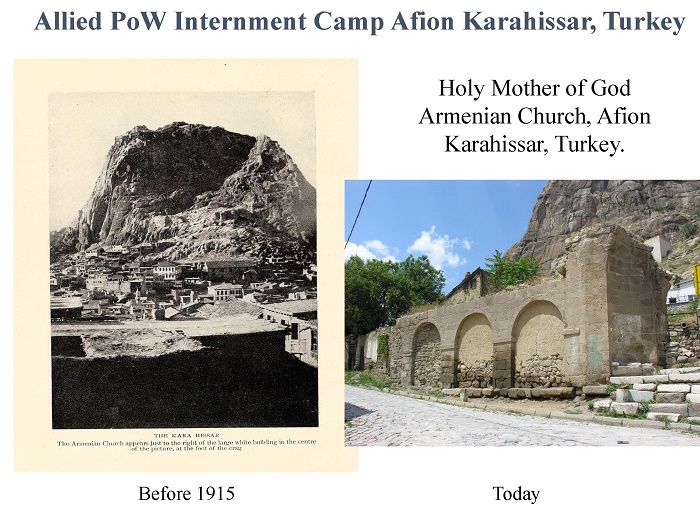
The Armenian quarter and the Holy Mother of God Armenian church at Afion Karahissar in western Turkey became the major internment camp for allied prisoners during the war.
Turkish soldiers armed with whips were driving the women and children into the train. It was evidently intended to transport them to some distant concentration camp.
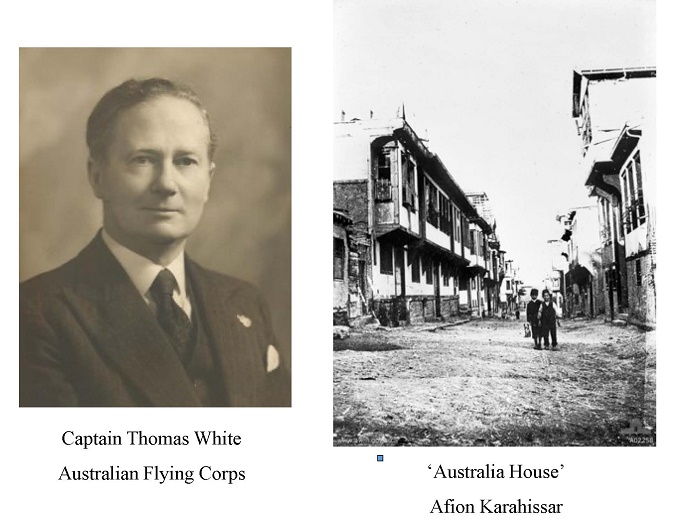
Upon arriving at the church, Australian prisoner Captain Thomas White, of the Australian Flying Corps, saw “a number of Armenian women and children of all ages sitting outside the church on bundles of clothing”. Evidently, he wrote, they “had been moved out to make way for us”. White was not surprised to see them looking “very sad and miserable”, for he wrote: “Their menfolk had been killed, their houses and furniture confiscated and now they were being turned into the street from their last possible sanctuary.”
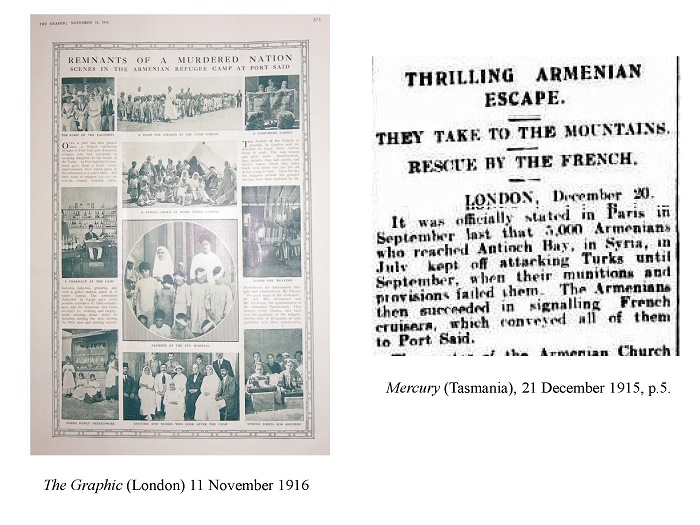
In July 1915, about 5,000 inhabitants of 6 Armenian villages near the Mediterranean Sea in south eastern Turkey decided to resist the Turks rather than be deported. After 53 days of resistance they were miraculously saved by a French warship patrolling the Mediterranean Sea.
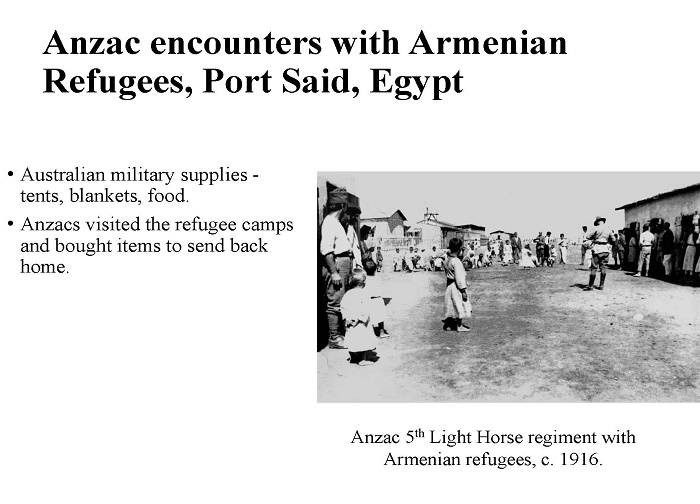
When the refugees arrived at Port Said, Egypt, the senior British officer at the Suez Canal made use of three Australian supply ships to meet the emergency. This included blankets, tents and food. The proximity of the refugee camp to the Anzacs stationed in Egypt meant that there were frequent encounters between Australian military personnel and Armenian refugees. Many Anzacs would purchase Armenian handiwork and send them back as gifts to their families back home in Australia.


The proximity of the refugee camp to the Anzacs stationed in Egypt meant that there were frequent encounters between Australian military personnel and Armenian refugees.
As the Anzac forces advanced on the Palestine/Syria front in 1918 they encountered deported Armenians. Lieutenant-Colonel Arthur James Mills was among a contingent of Australian Light Horsemen and Cameleers on the Palestine front, who helped rescue several thousand Armenian refugees in early 1918. In a touching display of humanity amidst the horrors of war, Mills carried a four year old Armenian “girl sleeping in his arms, on his camel” to safety. The story of Victorian Colonel Stanley Savige follows a similar vein. As a member of the elite Dunsterforce, Savige and his colleagues defended a column of some 80,000 Armenian and Assyrian refugees fleeing the invading Turkish Army in northern Iran during the summer of 1918. Savige was awarded the Distinguished Service Order for his role in the rescue effort.
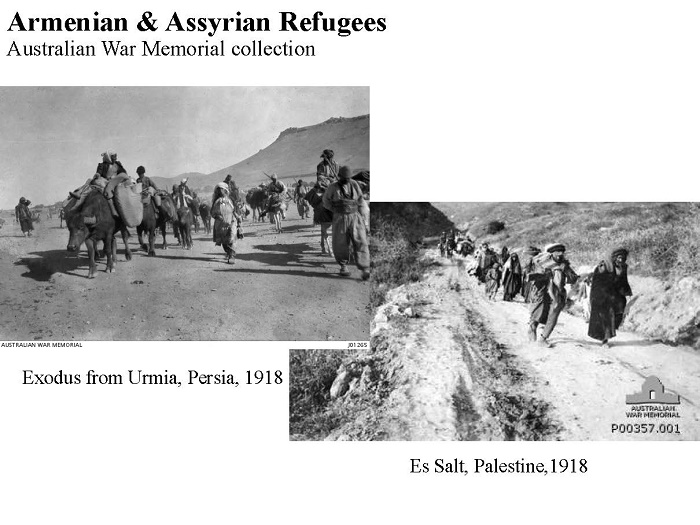

About 5,000 Armenians, many from the refugee camps in Egypt, were formed into a battalion by the French in 1916. Known as the Armenian Legion, they fought alongside the Light Horsemen under the command of General Edmund Allenby. The Armenian Legion took part in the decisive battles in Palestine in September 1918 which saw the defeat of the Ottoman forces.
Some Armenian interpreters like Armenag Kememian played an important role in Allenby’s victories in Palestine and Syria. Armenag was killed beside four Australians when an enemy bomb was dropped into their camp on 17 April 1917. His remains were later transferred to the Australian section of the Beersheba war cemetery under the protection of the Commonwealth War Graves Commission, where he lies among the Anzacs with whom he served.

The Armenian Legion took part in the decisive battles in Palestine in September 1918 which saw the defeat of the Ottoman forces.
Every major newspaper in Australia covered the genocide with regularity— the Melbourne Age having published more than 40 articles on the event in 1915 alone.
News about the Armenian massacres mainly appeared in the “war news” columns, beside reports of the Anzacs’ deeds. This gave extensive coverage to the Armenians’ plight
The story of Armenian suffering evoked a strong humanitarian response in Australia at the time leading to the establishment of the Armenian Relief Fund, which began in Victoria in 1915, spread throughout the country, and continued its work for over a decade. In 1917, the Victorian state war council recognised the Armenian relief fund as a “patriotic fund” – one considered as having been formed for the purpose of supporting Australia’s allies as well as its own soldiers. The 22 April 1917 was designated as Armenia Sunday in Victoria and churches across the state helped collect over 2000 pounds. The Anzac Memorial Service of Melbourne also donated funds to the Armenian relief appeal.
The plight of the Armenians also featured in stirring speeches made during recruitment drives “to increase the number of reinforcements for the Anzacs at the front”. In one such recruitment drive held in Victoria in May 1917, Lieutenant Les Holder brought to the attention of the audience what had happened to the Musa Dagh Armenians he had seen in Egypt. He said “If you love and honour your own women relatives, cannot you see that they expect you as a man to go and fight for them, so that what happened to the women of our allies will not happen to them.”
The plight of the Armenians also featured in stirring speeches made during recruitment drives “to increase the number of reinforcements for the Anzacs at the front”.
In Sydney, the Armenian relief movement mobilised a broad spectrum of the city’s religious, political and civic leaders, including many leading feminists. The Lord Mayor of Sydney, James Smith became the Armenian relief fund’s first chairman in December 1918. Among its thirty participants were some of Sydney’s most influential residents: representatives of several churches but also leaders of the city’s business and philanthropic life. The general manager of the Bank of New South Wales (now Westpac Bank) and the general manager of the Bank of Australasia (now ANZ) became the fund’s joint treasurers. Businessmen such as William Cooper of the chocolate makers Cadbury Ltd, and Charles Lloyd Jones, director of the department store David Jones, became executive members of the fund.
Among its thirty participants were some of Sydney’s most influential residents: representatives of several churches but also leaders of the city’s business and philanthropic life.
In 1922, the head office of the Armenian relief fund was located at the Red Cross headquarters on 34 Jamison Street, Sydney. Not far from where we are tonight. Eleanor Mackinnon (OBE), an executive member of the NSW Red Cross committee, became the secretary of the Armenian Relief Fund of New South Wales. The fund’s headquarters were later moved to 333 George Street, which included a shopfront where needlework made by Armenian orphans was sold.
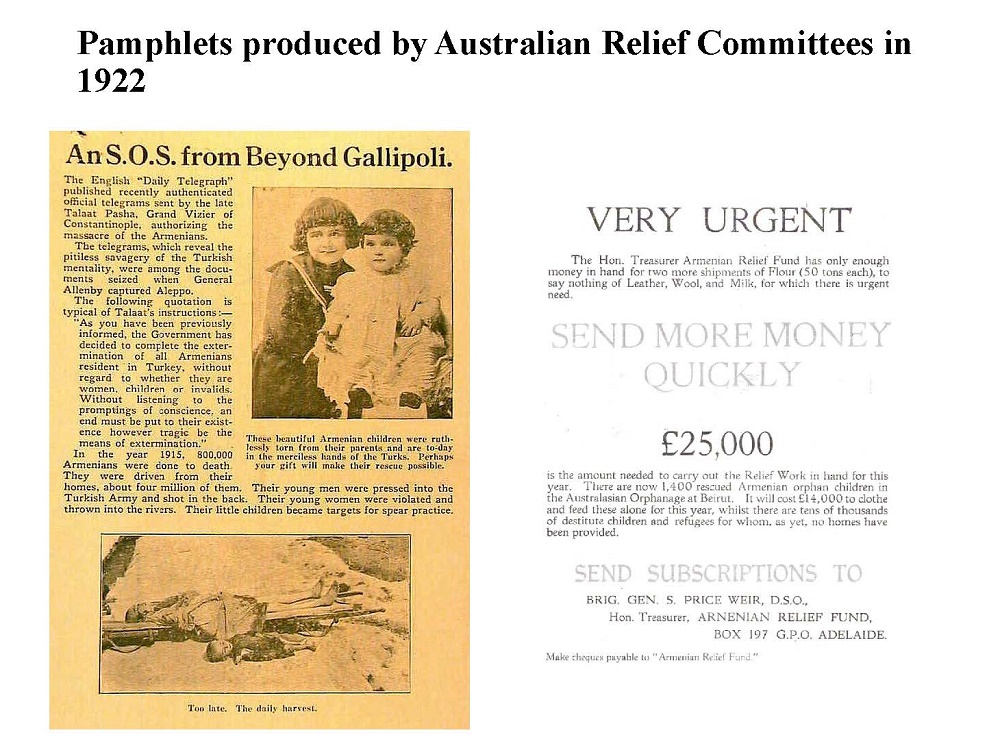
In its drive to awaken public consciousness, the Armenian relief committees prepared a number of pamphlets containing visual and literary images of Armenian suffering and innocence. By December 1922, every Australian state had an Armenian relief committee with regional sub-branches. By early 1923, a national committee was formed based in Adelaide, which co-ordinated the shipping, supplies and organisation of the various relief committees.

The Prime Minister of Australia, William Hughes, promised free freight to the Middle East aboard the Commonwealth Line of Steamers for the goods collected by the Armenian relief committees. The Armenian relief movement culminated in the establishment of an Australian-run orphanage for some 1700 Armenian orphans in Antelias, Beirut in Lebanon. It was run and supported by Australian and New Zealanders.

By December 1922, every Australian state had an Armenian relief committee with regional sub-branches.
Doctor Alexander Leeper, Professor of Classics at the University of Melbourne and the president of the Victorian Friends of Armenia committee in the 1920s regarded it as a privilege for Australia, “the youngest of nations”, to have had the opportunity to “save and restore the members of one of the oldest” of nations.
The Armenian relief movement continued until the 1940s and is arguably the first such sustained humanitarian relief effort in Australia’s history. Some of the humanitarian organisations which were involved in the Armenian relief movement such as the Save the Children Fund continue to exist today.
The Armenian relief movement continued until the 1940s and is arguably the first such sustained humanitarian relief effort in Australia’s history.
Australian women were particularly concerned at the suffering of Armenian children and of the thousands of Armenian women who had been abducted into Muslim households during the Genocide. Australian women delegates to the annual League of Nations Assembly held at Geneva were vocal supporters of the League of Nation’s effort to rescue the abducted Armenian women and children. Women’s organisations such as the National Council of Women contributed funds towards the rescue movement.
It is quite common nowadays to find elderly Australians who can still remember as children being told by their parents, that if they didn’t finish the food on their plates, to remember the starving Armenians.

Sadly, the story of Armenia, Australia and the Great War is largely excluded from our nation’s historiography of World War I. Perhaps an explanation can be found in a passage from a work by Paul Shackel on the relationship between power and collective memory, in which he suggests that “public memory is more a reflection of present political and social relations than a true reconstruction of the past”.
Sadly, the story of Armenia, Australia and the Great War is largely excluded from our nation’s historiography of World War I.
As we mark the 101st anniversary of both the Armenian Genocide and the Gallipoli campaign, perhaps it’s time that the link between these two events takes its rightful place in our nation’s collective memory of World War I.
