
Speaker
Peter Ridd
Speech Date
November 29, 2017
Issue
Issue 41
What are the disputed facts on climate science? The debate is widening as scientists disagree on weather measurements and coral bleaching. Earlier this year, Jennifer Marohasy challenged the CSIRO’s weather and temperature measuring methods and forced a review. Her edited collection Climate Change – The Facts was published in 2017. More recently Professor Peter Ridd has upset his employer James Cook University over his critique of research into coral bleaching. Professor Peter Ridd is Professor of Physics at James Cook University (Townsville) with particular interests in coastal oceanography, including human impacts on coral reefs. He has published over100 papers in international science journals. Dr Jennifer Marohasy is a Senior Fellow at the Institute of Public Affairs, with recent publications in the international climate science journals Atmospheric Research and Advances in Atmospheric Research, as well as Wetlands Ecology and Management, Human and Ecological Risk Assessment, Public Law Review, and Environmental Law and Management. On Wednesday 29 November, at The Sydney Institute, Jennifer Marohasy and Peter Ridd discussed climate science and the challenges facing all scientific disciplines.
THE GREAT BARRIER REEF, AND THE NEED FOR BETTER QUALITY ASSURANCE PROCESSES IN SCIENCE
PETER RIDD
I’m going to talk about the Great Barrier Reef and the problems with quality assurance in science. You’ve heard about the Great Barrier Reef, that it’s on its last legs. There are things killing the reef – from sediments, nutrients, pesticides, dredging, coral calcification stopped by acidification, global warming – at least three of those things, according to some scientists, have each killed half the reef. That’s what you know. We’ve heard of mass coral death, mainly by bleaching but there’s lots of other things that are supposedly killing the reef and really it’s a story made in heaven for the media because the thing about corals is it tends to die in a very spectacular way and then grow back very, very quietly while the media and the scientists aren’t watching.
The thing about corals is it tends to die in a very spectacular way and then grow back very, very quietly while the media and the scientists aren’t watching.
First is bleaching. Here we need a little lesson in marine biology. A coral is a little animal and inside the polyp there are mites called the zooxanthellae. They’re algae and actually produce the energy from the sunlight for the coral. It is a masterpiece of adaptation, this symbiotic relationship between the polyp and the algae. It allows remarkable adaptability to temperature changes. When the coral gets hot, or when it gets cold actually, it will sometimes eject the zooxanthellae and turn white. It’s not a death sentence. In fact, it is more a survival strategy.
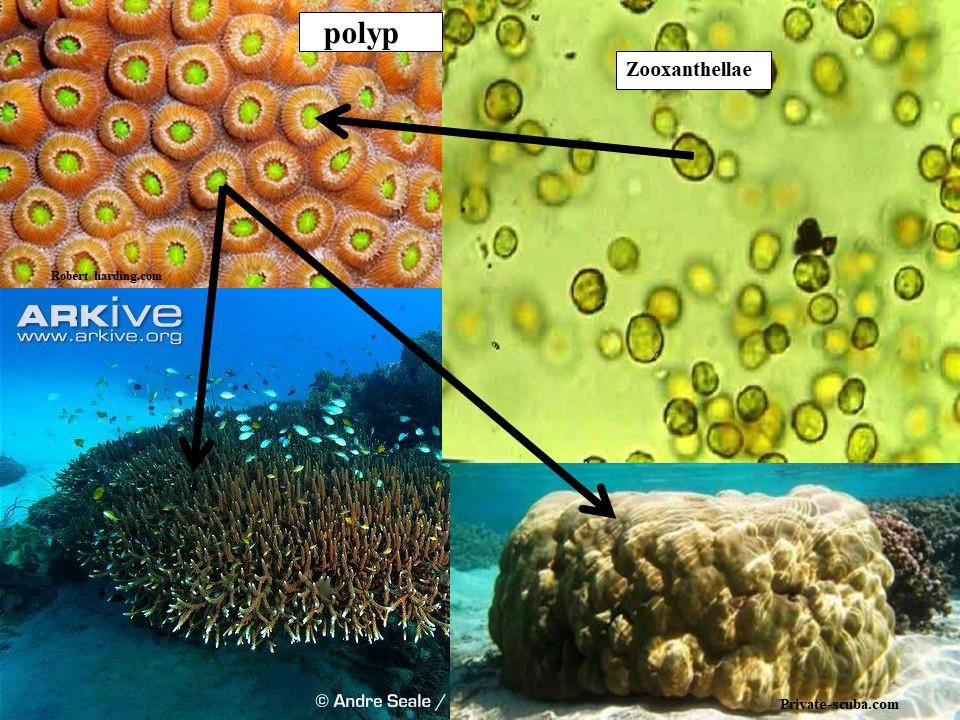
Most of the corals that bleach will recover. Corals are not born with zooxanthellae, these algae, they capture it from the surrounding water. There’s lots of different types of zooxanthellae that they can capture. Over the last 200 million years corals have been playing a game of Russian roulette. They can take in a type of zooxanthellae that’s just floating around in the water. What I would call say a low octane zooxanthellae. This will give them a resistance to bleaching. They can take the high temperature but on the other hand it means they’ll grow slowly. There’s a trade off. On the other hand coral can take a high octane zooxanthellae which will make them grow really fast. But if there’s a hot weather event they may die. In some cases, a coral might bleach, throw out one particular type of zooxanthellae and bring in a different type of zooxanthellae which might make it more adaptable or less susceptible to the high temperature events. There is a remarkable ability to adapt to temperature.
In some cases, a coral might bleach, throw out one particular type of zooxanthellae and bring in a different type of zooxanthellae which might make it more adaptable or less susceptible to the high temperature events. There is a remarkable ability to adapt to temperature.
We should also remember that it’s these short lived acropra – the staghorn and the plate-type coral – that are by far the most susceptible to bleaching. They have a very short life time. Maybe 10 years, maybe 20 years. If bleaching doesn’t kill them then a cyclone will kill them. Cyclones go across the reef very frequently like the weeds of the reef. So, there is no point in these short lived acropra growing slowly because they’ll be killed in 10 years anyway. That’s one of the reasons they like to grow fast but they’re more susceptible to bleaching.
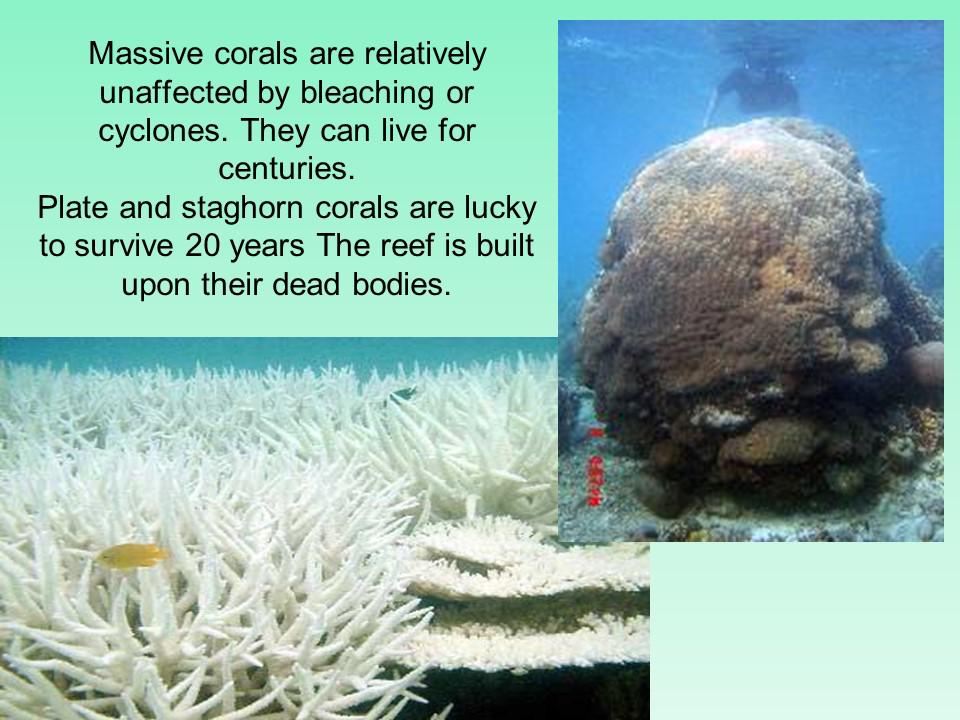
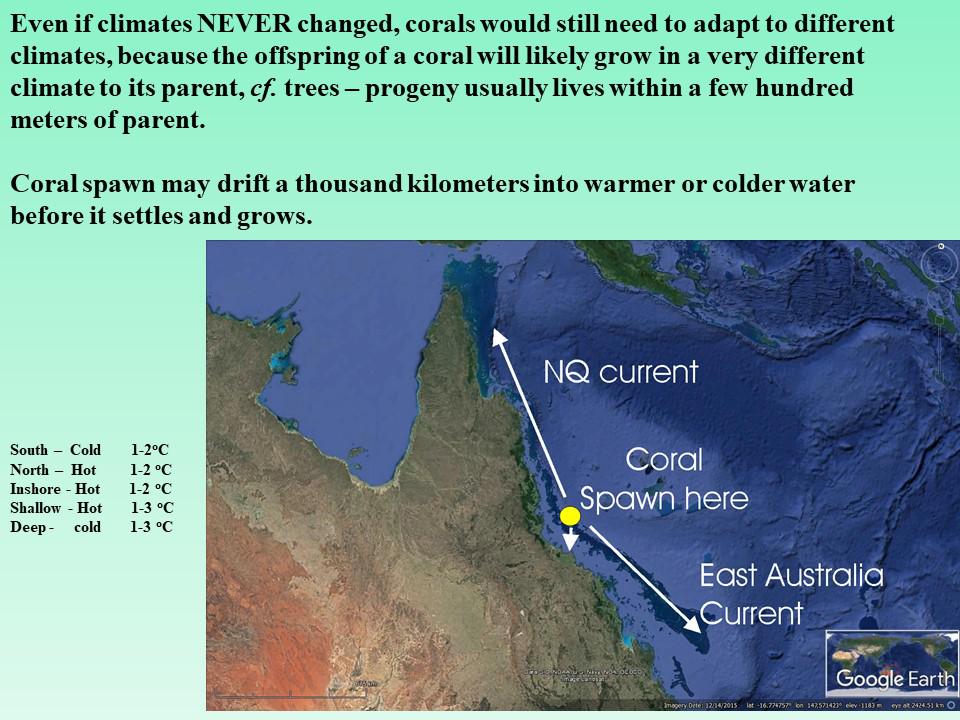
On the other hand, the great big corals can be hundreds of years old and they’re far less susceptible to bleaching. They’re like the big forest trees. In fact, even if there was never any climate change, as obviously there has been over hundreds of millions of years, corals must be very adaptable to temperature changes. A coral that says spawns in Townsville can have its spawn drift with the current and settle hundreds of kilometres away where the water is much hotter. Or it may drift hundreds of kilometres away where it’s colder. It might drift into shore where it’s hotter or it might go deeper where it’s colder by two or three degrees. And much more than the temperature change has happened over the last hundred years. Unlike a forest tree, which would drop its seed more or less in the same place and the offspring will be in the same place as the parent, in the case of corals their spawn likely to be in a completely different temperature environment.
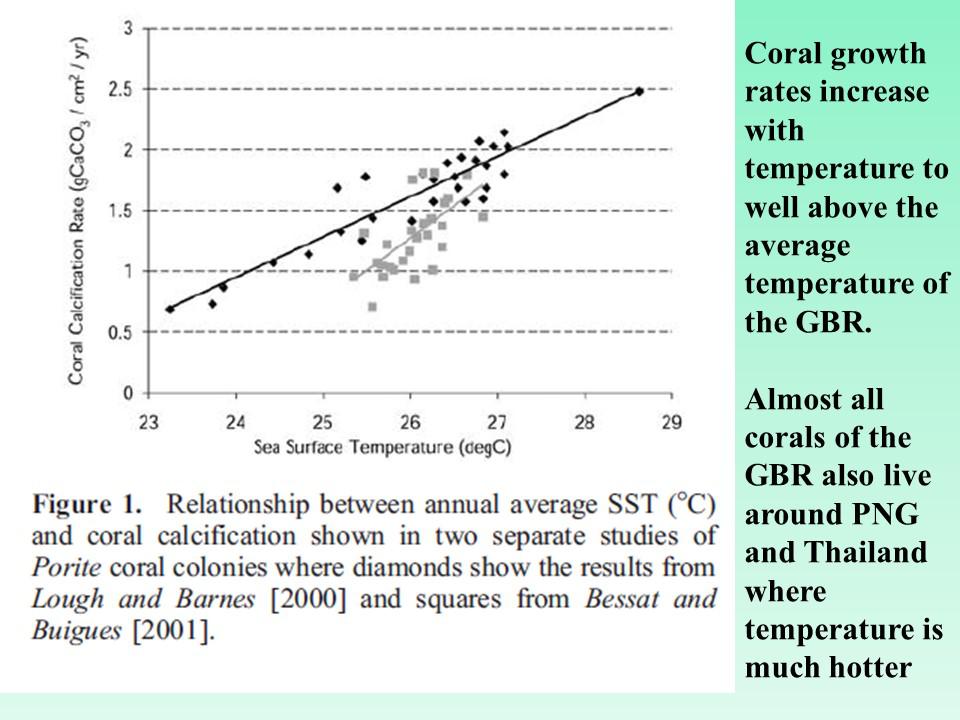
Corals are a tropical species. They like it hot. You have rubbish coral in Sydney compared with Townsville because it’s too cold. If you plot the coral growth rate versus the temperature, you get a more or less linear relationship. The hotter it is, the faster corals grow. More or less all the species of coral that live on the Great Barrier Reef also live around Thailand and Papua New Guinea where it’s one or two degrees hotter and they grow faster there.
Corals are a tropical species. They like it hot. You have rubbish coral in Sydney compared with Townsville because it’s too cold.
Over the past year we had a nasty bleaching event that killed a lot of corals in the northern zone. But there’s also a lot of bad science around, in my view. The survey after that event only looked at corals that were two metres from the surface. But that’s exactly where the hot water is in a bleaching event – where the water is very calm, there’s no wind and the top 3-5 metres gets very hot. But the coral goes right down to 40 metres and none of the deep coral was properly surveyed. So we don’t really know how bad that bleaching event was. It certainly was a nasty one, there’s no doubt about it. But you can’t necessarily believe the numbers.
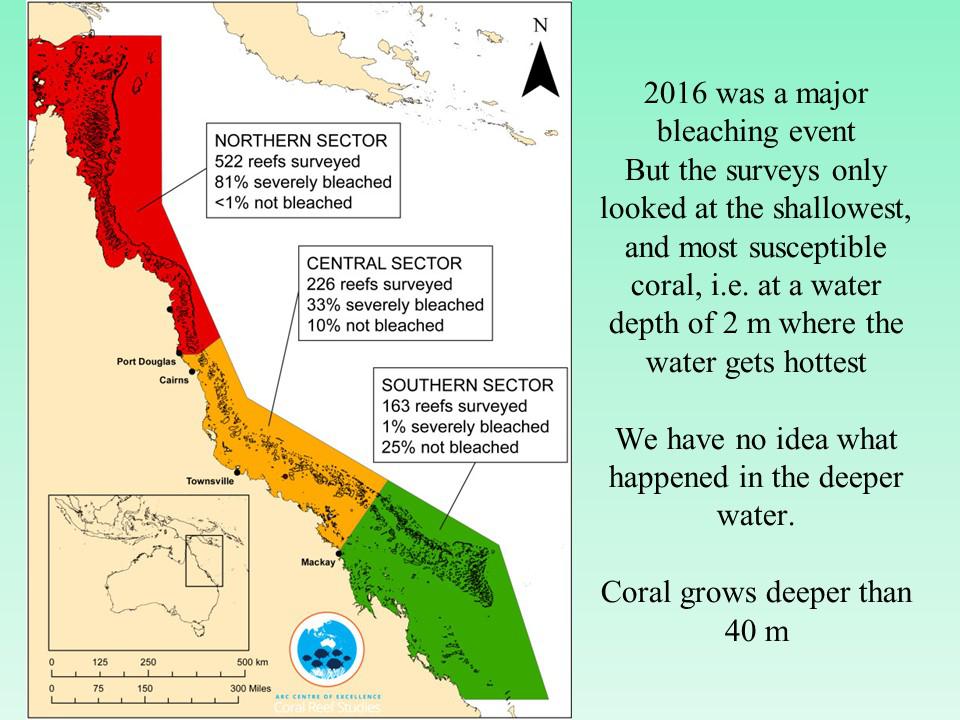
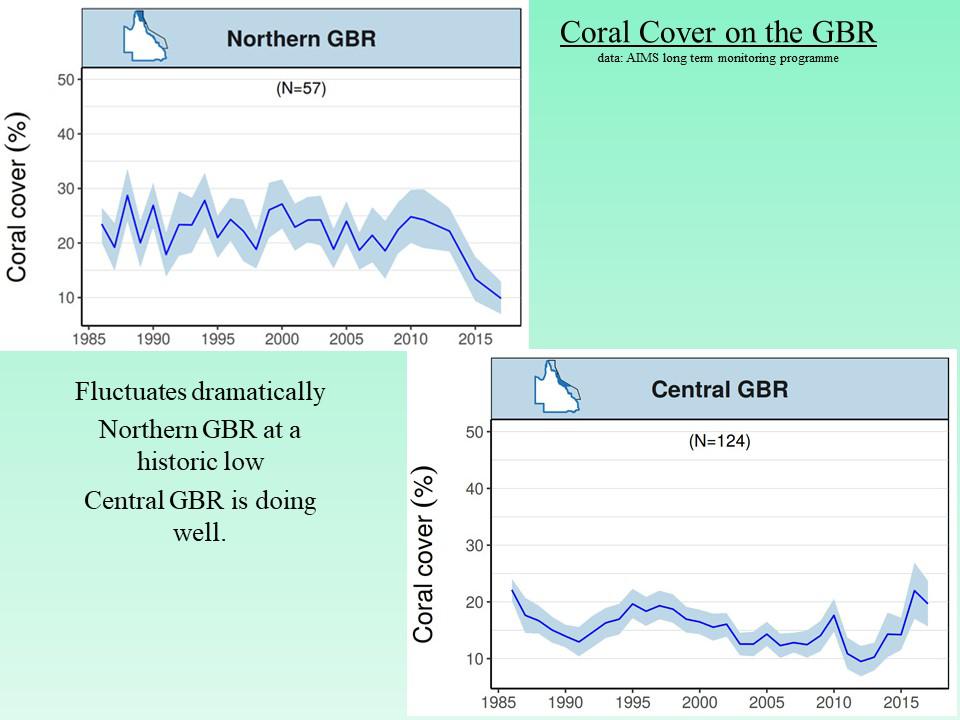
If you look back over the last 20 or 30 years, for the northern Great Barrier Reef, the numbers from about 1990 are very reliable. For the northern region it went along at about 20 per cent and then it fell down. This is the nasty bleaching event which we had. The central region bounces. These are large changes, between 10 and 20 per cent. A 100 per cent or a 50 per cent change in the coral cover over periods of five or 10 years. For the southern Great Barrier Reef there is a massive crash in 2010-11 when tropical cyclone Hamish wiped out enormous amounts of the reef. The amount of the coral covered dropped to less than 50 per cent of what it originally was. Yet, over the last five years, it’s bounced back so there’s now three times more coral in the southern GBR than there was half a decade ago. That’s a massive recovery.
For the southern Great Barrier Reef there is a massive crash in 2010-11 when tropical cyclone Hamish wiped out enormous amounts of the reef. The amount of the coral covered dropped to less than 50 per cent of what it originally was. Yet, over the last five years, it’s bounced back.
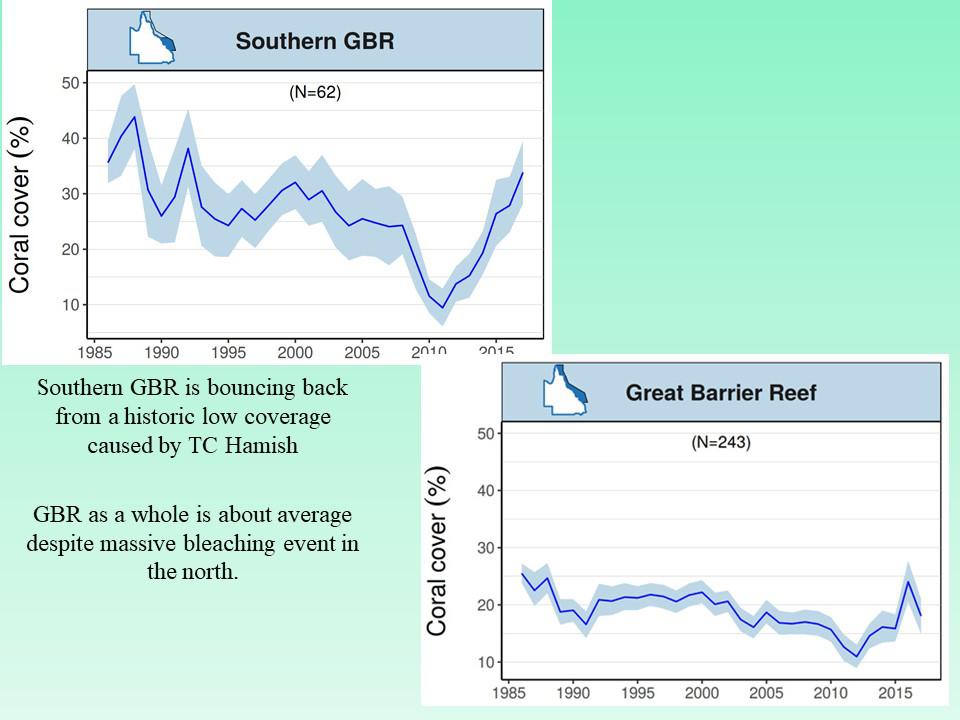
The Great Barrier Reef as a whole, bounces around – it hit a low point then it bounced back quite nicely by 2015, and came back down in 2016. I’m expecting that 2017 will be a bit lower again too because of a cyclone and another bleaching event. But, in five or 10 years, we can expect it to come back. We should think of bleaching as a bit like a bushfire – it looks very nasty but nature recovers from that.
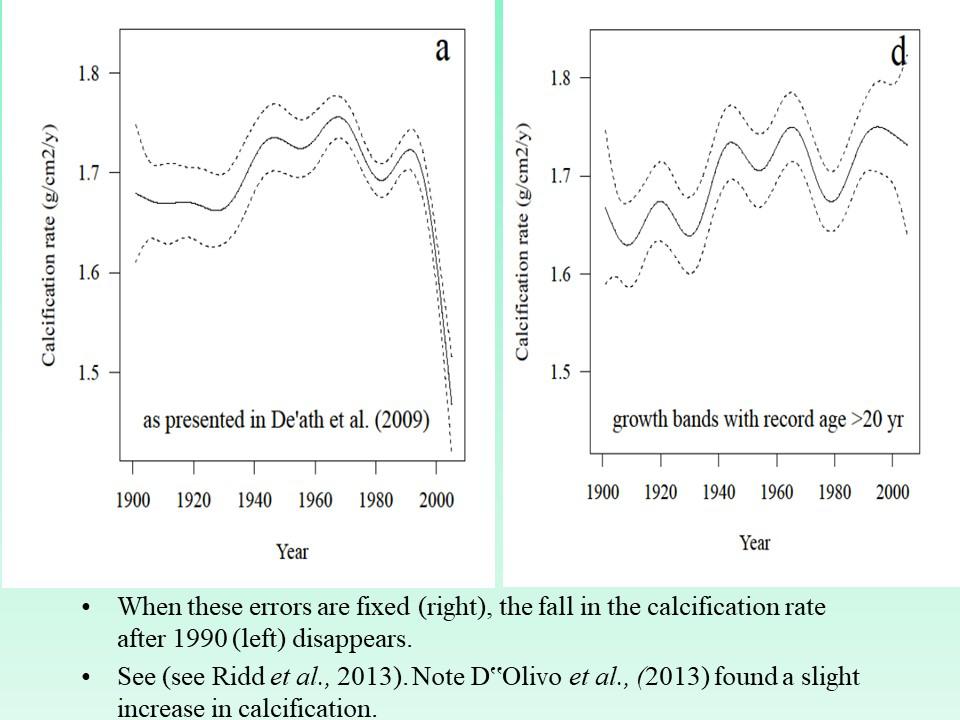
There’s a lot of other questionable science on the Great Barrier Reef. Here’s a little bit. The coral growth rate supposedly collapsed around 1990. We reanalysed this data and in fact there was no collapse. There were two major mistakes for the science behind that supposed collapse. A group using different measurements calculated that between 1940 and the present there has been an 11 per cent increase in the coral growth rates on 99 per cent of the area of the Great Barrier Reef. But there’s been a five per cent decrease in an area which is only one per cent of the reef. Now, instead of saying this is obviously a good news event, they say that our new findings nevertheless continue to raise concern properly reflecting the effects of CO2 driven climate change. This is a remarkable conclusion from a result that there’s more coral now than there was, or higher growth rates.
You have probably heard of the problem of the sediment from agriculture. We’ve done a huge number of measurements on that and there’s actually about 100 times more sediment that is resuspended completely naturally, and always has been, than actually comes out of these rivers. In my view, sediment is not a problem. There are some interesting pictures which have seen me get into trouble over the years. We have a reef in 1883 and, supposedly, the same reef today showing absolutely no coral. I sent my staff there and, in fact, you can see that there’s excellent coral in that particular location. So, pictures maybe don’t lie, but sometimes maybe they do.
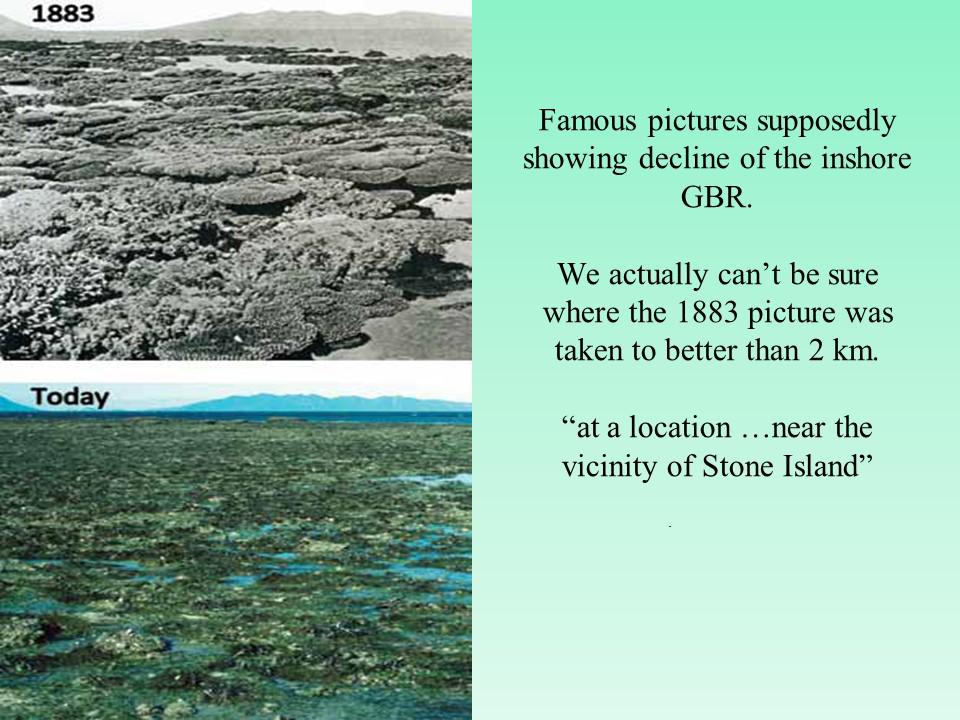
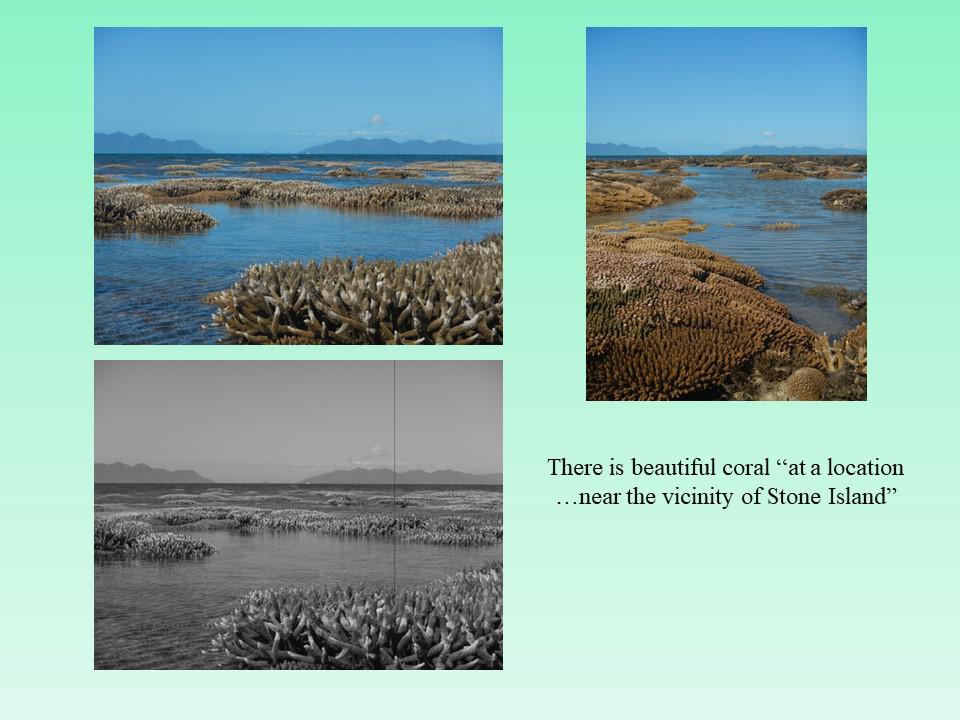
What do scientists want to do to save the reef? They want to close down the coal industry, they want to take sugar cane land out of production, they want to reduce the fertiliser rates, they want to stop clearing range land regrowth and all the bad publicity is massively affecting the tourist industry. Well, if you take all those industries away from North Queensland, we actually don’t have a great deal left.
So, what are the quality assurance mechanisms that we are using to make sure that this science is right? It boils down to peer review which you may think sounds all very impressive. That maybe a dozen scientists consider a work for a month or so. It’s nothing like that. Peer review is usually a review by two people and that may only last a couple of hours each. And that’s it. We know the system of peer review is biased, unjust, unaccountable, incomplete, easily fixed, often insulting, usually ignorant, occasionally foolish and frequently wrong. Peer review never involves going back and trying to replicate or do a proper survey of the work – almost never.
It’s nothing like that. Peer review is usually a review by two people and that may only last a couple of hours each. And that’s it.
How much of the work in science, then, is likely to be wrong? We have what is called a “replication crisis”. After this, when you go home, google the words “replication crisis”. It’s a big deal now in the whole of science literature. Richard Horton in The Lancet has stated that, “The case against science is straightforward: much of the scientific literature, perhaps half, may simply be untrue . . . . science has taken a turn towards darkness.” I think he’s right on this.
John Ioannidis from Stanford university is a mathematician working in the bio-medical field. The problem with science is right through the disciplines. It’s not just environmental science. Ioannidis has been at the forefront and says that 85 per cent of science resources are wasted because we’re chasing false and exaggerated findings in the literature. When the series of replication studies have been done over a wide range of fields – biomedical, education, psychology, criminology – we’re finding about 50 per cent of the published literature is wrong. When drug companies do replications of university work (as recorded in The Economist) they checked 60 or 70 original findings and found that just 20 per cent of the original work was right.
So, 80 per cent of major findings they found to be wrong. The proverbial hit the fan after that which was a good thing. What follows is the query, “Is it reasonable to question the trustworthiness of science and scientific organisation if peer review is the primary form of quality assurance/quality control (QA/QC)? And, should it even be a controversial question to ask these questions given the replication crisis which is sweeping through the rest of science?
So, 80 per cent of major findings they found to be wrong. The proverbial hit the fan after that which was a good thing. What follows is the query, “Is it reasonable to question the trustworthiness of science and scientific organisation if peer review is the primary form of quality assurance/quality control (QA/QC)?
I work a lot with engineers. I now know that they are much wiser than scientists because they know about quality assurance. When an engineer makes a mistake, the aeroplane crashes and there are mangled bodies in the wreckage. That really plays on their minds. When a scientist makes a mistake such as on the Great Barrier Reef, (they’ve been saying the Reef has been dying for about 50 years now) we actually don’t even know for another 30 years whether they’re right or wrong. We certainly don’t check the work.
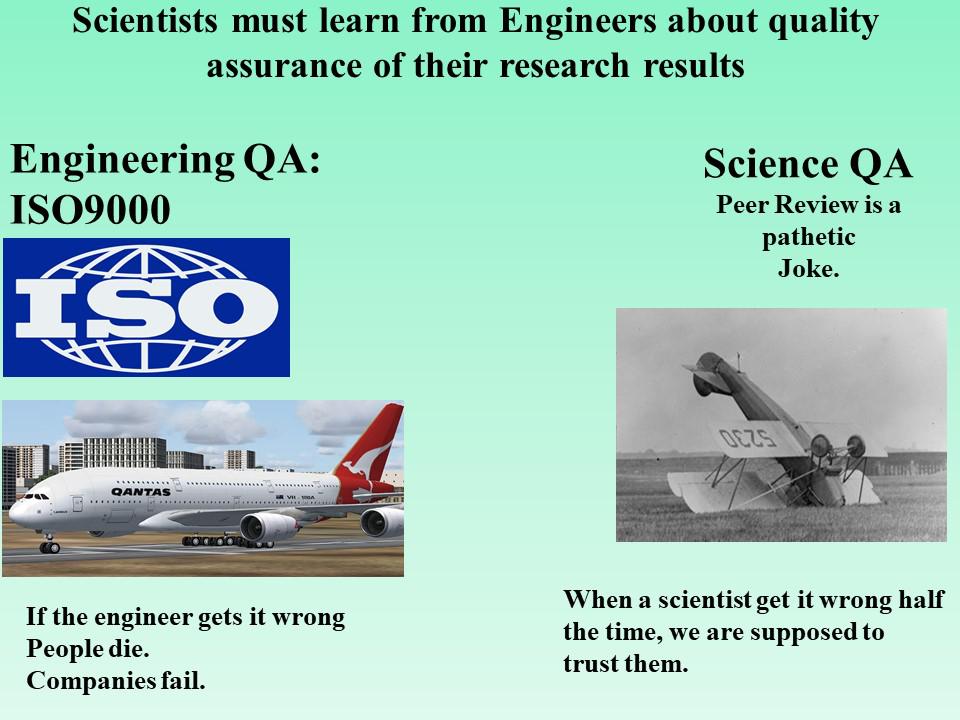
And you know, we’re told that we should respect scientists and science. And we should. If they get it right, half the time, a plane will only crash half the time. And that’s what the replication crisis is telling us. Half the science is probably wrong. And it’s not just for the Great Barrier Reef stuff which is how I got into it. It’s much broader. At the moment, I am trying to introduce methods by which we can actually bring the trust back into science. There should be no trust at the moment, in fact. Some of you might not believe in the global warming but it doesn’t actually matter.
And you know, we’re told that we should respect scientists and science. And we should. If they get it right, half the time, a plane will only crash half the time. And that’s what the replication crisis is telling us. Half the science is probably wrong.
What we should be looking at now is introducing systems where the science on which governments base big public policy decisions, and which we can no longer rely on, should never be assessed by peer review. We should take that science and subject it to a far more rigorous testing, checking and replicating process.
Scott Pruitt, the new US EPA Chairman, is talking about red teams and blue teams. So, you actually have a fight. The red team calculates the Reef is dying, fine. But let’s have a blue team test those this science on this and and all other sorts of policy. What we need is an Institute for Policy Science Quality Assurance that would do this, and not just on environmental work but on a whole lot of other science upon which governments use science.