
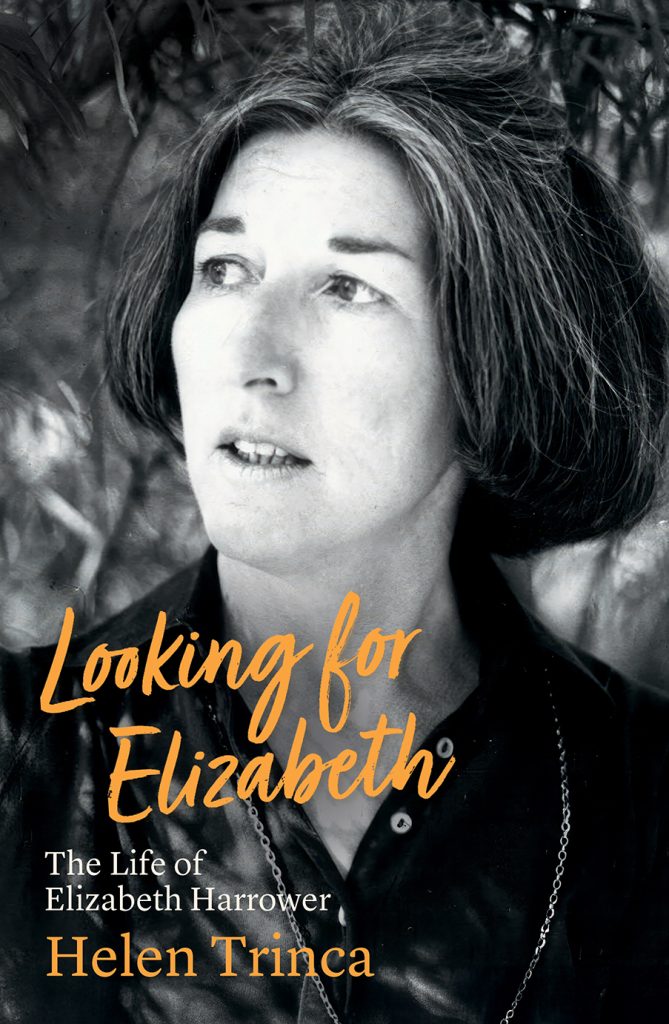
 A WRITER, A PUZZLE AND A SEARCH
LOOKING FOR ELIZABETH – THE LIFE OF ELIZABETH HARROWER
By Helen Trinca
La Trobe University 2025
ISBN: 9781760645755
RRP: $36.99 (PB)
Reviewed by Anne Henderson
There were many conundrums in the life of Australian writer Elizabeth Harrower. She produced five novels, largely based on her Australian experience of life and family -novels that marked her out as a psychological genius at probing the machinations of human emotion and manipulation, not least misogyny and domestic abuse. Most of these novels, in many ways, suggested they were part biographical. Yet, as a friend and public figure, Harrower was a closed book at any clues to her personal story.
Then there was her failure to produce additional novels after the success of her fourth – The Watch Tower – published in 1966. It would be 48 years before she allowed In Certain Circles to be published after its rejection by publishers in 1971. This had led friends like Patrick White to urge her to overcome her writer’s block and others to question the reasons she had stopped writing novels. Where a giant of literature like Emily Bronte could command the attention and acclaim of centuries with just one book, Elizabeth Harrower caught attention for stopping at four. Yet another puzzle.
Helen Trinca’s Looking for Elizabeth – The Life of Elizabeth Harrower, is a page turner of a biography seeking to unravel the conundrums surrounding her subject. Over her life, Harrower attracted a strong circle of friends among Sydney’s better known literary community but the enigma of her full story needed to be pieced together from recollections of friends and former colleagues, a vast quantity of letters and papers and, finally, her novels themselves. Helen Trinca’s book tackles the mystery that was Harrower with both empathy and revelation. As her friend, journalist and photographer Sally McInerney, told Helen Trinca, “There was always a feeling that although her life was like a very welcoming house with many rooms, there were some rooms which visitors should try not to enter.” Whether Trinca’s account opens doors to those locked rooms is up to the reader to decide. It certainly allows a possible viewing.
Born in 1928 in Newcastle, Betty Harrower – as her family called her – was affected by her parents’ separation in 1935 and their divorce proceedings that commenced in 1936 and dragged on. Left with her maternal grandmother in Newcastle while her mother took up work in Sydney, her grandmother’s separation from her heavy drinking husband in 1939 also affected Elizabeth. In adulthood, she would often refer to herself as a “divorced child”. The phrase, as Trinca registers it, is a key to understanding the emotional intensity that existed in Harrower and was replayed in her writing.
Aged 12 she relocated to live in Sydney where her mother had a new partner known as Richard Kempley whose profession of accountancy and real estate gave them certain respectability even as Kempley would spend four years in Long Bay gaol for a financial crime. His dominating character would be the basis for the manipulative male characters in Harrower novels.
From an early age, Elizabeth (known as Betty) was clever with words. Her grandmother had read to her often and she picked up the skill of writing quickly. She read copiously, attended night classes in semantics and history but did not attend university. Harrower took to Sydney life enthusiastically. She lived at various places on the lower North Shore from Manly to Cremorne. With her mother Margaret, she went shopping, took in movies; they went about like a pair of sisters. With various ploys, they coped with Richard’s moods and dominance. In 1951, Richard arranged for them to make a tour of Scotland and England, going by ship to the UK.
In Scotland, Harrower would get to know her older second cousin, Margaret Dick, a civil servant, unmarried and with Harrower’s same love of books. Their relationship would grow, last a life time and be grounding. It is here that Trinca notes how Harrower was susceptible to crushes on women friends. On leaving Sydney, Harrower ached for a letter from her work colleague Miss Maclean to whom she had become attached. Now, in Scotland, she became similarly besotted with her second cousin. Later, in Australia, a similar relationship would develop with writer Kylie Tennant. Harrower would in time destroy all her letters to Tennant as she did records of her life in London. Trinca analyses this trait in Harrower as of interest for the material it gave her for her novels when writing of the relationships between sisters and between younger and older women. But it does beg the question whether Harrower, in another age, might have been a lesbian. Trinca sees Margaret and Elizabeth, however, as of its time:
They would share houses in Edinburgh, London and Sydney … Over the years, some would wonder whether the cousins were a lesbian couple, they were so close, but these were family not lovers.
The trip would nevertheless set the trajectory for Harrower’s future. She would remain in London and not return to Australia until 1959. She paid her way taking typing jobs, having learned to touch type in Sydney and lived frugally. Her years in London set her path to literary success and were her most productive professional years as a writer. Her first three novels were written there. Living in cheap digs, Margaret showed Elizabeth the way to independence while Elizabeth guided Margaret to becoming a writer herself.
Trinca is dependent on Harrower’s late life interviews for glimpses of her personal life in London since Harrower would destroy all her letters and diaries of her time there. This lack of papers leaves much personal development for the reader to guess at. Harrower would say in later life she had been “loved” which leaves a great gap. There is no record of relationships she may have made while in London, or even connections she may have had with literary contacts. For all that, she sent off her first manuscript to three publishers before it was finally accepted. Down and Out in The City would establish her as a writer of note. This was followed by The Long Prospect, regarded in time, by Christina Stead, as her best novel.
Harrower’s recollections in later life interviews offer small glimpses into her penurious London lifestyle, Labour Party support and the way she and Margaret made use of all free offerings for museums and galleries to pursue their love of art and history. Yet it is a tragedy of sorts that little can be known of the emotionally connected writer in that time. And anything of why and how she developed as a writer, and her London experiences from which she grew more confident and able to push into a most competitive field. Harrower claimed she had not read an Australian novel at that stage of her life – yet she could write of Sydney and Australia from afar with intimate detail.
Returning to Australia with Margaret Dick in 1959, Harrower was seeking to re-engage with her Australian roots. She had a new identity as a writer and the women were noted in the social pages on arrival back in Sydney. Harrower went from shock at the city’s “complacency” to falling in love with Sydney writing: “I took to the place all over again … I felt the level of goodwill.” The women accepted interviews, did reviews for The Sydney Morning Herald and took part time work. They became established in Sydney’s small writers’ community.
The bulk of Trinca’s search for Harrower follows her return to Australia. Harrower’s third novel The Catherine Wheel – written in London but published after her return to Sydney – brought mixed reviews and her writing of short stories and even short plays seemed to go nowhere. Then Max Harris and Geoffrey Dutton discovered her novels and an essay by Harris promoting Harrower’s writing set her up as ranking beside Patrick White but with “slighter range and power”. Trinca writes: “Harris had created a place in the canon for Harrower’s work in a way that would have been impossible in London.”
Trinca’s search is intricate and detailed. As one of the new “finds” of literary circles, Harrower found herself part of a tribe well beyond her modest beginnings. She was on a high. Her sudden acceptance by those she looked up to, intellectually and socially, also brought comfort and new experiences. But, in the longer term, she would only publish one further successful novel – The Watch Tower – and leave her last novel, upon rejection, in the files until decades later. Why and how this happened centres on three important relationships which Trinca explores. They were Harrower’s friendship with Kylie Tennant, Shirley Hazzard and, above all, Patrick Whilte.
Harrower met Tennant in 1962 when the popular left-wing writer of struggle street stories persuaded Harrower to move publishers from Cassell to Macmillan. They clicked, Tennant’s political views suiting Harrower. But the relationship soon went further when Harrower joined Tennant in buying a weekend shack in the Blue Mountains. Tennant’s marriage was troubled and the shack allowed Tennant to live separately for part of the week from her husband Lewis Rodd (known as Roddy), much older and invalid after an attempt to kill himself. In 1961, in her diary Tennant wrote that her domestic life was overpowering her with limited means and two children, one showing signs of mental illness, and a husband she regarded as “insane”. Harrower, writes Trinca, was a breath of fresh air”. Tennant arranged for Harrower to get a position working at Macmillan.
Tennant’s daughter Benison, looked back six decades later and opined that Elizabeth was “probably in love” with her mother and wanted her to leave the marriage. But Tennant would not leave her husband who needed care. The weekender became a weekly ritual, the two women driving to the mountains for a separate life. This was another productive time for Harrower. The Watch Tower, Harrower’s fourth novel was published in 1966. It was a success but repeated the theme of younger women dominated by manipulative men, in this case degraded by their relationship with one man. In time, critic Georgie Williamson assessed the novel as “a time-and-motion study of extreme violence and mental distress; a work where Australian masculinity is shown as a gibbering gimp”.
The relationship with Tennant outlived its harmonious early years, however. Trinca traces Harrower’s years after The Watch Tower as full of personal distractions that distressed her, including the death of her mother who had been a true supporter. Alongside this, writer’s block at what next to write and the growing Rodd children filling the weekender with their sleeping bags and mates drained the pleasure she had once derived from it. Trinca writes: “The beginning of the end of Elizabeth Harrower’s career as a novelist coincided with the unravelling of one of the deepest relationships of her life … as tensions grew in her friendship with Kylie Tennant she began to lose her impulse to write.”
Overlapping this, was the second relationship which took its toll on Harrower. Her friendship with Shirley Hazzard. It began with Harrower helping Shirley’s mother Kit who was living, somewhat needy and lonely, in Macleay Street. A thank you letter from Shirley resulted in what Trinca describes as a “slightly awestruck letter” back to Hazzard. From this, a long distance friendship began mostly in the form of letters. Over time, however, Harrower was left with Kit and her troubles in Sydney while Hazzard travelled between New York and Italy with a wealthy husband and increasingly became an internationally recognised novelist, short story writer and occasional commentator on public affairs. On a visit to Hazzard and her husband Francis Steegmuller in Italy, Harrower became unhappy and shortened her trip. Her relationship with Hazzard, as Trinca sees it, was part competitive, part resentful and partly Harrower’s attraction for the global recognition it gave her.
And then there was Patrick White. Harrower had read his Tree of Man in London and loved it. So, she had read at least one Australian novel by the time she arrived back in 1959. They were introduced to each other by Kylie Tennant and over thirty years Patrick White and his partner Manoly Lascaris became as close as any friends Harrower might have had – dinners together, long visits, Sunday morning phone calls and White’s obsessive concern that Harrower was throwing her concentration on caring for Kit rather than on time for the next novel.
White became in fact something of a nag at Harrower which leads Trinca to see the relationship as not so much supportive as draining Harrower’s confidence. Harrower also learnt that at some of White’s dinner parties he could laugh at her behind her back. For the super sensitive Harrower, White could be seen as both a friend and bully. Trinca does not say it but, in many ways, Patrick White was something of a trap for Harrower, another one of those domineering men to be found in her novels.
In later life, Harrower would have a renaissance with a fresh publishing of her novels and eventually In Certain Circles – the manuscript left in the drawer from 1971. Her revival capped off a full life and came as a sort of consolation prize in that Harrower so often closely missed the real ones.
The search for Elizabeth Harrower is a deeply engrossing work, throwing up as many questions as it solves. There could have been a novel in the White/Harrower friendship, but Harrower was too overcome with awe that White had made her his friend to ever see him in full as yet another domineering male presence. That she never wrote a novel after 1971, became the big mystery.
However, there is another way to see it. David Malouf told Trinca in 2024: “In the time that I knew her [Harrower], she was really quite certain that the books that she had already published constituted a body of work that was cohesive and original, and very much that the books belonged to one another. … she couldn’t see that anything she wrote would amplify them in any way … I had huge respect for that.”
Anne Henderson is Deputy Director of The Sydney Institute and author of Menzies at War, which was shortlisted for the 2015 Prime Minister’s Award for Australian History.
* * * *