
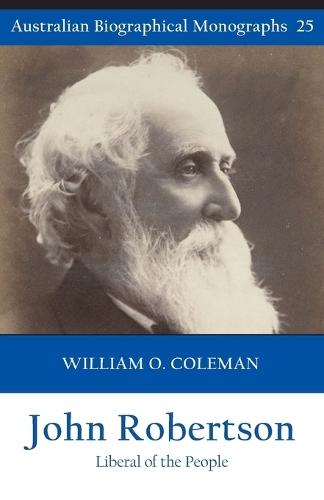
 FATHER OF LAND REFORM – AN ECONOMIST’S ASSESSMENT
JOHN ROBERTSON – LIBERAL OF THE PEOPLE
Australian Biographical Monographs 25
By William O Coleman
Connor Court 2025
ISBN- 9781923224612
RRP: $19.95 (PB)
Reviewed by Anne Henderson
Knowledge of Australian history among the young is fading. Whether this is a failure of curricula or the overwhelming emphasis in historical studies on Indigenous Australians’ cultural losses in current times is hard to say. But this makes the enterprise edited by Queenslander Scott Prasser all the more important. His Australian Biographical Monographs series seeks to keep many of Australia’s key historical players “on the record” so to speak. To publish brief assessments and history of those who built our present settlement, to bring them into the public arena again reminding us of so many people we owe for our national good fortune.
Number 25 in the series has now been released. Written by economist William Coleman, it brings to life a political giant of colonial New South Wales, a leader who championed representative government before the Australian colonies federated and was the equal of Federation hero Henry Parkes. Parkes would survive 1901 as the father of Federation making him a national figure in the history books. Robertson, who opposed federating the colonies, has been left in a smaller pool of NSW politics. However, it is Coleman’s challenge to his readers that Robertson was the embodiment of a liberal stream in our colonial parliamentary politics, a voice for reform in an egalitarian milieu.
The son of a clockmaker, first in the village of Bow and then on the outskirts of London’s east, Robertson was part Scottish (father) and English (mother) with the Scottish side predominating both at the Presbyterian church the family attended and in Robertson’s slight Scottish accent. Aged four, he came with his parents to Sydney as free emigrants and apart from a year back in England in adolescence Robertson remained in Australia. Coleman quotes how he saw himself when he said at one stage: “I may have been an English infant, but as a man I am Australian.”
The colonial world Robertson had adopted offered opportunities the son of a clockmaker would never have had in old England. As a young man, Robertson abandoned any idea of following his father in trade and set off to acquire land as a squatter. It was as a squatter on the Liverpool plains beyond the more popular reach of the Hunter Valley that Robertson represented his neighbours to plead the squatters’ case when NSW tried to put a stop to squatting where the police were not able to offer protection – apart from other harsh treatments of squatters such as summary fines. Robertson had made his mark as a leader at a very young age.
In mid nineteenth century New South Wales, with the limits on authority plagued by distance and lack of communications, a young aspirational man like Robertson could move quite easily across social barriers as a strong voice. And Robertson soon showed a pragmatic ability to take up causes rallying local grievances. He was opposed to the resumption of transportation for NSW in the 1840s while at the same time supporting emancipists as “useful and reputable members of society”. He moved from voicing squatter grievances to those of freeholders as he himself became a freeholder. He opposed any upper house as a body of elites and then won a seat in NSW’s first Legislative Assembly in 1856. He would go on to serve as premier on five separate occasions and defeat Henry Parkes in 1875 while later collaborating with Parkes in government.
It is Coleman’s brief in this cameo of Robertson to mark out a political “creed” that set him apart as a reformer. Coleman writes: “In defining Robertson’s liberalism one can do no better than identify it with a root precept: you should be allowed to do as you choose with what is yours.” Then comes the query – well what is “yours”? It is Coleman’s conclusion that Robertson’s contention of right to do with one’s own as one wished should be set against the contention on the left that “nothing is your own”. From this Robertson’s creed can be drilled down to a belief that there was a right to “dispose of the fruits of your labour as you thought fit regardless of what others would rather you do or not do with them”.
In his tussles with Parkes, Robertson would eventually lose over government schooling and win over land resettlement. Parkes, unlike Robertson, was a bitter sectarian set on driving Catholic schools out of existence. Robertson saw more value in the Irish National System of schools where – with the guidance of Richard Bourke – all denominations could agree with a national system that embraced religious teaching as “mutually agreed upon” among the different strands of Christianity. For all that, Coleman writes that Robertson’s failure to get his educational vision implemented was a “failure in his attempt to reconcile liberalism’s commitment to Freedom with democracy’s commitment to equality”.
On Chinese immigration, Robertson sought to understand local antipathy towards the influx of Chinese residents while also supporting more moderate attempts to slow their settlement. This Robertson middle way Coleman defines eventually as a politics of “camaraderie” which worked in late 19th century Australia where, as Coleman puts it, “Parliament was political power itself, and not just its source”. This was enhanced by the lack of any formal political parties during Robertson’s lengthy time in the Legislative Council. From this, Coleman identifies how Robertson developed a workable “circle” of supporters that was an alternative to a modern day faction.
The members of Robertson’s circle could have differing positions on various political stances. They could challenge, for example, his land legislation that eventually developed into the Robertson Land Acts. Coleman writes:
The mutual loyalty and rational trust of the circle fostered political action. It could even create government; thus one government could be described by The Sydney Morning Herald as “John Robertson and his friends”.
But the politics of circle had its limitations and Coleman does not quite make the case for its endurance as an embodiment of any true sense of liberalism. It was open to favouritism and depended on compromise in which Robertson was an adept player. And, as the 19th century moved more and more into modern developments such as better communication alongside a substantial increase in voter population, the growing formalisation of groupings was inevitable. Hence, also, the slow development of loose collections heading towards the loyalty of political party identity.
Robertson’s great legacy was his land reform acts. Coleman tackles the criticisms of historians and others down the decades. In schools and universities in the 20th century, students were taught mostly the failures of the land reform legislation, designed to break up the stranglehold of squatting estates on Crown land. For Coleman this derision of Robertson’s reform is a failure to recognise the legislation can be seen as both “liberal” and “democratic”. He writes:
… despite that, and because of that, it soon became the subject of censure and dispraise and had remained so to the present day. The essential “left” criticism of the Acts is that they did not succeed in putting the poor man on the land by establishing a mass of v smallholders.
Coleman goes to work on the figures and is able to show that in a half century those land acts did make a difference to smaller holdings and a redistribution of Crown land. Land reform did happen. This re-evaluation is long overdue. The “Dad and Dave” and On Our Selection literary portrayals of selectors is but a send up not an objective analysis.
There is no doubt the story of John Robertson of New South Wales is bigger than the story of his legacy making land reform acts. But legacies are about change that endures. William Coleman in bringing an economist’s eye to Robertson’s history has restored his place in it.
Anne Henderson is Deputy Director of The Sydney Institute and author of Menzies at War, which was shortlisted for the 2015 Prime Minister’s Award for Australian History.
* * * *