
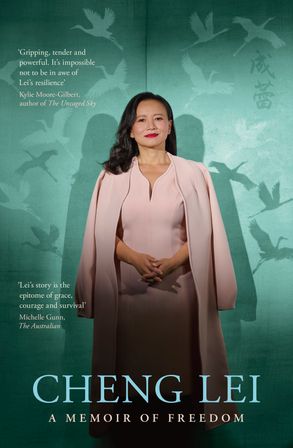
 THE POWER OF RESILIENCE AND RESOLVE
A MEMOIR OF FREEDOM
By Cheng Lei
HarperCollins 2025
ISBN: 9781460766576 ; ISBN 10: 1460766571
RRP: $35.95 (PB)
Reviewed by Keith Harvey
Chinese-born Australian Cheng Lei’s memoir of her three years and two months spent in detention in China is a powerful tale of her arbitrary arrest and the cruel treatment of herself and fellow detainees in the unjust “justice” system operated by the Chinese Communist Party (CCP).
Sadly, while her account is remarkable it is not unique– there are many such other accounts of unlawful, unwarranted and inhumane incarceration of individuals at the hands of authoritarian regimes. The Bolshevik coup in Russia in 1917 set a continuing pattern of arbitrary detention and injustice by successive totalitarian Communist party regimes.
As well as numerous personal written accounts, Solzhenitsyn’s three-volume Gulag Archipelago which detailed his own experience and that of millions of others and Anne Applebaum’s Gulag – A history describe a pattern of cruel regime behaviour that continues to the present day under the CCP regime in China.
Cheng was arrested in Beijing in September 2020 and only released in October 2023. Another Australian citizen, Dr Yang Hengjun, 60, remains in jail in China having been sentenced to death for alleged spying and may serve a life sentence.
Cheng Lei’s memoir is remarkable for its detail and frankness. Without access to writing materials, she has committed to memory and now put down on paper an account that takes the reader inside the cells in which she – alone for long periods of time – and her cellmates lived for three years with extremely limited contact with the outside world.
This is a “warts and all” account which details the humiliating treatments inflicted on detainees, some of them particularly difficult for female inmates. It is a gritty, even crude, story because the conditions were crude and inhumane. Every activity of daily living had to be done in the full view of others, including the guards. Readers are warned: this story is not a pretty one.
The comparison with Cheng’s previous life as a journalist on Chinese television could not be starker – nor her conditions more degrading. That she survived this treatment is a testimony to her mental toughness and personal resilience. Readers will also wonder how they would survive the treatment meted out to Cheng and her fellow inmates. This aspect of her account is inspiring – holding up mentally and physically in these circumstances is a triumph of mental strength and courage.
Cheng – like other detainees – was kept first in what is known as Residential Surveillance at a Designated Location (RSDL). This sounds like house arrest but it is actually a form of solitary confinement. Cheng was alone in her cell for six months, accompanied by two guards who sat and stood in her cell with her 24 hours a day on four-hour shifts. Cheng had to ask permission for every move she wanted to make. Communication was forbidden – the only relief was interrogation sessions which almost came as a welcome relief and consular visits from Australian officials. Cheng was not allowed to see a lawyer for 10 months (after she left RSDL).
This system of detention is not supposed to last for more than six months and Cheng did the full time allowed. It has been described as a form of torture and is designed to break the prisoner and make them believe that conviction and jail is a better outcome.
After RSDL comes the pre-trial period where the accused moves to a cell with other detainees while the case “progresses”. In Cheng’s case, the pre-trial period lasted about 18 months before she was convicted. The convicted person remains in this form of detention until sentencing which, again in Cheng’s case, took a further 18 months.
During this period, while Cheng shared a cell with other women, they were not allowed to tell each other their names, only their prison numbers, or discuss their cases.
Only after the sentence has been handed down is the prisoner moved to a jail. Cheng Lei spent over three years in detention but never went to jail (where prisoners have more rights and freedoms). She was eventually effectively sentenced to time served and released from detention, flying back to Australia immediately.
Both Solzhenitsyn and Applebaum describe in their accounts the process of arrest and the psychological impact on the detainee. “Me? What for?” is the most common reaction to the arrest because there is, of course, no reason. The second reaction is to imagine that it is a mistake and will be sorted out quickly once properly investigated. Arrested at work one morning, Cheng was advised by a colleague to “just explain to them and you will be all right”. But explain what? And it is never all right; once arrested there is no going back – the totalitarian state makes no mistakes and the accused is in effect already guilty and sentenced – even if this process takes years.
After her arrest, Cheng was taken to her apartment, which was searched. With prompting, she took only a few personal items with her into detention, expecting to be home again within “a few days, two weeks, tops…” She never returned.
The treatment of arrested and detained persons by extreme left-wing and communist regimes can be traced at least as far back to the French Revolution of 1789. During the Terror, the revolutionary regime passed the “Law of Suspects” leading to the arrest of tens of thousands of ordinary citizens for little or no reason.
When these arrests clogged the Revolutionary Tribunals, further laws were passed denying the accused legal representation or the ability to call witnesses. Ultimately, the accused was required to defend themselves. The presumption of innocence was reversed, the accused having to prove their innocence, in effect. But at least they had the opportunity to plead not guilty and make their case.
Under the CCP’s system of (in)justice, the onus is reversed again – but not to the presumption of innocence: the onus is now on the accused to prove their guilt! Not satisfied with her initial “confession”, Cheng’s interrogators pressed her to go further: “…eventually, I twigged: they wanted us to make their case for them. Their job was to churn out iron-clad guilty pleas.” [page 68]
The same was true in the Soviet Union; under extreme pressure, detainees “confessed” to the most fanciful crimes, often laughably and impossibly absurd. They were convicted anyway, shot or sent to the Gulag.
What was Cheng Lei’s crime? She was being investigated for “revealing state secrets to foreign organisations” it transpired that her offence was revealing eight words about an official Government report on the economy, seven minutes before an embargo [of which she was unaware] elapsed. This information could hardly have been a state secret since it was about to be in the public domain, both in China and elsewhere.
And the real reason? It is of course hard to be certain, but Cheng was arrested after Australia’s then Foreign Affairs Minister Marise Payne had called for an investigation into the origins of the COVID-19 virus which had emerged in Wuhan, China in late 2019, early 2020. It is strongly suspected that this was the CCP’s tit-for-tat response, punishing Australia by detaining an Australian citizen.
Foreign Minister Payne had called for this inquiry on the 19 April 2020. While Cheng was not arrested until August that year, it transpired at her “trial” that she had been placed under surveillance on the 23 April, just four days after the Minister Payne’s call. The act for which Cheng was arrested and convicted occurred on the 22 May.
Throughout her ordeal, Cheng Lei was supported by the Australian Government and especially by the Australian Embassy in Beijing through regular consular visits – although most of them, due to COVID, were conducted by video link.
After the election of the Albanese Labor Government in 2022, relations between Australia and China improved. Cheng was eventually sentenced to two years and 11 months jail time. As her six months in RSDL only counted as three months, this was effectively a sentence of time served and less than the five years said to be the minimum for state security offences (and expected by Cheng).
Did improving relationships between Australia and China lead to this outcome? Probably. In her memoir Cheng thanks the Australian Government, especially Foreign Minister Penny Wong for their assistance as well as that of the Australian diplomatic team in Bejing. She also acknowledged the support of former Prime Minister John Howard, whom she had once interviewed on TV, who provided a letter of support.
Yang Hengjun remains in jail in China, reportedly suffering ill-health, despite a high-level visit to China by Prime Minister Anthony Albanese in 2025.
Cheng Lei was born in China but came to Australia with her mother to join her father – an academic – at the age of 10 in 1985. After the Tiananmen Square massacre in 1989, Prime Minister Bob Hawke granted Chinese citizens in Australia the right to stay in Australia and Cheng Lei and her parents became citizens.
In her 20s, Cheng returned to China and ended up as a journalist on Chinese state-owned television presenting global business news. At the time of her arrest her two children were in Australia due to COVID travel restrictions. She did not see them for more than three years.
Cheng Lei was not a pro-democracy or human rights activist. Prior to her arrest she had a high-profile job in government-controlled media. From Davos to nakedness in detention, she notes in one of the more humiliating experiences in her period of detention.
Cheng’s memoir is almost exclusively confined to her experiences in detention. It is not a reflection on the Chinese Communist Party’s rule of China since 1949. She does not comment about what she thought of CCP rule when she was a prominent employee of a state-run media organisation.
As a result of her detention, if for no other reason, Cheng is clearly not a fan of the Chinese Communist Party. She has appealed for an understanding that the CCP is not the true spirit or culture of China nor representative of the Chinese people themselves and for outsiders to make this distinction.
Speaking to The Sydney Institute about her memoir, Cheng Lei appealed for greater “Chinese literacy” or understanding of these distinctions. In her address she mentioned that she had spoken to a group of Australian lawyers, who appeared shocked that she was denied legal representation for the first 10 months of her detention.
We should be shocked that Australian lawyers have so little appreciation of the absence of the rule of law in China and the lack of judicial independence and the inability of lawyers to defend their clients.
Since her release and return to Australia, Cheng Lei has continued to be vilified in the pro-CCP Chinese language press and described as a “monster”. She has been “shadow-cancelled” by organisations and even friends and work colleagues with continuing connections to China no longer comfortable to be seen in her company.
Cheng Lei’s memoir stands as another warning of both the nature of the CCP’s rule and the dangers of involvement in working and doing business in China under the CCP regime. The memoir should be read by all contemplating any involvement in the Chinese business world.
As a personal account of individual resilience in the face of unjust, cruel and inhumane treatment it is also worth reading. We know about Cheng Lei’s experience because she is an articulate Australian citizen. We know little or nothing of the experience of hundreds of thousands or even millions of Chinese citizens similarly treated who have no foreign governments or citizens to take an interest in them. We can only imagine that their fate is much worse.
Since returning to Australia, Cheng Lei has joined with Kylie Moore-Gilbert (who was detained by the Iranian regime for 804 days) and others to form the Australian Wrongful Arbitrary Detention Alliance which aims to prevent and assist others caught up in the same situation as she endured. Cheng Lei is employed as a journalist/broadcaster by Sky News.
———————————————————————————————————————-
Cheng Lei – A memoir of Freedom, HarperCollinsPublishers, 2025, $35.99 PB, $16.99 eBook
Watch Cheng Lei’s address to the Sydney Institute here: https://thesydneyinstitute.com.au/blog/cheng-lei-surviving-china-imprisonment-and-injustice/
———————————————————————————————————————–
Keith Harvey is a non-factional member of the Victorian ALP. His Memoirs of a cold war warrior [2021] detailing his work in the trade union movement is available from Connor Court Publishing as is his biography of former Independent Senator Brian Harradine [2023].
* * * *