
 AUSTRALIA: A HISTORY
By Tony Abbott
HarperCollins 2025
ISBN: 9781460718995
RRP: $50
Reviewed by Gerard Henderson
Without question, Tony Abbott, Australia’s 28th prime minister, is a great communicator. As a politician this was evident when leading the Liberal Party/Nationals Coalition to victory over the Kevin Rudd-led Labor Party government in September 2013 Abbott promised that, if elected, he would “Stop the boats, scrap the carbon tax, build the roads of the 21st Century and get the Budget back under control”. The Coalition won 17 seats – over and above the 8 seats it won from Labor when Tony Abbott led the Coalition at the 2010 election – just failing to win against the incumbent Labor prime minister Julia Gillard. In other words, over two elections the Coalition won 25 seats from Labor under Abbott’s leadership.
Few former Australian prime ministers have written books other than about themselves – Labor’s Gough Whitlam and the Coalition’s Malcolm Fraser come to mind in this instance. However, John Howard wrote an important study of Australia’s longest serving prime minister Robert Menzies – and Menzies wrote two books of essays on national and international issues. And now there is Tony Abbott’s ambitious Australia: A History.
An alternative to the left’s alienated history of Australia
In the lead-up to Australia Day 1993, at the request of Trevor Sykes, I wrote an article for The Bulletin. It was published in the double edition (dated 19 January/2 February 1993) and featured on the front cover. My thesis was that so much of the general histories of Australia were written by alienated leftists. I specifically criticised Manning Clark (1915-1991), Robert Hughes (1938-2012) and John Pilger (1939-2023). There were references to Clark’s claim that Australian society exhibited a “sickness at large”, to Hughes’ assertion that Australia was the world’s first totalitarian society and Pilger’s view that Australia had always fought other people’s wars (including the Second World War).
The article concluded as follows: “It’s time to junk the guilt and alienation: Down with the falsification of Australian history”. The latter phrase was a send-up of the cry “Down With” much beloved by Marxists the world over. The left wing historian Stuart Macintyre (1947-2021) did not like the irreverence and berated me. His general histories – which were widely taught in tertiary institutions – continued in the pattern of Clark/Hughes/Pilger alienation albeit without the hyperbole.
What’s impressive about Australia: A History is that the author has decided to write a non-alienated history devoid of alienation but aware of the nation’s successes and failures.
Geoffrey Blainey’s assessment
In the foreword of this book, leading Australian historian Geoffrey Blainey describes Abbott’s work as “mostly a political history” and states that the author’s “final verdict is that ours is a very successful nation, though scarred by failures”.
Abbott’s essential message can be found in his introduction. He pointed out that when the First Fleet set sail from Plymouth, Britain in 1787 “the modern world at its best – free, humane and prosperous – was taking shape”. The introduction concludes:
It was from here that the First Fleet set sail. This was the culture that animated the people on board. This was the underpinning of modern Australia: a country with an Indigenous heritage, a British foundation and an immigrant character, and, as we shall see in this, the story of us, a proud history all of our own.
Again, this is a simple message – and one that is difficult to criticise. Contemporary Australia does have an Indigenous heritage, a British foundation and an immigrant character. It is also a manifestation of what Christians call “The Fall”- namely, the imperfectability of humans and the societies they create.
One of the strengths of Australia: A History is that it is written at the level of those who read such newspapers as The Australian, Sydney Morning Herald, and the Sydney Daily Telegraph – and the latter two’s interstate equivalents. Moreover, the print is clear, the leading (i.e. gaps between the lines) is large, and the 18 chapters are broken into various sections.
The author obtained pre-publication endorsements from not only John Howard, John Anderson and the British historian Andrew Roberts but also from Nova Peris (the first Aboriginal Australian Olympic gold medallist and former Labor senator) plus former Labor leaders Kim Beazley and Bill Shorten along with the Vietnamese-born Independent Dai Le and more besides.
* * * * *
Australia: A History is not a political tract. Its endnotes make uncritical references to the writings of such left-of-centre authors as Frank Bongiorno, Judith Brett, Stuart Macintyre, David Marr, Lyndall Ryan and Clare Wright. Yet there is no reference to the late Keith Windschuttle, the one-time radical leftist who became a political conservative and Quadrant editor. In short, Abbott has respect for viewpoint diversity that the award-winning Stuart Macintyre, for example, did not exhibit in his political histories.
Abbott’s position is that from 1788 Governor Arthur Phillip, who opposed slavery, established a convict settlement which was governed by civil law. There were prisons, to be sure. But many of the convicts lived and worked outside jails. Despite considerable privation before the Third Fleet arrived in 1791, the settlement survived. As to Australia before January 1788, Abbott had this to say:
Because nothing was recorded, other than in paintings and in clan folklore, the latter told and retold down the generations, and now largely lost, we know little of specific people and events before 1788. What we do know, though, is that the Aboriginal people of Australia had survived, often ingeniously, on a harsh continent.
Here he makes the controversial but accurate point, that while oral history is important it does not have the authority of written or recorded evidence. Memory, even in the short term, is often very unreliable – the fallibility of memory increases over the ages. Later on in Chapter 1, the author has this to say:
We have reason to be thankful that the British reached the continent first. France, an absolute monarchy, would shortly plunge into revolution and descend into terror. Furthermore, British liberty – although far from perfect – was more substantial than anything on the European continent at that time. As well, the American experience had impressed on the British establishment the need for settler colonies to have a path to self-government: present freedom plus future self-government. No other coloniser would have offered such a prospect. Whichever European people had settled Australia first, almost certainly the Indigenous population would have suffered from disease and occasional violence. Indeed, settler violence would almost certainly have been worse under any other European power. Although sometimes more in theory than in practice, to the authorities in London, Aboriginal Australians were British subjects, under the protection of the Crown.
* * * * *
In spite of this, Abbott recognises the suffering of Aboriginals. In Chapter 2, he reports on Governor Lachlan Macquarie’s decision to send “three detachments of soldiers to sweep around the Cumberland Plains (south west of Sydney), “where some settlers had been killed by “Aboriginal warriors”. He records that “14 people were killed including women and children” and writes that “the Appin Massacre was the most bloody incident of a campaign designed to control the Sydney hinterland once and for all”.
Later on, Abbott makes the point that the various governors understood that “New South Wales could be managed, but not controlled” – and notes that the free settlers were the most difficult to control. Abbott refers to the fact that, following the Myall Creek Massacre in 1838 where up to 30 Aboriginal men, women and children were killed, action was taken. Due to the determination of Governor George Gipps and the Irish Catholic solicitor-general Oliver Plunkett, seven of the accused were convicted of murder and executed.
In the end, the author takes a balanced view of the interaction between one of the most traditional people on earth and one of the most developed societies at the time.
Quantifying the numbers killed in frontier conflict has been highly contentious. The Colonial Frontier Massacre Map, managed by academics at the University of Newcastle, claims 421 sites with 11,257 Aboriginal deaths between 1788 and 1930. Because eye-witness accounts and reliable contemporary records are often not available, these numbers should be regarded as guesstimates. What can’t be denied is that frontier life was brutal and dangerous, and that Aboriginal people suffered grievously. Yet to see the expansion of settlement as only a series of “frontier wars” is hardly accurate either. Settlers relied on Aboriginal workers for their local knowledge of the country and for their skills in working it. Aboriginal people were not just useful, but indispensable.
And then there was the fact that there was inter-racial partnerships – even marriages – between Aboriginals and colonial settlers which resulted in the birth of children – who would not have been born without a “colonial” mother or father.
* * * * *
Once the reader makes it to Chapter 5, the author’s focus is on the development of modern Australia including democratic structures which were prompted in Victoria by the aftermath of the Eureka Uprising on the Ballarat gold fields. Abbott points out that “later in the century, Australian federation was achieved without any civil unrest – this peaceful transition from autocracy to democracy is almost unparalleled anywhere in the world”.
An important point. In the Anglo-Celtic world, there was the English Civil War (circa 1642-1651) followed by the Restoration. The American War of Independence (1775-1783) followed by the American Civil War (1861-1865). And the Irish War of Independence (1919-1921) followed by the Irish Civil War (1922-1923). However, contemporary Australia came into existence by means of agreement between representatives of the local people and Britain – followed by a free vote in the various colonies to establish the Commonwealth of Australia on 1 January 1901.
Australia: A History’s coverage of the 20th Century is uncontroversial. The author downplays the significance of the division between the Protestant establishment and the Irish Catholic minority (around 20 per cent of the population). Addressing The Sydney Institute on 12 December 2025, Abbott acknowledged this criticism but noted that the Irish-born Patrick Moran, the Cardinal Archbishop of Sydney, had once said that nowhere on Earth have the Irish enjoyed such freedom and opportunity under the Crown than in Australia. He referenced this to a work by Geoffrey Partington – but Moran is not mentioned in the book. Abbott commented that Moran’s view was “largely true”. The Irish-born Daniel Mannix, the Catholic Archbishop of Melbourne, had a different view during the first half of the 20th Century.
Abbott supports Australia’s involvement in World War I and World War 2 along with the Korean and Vietnam conflicts. He makes the important point, concerning Japan’s involvement in the Pacific War, that “with the prospect of US supply lines to Australia being cut [by Japan], no invasion was necessary to make Australia’s position impossible”. The same is true of the First World War – since the Kaiser’s Imperial Germany was also a Pacific nation.
* * * * *
Abbott is broadly critical of politically conservative prime ministers Billy Hughes and Stanley Melbourne Bruce along with Labor’s Gough Whitlam and Kevin Rudd. But he is broadly supportive of Labor prime minister Bob Hawke and former Labor leader Kim Beazley – and also recognises Paul Keating’s political skills. Abbott praises Australia’s longest-serving prime minister Robert Menzies but states that John Howard “has a strong claim to be regarded as our best ever PM”.
The author is not into self-pity. However, he makes the point that, having won the 2013 election in a landslide victory, he was replaced by Malcolm Turnbull in a party room ballot on 14 September 2015. He has this to say in an implied criticism of Howard:
After Malcolm Turnbull lost the Opposition leadership in 2009 through trying to get the Coalition to back Rudd’s emissions trading scheme, John Howard had helped to dissuade him from leaving the parliament. But Turnbull hadn’t stayed on with the intention of being someone else’s minister. In September 2015, harnessing backbench anxiety about poor polls, claiming that there’d been too many “captain’s calls”, playing on concerns about “climate denial” and offering several junior ministers promotion to cabinet, he persuaded a majority of the Liberal Party room to inflict on itself the same destructive political cannibalism it had earlier witnessed on the other [i.e. Labor] side.
In the event, after initial support in the electorate, Turnbull’s political charm evaporated and, after a disastrous election campaign in July 2016, his government defeated the Bill Shorten Labor Party but with only a one seat majority. Turnbull was replaced by Scott Morrison in a party room ballot on 24 August 2018 and the Coalition went on to win the 18 May 2019 election with a majority of two seats. Turnbull regarded his replacement by Morrison as a “coup” but did not regard his earlier replacement of Abbott as a coup.
In a wise move, there are only three mentions of Turnbull in Australia: A History. This is not a work in which the author seeks revenge against a rival. Unlike Malcolm Turnbull’s self-serving 2020 autobiography, A Bigger Picture (Hardie Grant).
* * * * *
What’s particularly fresh about Australia: A History is the author’s assessment of Joseph Lyons and John Curtin.
* * * * *
A former Tasmanian Labor premier, Lyons was treasurer in the Scullin Labor government after Labor won the December 1929 election but quit over economic policy with respect to the Great Depression. He became the inaugural leader of the mainstream conservative political party – the United Australia Party – which won the December 1931 election in a landslide and died in office in April 1939. In 1944, under Menzies’ leadership, the Liberal Party replaced the UAP as the main non-Labor party.
Abbott makes the point that “no Labor leader before or since has championed financial propriety and stability quite so fervently” as Lyons when he was treasurer in the Scullin government and UAP prime minister. Abbott quotes John Maynard Keynes as writing in 1933: “I am sure that the Premiers’ Plan [over which Lyons presided as prime minister] saved the economic structure of Australia”.
A full analysis of Lyons can be found in Anne Henderson’s 2011 biography Joe Lyons: The People’s Prime Minister (NewSouth) which is cited in Abbott’s endnotes. This preceded Kevin Andrews’ monograph Joseph Lyons published in 2016.
Tony Abbott also refers to the fact that Joe Lyons and his wife Enid (later to become a Liberal Party MP) met with Indigenous leader William Cooper on the day of mourning which was held on 26 January 1938 – 150 years after European settlement in Australia. Abbott writes that the Lyons/Cooper meeting was the first formal encounter between an Aboriginal delegation and a prime minister. He adds that the delegation “made the case for the government to address the issues of land rights, citizenship and state protection boards”.
Until recent times, Lyons (who is one of only six prime ministers who have won three or more elections) had been virtually forgotten. Partly because he was disliked by the Labor Party and not formally embraced by the Liberal Party since he was a UAP leader, which preceded the Liberal Party.
* * * * *
Abbott also takes a fresh look at Labor’s John Curtin, who was prime minister from October 1941 until his death in office in May 1945. Curtin is regarded among Labor supporters as a Labor saint. Some commentators have gone so far as to describe him as Australia’s greatest prime minister. Tony Abbott does not concur.
Many readers of Australia: A History will find Abbott’s critique of Curtin as a war-time hero revealing. He does not cover Curtin’s role in opposition in the 1930s when – like Lyons and Menzies – he supported appeasement until Menzies declared war on Germany in September 1939. Such a reference would have revealed that in the 1930s Curtin opposed every attempt by the UAP government led by Lyons and then Menzies to increase Australia’s defence spending.
During the Second World War, from Opposition, Curtin opposed the Menzies government’s decision to send the Second Australian Imperial Force overseas to fight Hitler’s Germany, Mussolini’s Italy and Pétain’s Vichy French. In fact, the Second AIF was crucial to the Allied campaigns in the North African, Greece, Crete and Syria. After Japan’s attack on the United States at Pearl Harbour on 7 December 1941, Germany declared war on the US. US ground forces did not engage German forces in North Africa until November 1942 and mainland Italy until September 1943 before the D-Day landings on 6 June 1944. In short, Germany could have conquered the Allies before the US entered the war. The Second AIF, along with British, Canadian and New Zealand forces fought the Nazi-led Axis – when Curtin believed it should remain in Australia.
Curtin was critical of the proposal to introduce conscription for overseas service. As prime minister he later presided over limited conscription for a defined small area of the South West Pacific – while US forces (including conscripts) fought the Japanese in the Pacific theatre between 1942 and September 1945.
Curtin declined Menzies’ offer to form a war-time national government. Unlike the British Labour Party which joined a national government led by Conservative prime ministers – initially by Neville Chamberlain and then Winston Churchill.
* * * * *
Curtin became prime minister when Arthur Fadden lost his majority in the House of Representatives after two Independent MPs switched their support from the Country Party-UAP Coalition to Labor. Soon after, on December 1941, Japan attacked the United States at Pearl Harbour. Writing in the Melbourne Herald, Curtin declared that Australia now looked to the United States “free from any pangs as to our traditional links or kinship with the United Kingdom”.
This is interpreted by some members of the John Curtin Fan Club as the commencement of the Australian American Alliance. But, as Abbott points out, when Menzies returned from an overseas trip in May 1941 he declared: “Here [in Australia] as in Britain, we look to the great democracy of the United States and believe we will not look in vain”. Also, as Anne Henderson documents in Joseph Lyons: The People’s Prime Minister, Lyons had a most successful visit to the US in July 1935 where he got on very well with President F.D. Roosevelt and appeared on the cover of Time magazine on 8 July 1935.
In October 1942, Curtin cabled Churchill demanding that our last major military formation be brought back from the Middle East in view of the situation in the Pacific theatre. Abbott writes that “most historians have backed Curtin’s decision and his sense of Australia’s priorities but this further withdrawal from the Middle East might have been a strategic mistake and was at odds with New Zealand’s decision to leave the bulk of the army to fight in North Africa and then in Italy” – against, variously, Nazi Germany, Vichy France and Fascist Italy.
And then there is Curtin’s willing subservience to US General Douglas MacArthur the commander of US forces in the Pacific. As Abbott puts it:
From the moment he set foot on Australian soil, MacArthur was the driving force in the nation’s war effort. The Australian government made it clear that MacArthur’s orders were to be “considered… as emanating from the Commonwealth Government”, and Curtin remained steadfast in backing him against opposition from other military officials and his own Labor Party. One result was a sidelining of the Australian chiefs of staff and the inability of the Australian War Cabinet to deal with critical issues of strategy…
Curtin was probably a finer man than he was a great war leader. He over-relied on General MacArthur, quoting him in cables to Roosevelt, and allowing him to dictate lines in his addresses to the Australian public. Curtin never visited a battlefield and rarely thought about the war in any deep strategic sense. He tended to downplay the European theatre as “anybody’s war” with its “far-flung battlefields”. He did not like the idea of the D-Day invasion and turned down an invitation to visit the planning headquarters for it….
Paul Hasluck was probably correct in concluding that Curtin’s ministers “were not in full command of their own policy”. Likewise, the historian David Horner has described this period as a “time of frustration rather than mastery”. As the battlefront shifted north from 1944, the highly capable Australian forces were largely engaged in “mopping up” the remaining Japanese forces in New Guinea, New Britain, Bougainville and Borneo. This is not to understate the intensity of the fighting, the courage displayed by the Australians and the scale of particular engagements, such as the largely Australian amphibious assault on Balikpapan in Borneo in July 1945. Nonetheless, it was a contrast to the central role that the AIF had played in the Great War. Officers and troops were frustrated at being sidelined; so were the public.
* * * * *
The final third of Australia: A History contains interesting reflections. Abbott is aware of the influence of the Communist Party of Australia and its control of part of the trade union movement in the 1940s and 1950s. He writes well of his “one-time mentor” – the Catholic anti-communist activist B.A. Santamaria and quotes historian John Murphy as depicting the erratic Labor leader Bert Evatt as the person who lit the match that triggered the explosion that caused the Labor Split of 1955. Santamaria, who was only 40 years old at the time, has been sometimes blamed for the Split which led to the formation of the Democratic Labor Party. The DLP directed its preferences to the Coalition – which saved the Coalition from defeat at the 1961 and 1969 elections.
Abbott records that the one-time Catholic Labor leader Arthur Calwell tightened the White Australia Policy when a minister in the Labor government and that it was one-time Liberal leader Harold Holt who initiated its breakdown. He also records that on Australia Day 1949, under the Chifley Labor government, “every British subject who had been born, naturalised or resident in Australia for five years, acquired Australian citizenship”. This obviously included Indigenous Australians – even though some commentators falsely claim that Aboriginals did not become citizens until 1967. And he remarks that Chifley hated the banks – leading to Labor’s flawed attempt to nationalise the banks in the late 1940s which contributed to its defeat in the December 1949 election.
As mentioned earlier, Abbott is critical of the Whitlam Labor government but broadly supportive of the Hawke/Keating Labor government. He recognises those commentators who, supported by some politically conservative politicians, called for the reform of Australia’s highly protected economy and highly centralised industrial relations system in the early 1980s – which ushered in the economic reforms of the Hawke, Keating and Howard governments.
Abbott also states his views with respect to Indigenous affairs, multiculturalism, immigration, climate policy, education and more besides. He obviously is concerned about the current state of the Australian economy but is broadly optimistic about the nation’s future.
The likes of Faith Bandler, Caroline Chisholm, William Cooper, Megan Davis, Cathy Freeman, Marcia Langton, Enid Lyons, Elizabeth Macarthur, Mary MacKillop, Kylie Minogue, Jacinta Nampijinpa Price and Mary Reibey also score a well-deserved mention. In short, unlike some histories of Australia, this book does not overlook the contribution of Indigenous Australians and women’s rights organisations to the nation’s success.
* * * * *
I only noticed one error in Australia: A History. It’s an important one since this book will last a long-time as a politically conservative interpretation of the nation’s story. It involves the dismissal of Gough Whitlam’s Labor government by the Governor-General Sir John Kerr on 11 November 1975. The Coalition, led by Malcolm Fraser, had blocked supply and Whitlam insisted on governing without supply. When neither man would budge, Kerr dismissed Whitlam and appointed Fraser as a caretaker prime minister pending a double dissolution election which the Coalition won in a landslide.
On the morning of 11 November 1975, Kerr phoned Whitlam at 9 am and was advised by Whitlam that Labor’s position had not changed. Kerr then phoned Fraser at around 10 am and was advised that the Coalition’s position had not changed. This is how Abbott describes the situation:
By this time, Kerr had already made up his mind. He would withdraw Whitlam’s commission as prime minister. He did not believe the half-Senate election was viable without supply guaranteed. At 9.55 am, Kerr called Fraser to seek assurance on several conditions necessary before he could be commissioned as prime minister, including passing supply and seeking a double-dissolution election. Fraser agreed to every condition and arranged to visit Government House at lunch break.
This is a highly contested comment. In 1978 Kerr wrote in his Matters for Judgment that when he phoned Fraser around 10 am he only discussed whether or not the Coalition was intent on continuing to block supply – and received an answer in the affirmative. Kerr maintained that this is all he discussed in the phone call.
Kerr had a contemporaneous note, dated 16 November 1975, to confirm this. Fraser said nothing about this phone call until the publication of Philip Ayres’ Malcolm Fraser: A Biography in 1987 – in which Fraser was quoted as saying that, in the circa 10 am phone call, Kerr had not only asked Fraser whether the Coalition was still intent on blocking supply. But also whether, if appointed caretaker prime minister, he would agree to four conditions. This makes no sense – since Fraser had no option but to accept the basic conditions covering a government when writs for an election have been issued.
This led to the allegation from Kerr antagonists, that Kerr had “tipped off” Fraser before dismissing Whitlam. There followed allegations of “betrayal” and “treachery” about Kerr – while deflecting criticism from Fraser for blocking supply in the first place.
As I have documented in my book Malcolm Fraser: A Personal Reflection, Fraser mislaid his copy of the note he claimed to have taken during the phone call and did not locate it until the early 2000s. It was published in Malcolm Fraser: The Political Memoirs in 2010, which was co-authored by Malcolm Fraser and the left-of-centre journalist Margaret Simons. The note reveals that Fraser wrote down six (not four) conditions. It also reveals that the handwriting at the top of the document is dramatically different from the date, time and signature at the bottom of the page. Also, Fraser’s signature at the bottom of the page is dramatically different from that which he used at Parliament House around the same time on 11 November 1975.
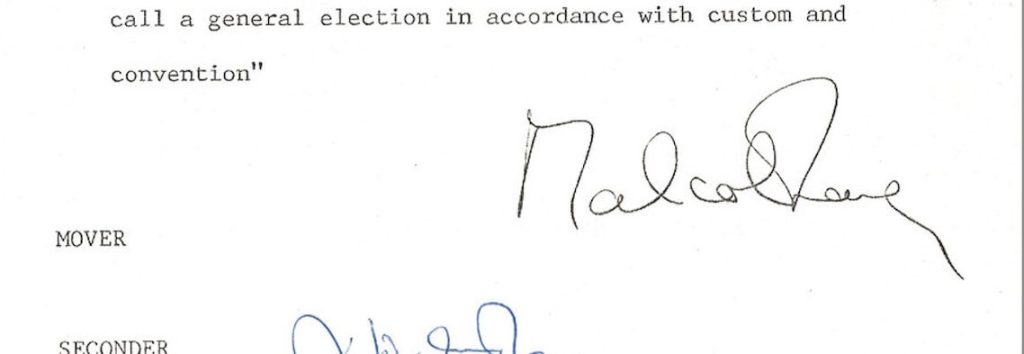
This is Malcolm Fraser’s signature on a censure motion on the morning of 11 November 1975
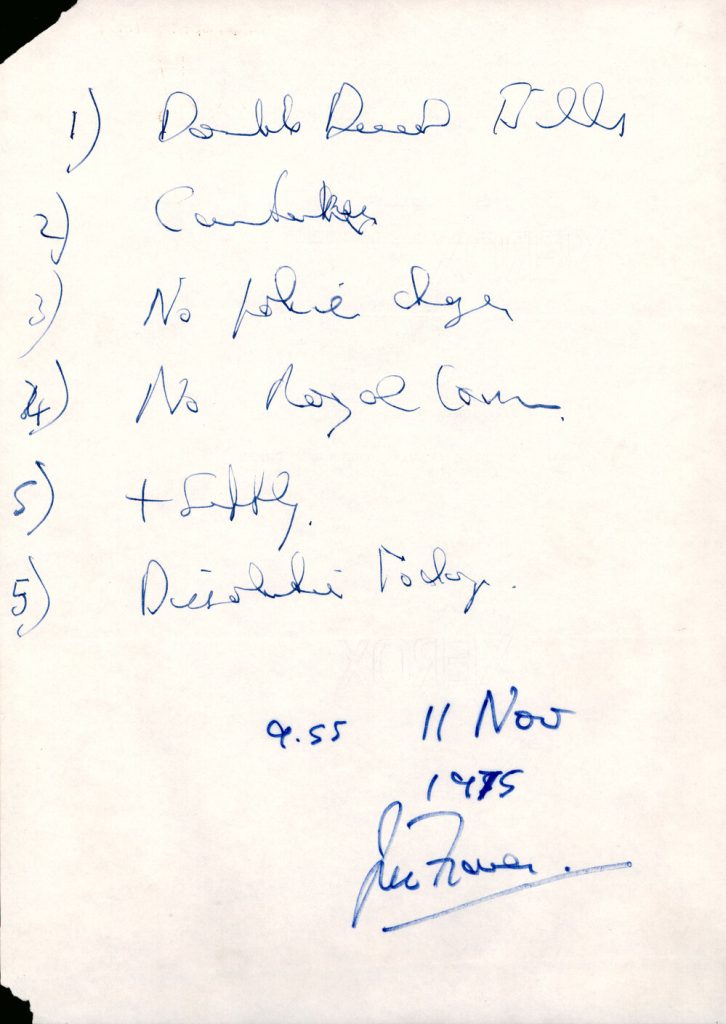
This is the signature on the bottom of a hand written note which Malcolm Fraser claimed that he wrote on the morning of 11 November. Note that the handwriting at the top of the page is dramatically different from that at the bottom. Also the “7” in 1975 appears to be written over an “8” and the signature appears to commence with a capital “J” followed by a capital “F”. Note that Fraser’s full name was John Malcolm Fraser.
*****
This suggests that Fraser post-dated the note. Also, the late Bob Ellicott KC, Fraser’s shadow attorney-general who was present when the Kerr-Fraser phone call took place told Gerard Henderson that it was too short a conversation for Kerr to have laid down six conditions to Fraser which the latter wrote down.
As Tony Abbott acknowledges in his “Author’s Note”, Australia: A History is his “personal account based on the existing nuances”. In this instance, he has relied on a secondary source which ran the anti-Kerr line that Kerr tipped off Fraser that he was about to sack Whitlam – making it easier for Fraser to keep his Liberal Party backbenchers on side at the time. In any event, Fraser had no option but to accept any conditions which Kerr laid down before appointing him caretaker prime minister. It is impossible to imagine that he would have resisted the offer to become prime minister. Kerr would have understood this.
It would seem that, in this instance, Abbott and his researchers accepted the memory of Fraser a decade after the event along with opinions of such contemporary Kerr antagonists as Troy Bramston – a talented historian but, in this instance, a Kerr antagonist. By the time of the publication of his political memoirs in 2010, Fraser was in the habit of criticising the late John Kerr as “weak”.
Postscript
As mentioned above, Australia: A History, is a “personal account based on existing sources”. It contains over 800 endnotes along with a bibliography which runs for 4 pages plus a detailed index. In addition to the left-of-centre commentators mentioned in the book who are cited above, the author also refers to the work of Geoffrey Blainey, John Hirst, Malcolm Ellis, Andrew Tink, Alex McDermott, Mark Tedeschi, W. K. Hancock, Jeffrey Grey, Joan Beaumont, Carl Bridge, Anne Henderson, David Horner, Peter Edwards, Paul Hasluck, Ian Hancock, Warren Mundine, Patrick Mullins, Paul Kelly and Trevor Sykes among others.
The author is generous in citing individuals who helped him. Namely, John Roskam, Andrew Kemp, Alex McDermott and also researchers Paddy O’Leary and Dom O’Leary. The idea of the project came from John Roskam. The research was assisted by Institute of Public Affairs staff.
When Tony Abbott addressed The Sydney Institute on his book, the following exchange took place in the Q&A session:
Anthony Benscher: I was wondering whether you might share some reflections on the process of writing the book. What surprised you, perhaps, about the process? What did you enjoy? And how long did it take?
Tony Abbott: Well, it was quite a lengthy process. Because, I mean, I have a lot of things to do as well as write. And I guess you’re often interrupting what might be your major ongoing project with a whole lot of other projects which are pressing at the time, although perhaps not as significant in the longer run. The origin of the book was a conversation that I had with John Roskam in the depths of the interminable, intermittent Melbourne [COVID-19] lockdowns. I was down there to do a few podcasts with Roskam. After one of the podcasts, we were lamenting the state of our country and trying to work out what we can do to improve the shining hour.
And eventually I said, maybe what we need is a new history that at least gives a glass-half-full as opposed to a glass-half-empty perspective on the country. And John said, “I think you’re just the person to write it and, if you do, I’m certainly going to help.” And so, thanks to the Institute of Public Affairs (IPA), I had a couple of terrific researchers – including Andrew Kemp, David’s son, who collaborated with me on Battlelines – which, some of you might remember, came out in 2009.
And so, what would happen, typically is, before the task of writing each chapter started, I would sit down with Andrew Kemp and a couple of others. I would talk about what I thought the chapter ought to cover. They would go off and do us a draft. I would then say, well, this draft is good in this respect and that respect, but honestly, I would have more on this and less on that, and why did we forget talking about whatever else it might be.
So, it was a kind of an iterative process. And then when they had done their work, I then spent a lot of time, I guess, translating it all into Abbott-speak. That’s why, I guess, it did take a lot longer than I expected it to take. I mean, unlike all of my previous books, which have essentially been works of advocacy, this had to be, if you like, a book that stood up not just to critical scrutiny of the arguments, but to critical scrutiny of exactly what was said in terms of what was in and what was out, whether I’d done justice to all of the various key elements in our history.
So, it took a lot longer than I thought. And I have to say, once I had a draft that I was happy with HarperCollins being a, I suppose, much more exacting publisher than the others who’ve published books of mine, they had a whole series of questions and issues that they wanted further developed and explored. So that’s why it was all quite lengthy.
But I’ve got to say, I am incredibly thrilled at the final product. I’m already thinking of some of the things that might be further developed and there’s one or two tiny imperfections. So, I’m thinking of what might come in an updated edition at some point in time. Well, there’s already been quite a few reprints, but at some point, I suspect there’ll be an updated edition. But no, I’m really proud of what’s been produced. But like everything that’s worth doing – in the end, it’s a team effort.
Gerard Henderson is executive director of The Sydney Institute, a columnist with The Weekend Australian and a weekly commentator on Sky News’ The Media Show. His Media Watch Dog blog is published by Sky News every Saturday. He is the author of a number of books of Australian history.
* * * * *