
GERARD HENDERSON’S MEDIA WATCH DOG
ISSUE – NO. 768
27 March 2026
* * * *
The Latest – Jimmy Kimmel sneers at Markwayne Mullin
Can You Bear It? – The ABC on strike; The Saturday Paper’s Jason Koutsoukis mans the barricades for his ABC comrades; Melbourne International Comedy Festival director defends the cancellation of Barry Humphries; Linton Besser sneers at Pauline Hanson
David Rowe’s controversial cartoon
Your Taxes at Work – Melbourne Writers Festival a leftist stack in denial
A Barrie Cassidy Moment – A self-described boomer rant
Correspondence – Gerard Henderson & Dale Budd re The Dismissal
* * * *
THE LATEST
The sneering leftists as intellectual snobs
Today’s Media Watch Dog carries a segment on ABC TV Media Watch presenter Linton Besser’s intellectual snobbery with respect to One Nation leader Senator Pauline Hanson.
On Wednesday 24 March, Fox News’ Hannity show ran this piece of leftist intellectual snobbery with respect to the recently appointed US Secretary for Homeland Security. It was delivered by Jimmy Kimmel – who, in Barry Humpries terminology – identifies as a comedian:
Jimmy Kimmel: Before he was elected to the Senate, Markwayne Mullin was a low-level MMA fighter and a plumber. That’s right, we have a plumber protecting us from terrorism. Now, it worked for Super Mario. Why not Markwayne? But honestly, I mean, [applause] if Trump is going to keep taking these unqualified people to run the department, why not have more fun with I mean, next time, instead of Markwayne. How about Lil Wayne for Homeland Security? Least we could get a concert out of it, right?
This is yet another example of the contempt in which many leftists have for skilled artisans, small business operators and the like.

- ABC’s journalists protest – but not about their sense of entitlement
While on the topic of the taxpayer funded public broadcaster – what fun it was to see the comrades going out on strike at 11 am on Wednesday 25 March for 24 hours.
Why 11 am? Well, the late start meant that the comrades could be filmed laying down their computers and marching out of the ABC Sydney headquarters in inner-city Ultimo. And what a fetching collection it was.
There was David Marr of ABC Radio National’s Late Night Live (aka Late Night Left) in a short-sleeve t-shirt purchased or hired from the Media, Entertainment and Arts Alliance (MEAA) trade union. Your man Marr – he of the Pymble (i.e. North Shore) Accent – with the word “Press” emblazoned on his chest, and the message “Press: Stronger Together MEAA.com” on his back
And then there was Fran Kelly who left the ABC some years ago to return to host a 6 pm program on ABC Radio National. Demonstrating, once again, that the ABC is a bit like the Hotel California song – guests can check out but they never leave.
Comrade Kelly was photographed in a MEAA tee-shirt standing next to a female colleague who held a message which read: “Democracy Dies in Darkness – And We’re Struggling To Pay Our Power Bills” over the ABC logo. In other words, according to this the message was: There’s no democracy in Australia without the taxpayer funded public broadcaster. Really.
ABC journalists were offered effectively a 4.5 per cent pay increase over three years (including an immediate one-off payment of $1000) plus improved conditions. And Comrade Kelly and her fellow comrades reckon that acceptance of the ABC offer would ignite the end of Australia as we know it.
What the ABC’s strike demonstrated last Wednesday was the sense of entitlement shared by so many ABC journalists. Here are two examples. Fran Kelly told the rally outside the ABC’s Ultimo Office:
Fran Kelly: [rally] There’s people on my team who live in Wollongong because they can’t afford to live in Sydney, or who live in Newcastle because they can’t afford to live in Sydney. There’s people on my team who have been on the same pay level for five years, for eight years, and have been told they won’t get a promotion this time around.
Which raises the question – what’s wrong in living in Newcastle or Wollongong? And is it reasonable for ABC staff to believe that they are entitled to not only annual pay rises but also promotions along with what they term “sustainable and secure jobs”.
And then this from Michael Yanda, the ABC’s business editor, who used ABC facilities to read – yes read – this statement:
Michael Yanda (ABC Business Editor): It’s worth noting…that our coverage of inflation and finance for the rest of the day will be different from usual, because my colleagues and I will be on strike. Like many of our viewers, a lot of ABC staff are struggling to keep up with the rising cost of living, and we’re asking for a pay rise that will help keep our heads above water. [OMG – what a boring cliché. – MWD Editor.]
It’s quite something when taxpayer funded journalists at the taxpayer funded public broadcaster use the taxpayer funded facilities of the taxpayer funded ABC to campaign for increased pay and conditions – to be paid for by taxpayers. Can You Bear It?
[No, not really – now that you ask. After all, ABC staff were offered a reasonable deal. This at a time when the commercial media is experiencing competition from social media outlets and inflation is stubbornly high. It would seem that when ABC trade union members are asked: “What do you want?”, their answer is: “More”. – MWD Editor.]
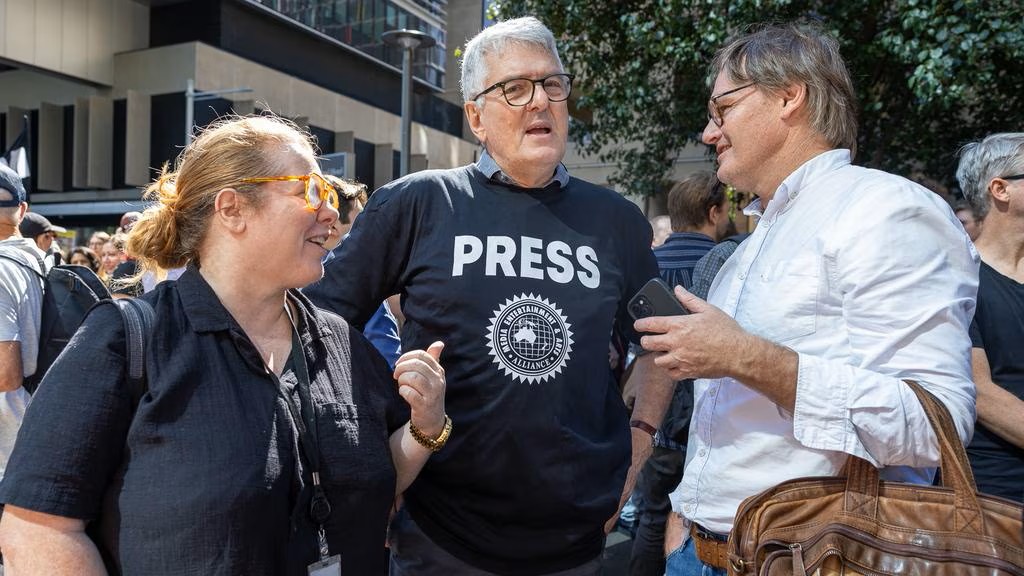
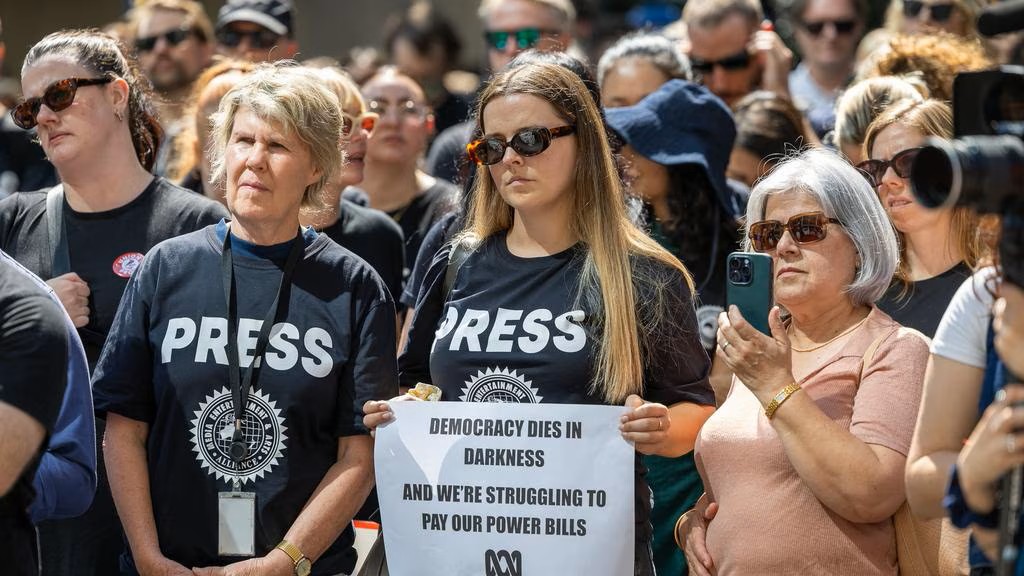
- – Images from The Australian 27 March 2026
The [Boring] Saturday Paper’s Jason Koutsoukis bores on for the ABC
While on the topic of the ABC strike of recent memory – how about the performance of Jason Koutsoukis of The [Boring] Saturday Paper?
Now Comrade Koutsoukis is a left-of-centre kind of guy who supports the various so-called “progressive causes”. And last Wednesday he came out in support of his comrades at the Conservative Free Zone that is the ABC when talking to Sarah Henderson, the Coalition’s Shadow Minister for Communications. Let’s go to the transcript:
Jason Koutsoukis: You don’t work at the ABC, so why is it your business to sort of get involved in ABC staff issues? Why shouldn’t they bargain aggressively for a pay rise?
Sarah Henderson: I’m the Shadow Minister for Communications. So I have responsibility on behalf of the Opposition, for the operations of the ABC. The ABC is accountable to the Australian people, and when I see ABC journalists breaching the ABC Act by hijacking –
Jason Koutsoukis: [interjecting] How are they breaching the act?
Sarah Henderson: When I see ABC journalists breaching the ABC Act –
Jason Koutsoukis: [interjecting] How are they doing it?
Sarah Henderson: – And the editorial policies – I just explained that before I’m happy to say it again.
Jason Koutsoukis: Unconvincing.
Sarah Henderson: So, a number of ABC presenters have hijacked news programs to prosecute their case to say that, basically, if they don’t get the pay they’re entitled to, as they say, then news and other information programs are at risk. That is not appropriate. If ABC journalists want to hold a news conference, fine. But they should not be hijacking news programs in breach of their obligations to deliver news and information impartially and accurately.
How comradely was that? Comrade Koutsoukis manning the barricades in support of his comrades, some of whom he works with as a paid contributor to the ABC TV Insiders program. So much so that he wants to silence the Coalition’s Sarah Henderson who was just doing her job. Can You Bear It?
Radio National’s interview with the Melbourne International Comedy Festival director re Barry Humphries
Barry Humphries is Australia’s greatest comedian – who attained an international reputation in English speaking countries. However, in 2019, the Melbourne International Comedy Festival (MICF) dropped The Barry Award on account of comments he had made about transsexuals.
Susan Provan, the Melbourne International Comedy Festival’s director, was asked about this by Sally Sara on ABC Radio National Breakfast. The date was 25 March. This was the answer:
Susan Provan: …Australian comedians in general value the incredible contribution Barry made. You know, he was the first really internationally famous Australian comedian, and no one can take that away from him. But yeah, he did have some hurtful things to say about people that are very much a part of our contemporary industry. So these things are difficult to balance and manage, but we move on.
Sally Sara: What are your recommendations for this year’s festival?
Sally Sara did not contest Provan’s view that comedians should not say “hurtful things” – nor did Provan or Sara identify the “hurtful things”. This from the Melbourne International Comedy Festival’s artistic director. Most comedy festivals consist of someone (verbally) hurting someone’s feelings and causing offence. Yet the MICF cancelled its founding patron because some fellow comedians had taken offence. Can You Bear It?
[Perhaps objection was also taken to Barry Humphries’ comment that some contemporary comedians are not funny – they just identify as comedians. Just a thought. – MWD Editor.]
Linton Besser’s sneering of Pauline Hanson remembered
Apart from the US/Israel-Iran war, the big media story of early this week was the South Australian election in which Labor had a convincing victory and Pauline Hanson’s One Nation finished second in the primary vote ahead of the Liberal Party. Yet the election was ignored by the ABC TV Media Watch program last Monday – which led with a story about serious charges laid against media proprietor Anthony Catalano. This matter had been extensively covered in the media last Saturday and Media Watch presenter Linton Besser and his Gang of Ten producers/researchers etc had nothing fresh to add.
This omission ignored the fact that sections of the leftist media, led by the taxpayer funded public broadcaster, are partly responsible for the rise in support for Pauline Hanson’s One Nation Party. The sneering at Senator Hanson by the left-wing media was counter-productive and contributed to the increase in One Nation’s support. One Nation voters were presented as poorly educated racists who were not very bright and did not follow the Green Left ideology which is so fashionable among sections of the media – and widely embraced at the ABC Soviet which is a Conservative Free Zone.
And who were among the leading ABC sneerers? – MWD hears avid readers cry. Step forward Media Watch presenter Linton Besser. As recently as 23 February, when it was evident that One Nation’s support was rising in the opinion polls, Besser had this to say on Media Watch about Senator Hanson. Let’s go to the transcript:
Having “her say” has never been an issue for the one-time peddler of fish-and-chips from Ipswich who, after decades in the public eye, is now one of our most enduring politicians and one whom the media has always struggled to get a handle on.
Tracey Curro: Are you xenophobic?
Pauline Hanson: Please explain?
– 60 Minutes, Nine, 13 Oct 1996
How about that? Comrade Besser declared that “the media has always struggled to get a handle on” Pauline Hanson – meaning understand her. And he described Senator Hanson as “the one-time peddler of fish-and-chips from Ipswich”.
Which raises the question: What’s wrong with “peddling” – i.e. selling – fish and chips in a small business in Ipswich which employs staff? Secondly, why are Comrade Besser and the Gang of Ten at Media Watch such intellectual snobs? And here’s another question: Can You Bear It?
Last Saturday, Nine’s Australian Financial Review published this cartoon by David Rowe – see below. Israel Prime minister Benjamin Netanyahu was drawn with a long nose saying, “Oy Vey” (a Yiddish, not Hebrew, term for frustration/dismay) while riding President Trump (shaped like a missile) who is shouting out “Torah, Torah, Torah”. Torah is the Hebrew Bible. “Oy Vey” is a term spoken by exiled Jews of Europe. Hebrew is the official language of Israel.
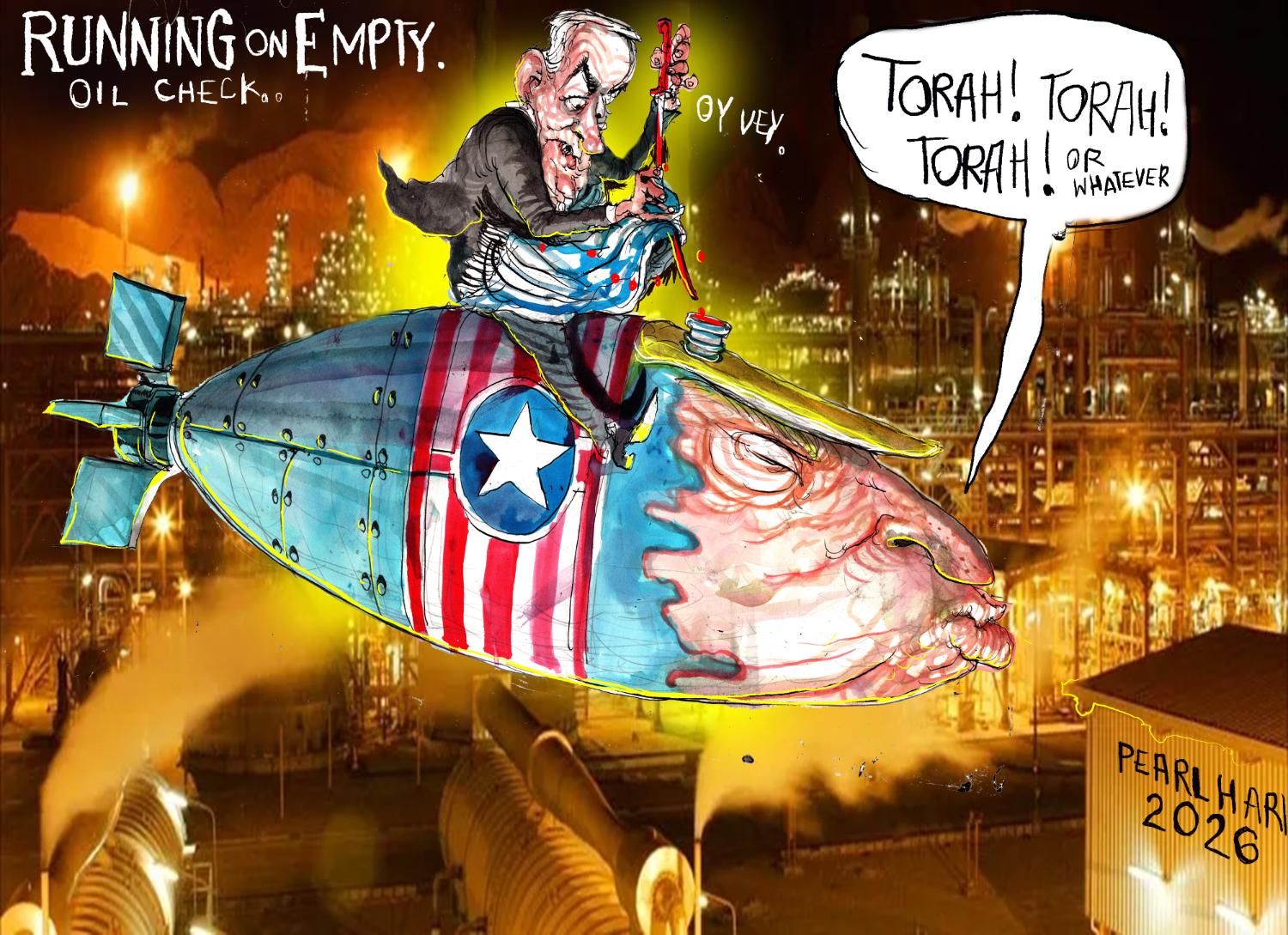
As Alex Ryvchin told Sky News’ Sharri Markson on 24 March:
Alex Ryvchin: When you break down the elements of this, he will no doubt say it’s a critique of Netanyahu and Trump and a critique of the war. But the motifs in this are unmissably Jewish. They’re not Israeli. They’re Jewish. The reference to Oy Vey, which is a Yiddish term…used mockingly by Neo-Nazis. The fact that Trump is chanting “Torah”, which is obviously the very origin of Jewish tradition and belief and law. And you know, I’ve seen many depictions by David Rowe of Trump, and he loves to depict him as being this great ogre and tyrant and this loner who holds others in contempt. Never have I seen him depict him being ridden and coerced and manipulated by someone else. And lo and behold, the person doing that happens to be the prime minister of the Jewish state.
In June 2020 Nine published a David Rowe cartoon which drew the Jewish Australian Josh Frydenberg with a long hook nose – along with a dollar sign.
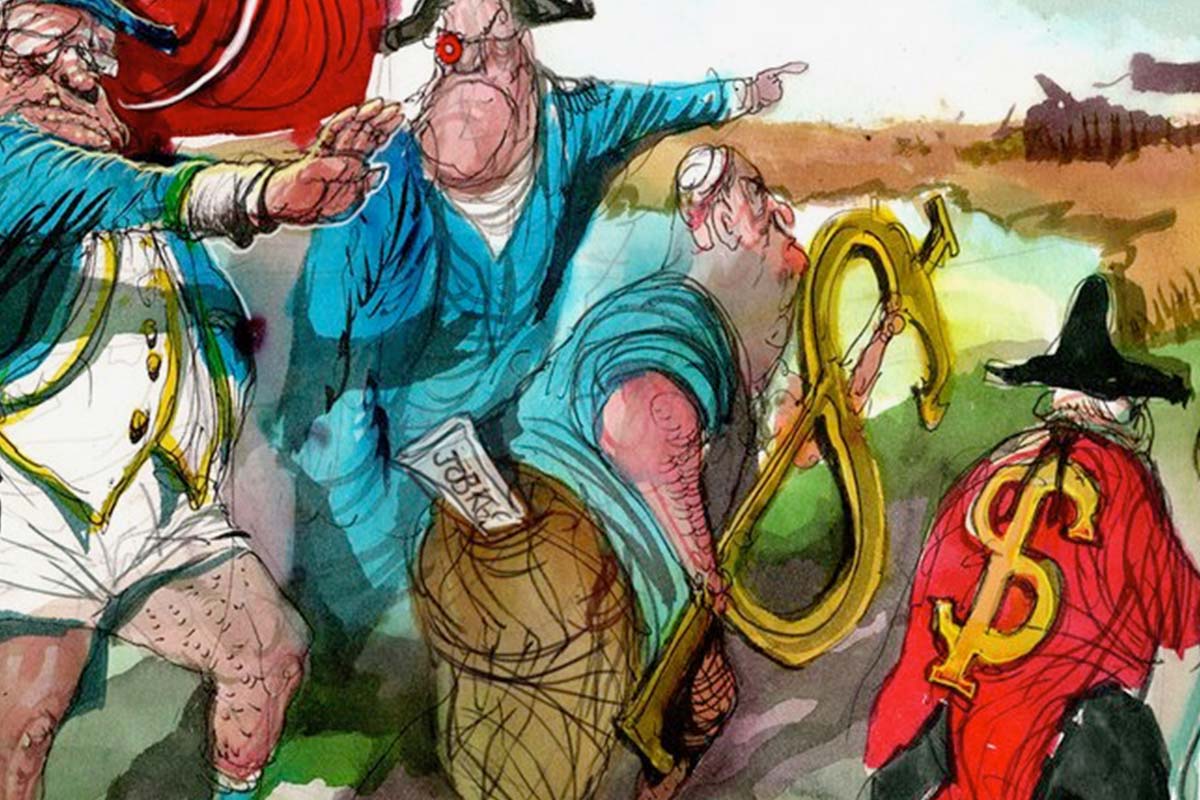
And in January 2026 Nine’s The Age and Sydney Morning Herald published Cathy Wilcox’s cartoon suggested that Australians who supported a Royal Commission into the Bondi massacre were being propped up by Australian political conservatives who were marching to the tune of Netanyahu’s drum. (See MWD 759, 23 January 2026)
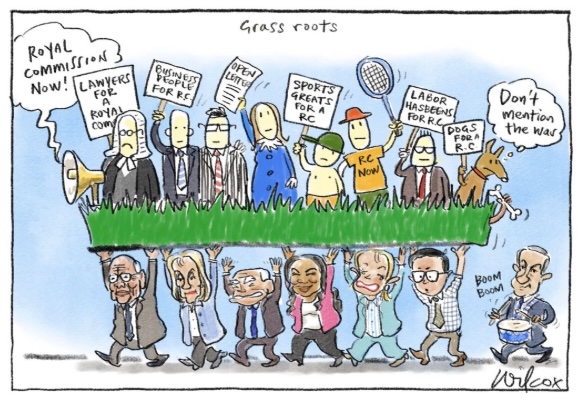
Nine apologised for the Wilcox cartoon and David Rowe’s Frydenberg cartoon. The latter said it was drawn in haste. But Nine found nothing wrong with cartoon last Saturday.
All this suggests that Nine editors and executives lack the intellectual courage to stand up to the likes of Rowe and Wilcox and vet their work before it appears in print and online. Especially since the Jewish Community in Australia does not feel safe.
YOUR TAXES AT WORK
This hugely popular Media Watch Dog segment looks at how taxpayers’ money is
spent by governments and councils – along with the various institutions they fund. Of particular interest to Gerard Henderson – a published author who never gets invited to literary festivals, which obviates the need for him to respond to any literary festival RSVP in a negative way – are the various taxpayer funded writers’ weeks.
MWD defines a literary festival as an occasion when a soviet of leftist activists and bureaucrats gets hold of a bucket load of taxpayer funds and invites members of the leftist intelligentsia to rock up to festivals (speakers’ fees, travel and accommodation costs all paid). There they meet fellow panellists of like mind and participate in forums in which almost everyone agrees with almost everyone else in a leftist kind of way on almost everything.
Each year, MWD focuses on various writers’ festivals – in particular, the taxpayer funded get-togethers in Adelaide, Melbourne, Sydney, Canberra and Newcastle.
2026 Melbourne Writers Festival director Veronica Sullivan in denial about the fact she presides over a leftist stack
There was enormous interest in last week’s segment titled “Yet another writers’ festival stack” which appeared in Media Watch Dog’s hugely popular Can You Bear It? segment. It dealt with the 2026 Melbourne Writers Festival (MWF).
Ellie’s (male) co-owner, after a quick look at the program, declared that it “looks like yet another taxpayer funded leftist stack”. This was confirmed when, last Saturday, he examined the whole program in the field of non-fiction. Here we go – you be the judge:
Bob Brown, Barrie Cassidy, Inala Cooper, Osman Faruqi, Paul Grabowsky, Marieke Hardy, Anita Heiss, Sean Kelly, Antoinette Lattouf, Louise Milligan, Ngarra Murray, Ray Norris, Bruce Pascoe, Amy Remeikis, Jason Steger, Grace Tame, Virginia Trioli, Sally Warhaft, Don Watson, Michael Williams.
Not a political conservative among this lot. As indicated last week, MWD’s fave session is this in the 2026 MWF:
Political Year in Review: One year on from the Federal Election, it’s time to take stock. Respected political experts Sean Kelly, Amy Remeikis, Don
Watson and host Barrie Cassidy come together for a frank
conversation on how the political decisions of the past have
led us to this current moment.
As MWD commented last week. Barrie Cassidy worked for the Hawke Labor government. Don Watson worked for the Keating Labor government while Sean Kelly worked for the Rudd and Gillard Labor governments. And Amy Remeikis is a former Guardian Australian journalist who now works for the leftist Australia Institute. You get the (leftist) picture. But at least it’s good to know that, according to the 2026 MWF, all these comrades are RESPECTED – even if we do not know by whom.
Ellie’s (male) co-owner understands that the participants for these literary festival panels are chosen by Barrie Cassidy – and that this commenced when he presented the ABC TV’s Insiders program.
Caroline Overington wrote this in The Weekend Australian on Saturday 21 March about the 2026 MWF:
He is one of the biggest-selling authors in the country, with more than 75,000 copies of his book sold since October, but you won’t see him at the Melbourne Writers Festival. Tony Abbott – former prime minister – didn’t get invited…. Mr Abbott’s omission is particularly stark, because the former prime minister of New Zealand, Jacinda Ardern, has been invited, and will be talking about her book, A Different Kind of Power, with broadcaster Virginia Trioli. Sales of Mr Abbott’s book, Australia: A History, are worth somewhere in the order of $2.5m.
Caroline Overington concluded as follows:
Melbourne’s festival director, Veronica Sullivan, said: “Melbourne Writers Festival is proud to platform a wide range of perspectives and voices … and while no single program can represent every voice or every book, we are proud of the breadth, ambition and quality of what we’ve assembled.”
Turn it up. How delusional can a writers’ festival director get? The 2026 MWF does not consist of a “wide range of perspectives and views”. And no one has suggested that a “single program can represent every voice or every book”. But taxpayer funded literary festivals should contain at least some viewpoint diversity. Even if their audiences are primarily Greens/Teals well-off members of the Sandalista class who do not want to hear views contrary to their own.
[I recall that you covered the forthcoming State of the Nation segment at the 2026 Sydney Writers’ Festival in MWD on 13 March, Issue 766. As I remember, Barrie Cassidy has invited three left-of-centre commentators to his “Barrie Cassidy and Friends” segment. Namely, Waleed Aly, Sean Kelly and Amy Remeikis along with vehement Liberal Party critic Niki Savva. Not a political conservative among this lot, either. I wonder – does Comrade Cassidy fear debate and discussion? Just a thought. – MWD Editor.]
A BARRIE CASSIDY MOMENT
Barrie Cassidy in self-declared leftist boomer rant on The Guardian website
While on the topic of Barrie Cassidy, lotsa thanks to the avid Sydney reader who drew MWD’s attention to the podcast Back to Back Barries – starring former ABC journalist Barrie Cassidy and former Victorian Liberal Party deputy director Tony Barry. The reference was to the segment – sponsored by the avowedly leftist Guardian Australia – of 7 March 2026. Let’s go to the transcript when Barrie spoke to Barry:
Barrie Cassidy: Obviously, first, we walked out of the studio last week and a war broke out. The United States again, at war. Australia again, supporting them. Not militarily this time, but supporting them nevertheless. I want to give you a sense of where I’m coming from on this as a baby boomer.
Vietnam. I was 15 when the United States went into that war. I was 25 when it ended. Millions of Vietnamese civilians were killed. The misery and the anguish went on right to this day because of the use of Agent Orange. The end of it all, North Vietnam won the war, and they controlled the country ever since.
In Iraq, a war based on a lie about weapons of mass destruction. 300,000 civilians killed and no real strategic value out of that. Afghanistan. I was 51 when that broke out, and 71 when it ended. 150,000 civilians killed. The country was impoverished, and after 20 years, when the war ended, the Taliban took back control.
And now we support the United States again in another endeavour. And worse this time, I think, because we support them with Donald Trump in charge. So, Australia now, the government is effectively backing his justifications, his judgments, his strategies, and, worst of all, I think his moral values. Hopefully it won’t be the worst American war in my lifetime, but I think it could be the dumbest. What do you think?
Tony Barry: Yeah, I worry it’s not so much Operation Epic Fury, but Operation Epic F–k Up. [Groan. Why does Barry-the-bore keep coming up with these “jokes”. – MWD Editor.]
What a rant by self-confessed boomer Barrie who these days seems closer to the Greens than the Labor Party for which he once worked. Comrade Cassidy failed to mention that the United States, along with Australia, supported the non-communist South Vietnam government against the communist North Vietnam regime. Sure, South Vietnam collapsed after the US Congress withdrew military support with respect to weapons. But most of the tens of thousands of Vietnamese Australians would not support Comrade Cassidy’s position on the war.
There is no evidence that the Coalition of the Willing – US, Britain, Australia and Poland “lied” about what were believed to be Saddam Hussein’s chemical weapons. And many nations supported the war against the Taliban in Afghanistan – in addition to the US – including Australia, Britain, Canada, Denmark and more besides.
Then Back to Back Barries commenced ranting against President Donald J. Trump. Hendo listened until Zzzzz zzzzz.
Back to Back Barries – how about Back to Back Bores?
Verily, A Barrie Cassidy Moment.

This overwhelmingly popular segment of Media Watch Dog usually works like this. Someone or other thinks it would be a you-beaut idea to write to Gerard Henderson AC (aka Always Courteous) about something or other. And Hendo, being a courteous and well-brought-up kind of guy, replies. Then, hey presto, the correspondence is published in MWD – much to the delight of its avid readers.
There are occasions, however, when (the late) Jackie’s (male) co-owner decides to write a polite note to someone or other but does not receive a response. Nevertheless, publication of this one-sided correspondence still takes place in MWD. For the record – and in the public interest, of course.
Gerard Henderson & Dale Budd re The Dismissal
On 11 November 2025, Sky News ran a documentary on the Dismissal of Gough Whitlam’s Labor government on 11 November 1975 by the Governor-General Sir John Kerr. Titled The Dismissal: 50 Years On, it was presented by Chris Uhlmann and contained different views. On 17 November 2025, the ABC News Channel ran a documentary on the Dismissal titled Whitlam Dismissal: 50 Years. It was presented by Greg Jennett and it contained virtually no viewpoint diversity. All but one of those interviewed on the program criticised John Kerr to a greater or lesser extent. In short, Jennett presided over a media hit-job on Kerr. So much so that even the ABC agreed to correct Jennett’s howler that Kerr “chose self-exile in England, defensive until death”. See MWD Documentation and Correspondence sections Issue 756, 28 November 2025.
The Sky News program carried different opinions by Dale Budd and Gerard Henderson, among others – as the following Correspondence segment documents. Media Watch Dog will let avid readers know if there are further exchanges of emails. Now read on, s’il vous plait.
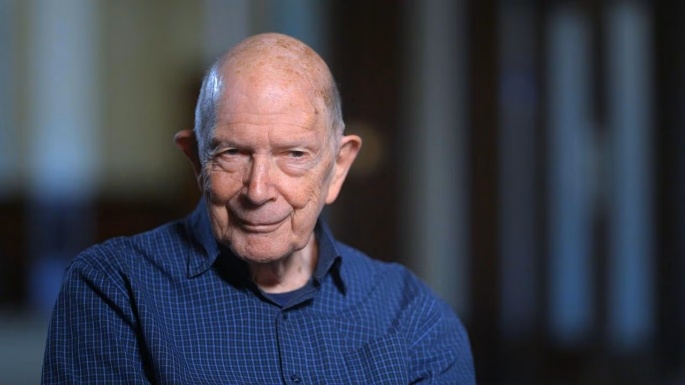
Dale Budd was Malcolm Fraser’s chief-of-staff in November 1975
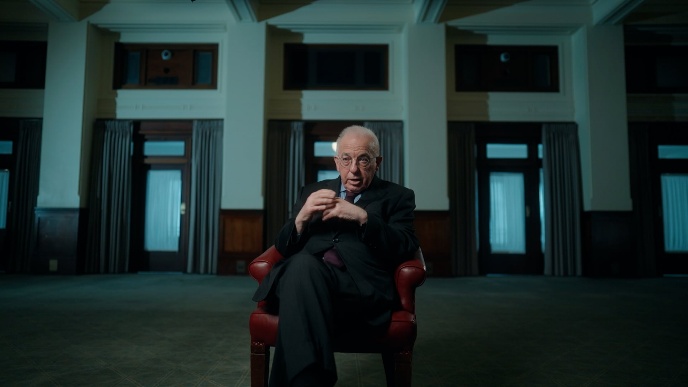
In 1987, Gerard Henderson interviewed John Kerr about the Dismissal and knew Kerr during his retirement in Sydney.
As they appeared on Sky News’ The Dismissal: 50 years on which first aired on 11 November 2025.
Gerard Henderson to Dale Budd – 20 January 2026
Dear Dale
I recently watched your full interview for the Whitlam Dismissal: 50 Years documentary on the Sky News’ website. I found your comments on John Malcolm Fraser’s personality of particular interest.
As you will recall, in your discussion with Chris Uhlmann you had this to say concerning the events of 11 November 1975:
…Later… that day, I was in Malcolm Fraser’s office, and on his desk was the sheet of paper on which he’d jotted down these half a dozen conditions. And I recognised this is very significant. And I made a photocopy of it, which I still have. The original is in The Malcolm Fraser Archives at University of Melbourne. But yes, I didn’t see that until later in the day, as the day wound on I didn’t know that that call, and though, and the content of that call had happened.
It would be appreciated if you could provide me with a photograph of the photocopy which you took on the afternoon of 11 November 1975. I understand, from reading The Dismissal: In the Queen’s Name by Paul Kelly and Troy Bramston, that you gave a copy of the photocopy to the co-authors.
Also, as someone who worked for Mr Fraser, I would appreciate your view on the signature on the document which you told Chris you photocopied during the afternoon of 11 November. It appears to be dramatically different from the signature on the censure motion moved by Malcolm Fraser on 11 November 1975 – i.e. around the same time on the same day.
The signatures are set out below along with another signature made on 12 November 1975 by Mr Fraser concerning an appointment of a minister to the caretaker government.
I look forward to your response.
Best wishes
Gerard Henderson
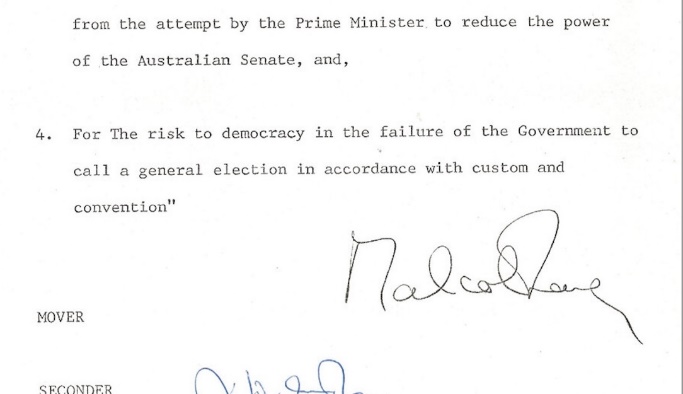
Malcolm Fraser signature on censure motion on 11 November 1975
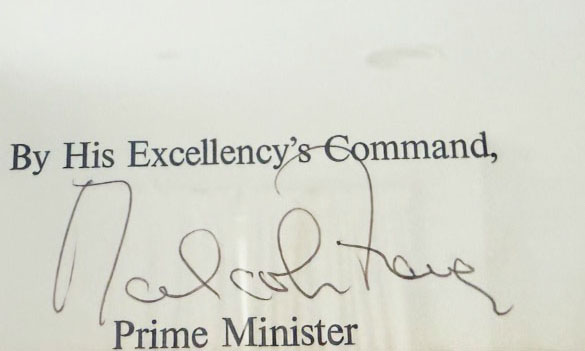
Malcolm Fraser signature on a letter dated 12 November 1975
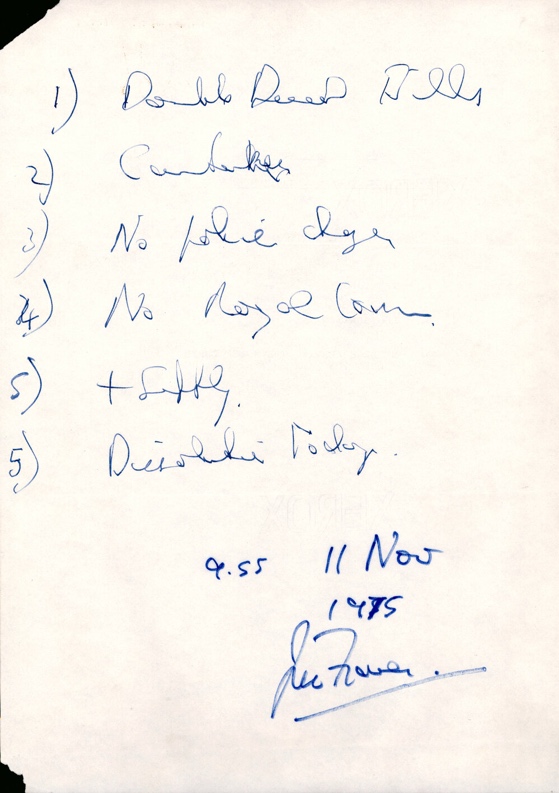
Malcolm Fraser signature on a handwritten note dated “11 Nov 1975” (where the “7” appears to be written over an “8”). This appears to commence with a “J”. As you know, Mr Fraser’s full name was John Malcolm Fraser. However, circa November 1975 he signed off as “Malcolm Fraser”.
Dale Budd to Gerard Henderson – 21 January 2026
Dear Gerard,
I received your email and attached letter…It will be at least two or three weeks before I can get back to you.
I trust you are aware that the note which Malcolm Fraser made on the morning of 11 November 1975 is on display – the original, not a copy – at Old Parliament House until 8 February when their Dismissal exhibition concludes. It is on loan from the University of Melbourne archives.
Regards,
Dale
Gerard Henderson to Dale Budd – 21 January 2026
Dear Dale
Thanks for your prompt response. I have examined MF’s note at the University of Melbourne Archives and saw it again at Old Parliament House recently. Even so, I would like a copy of your note. I understand that you provided Troy Bramston with a copy of the document in your possession.
When you have time, I would like to receive your explanation about how to explain the difference in writing between the top and bottom of the note. And the dramatic difference between Malcolm Fraser’s signature on official papers on 11 and 12 November 1975 and his quite different signature on the note which he dated 7 Nov 75 – where the “7” appears to be written over an “8” and where the signature commences with a “J”.
Best wishes
Gerard
Dale Budd to Gerard Henderson – 27 January 2026
Dear Gerard,
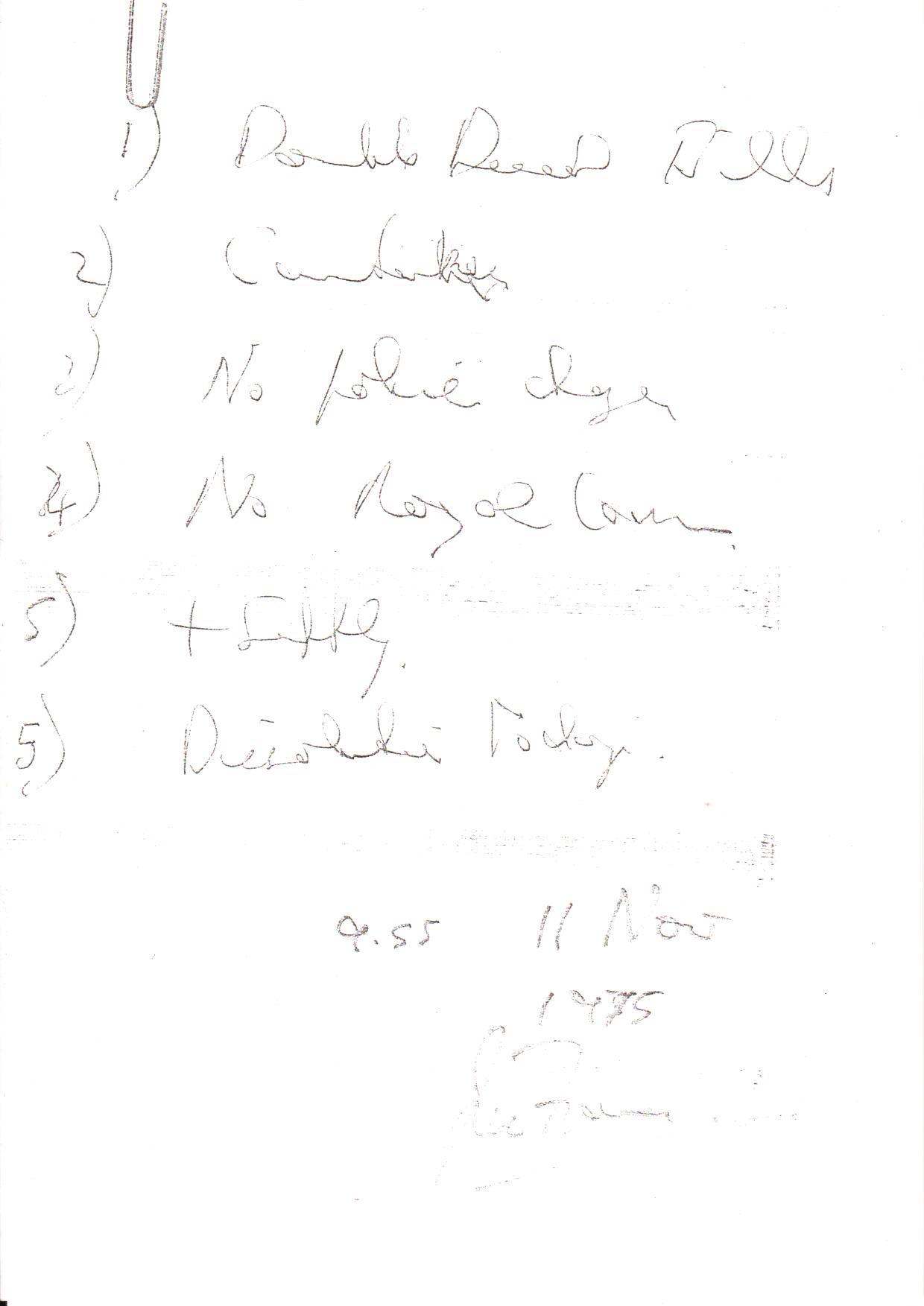
See copy of note attached. I don’t attach any significance to variations in Malcolm Fraser’s handwriting. His handwriting was terrible: sometimes legible, sometimes not. Many times after he had written on a document from the Department, I would send it back with a covering note saying “Please note the Prime Minister’s comment on the attached submission, which reads ……….” It was easier for me to explain his comment rather than make someone else struggle to read it.
Similarly I don’t attach significance to variations in his signature. I use two quite different signatures myself: ‘A H D Budd’, or ‘Dale Budd’.
Best wishes,
Dale
Gerard Henderson to Dale Budd – 27 March 2026
Dear Dale
Thanks for your email of 27 January 2026 in response to my letter of 20 January 2026 – and for attaching a copy of the note signed by Malcolm Fraser dated 11 November 1975. Apologies for the delay in responding – I have been somewhat busy of late.
In response, I make the following comments. I do so in the knowledge that you criticised me by name in the Sky News documentary The Dismissal: 50 Years On which aired on 11 November 2025. You replied to a question about me in a way that was critical of me. In the program I did not refer to you in any way.
The indistinct (Malcolm Fraser) note
The copy of the note attached to your email – which you say that you photocopied in Malcolm Fraser’s office on the afternoon of 11 November 1975 – is very indistinct. For example, Fraser’s signature is barely readable despite the fact that on the original document the Fraser signature is highly visible. Could the document in your possession be a copy of a copy or copies? Or could it be that the photocopy machine in Fraser’s office at the time was dramatically faulty?
On dates & signatures
You write that you “don’t attach any significance to the variations in Malcolm Fraser’s handwriting” – adding that when you worked for Fraser in the 1970s and 1980s his handwriting was “terrible: sometimes legible, sometimes not”.
I am aware that Fraser’s handwriting was poor. I noticed this when I worked in the Fraser government between 1976 and 1979. This was evident in the former prime minister’s signature on 11 November 1975 and 12 November 1975 (see below) – photos of which I sent to you on 20 January.
However, the signature at the end of the note – legible or illegible – is dramatically different to Malcolm Fraser’s handwriting on the other documents circa November 1975. Then there is the fact that the “7” in “1975” is written over an “8”. Why would Fraser, in 1975, initially write the date as 1985? No one has been able to explain this.
I accept that you sometimes sign yourself as “A H D Budd” and at other times “Dale Budd”. I sometimes sign myself as “G J Henderson” and at other times “Gerard Henderson”. But my handwriting does not dramatically change within five minutes on the same day. Nor does yours, I suspect.
I would be interested to know if anyone close to the late Malcolm Fraser, who has access to the Malcolm Fraser Collection in Melbourne, can locate any document circa November 1975 which was signed “J.M. Fraser” in the totally different handwriting from that on the documents in your possession – and which are produced again here:
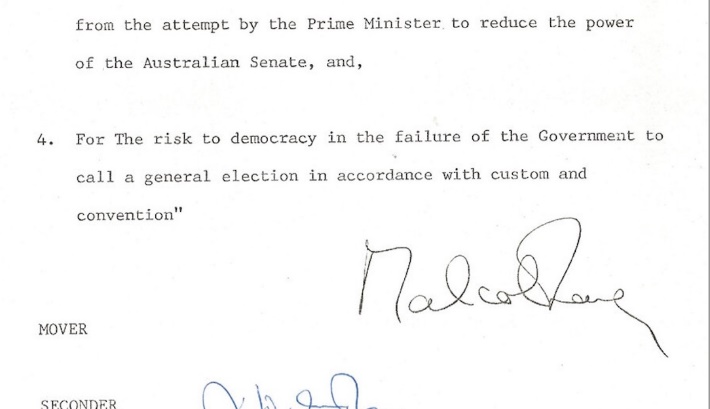
Malcolm Fraser’s signature on censure motion on 11 November 1975
* * * * *
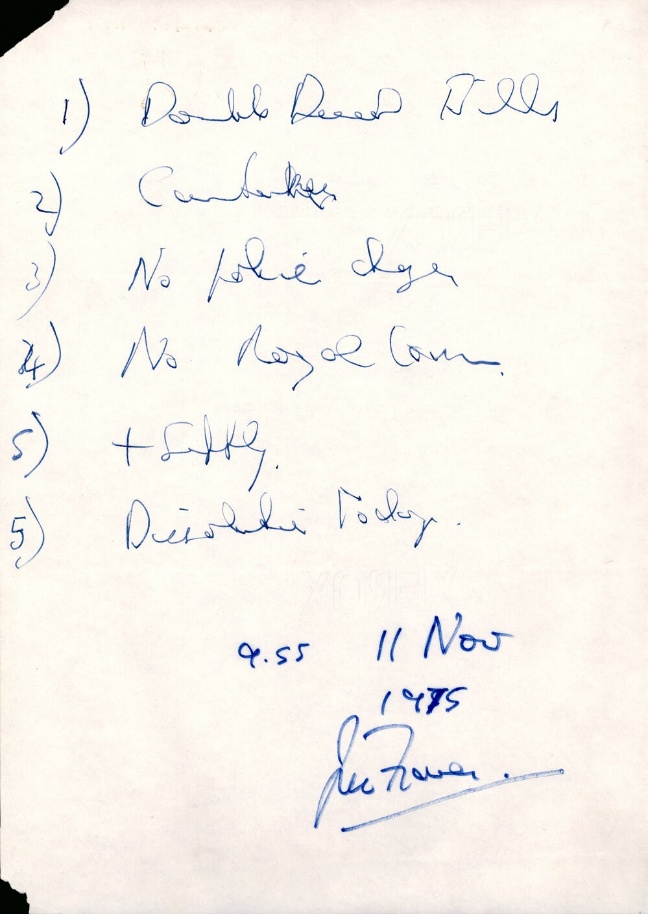
Malcolm Fraser’s signature on a note which he dated on 11 November 1975.
* * * * *
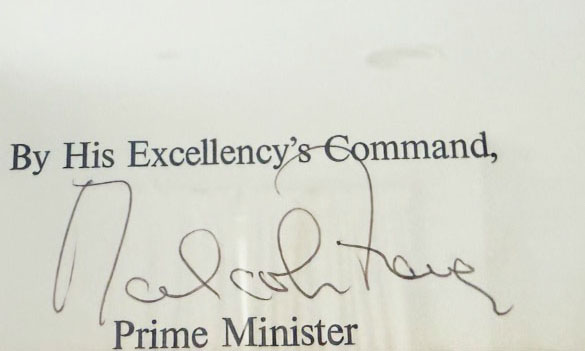
Malcolm Fraser’s signature on a letter dated 12 November 1975.
* * * * *
Certainly, during his lifetime, Malcolm Fraser never explained the difference – nor has Margaret Simons, the co-author with Fraser of Malcolm Fraser: The Political Memoirs (MUP, 2015). In view of this I maintain my position that the signature and time on Fraser’s note were written after 11 November 1975.
Your memory of 11 November 1975 – Part 1
As you may be aware, in his The Political Memoirs, Fraser declared that his memory was “notoriously fallible”. Few individuals have what is sometimes called “elephantine memory”. However, some memories are better than others.
In 2005, in Sybil Nolan’s edited collection The Dismissal (MUP, 2005), you wrote that during the afternoon of 11 November 1975, you “discovered” on Malcolm Fraser’s desk “the notes Fraser had made” of John Kerr’s call to him on the morning of 11 November 1975. As I understand it, this was the first occasion that you mentioned that a copy of this note was in your possession – i.e. 30 years after the event.
As you will be aware, in Philip Ayres’ book Malcolm Fraser: A Biography (William Heinemann, 1987) Fraser was quoted as saying, for the first time, that Kerr had phoned him on the morning of 11 November 1975 and spoke of the conditions required for him to be sworn-in as caretaker prime minister.
As you know, Fraser co-operated with the author in the publication. Fraser told Ayres that, in the conversation, Sir John Kerr had asked him “four questions…the answers to which Sir John needed to know before he dismissed the Prime Minister”. Fraser told Philip Ayres that the call must have been made between 10.05 am and 10.30 am when a Joint Party Meeting commenced. I understand that the meeting was scheduled to commence at 10 am but had been postponed till 10.30 am. This is consistent with what you wrote in the Sybil Nolan collection.
Ayres did not refer to any note in Fraser’s possession. Rather he cited Fraser’s “recall” – that is, what Fraser later acknowledged was “notoriously fallible”.
As you will be aware, Kerr challenged Fraser’s account of this phone call following the publication of Ayres’ book. I revealed this in my article in The Weekend Australian on 7-8 November 1987. This was an important issue since if Fraser’s account of the conversation was correct then Kerr had effectively “tipped off” Fraser that he was about to dismiss Gough Whitlam. This is the allegation made by Paul Kelly and Troy Bramston in their book The Dismissal: In the Queen’s Name (Viking 2015). Other Kerr antagonists have made the same point since the publication of Ayres’ book in 1987.
When the matter became public in late 1987/early 1988, did you advise Fraser and/or Ayres that you had a copy of the note that Fraser (allegedly) signed on the morning of 11 November 1975? If not, why not? After all, among others, you are thanked in the acknowledgements section of Ayres’ book. Also, there are three references to you in the text in the very same chapter that carries Fraser’s account of his phone conversation with Kerr (i.e. Chapter 13). Moreover, why did it take you until 2005 to say that you had a copy of the original made on the afternoon of 11 November 1975?
In December 1990, I interviewed Malcolm Fraser for my book Menzies’ Child: The Liberal Party of Australia (Allen & Unwin 1994; Harper Collins 1998) – see Chapter 9. Fraser told me that this was a conversation he would be “most unlikely to forget” and that he had “no doubt” that the phone conversation occurred. But Fraser did not tell me that he made a note of the conversation while it was taking place.
In May 1995, Paul Kelly interviewed Malcolm Fraser for his book November 1975 (Allen & Unwin, 1995). Fraser said this about the Kerr/Fraser phone call:
There were some people in my office at the time. I think Withers, Lynch and Anthony, were the most likely ones. They wouldn’t have heard. They would have seen me take a few notes on a piece of paper which I haven’t kept, I promise you that.
This was the first time that Fraser said that he had made a note of the conversation – that is two decades after the Dismissal. He could not recall who was in the room but he remembered the content of the note in detail. There is no evidence that Doug Anthony was in the room. However, the National Country Party’s Peter Nixon – perhaps Fraser’s closest political adviser at the time – was there. But Fraser did not mention him.
Certainly, Nixon did not believe that Whitlam was about to be dismissed. As Ayres wrote in Malcolm Fraser: A Biography, when Fraser was leaving for Government House Liberal Party MP Tony Staley “remembers Peter Nixon saying, ‘It’s no damned good, Malcolm; Whitlam’s got Kerr in his bloody pocket; it’s no good’”.
For his part, Kerr wrote this in Matters of Judgment: An Autobiography (Macmillan, 1978). After talking to Prime Minister Gough Whitlam on the morning of 11 November 1975: “I next spoke to Mr Fraser who confirmed that the position and the Opposition policy [to block supply] remained the same. I said nothing else to him about the situation.”
In the 1998 edition of Menzies’ Child, I wrote:
John Kerr maintained in private conversation [with Gerard Henderson] that Bob Ellicott had been in Malcolm Fraser’s office when the conversation took place and had claimed that the call was too quick for the Governor-General to have stated, and the Opposition leader to have recorded, the four points in question. Subsequently, Bob Ellicott made the same point to me in a personal conversation.
Ellicott (who died in 2022) did not seek a correction concerning my account of the phone call. By the way, Kerr in fact laid down six conditions.
In their book The Dismissal: In the Queen’s Name, Paul Kelly and Troy Bramston do not refer to the reported recollections of either Nixon or Ellicott. However, the authors reported, “Fraser told Bramston that he had found the note when he began sorting his papers in the 2000s and gave Bramston a copy of it in 2013”. The note was first published in 2010 in Malcolm Fraser: The Political Memoirs which was co-authored by Malcolm Fraser and Margaret Simons.
I believe it was around the early 2000s that Fraser dated and timed the note – with a different pen, a different writing style and a different signature.
Could it be that Fraser gave you a copy of the note in early 2000s when, as Fraser told Bramston and Kelly, he located it? And that you have forgotten this? After all, there is a long gap between when you said that you found Fraser’s note and when you wrote about it – 30 years in fact. And, as mentioned above, the copy you sent looks like it has been copied on many other occasions.
Your memory of 11 November 1975 – Part 2
Your memory of past events was challenged by the late Sir David Smith (Sir John Kerr’s official secretary during his time as governor-general).
In your chapter in Sybil Nolan’s The Dismissal, you wrote:
At about 1.30 pm [on 11 November 1975] I had another call from David Smith. “You are now working for the Prime Minister,” he said. “He is on his way back. He wants to see Senator Withers, Mr Menadue and Mr Yeend as soon as possible”. Withers was Opposition leader in the Senate, Menadue was head of the Prime Minister’s department and Yeend was deputy head of the department.
During his speech to The Sydney Institute on 8 November 2015, Sir David described your recollection as “a total fiction”. He said that after the Dismissal, at Malcolm Fraser’s request, he phoned John Menadue (the head of the Prime Minister’s Department) and Ewart Smith (an officer in the Attorney-General’s Department responsible for preparing the proclamation announcing the dissolution of Parliament; to be delivered later that day). At Sir John Kerr’s request, he also phoned Buckingham House to advise about the Dismissal. Smith told The Sydney Institute:
And so, I was making these phone calls for Mr Fraser and for the Governor-General. I was not asked to call Dale Budd. I had no reason to call Dale Budd. I think Dale Budd, in the book [edited by Sybil Nolan]…says that I told him that Mr Fraser wanted to see David Kemp and Senator Withers. Why I would have been asked to carry that sort of message, I can’t imagine. The only message I was asked to carry was the one to Menadue and one to Ewart Smith. I made no phone call to Dale Budd that afternoon. [See The Sydney Institute Quarterly Issue 27, January 2006].
This made sense – since Smith worked for the governor-general not the caretaker prime minister. The logical person to make that call was Malcolm Fraser himself since he was at Government House on his own – that is, without staff. At your request, The Sydney Institute Quarterly published a letter from you in the August 2006 issue of The Sydney Papers. Your correspondence included the following comment:
I have kept in my possession the page on which I made a note of this call while it was being made, including the instruction that Malcolm Fraser wanted to see Senator Withers, John Menadue and Geoff Yeend as soon as possible.
I have phoned David Barnett and David Kemp to check their recollection of events. David Barnett clearly recalls me telling him of the dismissal, and of the fact that Malcolm Fraser was now Prime Minister. He believes that this happened before Fraser returned from Government House. David Kemp has a very clear recollection that I told him the news before Fraser returned. How could I have done so, unless I had been informed by the Governor-General’s office?
Well, the answer is obvious. You could have been phoned by Malcolm Fraser who was at Government House. My response to your letter in The Sydney Institute Quarterly was as follows:
The Sydney Institute Quarterly is pleased to print Dale Budd’s letter. I understand that Fraser has withheld permission for Mr Budd to publish the initial document referred to in his letter [concerning the 11 November note]. I also understand that the second document referred to in Mr Budd’s letter reads, in its entirety: “PM Sen Withers ASAP/Mr Menadue Yeend → to see ASAP”.
This seems to be an instruction from the “PM” (i.e. Malcolm Fraser) to Dale Budd to contact Mr Menadue and Mr Yeend as soon as possible. There is no reference to the “GG” (i.e. Sir John Kerr or to David Smith). But there is reference to the “PM” (i.e. Malcolm Fraser).
Your memory of 11 November – Part 3
When interviewed for the Sky News documentary The Dismissal: 50 Years, you had this to say to Chris Uhlmann about the Kerr/Fraser phone call.
Dale Budd: I wasn’t in the room when that call came. Obviously, Kerr had Fraser’s direct line. But he made that call and I understand Malcolm Fraser told me that he said Kerr hadn’t made up his mind. But that he wanted Fraser’s agreement that should there be a caretaker government that these were the conditions which would apply. There’s no doubt, there’s no doubt that call and the content of that call was a signal to Fraser of the way the Governor-General was thinking.
In other words, following a discussion with Fraser about the Kerr/Fraser phone call, you believed that Kerr had given a “signal” to Fraser on the way he was “thinking” – i.e. to dismiss the Whitlam Government.
However, this is what you wrote in 2005 for the Sybil Nolan collection:
After Fraser’s address, Whitlam responded. He started speaking just before 12.10 pm and Fraser remained in the chamber to listen. At about 12.15 pm, while the PM was still on his feet, I received a phone call from the Governor-General’s Official Secretary, David Smith. The Governor-General wanted to see Mr Fraser. Mr Whitlam was going to see him as soon as he finished speaking in the House of Representatives and Mr Fraser should follow ten minutes afterwards.
This call did not generate any particular excitement. During the period since the Opposition had blocked the Budget, the Governor-General had called the Prime Minister and the Opposition leader in to see him on several occasions, so he could hear firsthand the positions they were taking. Even though we thought that November 11 could be a day of resolution, the news of these meetings were not by itself very significant.
So, in 2005 you wrote that the fact that Fraser has been called to Government House after Whitlam “was not by itself very significant”. However, in 2025 you said that the call which took place early on the morning of 11 November 1975 gave “a signal” to Fraser of the way the Governor-General was thinking – i.e. about dismissing Whitlam.
Your memories in this instance are inconsistent – both cannot be accurate.
Conclusion
I accept that your account of what occurred on 11 November 1975 is an honest recollection. I also accept that Fraser honestly believed that the note he made on 11 November related to a phone call – and not to a meeting at Government House later that day. And I have no doubt that you believe that you gave certain instructions following a phone call from Sir David Smith. It’s just that some people have clear recollections of events that never happened – due to a failure of memory, especially with respect to events of long ago.
Mr Fraser admitted that he had a “notoriously fallible” memory – whereas Sir John Kerr’s recollection of the Dismissal was documented in writing a few days after the event and quoted by me in 1987 in my article in The Weekend Australian.
That’s why I do not accept that Fraser’s signature on the note dated 9.55 am was made on 11 November 1975. And I do not accept that the copy of Fraser’s note in your possession was taken at his office on 11 November 1975.
Malcolm Fraser was correct in referring to the fallibility of memory. It would be all the more so when personal recollections are made in this instance – decades after 11 November 1975.
Best wishes
Gerard
Gerard Henderson
PS: I have not addressed Michael Connor’s important and detailed article in the September 2017 issue of Quadrant titled “Inventing the Dismissal” in which he queried whether the Fraser note dealt with the Kerr/Fraser phone call. Or whether it was a note for Fraser’s speech in the House of Representatives in the afternoon of 11 November 1975 – after Kerr had dismissed Whitlam.
* * * * *
****
Until Next Time, after Easter
****