
Speaker
Warren Hogan
Speech Date
April 8, 2026
Issue
Issue 67
Economist Warren Hogan, is the Chief economic adviser at Judo Bank and managing director & founder of EQ Economics. In his view, the Federal budget will be set against the most challenging macroeconomic circumstances Australia has faced in more than 30 years. The question is whether the Government up to the task or will another dose of short-termism leave Australia vulnerable to an even more disruptive economic downturn in the not-too-distant future. On Wednesday 8 April 2026, Warren Hogan addressed The Sydney Institute to give a comprehensive analysis of Australia’s economic problems, outlining his advice for governments facing serious economic failures.
CAN THE FEDERAL BUDGET RESTORE AUSTRALIA’S ECONOMIC PROSPECTS?
WARREN HOGAN
Tonight, I’m not going to talk about individual Budget measures. I’m not an accountant, nor a tax specialist, and my topic goes beyond this sort of detail. I want to talk about why this is such a consequential budget from a macroeconomic perspective. We are facing the most pressing macroeconomic circumstances in decades. There are both structural and cyclical issues at play. But none of those issues will be addressed in the upcoming Budget. I will try to shed some light on the macroeconomic predicament, in which we find ourselves. This may also help us understand why the government refuses to confront these issues head on.
I’m going to get started. It’s a hell of a story. I think the original title was, “Can the federal budget put the Australian economy back onto a sustainable pathway?” Obviously, the answer to that is no.
I think the original title was, “Can the federal budget put the Australian economy back onto a sustainable pathway?” Obviously, the answer to that is no.
It is nigh on impossible to find the right economic policies if you are unable, and more than likely, unwilling to recognise the underlying problem.
I will cut to the chase and tell you what the Treasurer needs to do. He needs to cut real recurrent federal government spending by one per cent this coming financial year and instigate a plan to cut real recurrent government spending, what I call public consumption, by somewhere between 5 per cent and 10 per cent over the next decade. And once we realign real government recurrent spending, put in place new fiscal guardrails to ensure that we do not see an explosive fiscal expansion of the likes of this last four years ever again.
This long-term plan would take the government presence in the economy to levels never seen prior to 2020. A significant cut in government spending to be sure, future Treasurers would need some flexibility with the implementation; speeding the process in good economic times, and slowing, or even reversing course temporarily, when the broader economy is in retreat.
This is primarily about reestablishing some fiscal guardrails after the most explosive period of government expansion in our economy and, in our lives, in peacetime.
What I have described is beyond the political capacities of this government. Such as radical shift from increasing nominal spending by 5, 8, 10 per cent a year to cutting real spending by 1 per cent could be beyond the skills and courage of any government.
Tonight I will attempt to explain why this is exactly what we need to see. We need to take federal government recurrent spending back to where it was in 2022, when the temporary stimulus measures from the pandemic rolled off.
We need to take federal government recurrent spending back to where it was in 2022, when the temporary stimulus measures from the pandemic rolled off.
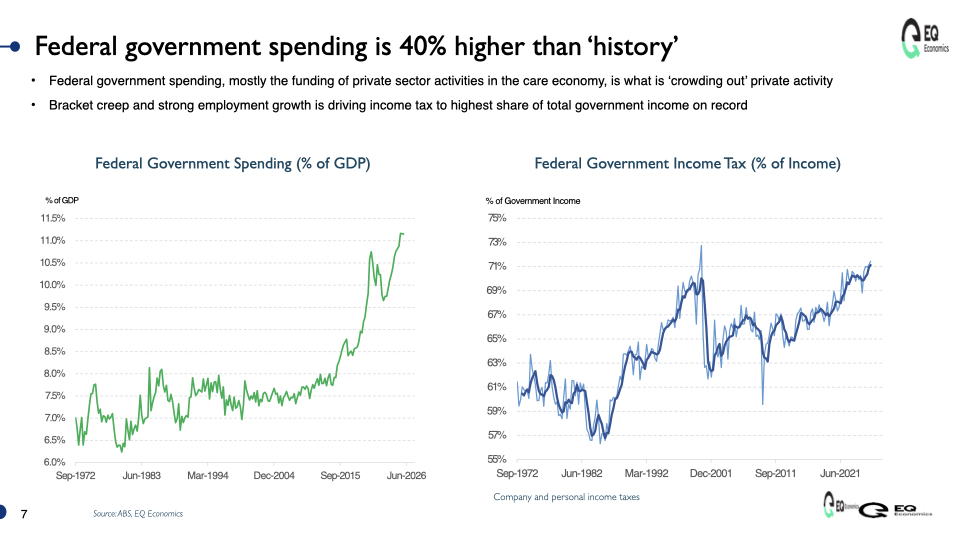
This level of Federal government recurrent spending will still represent a 20 per cent increase on the average level between 1980 and 2016. As a nation, we will have still increased the presence of government in our economy significantly. We may be able to sustain a 20 per cent expansion of the federal government. We definitely are unable to maintain the 40 per cent increase we are seeing in 2026.
Tonight, I will outline critical structural elements of my framework for analysing and forecasting the Australian economy. Incorporating what I call “secular forces” into traditional macroeconomic models and analytical techniques has formed the basis of my work in the commercial world since the depths of the pandemic in 2020.
The problem for most economists in policy and commercial practice emerged in recent years from a misunderstanding, or should I say lack of understanding, of how our economy has changed since 2020.
Critical functional elements of our economy have changed, and it has nothing to do with the pandemic or the policy response. It is all about demographics. Once you understand how the economy is changing, it becomes clearer what the policy response should be.
It also becomes more obvious what policymakers should not be doing. From a risk management perspective, the major structural shifts happening in our economy have profound implications for understanding (and hence managing) upside and downside risk scenarios.
In my view, it is the way the “new economy” alters the risk profile of policy actions between inflation and unemployment that is so profound, and the source of much of the policy error from Canberra, and at the RBA in recent years.
Hopefully, if nothing else, I’ll be able to give you some insight into that, and kick start your thinking on this new economic operating environment.
I’ll make a very important point straight away. Australia’s economic problems predated the commencement of hostilities in the Middle East. Before the 28 February, we were in a pickle.
I’ll make a very important point straight away. Australia’s economic problems predated the commencement of hostilities in the Middle East. Before the 28 February, we were in a pickle.
My second point is that this global supply shock could not have come at a worse time for this country, and it will reveal policy shortcomings, and maybe fast track some of the adjustments which are all but inevitable at some stage in the future. What am I talking about when I say “an unsustainable economy”? What is the essence of unsustainability? It is the underlying trend in inflation.
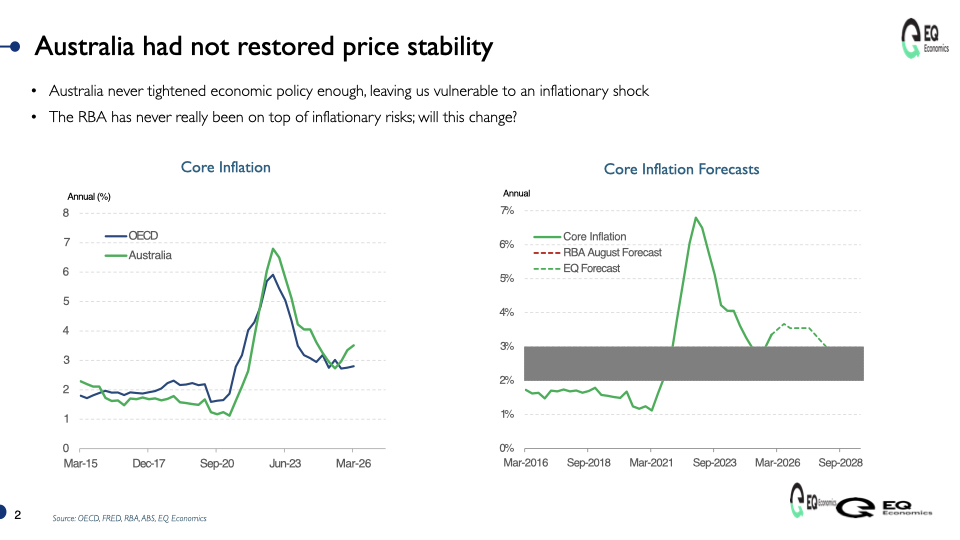
We never got on top of our inflation problem in Australia. This slide charts core inflation going back a decade. I’ve taken a measure of OECD nations’ core inflation versus Australia. You can see quite clearly that we have had inflation rising from the middle of last year. The rest of the world had stabilised inflation. It wasn’t at the desired level, it wasn’t at 2 per cent, but it had stabilised between 2 per cent and 3 per cent.
In no way, shape or form had we here in Australia stabilised our inflation. That reflects the failure of both monetary policy and fiscal policy, and it has a lot to do with this misunderstanding of how the economy is working.
The shock that has hit us, which the International Energy Agency (IEA) describes as the biggest energy shock in history, has come at the worst possible time for Australia.
The shock that has hit us, which the International Energy Agency (IEA) describes as the biggest energy shock in history, has come at the worst possible time for Australia.
The complacency with which this country has treated inflation over the last three years is breathtaking. Not only is it well understood by anyone who wants to look at economic history that inflation is the enemy of a market economy, it is the enemy of a free and open society.
Australia, as a highly successful market economy, as a successful free and open society, is more exposed to inflation than just about any nation on Earth. Primarily this exposure is because of our historically unprecedented levels of household debt, of which 85 per cent is at floating interest rates. Another exposure for Australia’s citizens is via bracket creep: our personal income tax brackets are not indexed to inflation. As inflation and wages rise, the real tax burden on households rises.
The Australian people have every reason to want inflation to be under control, but there are economic myths in our society that allow this complacency to continue.
We are seeing these myths that have been perpetrated for some 20 years reach a point where our public economic discourse has deteriorated into fantasy and ideology. The opposite of what we had in the 1980s and 1990s. Then our economic leadership and the public debate was underpinned by what I call “good economics”. Leaders such as Paul Keating would explain to the Australian people the “what and why” of “good economics”. Why economic the reform agenda would deliver shared prosperity, and the type of policy actions required to the get the outcomes.
We now have myths like interest rates up – bad, interest rates down – good. We have a myth that says what happened in the early 1990s in this country was a recession. That wasn’t a recession, that was a full blown financial crisis, that was our GFC. We almost lost Westpac and ANZ. We stopped supplying credit to the economy. The “recession we had to have” was no garden variety recession; it was a financial crisis.
These are myths, and that’s just the start of them. I don’t have time to go through them, but they are central to the decay of our political economy, or more importantly, the loss of “good economics” as a central feature of the public economic debate.
The second issue, and the reason this is such a problem now, is we are vulnerable to the interaction of an existing demand driven inflation problem with a global supply shock due to the conflict in the Middle East. This vulnerability exists only because our policymakers would not take the necessary measures to tighten policy enough to get inflation down.
This vulnerability exists only because our policymakers would not take the necessary measures to tighten policy enough to get inflation down.
Domestic demand driven inflation is going to interact with this global supply shock in ways that we don’t fully understand. I’m already seeing, in the last three weeks, the key issue of the passthrough of higher energy costs into a broader array of prices in our economy – the indirect effect of the supply shock.
Our central bank led the world in inflation targeting. As a commodity exporter, to occasion income shocks from global commodity markets we did not take a rigid approach to low and stable inflation; instead we sought price stability defined by inflation of 2 per cent to 3 per cent over the medium term. This allowed the RBA to look through temporary price spikes. The world has, over the last 20 years, essentially moved to the RBA model of inflation taken, largely through extended the time horizon for hitting the target from the short-term (1 year) to the medium term (3-4 years).
In a flexible medium-term inflation targeting regime the central bank and economists will look beyond how much headline inflation rises because of, say, a rise in petrol prices. The focus is almost entirely on the flow through to the rest of the economy of that initial spike in energy prices.
That flow through, which is the most important indirect effect of a supply shock, may not happen at all. In a world of price stability, many businesses will wear that cost surge on their margins if they’re confident it’ll be temporary. And if it does flow through, it may flow through slowly and only partially.
I have a feeling these second order or indirect effects on inflation are happening much more quickly and with much greater intensity because we had this existing demand driven inflation.
Our domestic inflation was essentially a story about business costs and the impact on operating margins of a constant upward pressure on costs. Australian businesses have been suffering persistent increases in costs year after year, through the last three years.
My best guess is, in aggregate, around 5 per cent cost increases each year due to unit labour costs as well as a range of other business costs such as energy, insurance, administration and compliance costs.
In my view, the only reason inflation came down below 5 per cent in 2024 and 2025, was a squeeze on business margins because demand was weak.
In my view, the only reason inflation came down below 5 per cent in 2024 and 2025, was a squeeze on business margins because demand was weak.
The sudden flick back in inflation over the second half of last year, as soon as we saw the first signs of life in the private sector economy, suggest to me that this is the right way of thinking about Australia’s inflation challenges of the last 4 years.
What happens next scares me to the point I don’t want to think about it much.
We are going to get some very high headline inflation numbers of 4, 5 even 6 per cent. More concerningly, our core inflation is going to pick up very quickly compared to what we would have seen if we had domestic price stability.
We are likely to see the second order inflationary consequences of this global supply shock manifest themselves in the economy much more quickly than in other countries that did not have such a weak starting point. That is, the central banks that had stabilised inflation will see the second order effects come through more slowly and with less magnitude.
That is the first vulnerability to this global supply shock that we have a a nation. The other one is poor short-term energy security.
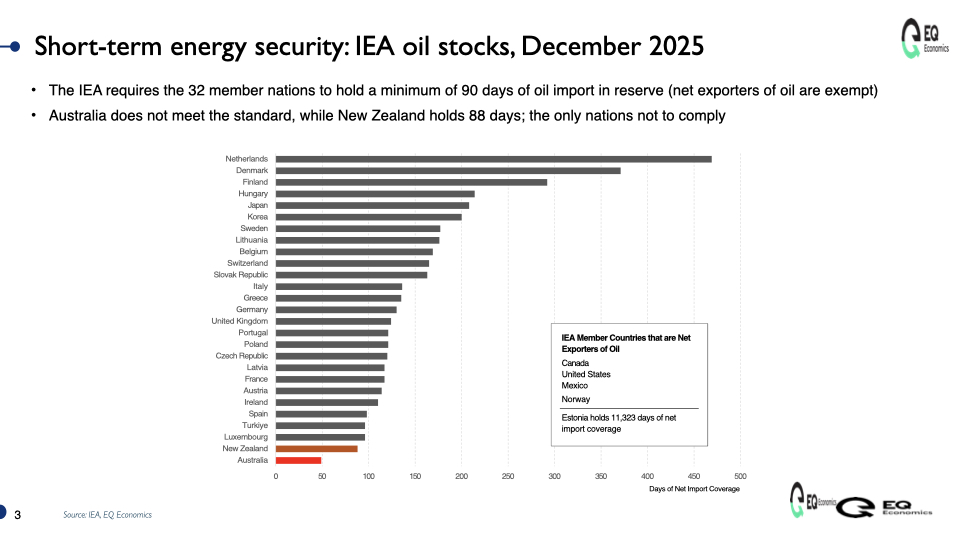
This slide is from the International Energy Agency; it’s up on their website. It’s seen all through the media over the past month.
Australia has an unbelievably low amount of onshore oil reserves. We are a net energy exporter, to be sure, but we are about 80 per cent reliant on refined oil product imports (petroleum, diesel, jet fuel).
I’m trying to get this data. I’ve seen it in a few places, but there is a dataset that says Australia was the biggest importer of diesel in the world in 2025. I still haven’t got data to confirm that. I am more comfortable with data showing us to be the biggest consumer of diesel per capita in the world. With that in mind, why would we run such skinny supply of reserves when we know that one of the main themes coming out of the geopolitical scene of the last decade, not just Covid, but across the last decade, is fragmentation and economic nationalisation.
Australia’s vulnerability is both inflation (price) and activity (quantity) aspects of the Iranian war.
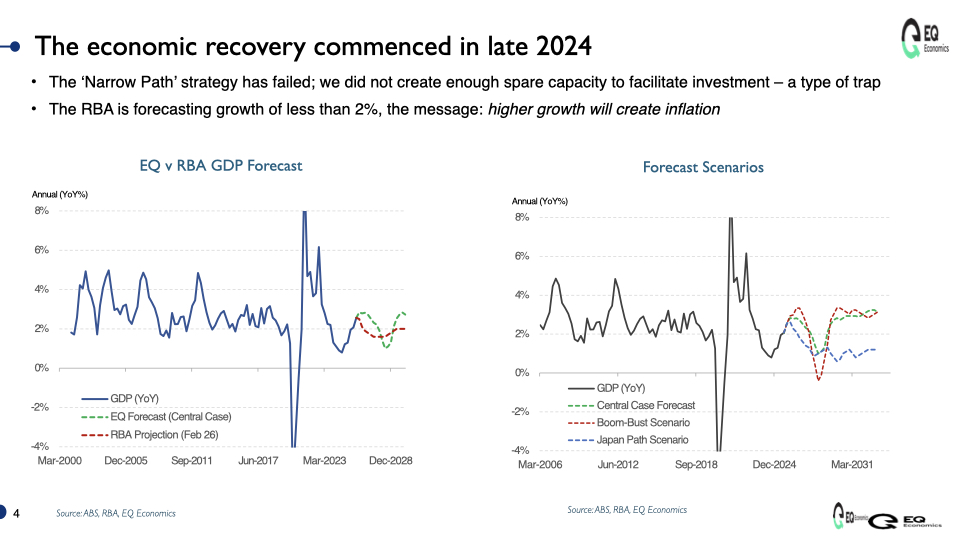
The recovery in the economy in 2025 has generated an immediate domestic inflationary response over the second half of last year. The Reserve Bank’s latest forecast for the economy is shown in the chart here. This is GDP growth. Their forecasts are in red and show the expectation for economic growth over the next three years is, on average, less than 2 per cent growth.
To their credit, they have been saying that this economy cannot grow faster than 2 per cent without generating inflation. That is our potential growth rate, our economic “speed limit”, whatever term you want to use, and it’s pretty much been proven to be right. This is critically important for everyone interested in Australia’s macroeconomy and macroeconomic policies. We have confirmation that our “economic speed limit” is 2 per cent. This should shape the whole debate from here.
. We have confirmation that our “economic speed limit” is 2 per cent. This should shape the whole debate from here.
We saw this recovery, an early-stage cyclical recovery in the private sector, commencing with a recovery in consumer spending and then picking up momentum over the back half of 2025 due to stronger business investment.
Because the governments of Australia have not even attempted to try and pullback their spending, we’ve seen economic growth rise quickly above potential and inflation accelerate from around 3 per cent – when stripping out temporary factors.
Inflation is now about 3.5 per cent. And that is leading into this energy shock. The issue really is – what is this unsustainable trajectory I’m talking about?
The economic cycle is alive and well despite the structural shifts in the economy, which I’ll come to a bit later. Unsustainable means that we are in an old-fashioned cyclical expansion which cannot continue along a path of 2.5 per cent growth, 4.5 per cent unemployment and inflation of 3-3.5 per cent.
We are either going to go on to what I would call a boom bust cycle – the one that worries me most. Or we’re going to go down some sort of a stagnation pathway – a Japan style secular stagnation
We are either going to go on to what I would call a boom bust cycle – the one that worries me most. Or we’re going to go down some sort of a stagnation pathway – a Japan style secular stagnation
The main driver of business investment is profitability: access to capital and cost of capital is a secondary factor compared to the ability to generate profits, otherwise known as new equity in a firm. That underpins not only the confidence to invest, the ability to fund investment through both debt and equity capital.
That Japan route has got some important implications for us although Japan has different circumstances and a different economy. But behind the cyclical macrodynamic sits one common element – the long-term demographic cycle. And Japan, like continental European economies, went through a once in 50-year turning point well ahead of us.
This demographic cycle is global. Everyone’s going through it. The timing is dispersed over about a 40-year period. India is only a few years away from their turning point. The first countries to turn, nations such as Japan and Germany, traversed the turning point 25 years ago. This cycle, best characterised as the retirement of the baby boomer’s generation is related to the severity of civilian losses in World War II, the steepness of the baby boom, and then the sharpness of the downturn.
Japan’s response to this demographic shift reflects their poor understanding of how the changes in dependency within a community alter the underlying balance of supply and demand in an economy.
As their baby boomer generation started to retire from the workforce, they experienced chronic labour shortages. What did they do? As a manufacturing economy, the most profound economic shift was to expand their economic capacity in other economies that did have the supply of labour available to run the operations.
They didn’t invest in Japan. They invested in Southeast Asia. Corporate Japan was the biggest investor in Southeast Asia in the last 20 years. But the biggest thing they didn’t do, is that they didn’t allow their labour market to adjust. Whether it was cultural, political or some other reason, the Japanese would not allow labour resources to be re-oriented. Businesses could not get rid of workers even if they had little to do.
the Japanese would not allow labour resources to be re-oriented. Businesses could not get rid of workers even if they had little to do.
To “paper over” the inefficiencies and poor economic performance of a highly regulated private sector the government pumped money into the economy.
We cannot go down a path that responds to structural challenges by making our economy less flexible. The modern Australian economy that was built in the 1980s and 1990s produced productivity and made us one of the richest countries, if not the richest, in the world. We got that trade-off between the brutal capitalism of America and the expensive socialism of Europe about right. Now, we risk giving it back with an experiment in that socialism.
A key element of Australia’s modern economy that is under appreciated was our ability to weather global economic shocks. The Asia crisis, the “Tech Wreck”, the mining boom, the GFC were all major shocks that Australia navigated in no small part because we have a flexible economy that could reorientate.
Japan failed to lean into the structural challenge. They used government spending to cover up their inability to allow the private sector to adjust. They built “bridges to nowhere” while office workers sat idle, staring out a window. In the process, they have built up a huge government debt.
Here in Australia, our state and federal government net debt is probably around 50 per cent of GDP. That’s not great, it was very close to zero 20 years ago.
In Europe and America, it’s 100-110 per cent. They’re worried, very worried. Greece saw their government debt surge from 100 per cent of GDP to 180 per cent as they went into meltdown
Japan’s government debt in 2026 stands at 235 per cent of GDP and, after decades of inflation near zero, it is now going up, as are the interest rates that determine the servicing of that government debt. Message to the Japanese: you can’t QE your way out of that – the Yen will collapse. We’ll see.
Message to the Japanese: you can’t QE your way out of that – the Yen will collapse. We’ll see.
In any case, I don’t think it’s a route we want to go down, but it is that route where government spending dominates the economy; where we take the easy way rather than the hard way. If you allow government to dominate the economy, at least in Australia’s case, we will lose dynamism. We will get stuck in a low growth trajectory.
Putting the two risk scenarios to the side, I do believe there is still some way to get through this where we retain our private sector lead economy. But this is looking like an increasingly narrow path as global risk continue to mount.
My central case projection is probably 45 per cent. The boom bust (upside) scenario is 30 per cent. The weak growth (Japan route) scenario is 20 per cent. These scenarios define the “probable range” of outcomes, which is currently assessed at a 80 per cent probability compared to the “possible range”. Having a central case projection of 45 per cent, effectively 45 per cent of 80 per cent, leaves an outright probability weighting of 36 per cent. This is barely a central case, reflecting the growing range of plausible scenarios for economy over the next few years.
It’s impossible to know in this environment with what’s going on in the Middle East. And we can go either way. I’m seeing signs of a massive inflationary pulse, which looks to be a done deal. The most critical issue is whether or not our economy starts to weaken immediately. Even with rapid indirect effects, inflation will eventually moderate if the economy tumbles into recession.
The most critical issue is whether or not our economy starts to weaken immediately. Even with rapid indirect effects, inflation will eventually moderate if the economy tumbles into recession.
The world appears to have sailed through the imposition of tariffs last year. At the time the financial markets thought we were going into recession. So did the RBA if their quarterly statement from May last year is anything to go by.
If we do navigate this global supply shock from an activity perspective, Australia is going to have a hell of an inflation problem to deal with.
We find ourselves in this unenviable position because we allowed our economy to overheat. Monetary policy has failed to do its job in 2024 and 2025 by not raising interest rates enough and then compounding the error by cutting rates prematurely. We were having to face up to these problems before hostilities commenced in the Middle east.
Why did the RBA stuff it up?
Two things. One is a misreading of the economy, which I showed on the first chart was a poor forecast for inflation from last August, when they last cut rates. At that time, they forecast inflation falling immediately to the middle of the target range and staying at that level indefinitely. That was little more than six months ago, and as we know, inflation has risen steadily from there. It wasn’t just the inflation forecast, they got the economy wrong.
There didn’t appear to be much “risk management” applied to either the forecast or the policy action. Given inflation is currently a percentage point above the forecast from less than a year ago, did the RBA Monetary Policy Board truly believe that the probability of inflation falling to 1.5 per cent as equal to what has transpired. If they did, their macroeconomic analytics are all wrong.
It appears misjudgements have been rife in the analytical and decision making processes of the RBA Monetary Policy Board for some time.
Interest rates and economic growth
Let’s say that the RBA board is struggling with understanding how structural change is impacting the economy, and by extension the assessment of the appropriate monetary policy. What you do when you’re in doubt, you go back to basics.
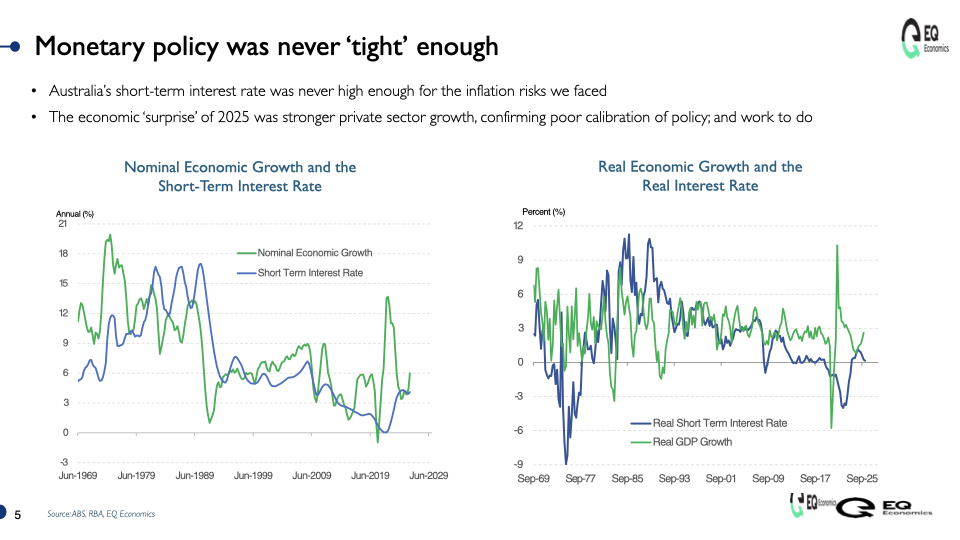
This chart is the Australian short-term interest rate and nominal economic growth. It’s not the cash rate, it’s the 90-day bank bill rate. The cash rate doesn’t go back all the way to the late 1960s. The other chart on this slide is real GDP versus the real short-term interest rate, basically the short-term interest rate less core inflation. In 2026 the real short-term interest rate is 0.8 per cent, calculated as interest rate around 4.1 per cent, and underlying inflation around 3.3 per cent
We have been through a period of excessively low real and nominal interest rates in comparison to the growth of the economy. The decade prior to the pandemic witnessed persistently low interest rates, both real and nominal compared to the rate of economic growth. This period of very low inflation and hence low interest rates was related, in my view, to state subsidised manufacturing (global goods deflation) and quantitative easing in the US and Europe in the wake of the GFC.
Whatever drove historically unusually low inflation prior to the pandemic, Australia was dragged into this world via our floating exchange rate and our low inflation. I have little doubt that many economists and forecasters have used this period between the GFC and the pandemic as a reference point for their thinking on the current economic environment.
People are terrible at the future. Most people’s view of the future is some version of the present coloured by the recent past. And for many economists, somewhat at sea in their efforts to understand the post pandemic economy, the recent past is that decade prior to the pandemic. But as we are learning every day, that decade prior to the pandemic, you should throw it out the window and forget about it.
for many economists, somewhat at sea in their efforts to understand the post pandemic economy, the recent past is that decade prior to the pandemic. But as we are learning every day, that decade prior to the pandemic, you should throw it out the window and forget about it.
Let’s look at the 1970s where we failed to get the interest rate up high enough at any stage to deal with the inflationary pressures that began building in the late 1960s and early 1970s. By not tightening economic policy enough, we allowed inflation into the system.
Subsequent to this period of stagflation in the 1970s, Australia experienced a type of financial repression whereby interest rates, real and nominal, had to be held well above economic growth. Ultimately this led to a financial crisis. There were a lot of factors in that, and it was part of the opening up of our financial system and the reforms of our economy. We were going through a lot of structural change, and that inflation of the 1980s, that recession of the early 1980s, and ultimately a financial crisis in the early 1990s fast tracked the economic adjustments within our economy. This severe economic downturn came at great cost to our society and economy, but it ensured the new “reformed” Australian economy was match fit. It laid the foundations for almost 30 years of uninterrupted economic growth
This period of extended low interest rates is setting ourselves up for exactly the same sorts of problems we saw in the 1970s and 1980s. Problems that were not resolved until the early 1990s. Problems which could be managed better by our political and economic leaders.
What the RBA must contend with can be seen in both charts. In August 2025, they cut rates and expected economic growth in nominal terms in 2025 to be 4 per cent. We found out a month ago with the release of the December quarter national accounts that nominal growth was 6 per cent.
For the RBA, back in August 2025 , you cut the cash rate to 3.6 per cent on the view that nominal growth is running around 4 per cent. Nominal growth has, on average, for the last 50, 60, years, been about 1 per cent above the nominal interest rate. If you get the forecast wrong by 200bp over such a short term horizon means they are in a spot of bother – the cash rate could conceivably be 100-150bp too low, hence they did back-to-back rate hikes in February and March and are likely to do a third in May. Half the economists around town were expecting rate cuts on New Year’s Day, they were equally as wrong – which tells us that the structural shifts in the economy are catching most economists out.
Half the economists around town were expecting rate cuts on New Year’s Day, they were equally as wrong – which tells us that the structural shifts in the economy are catching most economists out.
We’re not understanding this economy well. I don’t fully understand it, and I am looking like a genius compared to most other forecasters. The point is they’re playing catch up, and they need to. They’ve been so worried about destabilising the economy and destabilising their position with the political leadership that they have been far too timid in their actions.
It also reveals that the new monetary policy regime brought in following the review of 2023 has failed us.
We had one of the finest central banks in the world and one of the finest institutions in this country. The RBA has saved our bacon numerous times in the past 30 years. It was a model based on excellence within the RBA driving policy while eminent Australians kept an eye on them as board members.
It was based on people who had the courage to look forward and back themselves. Now it’s a monetary policy by committee, and we’re getting the outcome of that, which is sub optimal policy choices – to state it mildly.
Setting interest rates is no tough thing. The tough thing is anticipating where the economy is going and understanding the structural issues. Anyway, this can be fixed. If this was our only problem, you jack up rates, Australia experiences a garden variety recession, and we might get back on track. But that is not the problem. This is the problem.
I keep sticking this chart in my newspaper columns with the AFR and no one seems to listen. This is data. This is called evidence.
I started my career in 1995 about 100 metres above where we are tonight at the New South Wales Treasury Corporation in Governor Phillip Tower. I’ve been looking at Budget papers from the state to the federal level for 35 years, probably a little bit before that. I don’t like to use budget data. It’s pretty good, but you know what? Let’s use what the ABS is there for. Let’s use their data.
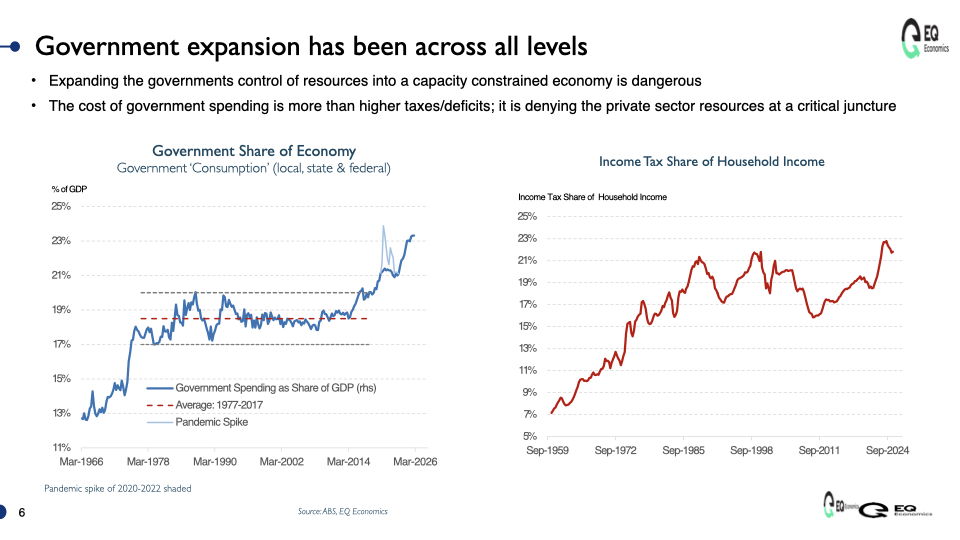
This data is from the national accounts. The general government income account. There’s one for national (federal government) and there’s one for state and local government. There’s a household income account. There’s a non-financial corporation income account. They all measure the income dynamics the same way. And this is consumption expenditure, which is not a bad proxy for recurrent spending. I’m not going to criticise governance about investment spending. If anything, in the last 30 years, they probably under invested. I do think there are issues about quality, but let’s just park the investment and focus on the recurrent, the “locked in”, spending.
There are two problems with this massive expansion in the presence of government in our economy.
You can see here that for 30, 40 years, that stability in government recurrent spending, as a share of the economy, moved around with the cycle. But it was a feature of the modern Australian economy. It had a political or a broad community support, which was very real at the ballot box. That political discipline is gone, no longer enforced by the electorate. And with it, we have seen an explosion in spending in the last decade.
The Intergenerational Report (IGR) was a great idea. I don’t really want to think of it as a Trojan horse for big government, but it’s looking that way. We’ve had an expansion of government in a very short time frame in macroeconomic terms, which is having big implications for the way our economy works. These implications are going to last for years.
We’ve had an expansion of government in a very short time frame in macroeconomic terms, which is having big implications for the way our economy works. These implications are going to last for years.
This is the big one. Take out state and local government and just look at the federal government. Federal government recurrent spending, as a share of the economy between the late 1970s and about 10 years ago, was seven and a half per cent of GDP on average and ranged between seven and eight per cent. Five years ago, in the pandemic, it spiked and came back down again. Because they did execute temporary, targeted measures, and it worked well. You’ve got to remember, these criticisms are in the context of some of the finest economic policy makers the world’s ever seen in this country in the last 30 years. So, I don’t do this lightly. We saw the economic recovery from the pandemic, a change of government at the federal level, and then kaboom.
In the last four years, it has exploded. This is not Canberra bursting out at the seams. This is not the federal public service. You could get rid of every federal public servant, and it’s less than 5 per cent of the federal budget.
It is this massive funding of the care economy. And this is the government, in some respects, nationalising industries.
It is this massive funding of the care economy. And this is the government, in some respects, nationalising industries.
I think people understand this. What it means is, if we go to the election and you say we’re going to do a care economy, and we get voted in, that’s the electorate speaking. We’ve got to accept that. And I would accept that. But part of my role as an economist is to make sure the electorate understands what that means. Now, at first glance, you’d say, well, people have accepted that we’re going to have to have higher levels of taxation to pay for this. I’ll generally give it to the broader community that they understand that. Whether that’s in the form of higher taxes now or in the future, ie higher deficits now. But its costs come in a much bigger form which is the resources denied to the private sector. And the costs in terms of loss of productivity of the economy.
And of course, at this crucial juncture as one of the most important technological revolutions ever is well underway. The potential for new supercomputing and AI technologies to enhance our productivity, boost our economy and benefit our society is compromised when the private sector has limited resources.
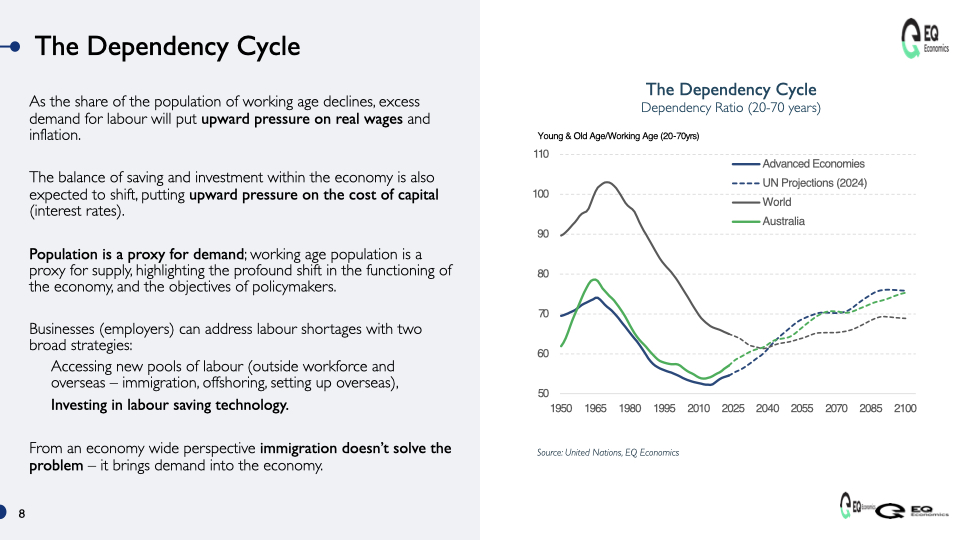
The single biggest issue confronting our economy is chronic labour shortages due to a long-term turning point in the dependency cycle. We have gone from an economy that had a problem with too much labour for decades, where unemployment was a real, genuine and prominent problem, to an economy that has the exact opposite problem. We have structural labour shortages, and when the government goes in and soaks up very scarce resources, the impact is magnified and the costs are magnified.
I discovered this idea of dependency, and the way it can affect the function of the economy, through reading a book by Charles Goodheart called The Great Demographic Reversal. He’s one of the best modern macro economists. I then put that into place in an active, applied sense of doing my macroeconomic assessment and forecasting since late 2020. Goodheart would be pretty pleased with what I have done. I am actively synthesising his thesis into my traditional macroeocnomic analytical and forecast techniques. And it works.
Dependency is simply, as the UN or a demographer measures it, the ratio of people in our community that do not work to those that do. It’s all done by age group. It’s conceptual. You’ve got to drop detailed analytics when trying to understand the concept.
This is one of the things that economists are bad at; they are constantly looking to rip things apart, which is good in many respects, just not when attempting to understand new ideas and concepts. Allow yourself to think about these big forces at play. Think of the ratio of people who do not work to those that do, measured by the young and the old versus the working age in a traditional sense. So, the baby boomers come in, and then from the 1970s right up until about 15 years ago, every year, we would have more workers coming into the economy than the growth in the size of the economy.
Think of total population as a proxy for demand. A three-month old needs to be clothed, fed, housed. A 90-year old needs to be clothed, fed and housed. Total population is in demand. The working age cohort are the people who are going to be able to supply the goods and services to meet that demand. All through that period, most of our lives, we had to deal with unemployment. We had a 1982 recession. Unemployment doubled in the blink of a macroeconomic eye. It happened again in 1991.
The thing that’s hard for people to understand and wrap their heads around is demographic shifts. It’s a secular force. It’s glacial, persistent and usually directional.
The thing that’s hard for people to understand and wrap their heads around is demographic shifts. It’s a secular force. It’s glacial, persistent and usually directional.
Here we have the Keynes quote. This is fantastic – “The difficulty lies not so much in developing new ideas as in escaping from the old ones.”
There is no one macroeconomic theory. Microeconomics is as solid as any science. But if someone says they’re a Keynesian or a monetarist or this or that in the macroeconomic sense, just keep walking. As a macroeconomist, you need to grab as much as you can from all of them. We don’t have a single model that can capture the complexity and unique features of a modern macroeconomy.
No one has got a model that captures demographic shifts, but the radical shift in this demographic reality is mucking around with the traditional macroeconomic models, partly because the parameters for all the models are estimated over the last 30-40 years; in a completely different demographic world where we had excess labour supply, deficiency of demand now replaced with labour shortages and supply constraints. And when someone says we have a supply constrained economy, it just simply means we don’t have enough people. Workers.
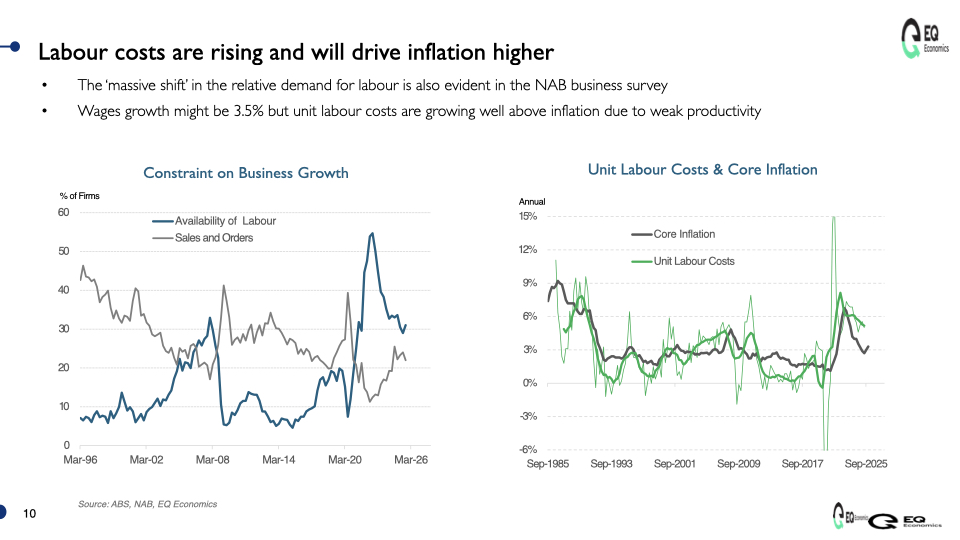
When I first came across this in 2020 it was, “Oh my god, Australia is the best immigration nation in the world. We are the lucky country. We are going to win once again.” And then it took me about three months to realise that immigration does not solve this problem. At the firm level, you go and find your carpenter out of London and get a visa program for them and bring them in and solve your firm level labour shortage. But when they come here, they need a Bunnings and a Coles and a hospital and a house and a road. Immigration does not solve the overall macro balance issue. It can help, but it can’t solve it. This is what the Europeans did after the GFC when the demographic pressure started to show up as labour shortages. Higher immigration hasn’t solved their problems; it may have added to them in a broader socio-economic context.
Higher immigration hasn’t solved their problems; it may have added to them in a broader socio-economic context.
In Australia, we have an active experiment with that population surge, which has put all that stress and strain and made it pretty clear what this means.
There is only one solution, apart from offshoring to more demographically favourable locations, and that is the utilisation of productivity enhancing technology in the production process. What does that give you? Wealth creation. It’s been happening for 250 years. The Japanese would have loved to have had AI 20 years ago. Remember the robots falling over on factory floors and in aged care homes? We are lucky, the technology is here to help. AI as saviour. But we have got to embrace it, and we are not.
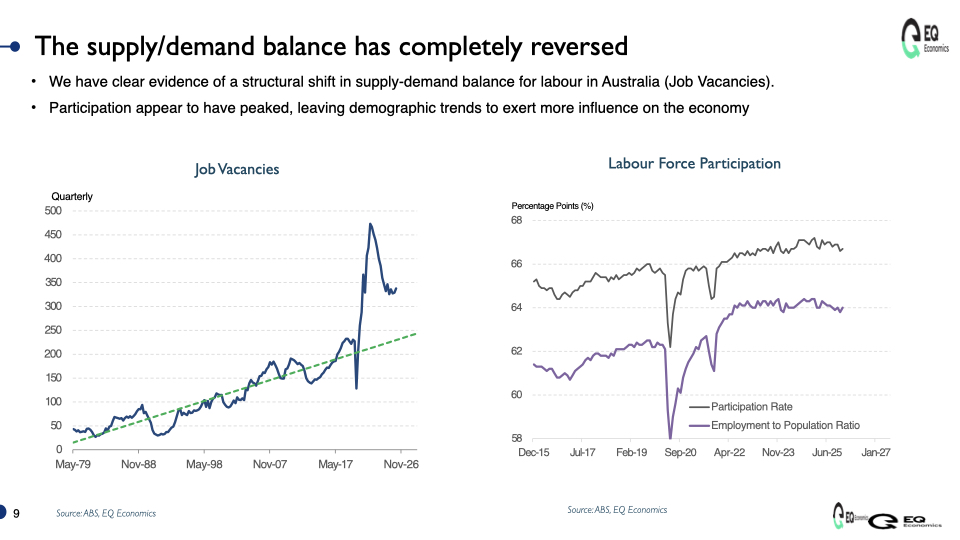
Job vacancies were released last week. I said, years ago, that the RBA’s Phil Lowe and then Stephen Kennedy should be carrying this chart around in their pocket. It is the single most important piece of data on the Australian economy, and it’s measured by the ABS. They simply go to their panel and ask, “How many job vacancies have you got?” It’s hard data, not like job ads. It goes back to 1979. All through this period, Asia crisis, tech wrecks, 1987 stock market crash, our financial crisis, the global one, the commodity boom, none of it has created the kind of volatility that we have seen since the pandemic.
My bit of work on this demographic stuff is macroeconomics, one of the most important concepts is lags. That is something happens and it takes time to filter through. Well, funnily enough, demographics takes about 10 years.
My bit of work on this demographic stuff is macroeconomics, one of the most important concepts is lags. That is something happens and it takes time to filter through. Well, funnily enough, demographics takes about 10 years.
What we have here is some evidence of the big shift we’ve seen in the, essentially, balance of the economy. An economy is essentially about people. It’s about consumers. The labour market is such an important element of what we do. We offset the first sort of phase to some extent. All countries of the world are going through this and one of the key swing variables that sits outside of this is participation. Switzerland is one of the wealthiest countries in the world. They have 85 per cent labour force participation, which sounds completely inconsistent with being wealthy.
Switzerland is one of the wealthiest countries in the world. They have 85 per cent labour force participation, which sounds completely inconsistent with being wealthy.
I was taught in microeconomics that life is a work/leisure trade off, but now it’s just work, work, work because of labour shortages. We have effectively increased participation – the utilisation of labour that exists in our economy, the long-standing trend for female workforce participation. The massive increase or what’s turned the dial on participation since 2010 has been older age participation. As in the participation rate of people over the age of 65. And it looks like these utilisation measures, either participation or employment to population ratio, have sort of run their course. We may have seen “peak participation”.
There is one other source. The youth participation of 15-24-year olds is about 70 per cent. It’s been pretty stable. That could go up, because we’re going to see a shift in the way people skill themselves out of high school. AI will assist in more on the job training and fewer people will be going to university. And that’s a good blend of the demographic story (labour shortages and demand for labour) and the technology story (AI and less formal training and skilling).
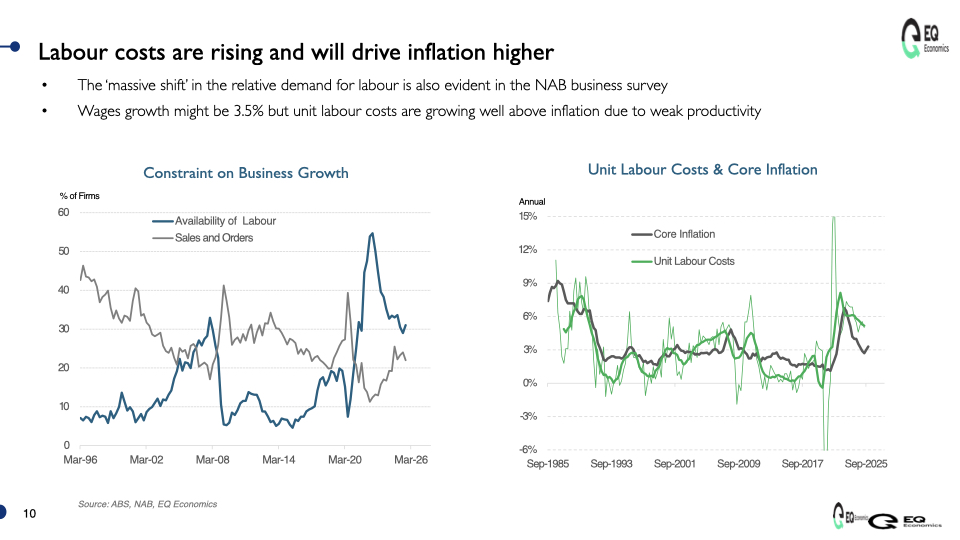
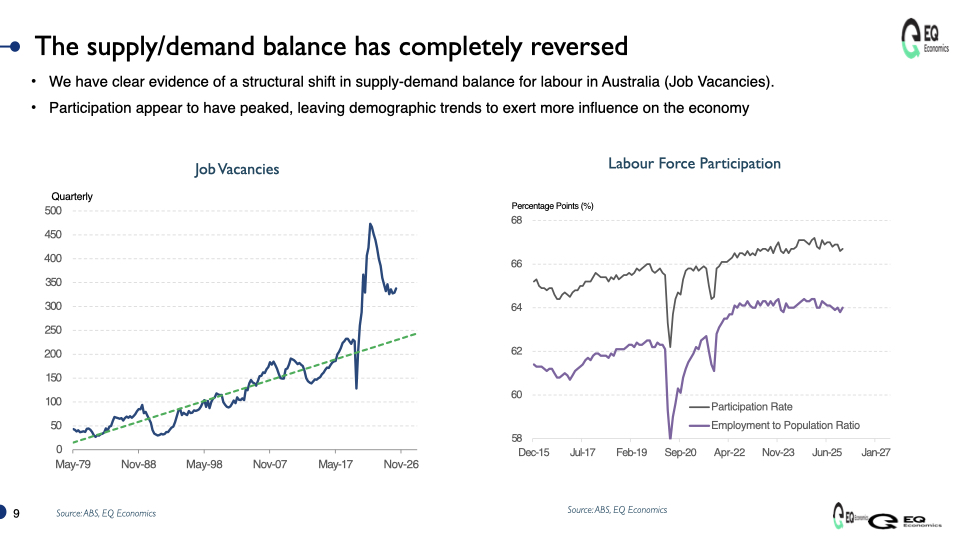
Okay, so more evidence. This is from the National Australia Bank’s quarterly survey. It’s been around for 30 years. It’s one of the best real time, high quality surveys, because it’s very simple. This is asked every three months – what’s the main constraint on your business? All through my career, the 1990s and noughties, there was always demand. For about 15 minutes before the GFC, we had an amazing mining boom, and workers put on high vis and went to Queensland and WA. We had labour as a main constraint. But look at it now. This economy has gone from an economy that’s all about demand, to one that’s all about supply.
The ramifications of this run deep. Our state governments are more important than ever because of the important role they play in the supply side of the economy. The federal government, which is ostensibly about demand management, needs to sit back into the shadows a bit.
. Our state governments are more important than ever because of the important role they play in the supply side of the economy. The federal government, which is ostensibly about demand management, needs to sit back into the shadows a bit.
We’ve got new measures from the ABS of what’s called market sector productivity and non-market sector. Non-market sector is a way to get a broader measure of the elements of our economy that are funded by the government. Uncontested would be the term I’d use. It’s the public service, public administration and safety, plus health and education. And you can see that it has been this non-market sector that’s been the weakest recently. And this is the level of productivity.
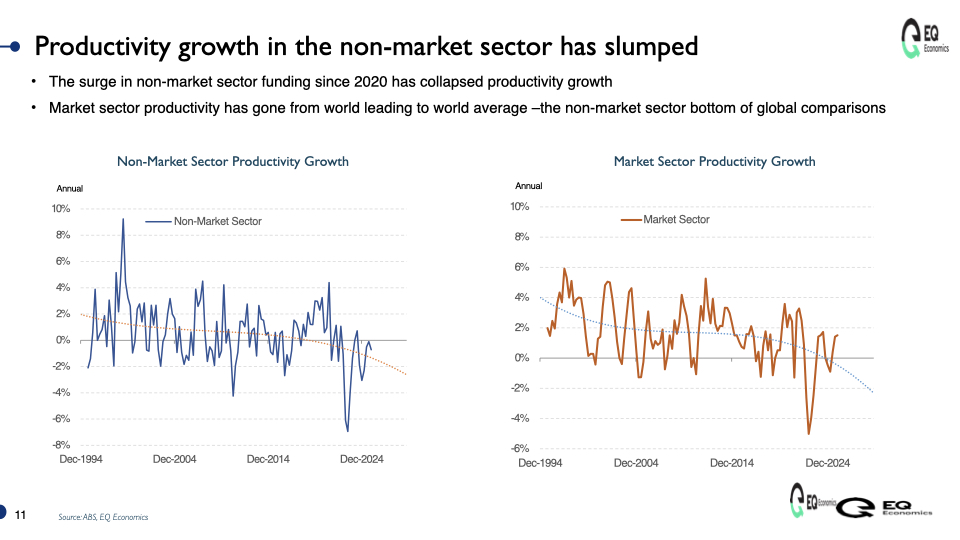
We’ve only got data back to 1994 and I’ve indexed it to 1994. Our non-market sector, which is government, plus those two other industries, are the fastest growing industries in our economy. Its index level in 2025 was 114. Despite the advent of the desktop computer, the internet, few management theories, they’ve managed a stellar 14 per cent improvement. The private sector, meanwhile, is at 168. It’s not contestable. You put resources into an environment that is competitive and people will try to provide either a cheaper or a better product. We all know the story. You do the opposite this is what you get.
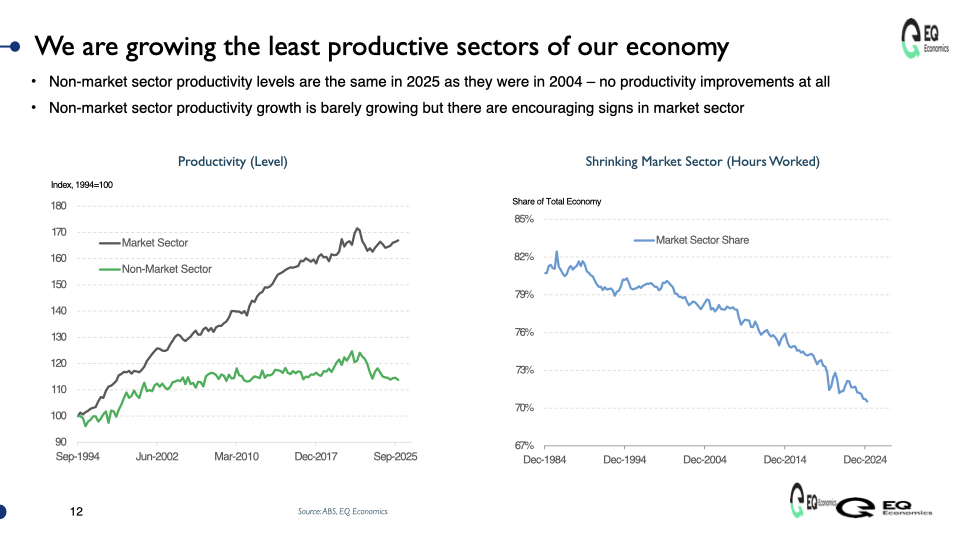
The essential element, the share of our economy, I’m using hours worked on that chart on the right side, the share of our economy taken up by the non-market sector is growing. And of course, what this essentially means is that we are putting resources, by government mandate, into the low productivity parts of our economy. Another interpretation of this is we’re taxing, increasingly taxing, the higher productivity elements of our economy to fund the lower productivity.
We know there is always this trade off. The question is, getting back to the election and what the costs of this are, are we making the right trade off? I don’t think any of us would disagree with the ambition of our care economy ideas, although there is some political ambition in there, as well as the well being of our society. But is it sustainable in the sense that will people put up with it?
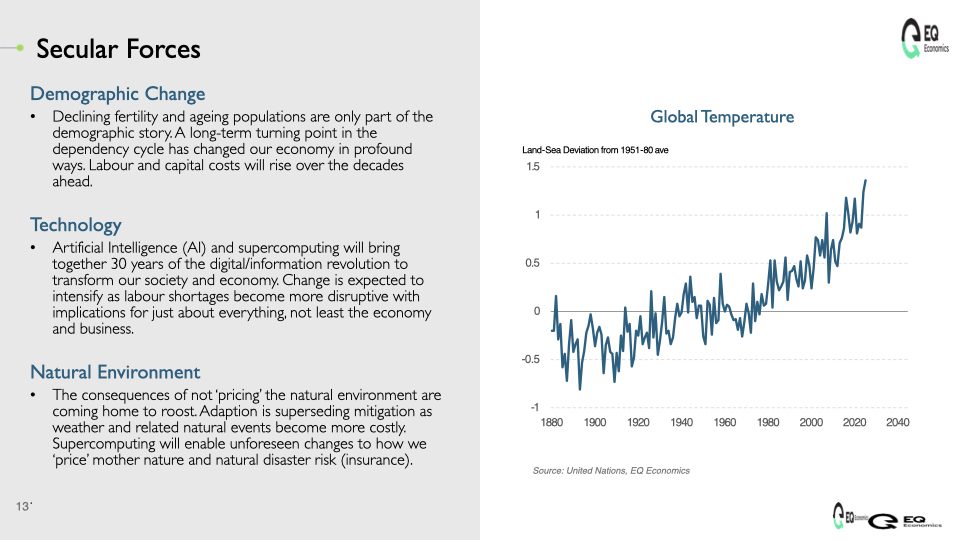
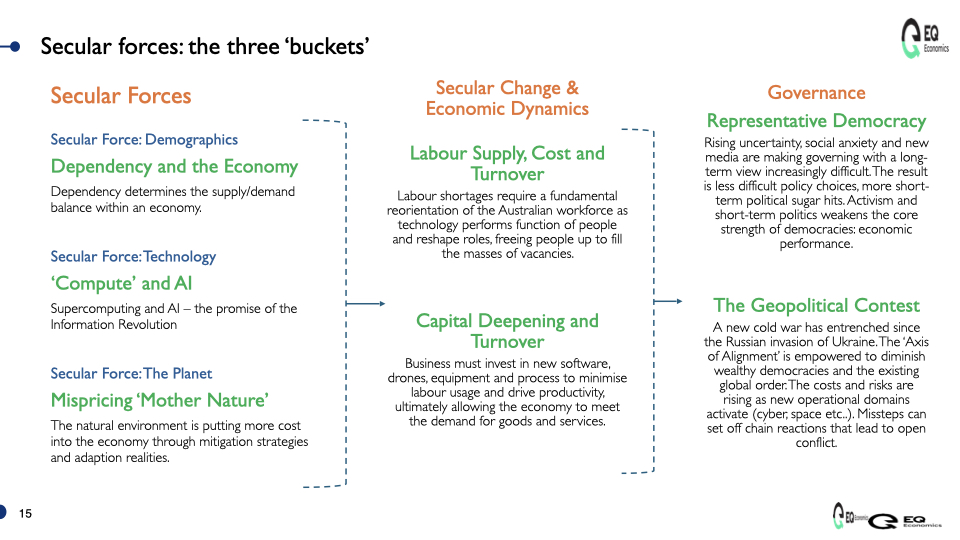
I don’t think so. It’s about what I call secular forces. There are three. Demographics is everything. Technology is, periodically, extremely important. And now is one of those times. And then there’s the planet. I suppose, if Elon Musk has his way, it’ll be called the universe. It’s the world we live in.
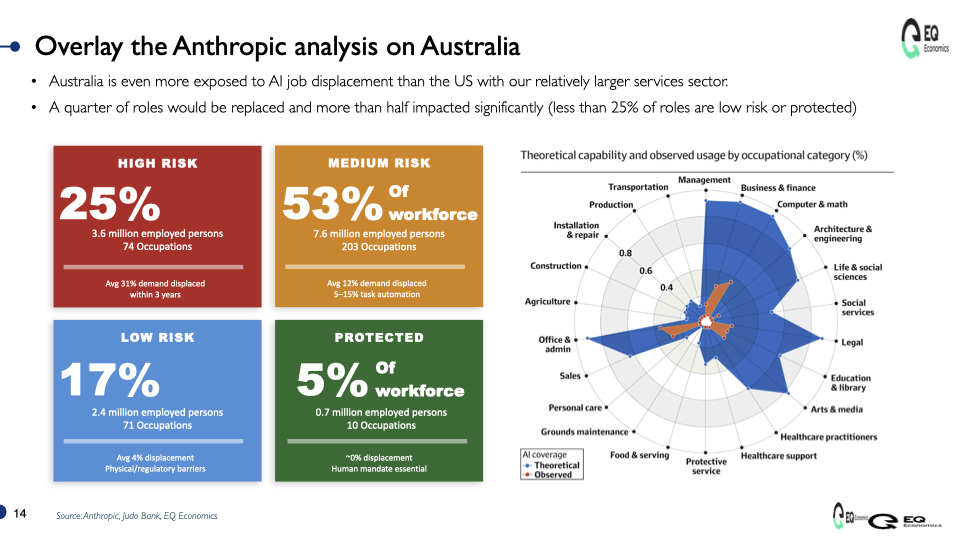
A month ago, Anthropic did some analysis of the jobs affected by AI. They’re pretty high end. And I’m sure they put some resources into this. A professor at Sydney, Clinton Free, quickly whacked that onto the Australian data set. It’s actually the same sort of ideas that have been floating around in this country for about two years. Fifty per cent of the labour force will be affected by AI. Twenty-five per cent of jobs will be gone within 10 years or so.
Fifty per cent of the labour force will be affected by AI. Twenty-five per cent of jobs will be gone within 10 years or so.
The intersection of these two forces, you cannot put back into the box. You cannot stick your head in the sand on this. We have this demographic shift which is profound. A once in 50 years event. It’s changed the functionality of our economy.
We’re not at all well geared for it, and people are resisting even understanding what this means, let alone changing policy to help deal with the issues that come from it. AI, as a new technology, is super computing in the computing power that drives this rather than AI itself. But we have technology that can help us solve this problem.
At the moment, the population we have and, in a relative sense, the people who can work just to produce the goods and services is falling. So, what we’re seeing right now, with our productivity going down and our living stands going down, is we’re not doing this effectively. We’re not delivering what we used to deliver. We should be delivering more. That’s the history of 250 years of application of technology. And this technology is very real and I can’t believe how fast it is being implemented. We’re only at the tip of the iceberg.
This is what the government should be worried about. We need to swim with the tide, but we are swimming against it. We’re not swimming with it. History is riddled with examples of how, when there is a regime shift, usually driven by technology, people resist it. And then there’s an economic crisis, which is a rapid reallocation of labour and capital resources within the community to reflect the realities of the world.
The recession is essentially a process of rapid industrial restructuring and employment and so forth. We need as flexible a labour market as possible. That round table that the Treasury had last year should have been wholly focused on how to make changing jobs less emotionally and financially stressful. That’s what we need to do. We need to get this technology in.
We need to take that labour out, and not like manufacturing in the early 1990s, when we lost all those jobs and too much labour as it was. Half the men aged over 45, who lost their jobs in manufacturing in Australia, never worked again. That is a tragedy, and we need all hands on deck. We can’t have that. And if we think the government can pay for people not to work, when we need people to work, plus them to be more productive, we’re on an unsustainable path.
I’ve worked on this for a long time. Governments are meant to help and they’re not at the moment. Australian governments did profoundly good things in the 1980s and 1990s. We need that again because we’re going so far the other way. We’re going to get ourselves into such a predicament. And that predicament starts in 2026.
It’s back to the Keynes point. You have got to escape old thinking. We’re going through one of the most radical shifts in 50 years, and it’s going to be how well we do. We have done incredibly well for 40 years in economic terms. But the pressure’s on right now. It’s about damage minimisation when it comes to this budget.
Throwing money at the problem, blaming a war, is only going to undermine the government’s political standing in the community. If they don’t understand why One Nation is rising in support, then they’re going to fall foul of it
Throwing money at the problem, blaming a war, is only going to undermine the government’s political standing in the community. If they don’t understand why One Nation is rising in support, then they’re going to fall foul of it