
Speaker
Michele Bomford
Speech Date
November 14, 2012
Issue
Issue 19
The story of the battle of Mont St Quentin-Peronne in 1918 involved the capture of the “unattackable” Mont and the “invincible” fortress town of Péronne, two of the great feats of Australian forces in the First World War. In her books, Beaten Down by Blood and The Battle of Mont St Quentin Peronne, Michel Bomford tells of the forces that drove the diggers forward, even when they had reached the limits of their endurance: “This is the Australian Corps at its very best, its diggers satisfied that, “whatever might lie ahead, at least everything was right behind them”. On Monday 12 November, Michele Bomford addressed the Sydney Institute to recount some of the horism of this powerful Australian experience during World War I.
THE BATTLE OF MONT ST QUENTIN-PERONNE – LEST WE FORGET
MICHELE BOMFORD
I thought I’d begin this evening by sharing with you something that happened just a few weeks ago. A gentleman living in Brisbane went into the city and bought a copy of Beaten Down by Blood after reading the review in The Australian – he said he read everything he could about the Battle of Mont St Quentin-Peronne because his father was in it. On the city cat on the way home, he was flicking through the book, which fell open at a certain page. He looked down, and there was a photo of his father, Private James Marshall. He was very surprised and very excited.
It is also important to let the men themselves speak
On looking more closely, he realised I’d consulted his father’s extensive collection of First World War materials – both written and visual – held in the Mitchell Library. No one in his family had any idea they existed. As soon as he could, he flew to Sydney and spent a day in the Mitchell, arriving on the doorstep at some early hour and harassing the doorman because the library wasn’t yet open. He plans to return and eventually compile the materials and produce copies for his children, grandchildren and other family members.
Apparently, this is not an unusual occurrence, and inevitably the relatives who discover unknown archives want to read them and learn more about their digger from the First World War. This says a great deal to me about the impact the Great War still has on Australians today. It tells me that there is a “connectedness” across nearly 100 years, that its echoes still resonate and touch people’s lives, that it is important to pass the knowledge and the stories to the next generation.
it was not until 2008, on my fourth visit, that I determined to write its story
It is also important to let the men themselves speak. As necessary as it is to establish the military details of a battle as accurately as possible – and in Australia we have access to the sources and resources which allow us to do this – it is their voices which add the colour and the human dimension to the canvas of the battlefield. In Beaten Down By Blood I have tried to combine military and social history, outlining the battle itself while giving a name and a face, and a purpose, to the men who fought. I have attempted to place the battle within its military context, and the men themselves within a wider context not just of war, but of their lives and families back home and aspects of Australia itself during the First World War.
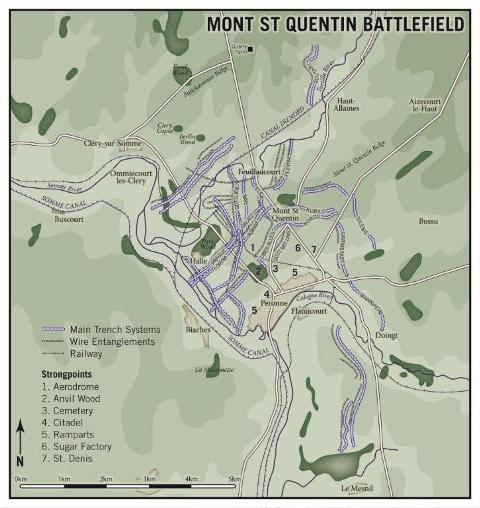
Unlike Jim Marshall, my gentleman from Brisbane, most Australians have not heard of Mont St Quentin-Peronne, a battle fought on the Somme in late August and early September 1918. It first captured my imagination nearly 20 years ago, as Mont St Quentin was the first battlefield I ever visited. But it was not until 2008, on my fourth visit, that I determined to write its story, a story which had not been told since Charles Bean completed the Official History in 1941, a story which had faded from Australia’s collective memory of the Great War. As my research took me deeper and deeper into this battle, I realised what an important story it was.
The Mont commanded a vast swathe of country, including the Somme crossing to the west, and was the key to the ancient fortress city of Peronne
This was a unique and complex battle fought across three sectors of a unique and complex battlefield by three tired and under strength Australian divisions, supported by British troops on their flanks. It was not what is called a “set piece” battle, where everything is planned and infantry, artillery, tanks etc are coordinated to play their part at the right time. Rather, this was a series of quick attacks, where sometimes fleeting opportunities had to be seized as the circumstances arose. In Sir John Monash’s words, “the developments from hour to hour, and even from moment to moment, are full of intense human interest and replete with tales of individual courage and initiative”. The intention was to seize the key strong points of the Mont and Peronne and the crucial high ground to the north, east and south. Let me introduce you to this battle and this battlefield.
Cartwright was awarded the VC for his exploit; Irwin, an Aboriginal soldier, captured three posts and was fatally wounded in attempting to take a fourth – he was awarded the DCM
In the grey dawn of 31 August 1918, 260 men – all that was left of the 20th Battalion, 5th Brigade, 2nd Australian Division – awaited the signal to attack “the dominating hill of Mont St Quentin”, a formidable strong point in front of Sir Henry Rawlinson’s British Fourth Army of which the Australian Corps, under the command of Sir John Monash, was a part. The Mont commanded a vast swathe of country, including the Somme crossing to the west, and was the key to the ancient fortress city of Peronne. The ground in front of the men was laced with double trench systems and barbed wire entanglements wound into circular forms resembling “huge burrs”, and pockmarked with old shell holes and heavily fortified strong points. None of the men believed they had “a ghost of a chance”.
The men had to crawl along the trench floor to stay under cover, fearful of attracting “a deadly shower of lead” every time they moved
As the minutes to zero hour ticked away, Major John McDonald, known as “Bluey Mac”, waited anxiously alongside his men, who were restless and tense. At 5.00am a desultory barrage opened and the men of the 17th, 19th and 20th Battalions stood straight up and charged forward cheering and yelling “all kinds of war cries”. They raced on, demolishing a whizz bang battery before halting for their barrage to lift. With “all eyes to the officer”, they readied for the second phase of the assault, when they dislodged the surprised Germans who were desperately trying to man their machine guns on the Mont. It was “a regular beehive disturbed”. By around 7.00am the 5th Brigade had captured Mont St Quentin, but with insufficient artillery support, too few men and strengthening German resistance, the Australians were pushed back during the afternoon.
On the crucial Bouchavesnes ridge to the north of Mont St Quentin, the 33rd Battalion, 9th Brigade, 3rd Australian Division, (the 33rd was commanded by Lieutenant Colonel Leslie Morshead) received its final instructions at 2.45am on 31 August after several changes of plan. It attacked at 5.42am without time for reconnaissance or to explain orders to the men.
When the battalion was held up at Road Wood, Privates George Cartwright and William Irwin separately rushed German machine gun nests, capturing the guns and killing or capturing the Germans who manned them (Cartwright was awarded the VC for his exploit; Irwin, an Aboriginal soldier, captured three posts and was fatally wounded in attempting to take a fourth – he was awarded the DCM). The wood was cleared as individuals and small parties worked round and forward, knocking out one strong post after another using accurate and deadly bombing tactics to catch the Germans in their dugouts, which became death traps. As Lewis guns blazed, the men captured a battery of six 77mm guns, its commander holding on until shot with a revolver. Finally the crest of the ridge was taken.
When the 6th Brigade resumed the attack for Mont St Quentin on 1 September, Second Lieutenant Percy Smythe from the 24th Battalion found himself with just 30 men in a trench near the cemetery on the northern side of the Mont. It was “a wretched place to be in” as the Germans fired on them from trees and some of “the higher fragments of the buildings”. The men had to crawl along the trench floor to stay under cover, fearful of attracting “a deadly shower of lead” every time they moved. With men of the 23rd Battalion who were held up by “smothering” machine gun fire and forced to wriggle forward on their stomachs, “sweating under the load of the Lewis gun” in front of Mont St Quentin, the 6th Brigade was unable to retake the Mont in the morning.
he was left for dead on the battlefield but somehow survived and returned to Australia, bearing the “hole” in his head for the rest of his life
After personal reconnaissance, Brigadier General James Robertson ordered that Mont St Quentin be pounded by an intense artillery barrage at 1.00pm and at 1.30pm the 6th Brigade charged, the 21st Battalion rushing the old brick wall which harboured German machine gun nests, the men sweeping over the Mont and onward, dashing enemy posts to pieces, kicking screaming prisoners to the rear and forcing the Germans to retire. On the north side of the Mont, Sergeant Albert Lowerson, Private Godfrey Dobson and three other men captured a crater with 12 German machine guns which were holding up the advance, storming it from the flanks, rushing in and using effective bombing tactics to inflict heavy casualties on the defenders, the remnants of whom fled. Lowerson and his men secured the machine guns, 30 prisoners and consolidated the position. By 3.00pm, Mont St Quentin was once again in Australian hands.
But the battle for Mont St Quentin was not yet over. It was essential that the ridge, stretching roughly north-east from Mont St Quentin village, and wood be taken. This was the task of the 7th Brigade on 2 September, against tenacious German opposition. Second Lieutenant Oscar Lawson from the 26th Battalion was hit in the head while attempting to silence his second machine gun post – he was left for dead on the battlefield but somehow survived and returned to Australia, bearing the “hole” in his head for the rest of his life.
The 25th Battalion deployed men in small groups to rush the weaker German machine gun posts and capture or kill the garrison. Using their new positions and grass tufts or shell holes, they blazed into the stronger posts, attacking from the flanks while using their Lewis guns, rifles and rifle grenades to fire from the front at the same time. Once the enemy began to retire, the posts were rushed frontally and the garrisons captured or killed. The ridge was captured and consolidated and Mont St Quentin became “undisputed Australian territory”.
Shortly after, the enigmatic Brigadier General Pompey Elliott, paddling about on the Somme in a little boat, with shells falling all around, rowed to a small island to rescue a stranded kitten
While the 2nd Australian Division was fighting for Mont St Quentin, the 5th was tasked with capturing Peronne. After an approach march which took 10 hours on 31 August when the direction of its attack was changed, the 14th Brigade arrived west of Mont St Quentin to be told it had yet another new task, to be carried out at very short notice on the morning of 1 September. The 53rd Battalion, with little artillery support, advanced into thick, uncut barbed wire and had to use wire cutters to force its way through. Near Anvil Wood, Private William Currey rushed in and captured a 77mm gun, killing its crew and turning the gun on the Germans. Corporal Arthur Hall and others of the 54th Battalion crossed the moat surrounding Peronne, using planks and debris, forcing their way into the town near the citadel where they engaged in “violent and isolated hand to hand fighting” amidst “the tottering blown in walls of the houses”.
The Battle of Mont St Quentin-Peronne quickly attained legendary status. It differed from the other battles of 1918
Peronne was consolidated on 2 September by troops of the 58th Battalion, 15th Brigade. Lieutenant Tom Slaughter took command of his company when all its other officers were wounded, skilfully deploying his men against a possible counter attack and silencing a number of machine gun posts. As the Australians advanced, one German machine gunner had his leg blown off by a shell, but rested the bleeding stump on the concrete defences of his position and kept on firing until the Australians were forced to kill him when he refused to surrender.
As the foundations of the old city rocked and swayed and shells ricocheted off the cobblestone streets, the Australians pushed forward, taking the eastern part of the town and its deadly ramparts. Shortly after, the enigmatic Brigadier General Pompey Elliott, paddling about on the Somme in a little boat, with shells falling all around, rowed to a small island to rescue a stranded kitten.
These are just snapshots – taken from Beaten Down by Blood – of what happened at Mont St Quentin and Peronne. They, by no means, tell the whole story. If we unpack these fragments, it becomes clear how the Australians were able to win this battle, when every indication was that they should not have got close to either the Mont or Peronne. At the time and shortly after, the capture of these strong points – with their reputation for being “almost unattackable”, “invincible” and “impregnable” – were regarded as two of the finest feats of the war. The Australians had achieved a stunning victory in a string of military successes.
It was also a significant victory in the context of operations along the Allied line, by Canadian, British, New Zealand and French formations. Mont St Quentin-Peronne was one in a series of battles which unhinged the Germans’ “winter line” for 1918/19 – which they were ordered to hold at all costs – forcing them back to their last strong defensive position on the Western Front, the Hindenburg Line, from where the Allies dislodged them in late September and early October. These operations brought the war to an end in 1918, saving thousands of lives.
The digger of 1918 is a far more plausible role model, much more in tune with our ways of thinking in the twenty-first century
The Battle of Mont St Quentin-Peronne quickly attained legendary status. It differed from the other battles of 1918 in that the usual array and quantity of mechanical resources – tanks, aircraft and most importantly artillery – were not available (there were in fact no tanks for this assault). This led Pompey Elliott to scrawl in the margin of a document he later sent to Official Historian Charles Bean that defences were “beaten down by blood”.

Exaggerated newspaper articles declared that the men prepared for “sublime suicide” as “the little woods were running red”. The men themselves felt that the battle resembled old time warfare, with engineers struggling to throw bridges across the many channels and marshes of the Somme and infantry charges against old abbey walls, ramparts, battlemented towers and moats. There were many examples of heroism, bravery and “exciting” exploits by men of all ranks. In the three days from 31 August to 2 September eight Victoria Crosses were won.
The men of Mont St Quentin-Peronne were upholding Charles Bean’s iconic image of the digger, born during and after the Gallipoli campaign. But Bean’s creation of the Australian soldier as a natural warrior, a superhero in the true mythological sense, can, and should, be questioned. It became obvious to me as I researched Beaten Down By Blood that it was far more than natural ability and superhuman qualities which led to the capture of Mont St Quentin and Peronne. These attributes had, after all, failed to secure the heights of Gallipoli.
This digger would not be out of place in the mission in Afghanistan today.
The digger of 1918 is a far more plausible role model, much more in tune with our ways of thinking in the twenty-first century, yet consistent in many ways with the mythological figure. Yet most Australians do not know him. At Mont St Quentin-Peronne, the digger is reduced to human size – he is thin and haggard, dirty and lousy, often with a beard. He is exhausted, having been pushed almost to the limits of his endurance. He expresses sadness at the destruction of the fine old town of Peronne and mourns his fallen comrades, careful to mark their graves so they will not be lost. Where the Germans surrender freely, he will take them prisoner and treat them well, but where they resist he will give them no quarter. He has not lost that characteristic sense of humour or commitment to his mates, or his belief in honour and duty and creating a better world, but he is also more cynical and driven by determination to achieve his objectives and get the job done.
Nearly 100 years on, the focus for our commemoration of those who served in the First World War still centres on Gallipoli
Most importantly, he is a well-trained, well-disciplined, highly skilled and experienced soldier, capable of using his initiative and intelligence to implement tactics using his own firepower and skills in field craft. He can operate individually or as part of a team to ensure the attack goes forward – often against determined opposition – whether he is a battalion, company or platoon commander, an NCO, or a private. He uses tactics such as surprise and noise with admirable effect. He can adapt to the “rapidly varying phases”, “freewheeling manoeuvres” and series of quick attacks that characterised Mont St Quentin-Peronne and set it apart from Monash’s more meticulously planned and executed set piece battles such as Hamel on 4 July and Amiens on 8 August.
Bean has distorted our memory of the Great War.
He fights as part of the Australian Corps, a dynamic national formation which from May 1918 was commanded and staffed by Australians, with high morale and a sense of cohesion, unity and purpose which filters down the chain of command to the private in the field and is, by August/September 1918, at the peak of its fighting effectiveness. This digger would not be out of place in the mission in Afghanistan today.
When Monash in 1919 wrote his Memoir, Australian Victories in France in 1918, there was an expectation that the victories of 1918 would live in the memory of Australians. Monash felt that Mont St Quentin rivalled the Anzac landing in its importance for Australia. Others believed that to go forward with the Australian Corps in the battles of 1918 was an honour equal to none. Major General Talbot Hobbs, commanding the 5th Division at Peronne, believed that the capture of this town had won for his men “imperishable fame”.
surely it is time to remember the forgotten Australian victories of 1918 – important battles such as Mont St Quentin-Peronne – and the individuals who fought in them.
Yet this has not been the case. Nearly 100 years on, the focus for our commemoration of those who served in the First World War still centres on Gallipoli. By 1916, Charles Bean had created a powerful legend, the birth of a nation springing from the ashes of Australia’s “baptism by fire” at Anzac Cove. Yet, in creating this legend so early in the war because he believed that no other action would be as readily identified with the Australians as this – from a campaign which was a sideshow and a military disaster – and unwilling to give Monash his due – as relations between the two men were strained at this time – Bean has left us to flounder with fact and fiction, with what is history and what is myth.
In not making the link between Gallipoli and the battles of 1918, particularly Mont St Quentin-Peronne because it is different to other battles – Bean has distorted our memory of the Great War.

The Anzac tradition, born on the shores of Gallipoli in 1915, came of age and is validated on the Western Front in 1918. It is in our forgotten battles, and Mont St Quentin-Peronne is a perfect example of this, where we see what mature Australian troops were really capable of and what really made them tick. In this battle, we see commanders and their staffs operating under enormous pressure to seize the opportunities that would fulfil Monash’s intention within a reasonable time frame.
By digging into the war diaries of the artillery, airmen, engineers, signallers, machine gunners and medicos, we gain an appreciation of the difficulties they faced in their attempts to support the infantry, as well as an indication of their considerable achievements. If we strip back the legendary overtones, we find at the core a battle where the substantial historical evidence supports the claim that the capture of Mont St Quentin and Peronne were fine feats of arms. The digger, too, can be acclaimed as a figure of history rather than myth.
It is time for Australians to look seriously at our historiography of the Great War, to get some perspective over its four years rather than just the eight months of the Gallipoli campaign, to get out of the muddy trenches of 1916 and 1917, to stop highlighting our greatest disasters as though these were the only battles we fought.
We need to place ourselves on the solid ground of the main theatre of war, the Western Front, in 1918, where the nature of warfare was changing, where armies were again mobile, where the Allied forces, from July, were advancing and pushing the Germans back. The Australian Corps played its part in this advance and surely it is time to remember the forgotten Australian victories of 1918 – important battles such as Mont St Quentin-Peronne – and the individuals who fought in them.
Yesterday we commemorated Remembrance Day, originally the day the guns fell silent on the Western Front in 1918, but now commemorating those who served in all wars. At the core of remembrance is sacrifice, not just that of the men and women who gave their lives, but those whose lives, and the lives of their families, were irrevocably changed. There were many such men at Mont St Quentin-Peronne. Lest we forget.
