
Speaker
Simon Chapman
Speech Date
June 14, 2011
Issue
Issue 12
In 2011, Australia prepared to legislate plain packaging for all cigarette sales in a bid to curb the damaging effects of smoking. A global first. So is this an example of a nanny state gone wild or a long overdue health measure? To discuss the proposed legislation, on Tuesday 14 June 2011, The Sydney Institute heard from two commentators on the issue. Ainslie Van Onselen is a former senior lecturer in law at Edith Cowan University, a Sydney based lawyer and company director, currently in sole practice, and also writes a weekly column in The Australian’s Legal Affairs section. Dr Simon Chapman is Professor in Public Health at the University of Sydney. His Public Health Advocacy and Tobacco Control: Making Smoking History was published by Blackwell (Oxford) in 2007.
TOBACCO LABELLING – TWO VIEWS
SIMON CHAPMAN
I’m not going to spend too much time this evening on why the government is introducing plain packaging but I will take a little bit of your time to try and explain it. Diseases like lung cancer in the sweep of history are relatively new diseases. A famous United States surgeon, Alton Ochsner, in a book about his career. recalled that he saw the first case of lung cancer in 1919 when he was summoned as a medical student. He waited 17 years, didn’t see any more and then he saw a spate of them. Of course the rest is history they say.
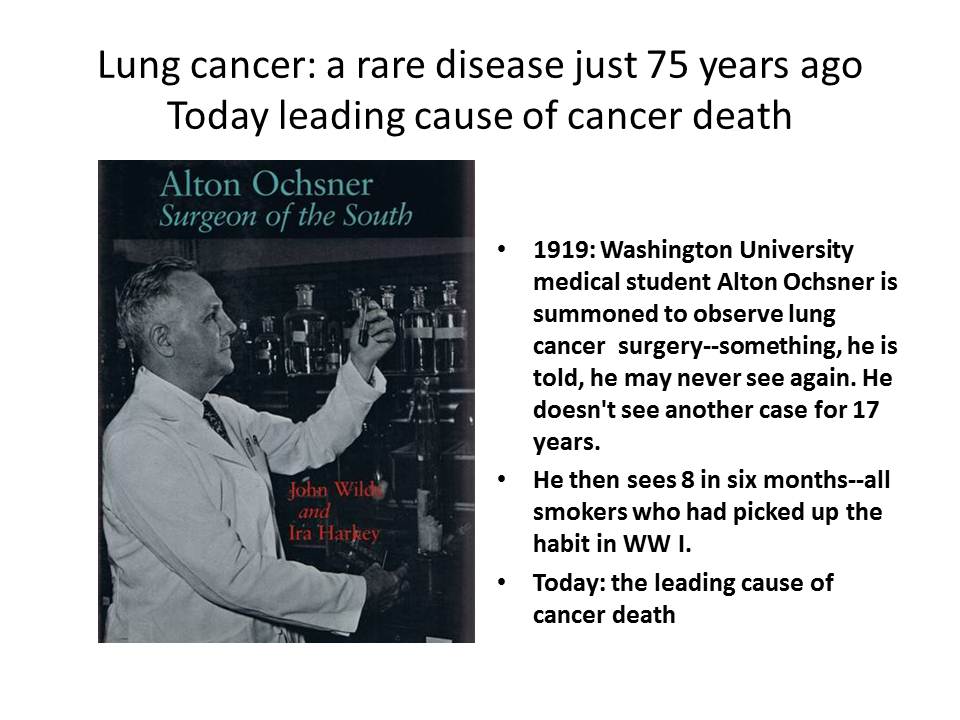
Lung cancer is now the leading cause of cancer deaths in the world. It claims more lives than any other form of cancer. Which is of course why governments like the Australian government are trying to do something about tobacco control. This is a slide which excites me a lot. It may not excite you but I’ll tell you why it excites me.
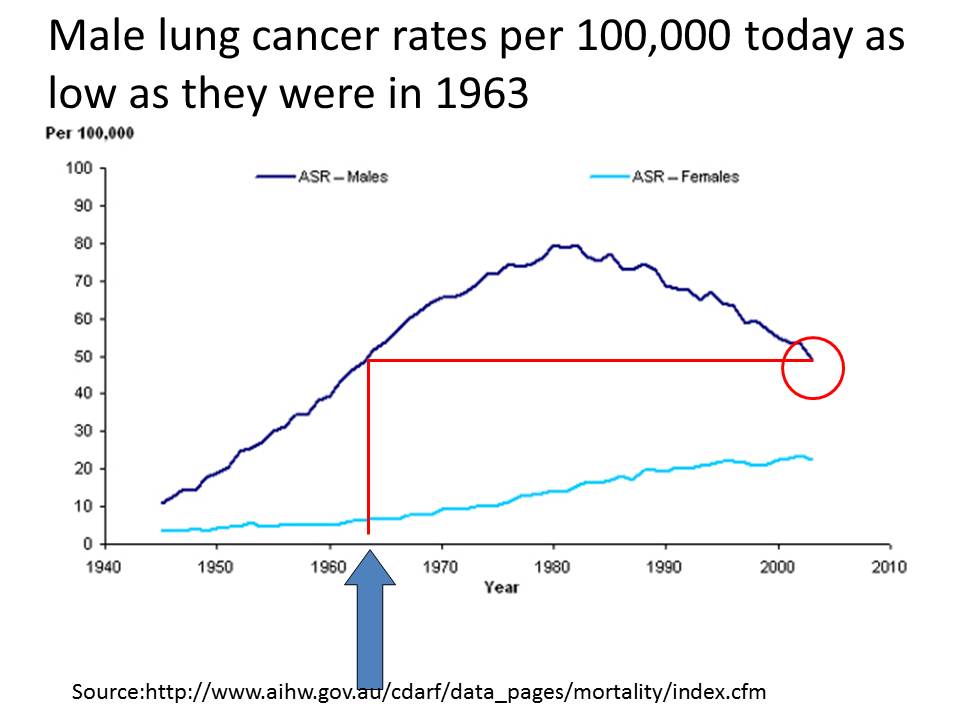
What we can see here is the historical rise of lung cancer in both males and females. You see females are far lower than males reflecting the traditionally lower rates of smoking in the community. You can see that from around about 1982 rates started falling. The most exciting thing for me, working in medicine, is when you look at where we are at the moment and draw a line back, you have to go back to 1962 to see rates of lung cancer as low as they are today. So we’re getting on top of this disease and we’re not doing that by accident. We’re getting on to it because we’re using evidence based approaches to drive smoking down from our population. It won’t happen in my lifetime, I’m 60 this year. But it will certainly happen in my children’s lifetime. Lung cancer will be probably be a disease that historians will look back on and say, “Well yes it happened for about that 150 year period between about 1930 and 2060. “ After that, it’ll become another curiosity case if we keep on going the way we are.”
So we’re getting on top of this disease and we’re not doing that by accident.
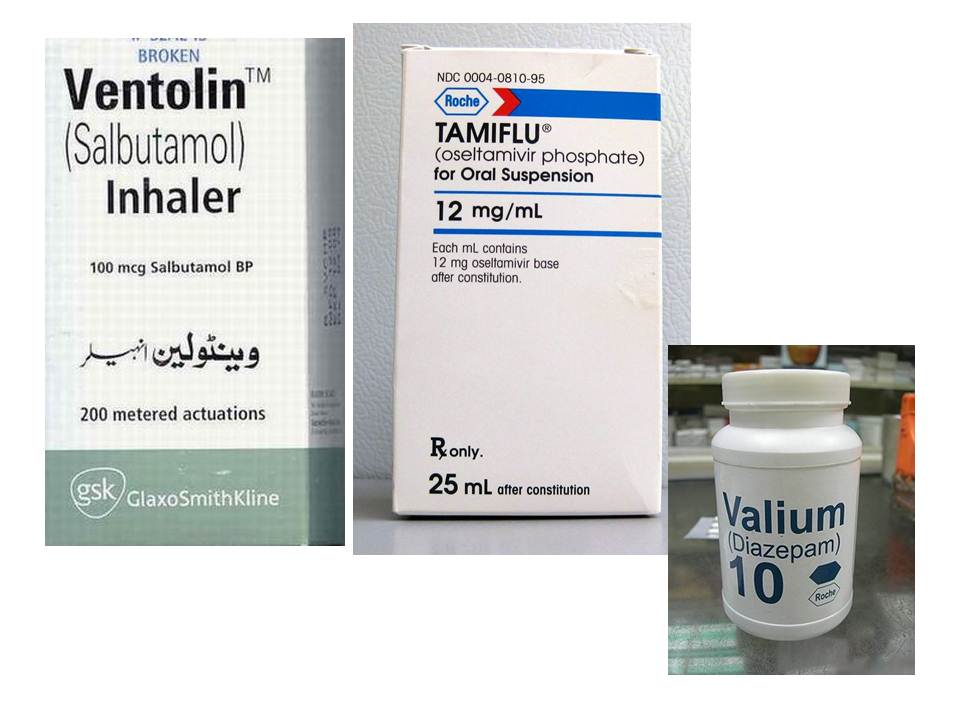
Here is how we package prescription pharmaceuticals. If you want a prescription pharmaceutical, an oral contraceptive, a codeine-based analgesic, an antibiotic malarial drug, you have to go along and see a person who has been trained for a minimum of six years at university. You have to wait in their waiting room for an interminable amount of time, pay them some money and then you are given a temporary license to consume one of these drugs and you will then take it to a person who has been trained for four years, a chemist, and you will give that person some more money and you’ll be given a temporary licence to take one of these drugs. And these are drugs which enhance health, save lives, which relieve pain, all of these sorts of things. And we all think that’s a very sensible system. But if you want to take a drug called nicotine other than in its therapeutic mode – nicotine replacement therapy – you can go to any corner store, any supermarket, any pub, any newsagent, any service station and you can buy it from someone behind the counter who may be 15 years old.
But if you want to take a drug called nicotine other than in its therapeutic mode – nicotine replacement therapy – you can go to any corner store, any supermarket, any pub, any newsagent, any service station and you can buy it from someone behind the counter who may be 15 years old.
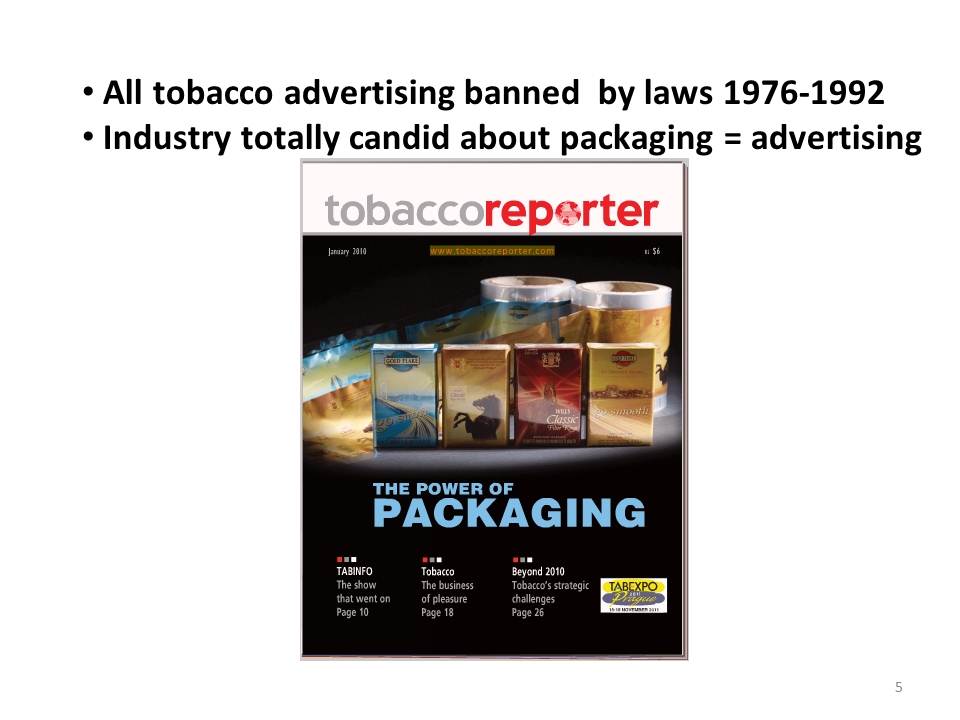
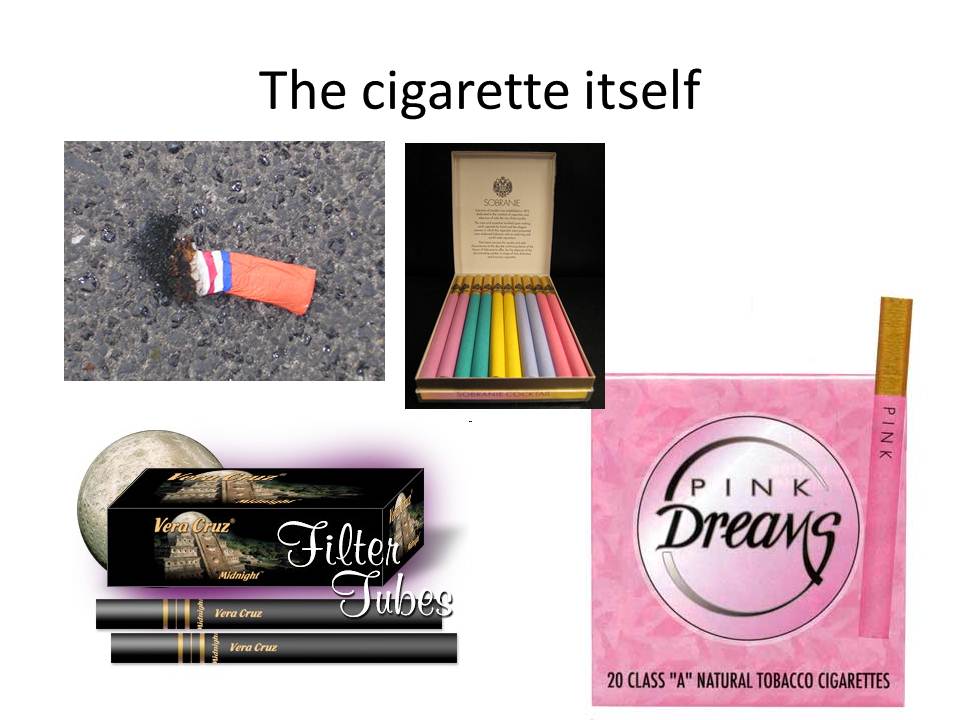
The tobacco industry is unequivocal in its writings about the power of packaging when it thinks it’s being read by people who are in their own trade. The industry describes it as a form of advertising. In fact it calls it the leading edge of advertising. There is a Canadian pack of cigarettes which looks to my mind very similar to another adult product that probably some of your children or grandchildren are very keen on, a Nano iPod. Here are the cigarettes themselves which of course are very carefully engineered and designed to make maximum appeal to the segments of the market that the industry studies and hopes to grow.

For those of you who don’t know, Pink is a very famous pop star and there are Pink cigarettes available. Balk and Sobranes, of course I smoked those like some of you did when I was at university but the butt on the top is in the Dutch football team’s colours and so the package, the product itself, highly designed for attraction, particularly to young people. These are designs from a tobacco company which had registered that we obtained from the Australian patent office. The shape of the box is terribly important as well. If you look through tobacco industry documents, which have been made available under litigation, you will see that there are all sorts of documents like this – in both public domains but also privately – where the tobacco industry is talking openly about how important packaging is and what plain packaging would do to its products.
It’s very difficult for people to actually distinguish one brand from another if they’re in blinded conditions. The products are essentially the same.
Here is another one from the president of Imperial Tobacco in Canada saying it’s very difficult for people to actually distinguish one brand from another if they’re in blinded conditions. The products are essentially the same, the differences that are sold to people are in the advertising and the packaging. And here is a long term tobacco industry consultant, a man called John Luik, who said very charitably:
One must give credit to the fact that the focus on plain packaging represents a new and more strategically sophisticated appreciation for how the industry is structured and how it earns its money. Cigarettes are in many ways a commodity product that achieves its distinctiveness not so much through functional differences but through brand identity, an identity that is represented in the product’s packaging.
So packaging is at the heart of the way in which the tobacco industry advertises its products today. Here we see a chocolate Freddo frog, a branded one. And here we can see one in the generic packaging. Which would your child prefer? I think we all understand which one the child would prefer. This is precisely why this argument about plain packaging has arisen – to remove, in countries like Australia where all tobacco advertising is prohibited, the last vestige of the ability of the industry to promote its products

This is precisely why this argument about plain packaging has risen – to remove, in countries like Australia where all tobacco advertising is prohibited, the last vestige of the ability of the industry to market its products.
People in different walks of life from me (Morgan Stanley for example) have said that plain packaging, homogenous packaging would significantly restrict the industry’s ability to promote their products. This is the cover of an internal journal from the tobacco industry sold to people within the industry: “Plain packaging can kill your business.” Well that’s the idea. People like me want the tobacco industry’s business to be killed. We don’t want it to splutter on for years and years and doing well. We want it to finish as quickly as possible.
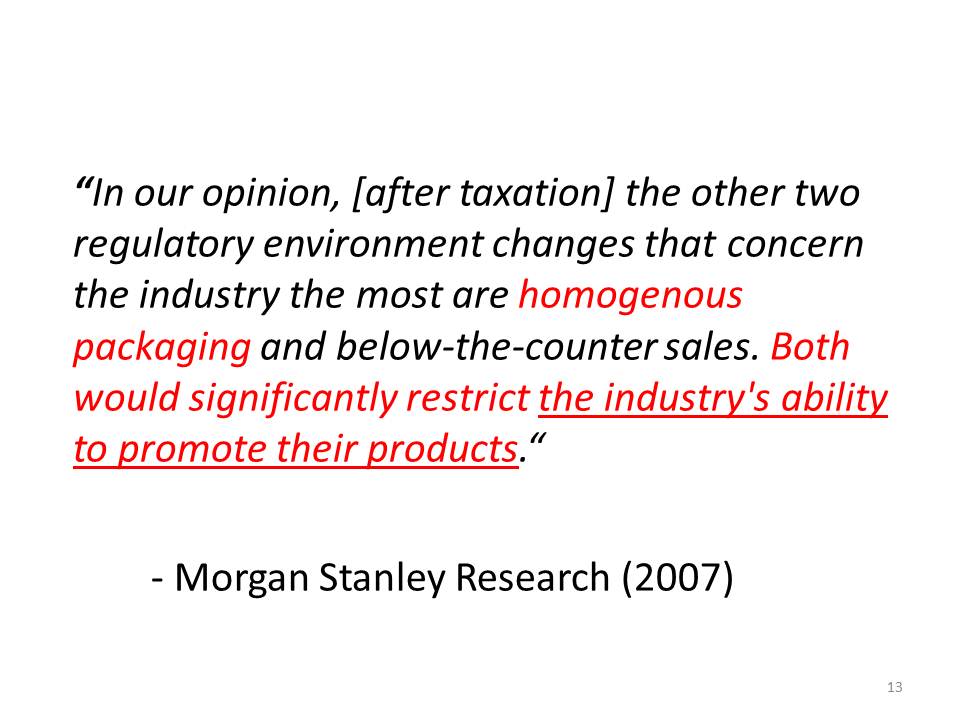
The goal is to standardise the appearance of cigarette packages and thus greatly reduce the status-signalling role and consumer appeal of the product.
The goal is to standardise the appearance of cigarette packages and thus greatly reduce the status-signalling role and consumer appeal of the product. Also to prevent the undermining of the health warnings. There’s a lot of information about packaging being designed to take attention away from the health warnings on the packs. In 2008, I reviewed a lot of this evidence and published it in a journal called Addiction. Shortly after that, I was invited to become a member of the taskforce which looked at what we should recommend to the federal government about tobacco control into the future.
I was not backward in coming forward, saying we should recommend plain packaging. And we did. In fact, the description of plain packaging was lifted directly out of my paper as published in Addiction. That’s what it will look like from the beginning of 2012. Most importantly, the name of the brand will continue to be on the packet. So it’ll continue to say “Benson and Hedges” or “Winfield” or something like that. The idea that we won’t be able to tell the differences between the brands and that shopkeepers will be all confused is nonsense. A customer can ask for a packet of Winfield Blue and the salesperson will select the package and hand it to the customer.

What I want to do with the remainder of the time available to me is to consider arguments thrown at this by a very desperate industry at the moment. First of all, that there’s no evidence of effectiveness. Or that the sky will fall in with High Court damages. Or that the TRIPS and World Trade Organisation will stop it. Or that there is a slippery slope, and where will it all end?
First of all, there’s no evidence. By this of course the tobacco industry means that no country has ever done this before. So they say in their sound-bytes on television, “No country has done this before”. Well, no country has done this before. The Wright brothers had never flown before, no country had ever banned tobacco advertising when Singapore – I believe it was the first country – did that, followed by Finland and so on and so forth.
They say in their sound-bytes on television, “No country has done this before”. Well, no country has done this before. The Wright brothers had never flown before.

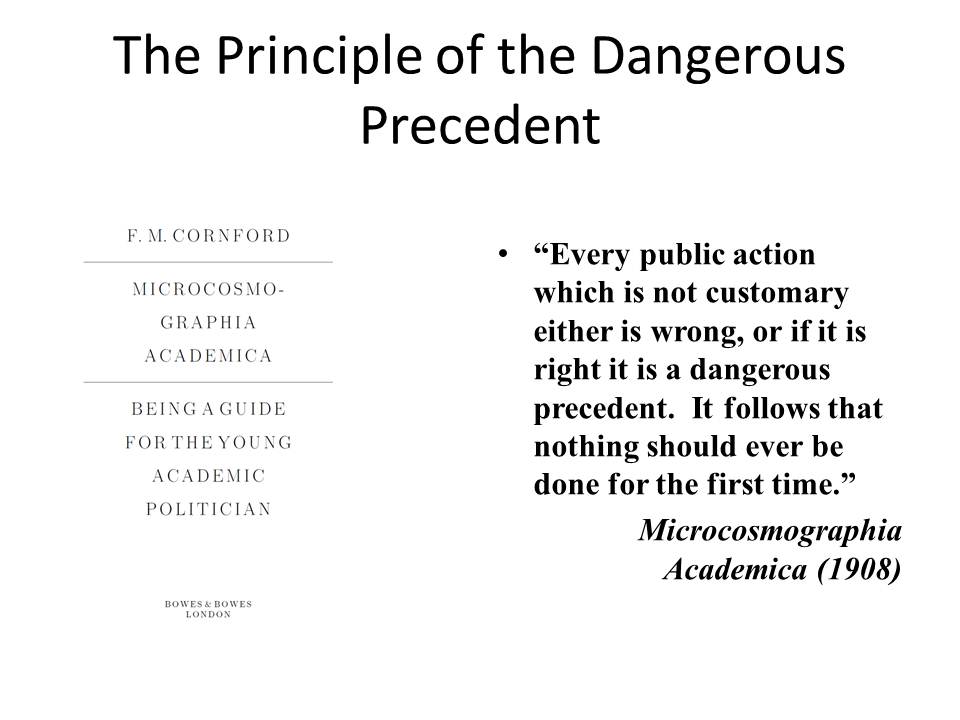
In 1908, F. M. Cornford said: “Every public action which is not customary is either wrong or if it’s right is dangerous precedent. So it follows that nothing should ever be done for the first time.” Ross Gittins wrote about this more recently. He calls it the “poor little stupid Australia argument”, that we should merely follow the lead of other countries because we’re not smart enough to dream up anything good ourselves. But if the idea is so unlikely to work why are the global tobacco giants fighting so hard to stop it? On the list are a whole lot of things that are wonderful in public health that were all done for the first time at some stage.
The next issue concerns damages. A lot of people say the High Court is going to come down like Armageddon. Three billion dollars is the figure, which we’re all going to be hit with as taxpayers. These people haven’t read the Act. The draft bill says that the Act does not apply to the extent that its operation will result in an acquisition of property from a person otherwise than on just terms. This is very purposefully put in there to say to the High Court or to anybody else, “Take us to court and if it is not on just terms, well then we will roll over.” So there’s no question about there being damages. The government, I assume, will withdraw the idea of plain packaging if the High Court says that it’s not on just terms. So the constitutional argument, however, that at least three professors of constitutional law around this country have assured me that there is no acquisition of property involved. “The mere extinguishment or deprivation of rights in relation to property does not involve acquisition,” said Justice Deane. And various precedents you can see on the screen all support that.
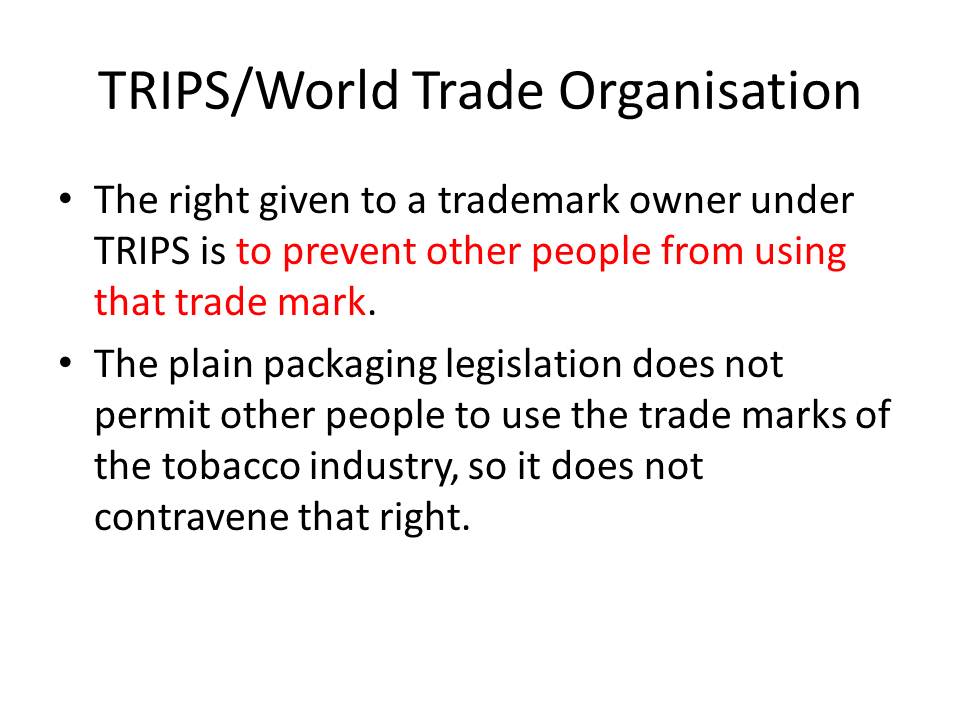
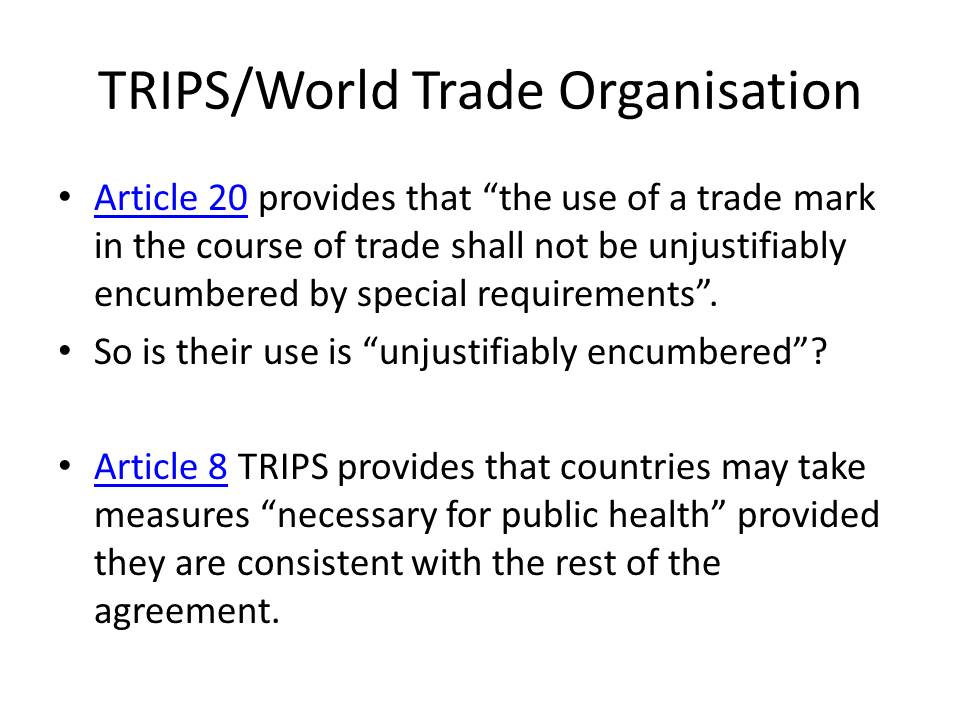
Let’s look at the argument about TRIPS and the World Trade Organisation. The World Trade Organisation makes it very clear that the right to a trademark owner under TRIPS is to prevent other people from using that trademark. If you’re in a tobacco company and I’m in a tobacco company and I decide that I’m going to take your trademark and going to put it on my product and sell it, you can get very upset about that. There’ll be all sorts of consequences. Plain packaging legislation does not permit other people to use the trademarks of the tobacco industry and so doesn’t convene that right. It’s not saying we’ll take the trademark of Benson and Hedges and allow somebody to use it. Article 20 provides in TRIPS that the use of a trademark in the course of trade shall not be unjustifiably encumbered by special requirements. So is the use of “unjustifiably encumbered” relevant in the case that we’re looking at here. We have to turn to Article 8 in TRIPS which provides that countries may take measures necessary for public health provided they are in agreement with the rest of the precedent.
Plain packaging legislation does not permit other people to use the trademarks of the tobacco industry and so doesn’t convene that right.
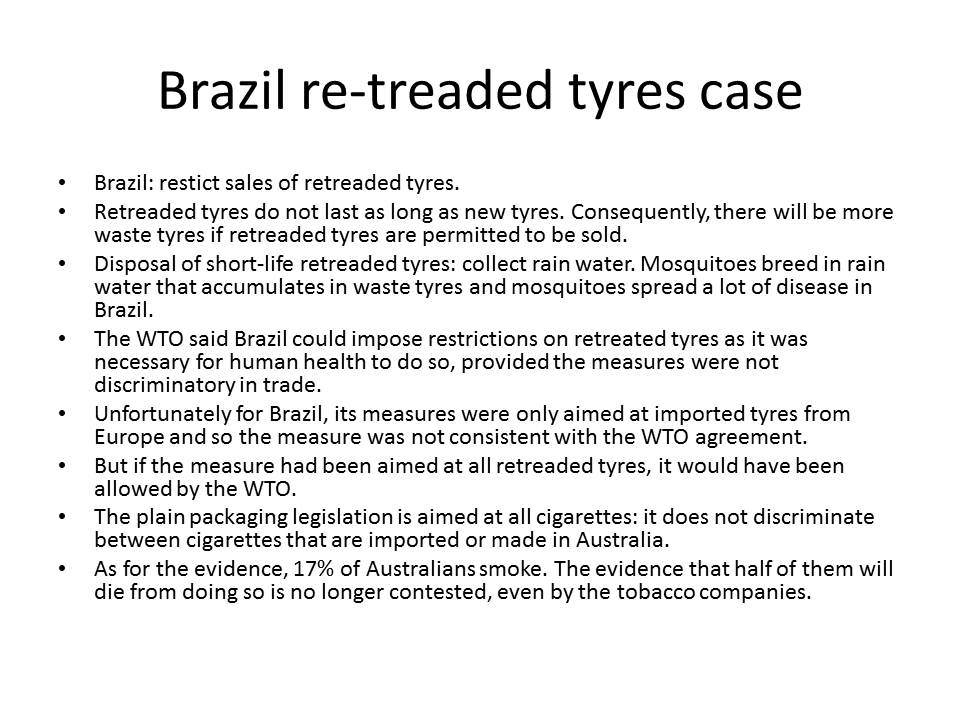
I’m going to take you to Brazil now and give you an exotic case. The Brazilian government tried to restrict the sales of re-treaded tyres. The reason being that they don’t last as long, people throw them out, they collect water in them and they breed mosquitoes which causes malaria and dengue fever. There was a big case. Unfortunately for Brazil its measures were only aimed at imported tyres from Europe. So the measure was not consistent with the WTO. But if the measure had been aimed at all re-treaded tyres it would have been allowed by WTO. In Australia, the plain packaging legislation applies to all products. It applies to imported products and domestically manufactured products. We’re very confident the WTO won’t have anything to say about this. We’re being lashed in the WTO at the moment by, of all countries, the Dominican Republic and Cuba, two big tobacco growers. I would ask you – can the liquor industry sue Islamic nations for restraint of trade through WTO? Can the asbestos industries sue governments? Can the gun lobby sue governments for all the sorts of things going on? I have no examples of this which have occurred anywhere.
We’re being lashed in the WTO at the moment by, of all countries, the Dominican Republic and Cuba, two big tobacco growers. I would ask you – can the liquor industry sue Islamic nations for restraint of trade through WTO?
We first banned tobacco advertising in the 1970s, 35 years ago. No other product kills remotely half its users. While I’m aware of some sections of the alcohol control lobby who say that they want all alcohol advertising banned, that is an extreme view. Most of the people I associate with talk about restrictions on alcohol advertising not total bans on it. I know no other product where people are talking about total bans. This is a nonsense argument.