
Speaker
Conrad Hackett
Speech Date
August 7, 2017
Issue
Issue 39
Dr Conrad Hackett is associate director of research and senior demographer at Pew Research Center. He works in international religious demography, sociology of religion, and how religion relates to characteristics including gender, fertility and education. Conrad Hachett is the author of The Future of World Religions: Population Growth Projections, 2010-2050, Religion and Education Around the World, The Global Religious Landscape, The Gender Gap in Religion Around the World, Global Christianity, The Global Catholic Population. On Monday 7 August, Conrad Hackett joined Dr Ruth Powell at The Sydney Institute to discuss the topic – “Word religions – Who’s up, Who’s Down”. Conrad Hackett’s visit to Australia was sponsored by the Australian Catholic University. The paper which follows was originally published with The Pew Research Center.
WHY MUSLIMS ARE THE WORLD’S FASTEST GROWING RELIGIOUS GROUP
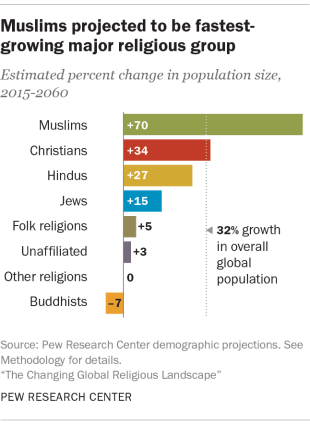
In the next half century or so, Christianity’s long reign as the world’s largest religion may come to an end, according to a just-released report that builds on Pew Research Center’s original population growth projections for religious groups. Indeed, Muslims will grow more than twice as fast as the overall world population between 2015 and 2060 and, in the second half of this century, will likely surpass Christians as the world’s largest religious group.
While the world’s population is projected to grow 32 per cent in the coming decades, the number of Muslims is expected to increase by 70 per cent – from 1.8 billion in 2015 to nearly 3 billion in 2060. In 2015, Muslims made up 24.1 per cent of the global population. Forty-five years later, they are expected to make up more than three-in-ten of the world’s people (31.1%).
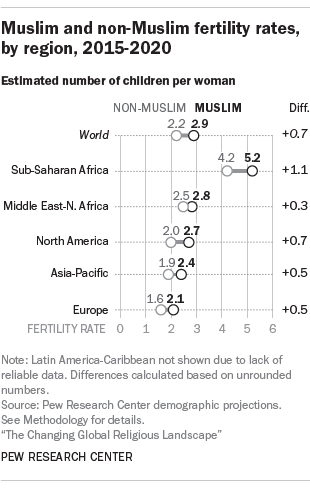
The main reasons for Islam’s growth ultimately involve simple demographics. To begin with, Muslims have more children than members of the seven other major religious groups analysed in the study.
The main reasons for Islam’s growth ultimately involve simple demographics. To begin with, Muslims have more children than members of the seven other major religious groups analysed in the study
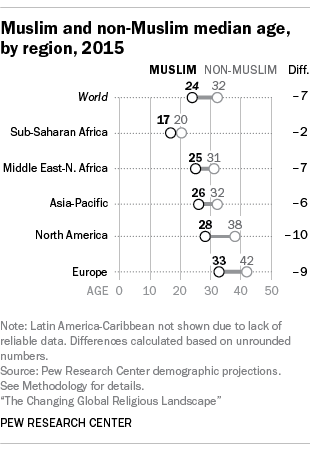
The growth of the Muslim population also is helped by the fact that Muslims have the youngest median age (24 in 2015) of all major religious groups, more than seven years younger than the median age of non-Muslims (32).
A larger share of Muslims will soon be at the point in their lives when people begin having children. This, combined with high fertility rates, will accelerate Muslim population growth.
More than a third of Muslims are concentrated in Africa and the Middle East, regions that are projected to have the biggest population increases.
More than a third of Muslims are concentrated in Africa and the Middle East, regions that are projected to have the biggest population increases.
For example, Muslims in sub-Saharan Africa, on average, are younger and have higher fertility than the overall population of the region.
Muslims in sub-Saharan Africa, on average, are younger and have higher fertility than the overall population of the region.
The same dynamics hold true in many countries where Muslims live in large numbers alongside other religious groups. For example, India’s number of Muslims is growing at a faster rate than the country’s majority Hindu population, and is projected to rise from 14.9 per cent of India’s 2015 population to 19.4 per cent (or 333 million people) in 2060. And while there were similar numbers of Muslims and Christians in Nigeria as of 2015, Muslims have higher fertility there and are expected to grow to a solid majority of Nigeria’s population (60.5%) in 2060.
Meanwhile, religious switching – which is expected to hinder the growth of Christians by an estimated 72 million between 2015 and 2060 – is not expected to have a negative net impact on Muslim population growth.