
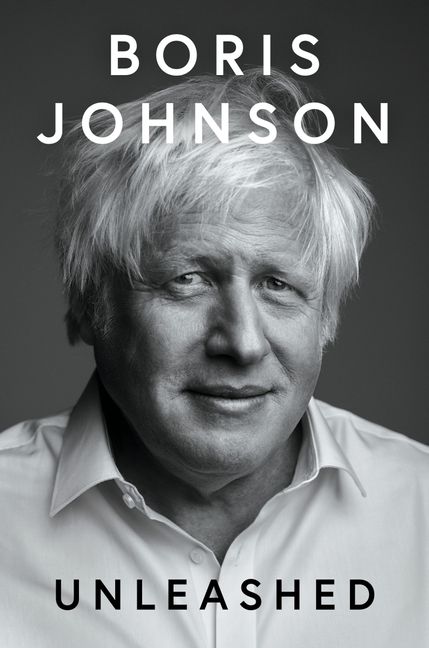
 BORIS JOHNSON – AS HE SAW IT AND AS HE LIVED IT
UNLEASHED
By Boris Johnson
William Collins 2024
ISBN 978-0-00 – 861020-9 (pb)
RRP: $39.99 (PB)
By Anne Henderson
Without having read it, his enemies will say it’s self-serving, the political memoirs of a former prime minister who failed to achieve true greatness while casting shadows on his contemporaries. For all that, Unleashed, the latest publication from UK’s Boris Johnson, is a tome worth staying with.
Johnson’s work is no Simon Hart rendition of the Conservative Party scandals behind the scenes as in Hart’s just released Ungovernable: The Political Diaries of a Chief Whip. Hart’s efforts owe no loyalty to the party that gave him political opportunities, leaving his racy stories to offer delicious tit-bits. For Boris Johnson, a former journalist, Mayor of London, minister and prime minister, there is no kickback just serious consideration of a life in government, scandals muted and a lack of animus.
Unleashed is certainly a stage-by-stage account of Boris Johnson’s climb to fame and distinguished service, relieved often by Johnson’s persuasive prose, breadth of experience and even self-deprecation. There is something of an ease to his writing and even to his various moves to bigger and bigger responsibilities. He admits to a somewhat chaotic administrative style saying: “My experience is that I go through quite a bit of chaos in any new job before the triumphs begin.” Sadly, for Johnson, as UK Prime Minister in the troubled times of the Covid lockdowns, the triumph of the post Brexit UK election that delivered the Conservatives led by Johnson a record breaking win was soon enough destroyed by that very sense of chaos as his colleagues sought his demise.
But this is no chest beating look back. Johnson reflects on his fall as UK PM in part as his own lack of perception as to what was happening:
You can take an active part in your own decline and fall without realising it is going on … The fundamental problem was that too many Tory MPs just wanted me out of their hair … I was complacent and thought I could just charm people into sticking with me.
Johnson was never the silver spoon in the mouth Tory of a David Cameron or Jacob Rees-Mogg which may explain some of his serendipitous approach to making it in politics, journalism wherever. His education at Eton was sponsored by a scholarship and his family, while in many ways well connected, lived modestly by upper class standards. Johnson recalls that for most of his childhood, living on his father’s farm on Exmoor, the family had “no TV, no central heating and no mains electricity”. At his Princess Road primary school – what he calls “the rough place by the canal with the knee scabbing playground” – he loved the dinner ladies who shovelled the food onto his plate saying: “Give this one a big helping, he always eats it.”
As Johnson tells it, there is something of a belief that life can and will spring opportunities your way. You just get on with it and they will come. At primary school, Mr Fox took him aside and gave him a small library of influential books for the holidays. A small gesture that made a difference to the rustic lad. Much later, relating his choice by the Conservative Party to run for Mayor of London he explains: “[B]y the summer of 2007, the Tory Party had run out of alternatives, and they were running out of time. Which is probably why they ended up with me … I wasn’t at all sure I should do it.”
Being Mayor of London should have prepared Johnson in some way for being a prime minister. He points out how London’s economy accounts for 23 per cent of the UK economy and is the eighth or ninth biggest economy in Europe. As he tells it, his taking control of City Hall held quite a few hints of what later would be the experience at Number 10. There were resignations of senior staff one by one which Johnson records in capitals such as POW! POW! POW! And SOCKO! And THUDDEROO! And so on. Bad news but taken in sardonic stride. Until all settled into the Johnson framework.
Told as a battle to stand up for the financial services industries, London made it through the financial crisis of 2008 and beyond to end up with a rise in unemployment of just 0.2 per cent compared to the rest of the UK with a rise of 2.5 per cent in unemployment. The much debated Crossrail – now the Elizabeth Line – was completed, along with preparations for the 2012 London Olympic site. As with all politicians, Johnson takes his reader through the achievements and there were many. Knife crime being a real challenge. The Olympics the crowning glory.
The breezy style continues even to, at some points, being confessional in approach. Moving from a position of scoffing at wind farms in his Telegraph columns, as the Green movement became more normalised, Johnson confesses to his idiocy in mocking wind power and how he eventually decided to take Pascal’s wager. If one was wrong about green energy, no loss to the nation; if you were right then it was a move to save the world. He became a zealot for electric cars. Today, as electric cars sales tumble in Western democracies, as energy prices rise in spite of alternative energy installations, and countries seek better solutions to wind and solar, Johnson’s conversion sounds more like a debate within himself to stay with the times.
There is an earnestness in Johnson about global issues. His journeys as Foreign Secretary – he visited more countries than any UK Foreign Secretary in living memory – cover geopolitics in absorbing accounts. Leaders met and discussions held. He notes the quantity of aid given with little influence. While acknowledging that Balfour’s start to the creation of the state of Israel was “a great and noble thing”, he notes that anti-Semitism remains a “virus, a spore, which has lurked beneath the floorboards”. He analyses the UK’s delusion about Russia’s Putin:
We felt that we had won all the big intellectual and strategic arguments, and that it only remained now to do business together … Then in 2014, Putin took advantage of Western lassitude to invade Ukraine. Our collective response this time was limp.
In fact, some of the best reading of the book are Johnson’s reactions, thoughts and experiences in foreign destinations from trading verses from Kipling’s “Mandalay” with Aung San Suu Kyi in Burma to driving through Mogadishu “where people were walking around with Kalashnikovs – in the same way Londoners might carry umbrellas” – to visiting Kabul and being introduced to female footballers and cricketers while the British embassy remained a fortified compound. In a few years the green shoots of female equality he had found in Kabul would have been killed once more by the revived Taliban. Johnson could find a new career as a travel writer.
More seriously, Johnson deals with the West’s hesitancy and lack of resolution in any direct confrontation with dictators seeking to undermine the allied free world. He reflects on the mess of Gaddafi’s legacy in Libya saying: “We broke it, we bought it, we own it … That is why the Libyan failure really marked the end of the [Tony] Blair doctrine of liberal humanitarian interventionism. As a doctrine, it lasted a decade or slightly more.” The failure, he believes, of this approach lay with the UK’s (and other leading Western powers’) ability to destroy regimes but not replace them, concluding: “As the Syrian civil war blew up and Assad tottered, we were willing to wound but afraid to strike.”
Johnson’s greatest claim to fame is of course his time as Conservative Prime Minister, after serving as Foreign Secretary in the Theresa May government. His challenge to May came after the vote for Brexit and the struggle within the Conservative Party to find a way to enact it. In his recollections of these times, Johnson gives amusing accounts of his inability to read May on various occasions, entertaining his readers with a description at one point of how May would twist her nostrils: “What did it mean, this nose twisting? Was it disgust? Or just reflection? What was she thinking?”
Johnson describes the gulf between May and himself as being “different kinds of people” without the same sense of humour. He captures the serious May speaking in “breathy vicar’s-daughter tones” in an incident where May asked cabinet to listen to Penny Mourdant speak on something “very important”. What ensued was a lengthy report on gender recognition with Phil Hammond and Johnson exchanging amused glances clearly regarding the matter as trivial and time wasting. On another occasion, Johnson recalls May and him lunching with President Chandos of Columbia. The president boasted of the many different frogs in Columbia, whereupon Johnson joked “That’s nothing. When I was Mayor of London we had 400,000 frogs – in fact more frogs in London than in the whole of Bordeaux.” May, Johnson tells us, simply “goggled” at her plate. The incident leads Johnson to a more serious evaluation that, “When it came to Brexit, I just could not work her out.”
Brexit would end May’s days as PM and usher in Johnson’s final success at taking the top job. How that happened is not explained in the book – no doubt, Johson does not need to add to the already large amount of published matter on the story. Likewise, the extended battles in parliament over Brexit before the 12 December 2019 UK general election and the campaign that led to its record victory for the Conservatives capturing northern electorates where Labour had dominated for decades. What follows is Johnson’s recollections of making it through the Covid lockdown years, the decisions made, his own battle with the virus, Britain’s success with the first vaccine and the tussles with Europe that followed, along with the fallout.
All of this provides a valuable record – among others. A record for the future but not one that is exciting reading. The pandemic may have hit – as Johnson puts it – “like a missile with multiple warheads” but war stories are much more entertaining. Pandemics are a bit like the pain of child birth – once over most just want to forget it. Which is perhaps why historians have not recorded in great detail accounts of the Spanish Flu epidemic in 1919. But Johnson is writing to keep the record and his long and detailed retelling of the Covid years will be valuable to scholars of the era.
Likewise, is Johnson’s retelling from inside Number 10 of the scandal nicknamed “Partygate” provoked by media splashes and headlines that staff and Johnson had partied while the rest of the nation was locked away unable to even join dying relatives. He was slow to pick up on the coming media meltdown: “I tended to dismiss the notion that it might be politically dangerous.” But by then there were enough of his enemies in the party to feed the media frenzy even if, according to Johnson, nothing more had happened than a lot of burnt-out staffers “sitting at their desks, over a warm white wine”. As he tells it:
Over the course of two years of fighting Covid, there were about 15 occasions when officials briefly slackened the tempo of their work and raised a glass to a departing colleague, or held a quiz, or marked a birthday – in the way all offices do. … At the time we believed that these events were in accordance with the rules – and I still think they were … [but] I was so confident of our fundamental innocence that never once did I think that the story would really endanger the government.
Johnson is kind to those who leaked and embellished stories to bring about his downfall. The Michael Gove betrayal in his first joust for the leadership after Cameron’s resignation is told without bile. Dominic Cummings’ leaks against him after Johnson made him a central force at Number 10 are told as if in passing. These accounts seem to register on the page as they registered to Johnson himself at the time – aware but not taking the undermining seriously. There is a sense in Unleashed that Johnson has decided to move on from the game of politics. He is focussed on the big issues. He ends his summation of Partygate and its misfortunes with, “Soon we had far, far bigger things to worry about … we were about to see the brutal invasion of a sovereign and independent country.”
Brexit, Covid, the invasion of Ukraine, the G7 meetings at Carbis Bay in Cornwall where he found Joe Biden to be acute and in touch, Afghanistan, saving the planet and much more are his emphases. At Carbis Bay, Johnson reveals details of the birth of AUKUS (the military technology partnership between the US, UK and Australia), in the attack on Ukraine he describes his secret journey to Kyiv – an eleven-hour trip from Poland under tight security (“steppe by steppe”) to meet Zelensky. And, so it goes.
Voted out of office, Johnson confesses to much that he failed to do as leader. Perhaps his big picture view meant he failed to accept that colleagues have to be kept onside. Concluding his chapter on his demise he writes:
How did it feel, then, getting assassinated? Well, I have never been shot … but I am told that sometimes you hardly feel the wound, at first. Then after a while, like all big human rejections, it hurts a lot. Then you start to think about the future, and it gets better.
Boris Johnson’s Unleashed is a big book at over 730 pages. Revealing, entertaining and surprisingly free of self-pity or revenge, it is a fine legacy.
Anne Henderson is Deputy Director of The Sydney Institute and author of Menzies at War, which was shortlisted for the 2015 Prime Minister’s Award for Australian History.