
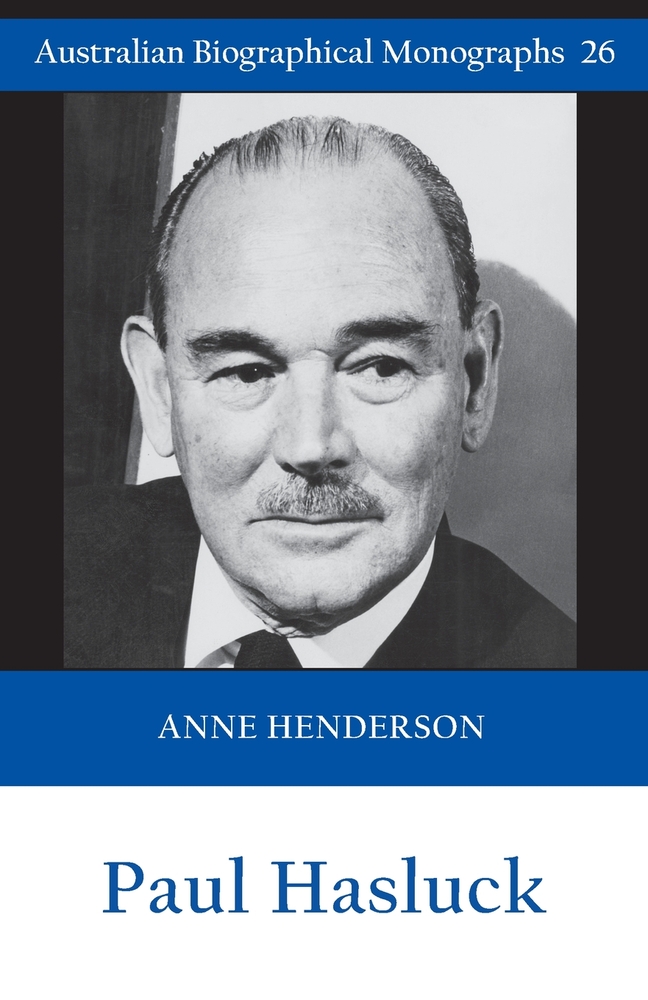
 PAUL HASLUCK by Anne Henderson
Reviewed by Geoffrey Lehmann
What emerges from Anne Henderson’s masterly 85-page biographical monograph on Paul Hasluck is how principled he was – how essentially good. Hasluck must rate a high distinction for goodness. As I read Henderson’s short book, I could not stop rating Hasluck’s contemporaries. In historical order these were John Curtin, H. V. Evatt, Robert Menzies, John Gorton, William McMahon and Gough Whitlam, with Malcolm Fraser and John Kerr as an epilogue. What was the goodness rating of all these men from a high distinction, or perhaps a bare pass, down to a fail?
In the West we have not had to think overly about our politicians’ “goodness” since World War II. The ability to read what is happening, a head for policy, some guile and effectiveness may have been more important. But we live in unsettling times, perhaps not unlike the late 1930s – our own 21st century version of that period, and in many ways just as threatening.
On 23 February 2022, a day before Putin invaded Ukraine, Nancy Pelosi suggested that Putin was “probably the richest man in the world.” In similar vein, a few weeks later Elon Musk was talking with Mathias Döpfner CEO of Axel Springer the European publishing behemoth:
Döpfner: How do you feel, being – at a net worth of USD 260 billion roughly – perceived as the richest person on earth?
Musk: I do think that Putin is significantly richer than me.
Döpfner: You really do?
Musk: Yeah.
As well as being putatively the world’s richest man, Putin is a green warrior in other people’s countries. In 2016 the Wilfried Martens Centre for European Studies reported a “stream of Russian funding” to discourage “mining shale gas in the EU [which] would disadvantage Russia . . . The Russian government has therefore invested €82 million in NGOs whose job is to persuade EU governments to stop gas exploration.” These NGOs were tactfully not identified. The Wilfried Martens Centre is the think tank associated with Ursula von der Leyen’s European People’s Party, whose electoral manifesto has included: “Making Europe the market leader in green technology . . .”
Mao Zedong, Stalin and Hitler were evil and hungry for power, but not very interested in money. Putin’s combination of autocratic power, evil intent and massive wealth accumulated with equally greedy cronies outlined in Catherine Belton’s Putin’s People is unique. His formation of a power bloc with other autocrats is an immediate threat to the democracies – and more urgent than the congeries of threats from climate change.
In several ways our situation is more dire than in the 1930s. At the start of World War II, the combined economic power of the English-speaking world and other non-Axis powers significantly exceeded the economic power of Germany and Japan. In particular, Germany and Japan had limited access to oil and Hitler stupidly attacked the Soviet Union. Xi Jinping and Putin are much cleverer. In 2024, China’s PPP-adjusted GDP was about $33.6 trillion – roughly 30 per cent larger than the US’s $25.7 trillion. If you add in the GDP of the EU, Japan and some other democracies, the equation is less favourable to the autocracies led by China and Russia. But the Europeans have demonstrated a chronic inability to use their economic power, and the democratic West is now leaderless.
Paul Meerna Caedwalla Hasluck was born in 1905 and died in 1993. His strange name “Meerna” was an Aboriginal word for joyful spring of fresh water. “Caedwalla” was a seventh century king of Wessex. Both his parents were Salvation Army stalwarts. In his childhood he lived in a Salvation Army home for boys, run by his parents, at Collie, 200 kilometres south of Perth. Henderson explains: “he mucked about with local lads, some of them Aboriginal, learned to ride and developed a love of horses.” His love of his parents and Salvationist upbringing contributed to a lifelong habit of questioning his own behaviour. But it also led to an abhorrence of what he termed “the hot-gospelling and the public practice of religion”.
This is the background to a curious incident some hours after midnight in Federal Parliament in September 1965. At 2 am a bill was being discussed which would have excluded Salvation Army officers working with the armed services from eligibility for armed services pensions. As Henderson explains, Gough Whitlam, then deputy opposition leader, “hounded government MPs for their lack of interest in speaking on the bill.” Two interjectors – one of them Hasluck – said this wasn’t true. Whitlam responded that Hasluck was “prepared to deny his parents” by supporting the legislation. Enraged, Hasluck called Whitlam “one of the filthiest objects ever to come into this chamber”. Whitlam then poured a glass of cold water over Hasluck.
Thanks to his father, Hasluck, aged 17, got a job with a morning daily The West Australian. He relished everyday reporting on different people’s lives and completed a Diploma of Journalism at the University of Western Australia. There he met Alix Drucker, who was producing the fifteenth century morality play Everyman and gave him the role of Everyman. They married in 1932. She soon discovered “Paul had a very bad temper”, which for no reason was directed at her, as she confessed in her autobiography (published more than a decade before his death, and showing the mutual trust they had for each other).
Through living in Salvation Army homes run by his parents, Hasluck had grown up knowing a number of Aboriginal people. He wrote in his memoir: “They troubled nobody and nobody troubled them” as part-nomads. But as they were increasingly forced off their lands into squalid camps their conditions worsened. In 1933 Hasluck helped Sister Kate Clutterbuck set up an Anglican orphanage for part-Aboriginal children. Sister Kate insisted that these children not be segregated and attend government schools.
In 1934 a Western Australian Royal Commission was set up to “Investigate, Report and Advise Upon Matters in Relation to the Condition and Treatment of Aboriginals”. In advance of the Royal Commission sitting, Hasluck wrote a series of articles under a pen-name “Polygon”, about the “villainous” treatment of Aboriginal people, and how their lands had been “rudely seized”, with “no systematic attempt to educate them”. Of the “roughly 18,000 natives (half-castes and full bloods) in touch with civilisation in 1932, there were permits for employment of 3,856.” Leaving aside 4,000 children, this meant there were “10,000 adults . . . whose means of existence is rations” so that they “must permanently be paupers.” Hasluck was a trenchant critic of the view that the Aboriginal race was doomed to extinction. Because of these articles, Hasluck was asked to go on tour with the Royal Commissioner, Henry Moseley on his investigations. Over those weeks Hasluck published reports in The West Australian, detailing, as Henderson recounts, how Aboriginal lives were lived “half-way . . . between cultures, where their fates were at the dictation of white authorities for minor infringements.”
Leprosy and venereal diseases were discovered to be a problem, with holding centres lacking resources. Towards the end of his tour with the Royal Commissioner, Hasluck reported that although Aboriginals were regenerating, their appalling accommodation was “rather worse than the poorer class of suburban fowl house” and the “humaneness” of their treatment was “of the type which the Royal Society for the Prevention of Cruelty to Animals lives to foster.”
At the start of the Second World War Hasluck was thinking of enlisting. He had completed his post-graduate thesis, arguing that “protective segregation” of Aboriginals had failed. It was published in 1942 as Black Australians. Hasluck held a temporary academic position at the University of Western Australia and his trajectory was headed for a life in academe, perhaps after serving in the armed forces. Then he had a chance encounter with John Curtin.
It is ironical that a Labor Prime Minister set in motion Hasluck’s accidental career as a conservative politician. Perhaps the two men were instinctively drawn to each other by a perception of shared values, despite coming from different political positions and their age gap. They had known each other when both were members of the Australian Journalists’ Association. Curtin advised Hasluck to join the Department of External Affairs. In fact, Curtin, when Leader of the Opposition, had already put Hasluck’s name forward, without his knowledge, because there was a perception that qualified graduates were needed to develop Australia’s foreign policy.
In October 1941 the Labor Party’s John Curtin became Australian Prime Minister and a former High Court justice, H. V. Evatt, (or Bert or “Doc” Evatt as he was often called), became Attorney-General and Minister for External Affairs. For most of the next six years, as Hasluck later wrote, no other officer of the department apart from John Burton, Evatt’s private secretary, “worked as closely to him or travelled as much with him as I did.”
Evatt’s two most notable political achievements were in foreign affairs and his inspirational defeat of Robert Menzies’ referendum to ban the Communist Party. In fairness to Evatt, I shall briefly outline his role in the referendum, although it has little connection with Hasluck or Henderson’s monograph, as it was a moment when Evatt shone, and his record in foreign affairs, particularly as it relates to Hasluck, is decidedly patchy.
Federal Parliament enacted the Communist Party Dissolution Act 1950 on 20 October 1950, with the Labor senators allowing the legislation to pass in the Senate, although some were concerned about the power the legislation gave to the Governor-General to declare any person a communist, thereby disentitling them from certain activities, such as joining a union or running for office.
Evatt appeared for the Waterside Workers’ Federation in a challenge to the Act, which was declared unconstitutional by a six to one majority. in the High Court. Menzies then obtained a double dissolution of parliament. His government won control of both houses of parliament and then called the 1951 Australian Communist Party ban referendum to ensure the constitutionality of legislation such as the Communist Party Dissolution Act. Opinion polls indicated that 60 to 80 per cent of voters were likely to vote Yes. Evatt had become Leader of the Opposition, following Chifley’s death. He boldly decided to oppose the referendum, barnstormed the country and the referendum in 1951 was narrowly defeated.
If it had succeeded the referendum would have inserted a new section 51A into the Constitution allowing Parliament to make laws “with respect to communists or communism as the Parliament considers to be necessary or expedient for the defence or security of the Commonwealth . . .” Who and what are “communist” and “communism”? The early Christians are sometimes referred to as communists. Justice Fullagar, one of the High Court majority justices, wittily commented: “A power to make laws with respect to lighthouses does not authorize the making of a law with respect to anything which is, in the opinion of the law-maker, a lighthouse.” Thousands of idealistic, misguided Australians would have been deprived of what are basic rights under a democracy. Section 51A would have injected into Australian political life something far more poisonous than the Whitlam dismissal, later proved to be.
Evatt’s record in foreign affairs was, as I have mentioned, patchy. Although not a permanent officer in the department, Hasluck worked closely with Evatt in his role as Minister for External Affairs, and travelling with Evatt overseas. Henderson writes that this meant that Hasluck was “the assiduous officer behind much of Evatt’s work towards setting up the United Nations”. Evatt came to rely on Hasluck as a speech writer and to undertake research on wider events. During 1942 “Hasluck became the officer working direct to Evatt, keeping pace with his demands. He was valued for his capacity for long, hard working hours, the ability to meet deadlines quickly and not be flustered by the disorder that Evatt created around him.” Hasluck also witnessed “Evatt’s behaviour . . . as a chaotic manager weakened by an overly suspicious mind.”
In 1980, long after Evatt’s death, and after his own retirement from public life, Hasluck published Diplomatic Witness: Australian Foreign Affairs, 1941–1947 recording his impressions of those years. Hasluck was dismayed by Evatt’s carelessness. His bulging coat pockets “were his filing cabinets for all sorts of material and when of necessity he emptied his pockets he left papers lying all over the place . . . In matters of my own experience when overseas my chief concern was his neglect to keep his own Prime Minister informed of what he was doing . . . He did not scruple to destroy or withhold papers which might contradict his own story.” Nevertheless, Hasluck was impressed by Evatt’s analytical ability.
Henderson repeats Hasluck’s entertaining story of Evatt’s failed attempt take Winston Churchill down a peg. Evatt had announced that “Churchill was getting away with too much” and “someone had to stand up to him”. The Australian Deputy PM Frank Forde and Evatt later attended a meeting in the War Cabinet room at 10 Downing Street in April 1945. Various ministers were called on by Churchill to speak a few words and told “That’ll do”. As the meeting was ending Forde was expressing his appreciation when Evatt started pulling Forde’s sleeve. Forde announced that Evatt had something to add. Hasluck in his Diplomatic Witness (as quoted by Henderson) described what happened next:
Evatt squared himself at the table eagerly. Churchill slowly swung in his chair. His jaw stuck out and his baby-blue eyes stared unwinkingly at Evatt. He leaned forward. “Oh, Doctor Evatt would like to say something,” he growled slowly. He leaned further forward, head out-thrust. “And what exactly does Doctor Evatt propose to say?” It was a direct challenge. Evatt wilted. He stammered uncertainly a few sentences to the effect he supported what the Deputy Prime Minister of Australia had said. Churchill heard him, still staring intensely and, after pausing a while to accentuate Evatt’s confusion, called on the Prime Minister of New Zealand to address us.
In 1946 Hasluck was sent to New York as Australia’s delegate to the UN Security Council. Henderson writes that Evatt did not allow Hasluck “the title of ambassador to the Security Council, preferring to keep that for himself.” Hasluck later wrote that Evatt told him: “I was getting too much publicity and not giving enough credit to him . . . The Security Council had really meant him to be chairman not me”.
In early 1947 Hasluck advised Evatt he wished to resign from the department. Evatt was upset. He had come to rely on Hasluck’s orderly assiduousness, perhaps realising he needed someone in his staff with a steadying temperament so different from his own. In 1948 Hasluck became a Reader in History at the University of Western Australia. In 1949 a new federal Western Australian electorate of Curtin was created where the Haslucks lived. It was regarded as potentially a Labor seat. Hasluck was invited to be the Liberal Party candidate and agreed, not expecting to be elected, but he told The Daily Telegraph in January 1949 that he believed in parliamentary democracy, and this was a way he he could serve, to try to maintain the Australian way of life, and after years abroad he was finding that on his return “class war was being actively preached”.
In the December 1949 federal election, a landslide win by a Liberal/Country Party coalition led by Robert Menzies ended eight years of government by Labor. In his maiden speech to the House of Representatives in March 1950 Hasluck paid tribute to Curtin, “as a colleague in journalism, and a friend long before he entered parliament” who had raised the Labor Party to “the highest level of respect it has ever enjoyed in this country”.
In 1951 the Menzies government won control of both houses of parliament following a double dissolution election associated with the attempt to ban the Communist Party. Hasluck was allotted a cabinet position and a new portfolio as Minister for Territories, principally the Northern Territory and Papua New Guinea. It was not a portfolio where he felt his skills could be best utilised, with the only positive being that he would be able to help Australian Aboriginals. But he was to hold the portfolio for 12 years.
Papua New Guinea, when he became Minister, was under-resourced and primitive, ruled by a generally not very competent local public service with a colonialist mindset. Hasluck set out to change this, as Henderson writes, “like a man driven”. He set about making administration more local, creating a Legislative Council for PNG in 1951 and appointing a new administrator. He took steps to widen educational opportunities and set up village councils. He opposed new land grants for offshore owners. He was seen as hostile to “private enterprise” by some, and much of his support among Australian parliamentarians came from Labor politicians – Kim Beazley (senior) and Arthur Calwell.
While there has been some controversy regarding Hasluck and Papua New Guinea, his policies regarding the Northern Territories’ Aboriginals have been strongly criticised as “assimilationist”. When a nomadic hunter-gatherer culture with its complex traditions collides with the brute power of an advanced technological culture, there is no clear way forward. Bad things will happen despite good intentions. Arguably the effective alternative in 1951 to assimilation and equality with other Australians was segregation and neglect, something Hasluck had long opposed.
He found himself caught in the crossfire, when his government excised from the Arnhem Land Aboriginal reserve (of 31,200 square miles) a large area – 57 square miles in a Prime Minister’s press release of February 17, 1963 – for bauxite mining, without the consent of the Yolngu people. Hasluck initially rejected a protest. But when Beazley presented a second petition, the famous “1963 Yirrkala Bark Petitions”, Hasluck immediately backed down. Beazley later wrote: “To my astonishment Hasluck . . . rose immediately and said ‘The Government readily accepts the proposal’.” Beazley commented that in his 32 years of parliamentary experience, he had never encountered anything like this, generously describing Hasluck as “that rare politician who can genuinely be called a statesman.” The Gove bauxite mine still went ahead, but “with guarantees that sacred sites and hunting areas would not be violated and with considerable royalties paid to Aboriginal people. But a principle had been established.”
After the Menzies government was re-elected in 1963, Hasluck moved from territories to the defence portfolio; then in April 1964 he became Minister of External Affairs where his contribution was less distinctive. He supported the Government’s policy of sending Australian troops to the Vietnam War. But in an hour-long address to students at Monash University in 1965 he did not handle interjections well and was “turgid” (in the view of Gerard Henderson who attended as a student). He fared badly against more charismatic speakers such as Dr Jim Cairns, and was less effective than Malcolm Fraser who spoke at a Monash “teach-in”, as they were called, a couple of years later.
In December 1967 Australia’s Prime Minister Harold Holt disappeared swimming off Cheviot Beach, Portsea. Hasluck was convinced by his supporters to become one of the contenders to replace Holt. Anne Henderson quotes from a letter, which Menzies, now fully retired, wrote to his daughter: “Paul Hasluck is, in my opinion, possessed of the best brain of the whole lot; but he is now the victim of subtle propaganda designed to attach to the Gorton banner whatever sympathisers there are in New South Wales with Willy McMahon . . .” Hasluck made no attempt to lobby colleagues and lost the vote to John Gorton.
Perhaps to remove a potential rival, Gorton offered the job of Governor-General to Hasluck, to replace Sir Richard Casey in 1969 when Casey’s term expired. Not long after his appointment Hasluck held a dinner at Admiralty House in Sydney for Australian writers, including Patrick White, Kenneth Slessor and Douglas Stewart. Many of those there knew each other personally. But I suspect few of us knew Hasluck, a life-long poet, who, as a politician, had been isolated from other writers and reluctant to publish his poetry until then. I was grateful to meet Hasluck’s son Nick and his wife Sally, now friends for more than 50 years.
In 1974 Hasluck retired from his role as Governor-General, one year early, for medical reasons relating to his wife. The Labor Prime Minister, Gough Whitlam, who had once emptied a glass of cold water over him, had indicated he wished Hasluck to stay on in the role, beyond his five-year term for another two years until 1977. There was a relationship of trust and familiarity between the two men which meant the constitutional crisis of 1975, resulting in the dismissal of the Whitlam government may have developed quite differently.
Hasluck’s “goodness”, his unflappable morality, is was what would have made him a much safer pair of hands, if he had been Governor-General in 1975. In a similar way Winston Churchill’s moral principles in his “wilderness years” in the 1930s made him a critic of the British establishment’s appeasement of Hitler. Moral principles sometimes handicap politicians. In the late 1960s, Gerard Henderson found Malcolm Fraser a more effective speaker at Monash University than Hasluck, although in later years Fraser later showed he was vapid. Whitlam was essentially a moralist, which is perhaps why he trusted Hasluck, but it did not stop him making policy errors.
But sometimes lack of moral principle is so egregious that it is harmful for a politician – particularly in a democracy. In the 1950s in the United States Joseph McCarthy’s deceit and lying culminated in his downfall and a famous rebuke: “Have you no sense of decency, sir, at long last? Have you left no sense of decency?” In her biography, Anne Henderson quotes an interview between Gerard Henderson and Hasluck in which Hasluck affirms three times that William McMahon was a treacherous liar – that “he got there, by treachery and lying”. This was also the view of McMahon’s political colleagues and the press. Although McMahon had sound economic policies – he significantly reduced the budget deficit while Treasurer – his years as prime minister were a shambles.
The only criticism I can make of Anne Henderson’s biographical monograph is that she makes no mention of Hasluck objecting to the House of Representatives adjourning to listen to the Melbourne Cup. She has done us a great service, and her book appears at a time when the world’s three most powerful political leaders have no moral compass at all.