
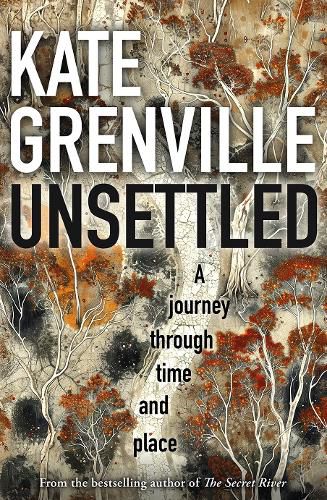
UNSETTLED – A JOURNEY THROUGH TIME AND PLACE
By Kate Grenville
Black Inc 2025
ISBN: 9781760645649
RRP: $36.99 (PB)
Reviewed by Anne Henderson
As Chaucer in his Prologue to The Canterbury Tales wrote, the coming of spring “longen folk to goon on pilgrimages”. The ancient notion of pilgrimage was a journey to a holy place, a spiritual journey to an earthly encounter with a place made holy by heroic goodness or saintly endeavour. The folk of the Tales were off to Canterbury Cathedral and the shrine of Saint Thomas Becket.
It is in this context, Australian writer Kate Grenville – in her new book Unsettled – sets out on what she calls her private pilgrimage to come as close as she can to a searing past in her family. It is a traveller’s journey into the hinterland of Sydney, trekking in a small car, taking back roads north to Tamworth, Gunnedah and, eventually, Guyra. As a descendent, on her mother’s side, of convict settlers who took up (in Grenville language “stole”) land which, for the Indigenous dispossessed, was their spiritual centre and identity, Grenville has long pondered the guilt of that legacy:
Whatever my particular, individual forebear did or didn’t do, he was part of the relentless flood of foreigners who eventually pushed into every corner of the continent. … For me this is a haunted landscape, haunted by a past that’s all the darker for the things that were never recorded.
To use the Canterbury Tales analogy, for Kate Grenville it is as if the colonialists of her forebears’ time were as guilty as the knights sent by King Henry II, who murdered Becket in Canterbury Cathedral.
Grenville’s pilgrimage will set foot on a host of spiritual places where the ghosts of Indigenous Australians lead her to question stories handed down by her family, alongside stories ignored by Indigenous witnesses but few of them recorded. Kate feels their plight all the more so for this lack of written testament. It will provoke in her assumptions about Indigenous life and a lament at the loss of recorded information of their place in colonial history. For all that, while showing on a number of occasions that the oral history in her own family had proved unreliable, and often untrue, there is no suggestion in her searching that traditional and oral accounts handed down by Indigenous generations might also be unreliable. The overall result of dispossession is enough.
Unsettled – as with all of Grenville’s writing – is a captivating read. Beautifully rendered prose melds personal grief and curiosity with the smells, sounds and colours of rugged and isolated nature still to be found off the beaten track in eastern New South Wales. For the early part of her journey, Grenville succeeds in coming as close as still is possible with the unspoiled nature Indigenous Australians once experienced. But, as the journey continues, development takes over and fenced off settlement dominates her story. As does Grenville’s more strident thoughts on “white” Australia’s handling of that colonial legacy.
In the last four decades or so, Australians have revised much of their historical perspectives on the culture clash that took place in colonial Australia. Guilt has been part of the journey as well as recognition. But, as Grenville herself admits, “We can’t undo what was done – not to the landscape, and not to the people who lived on it. And there doesn’t seem much value in perching on the high moral ground wringing my hands.” Thus, there is an ongoing journey for those Australians who now recognise the harm done and the impossibility of going back.
As Grenville suggests, her pilgrimage was made more urgent with her regret at the loss of the referendum on the Voice in 2023. Whether a Voice to parliament for Indigenous Australians would have brought closure for Grenville is an open question. But, as the argument against separate identity worked to defeat the referendum, it calls into question how Grenville’s guilt can be resolved. For Grenville, the lack of a treaty with Indigenous Australians began the erasure of Indigenous occupation. Yet, in Australia, attempts at a national treaty have failed owing to a majority of citizens rejecting separate entities as the Australian identity.
Unsettled is not a polemic; it seeps into the reader instead with its emotional and pictorial tensions. It’s a “take me with you” experience where it tugs at conscience and empathy. At each twist and turn, the unsophisticated outcasts – whether convicts on the make or desperate colonists toiling to make a fortune and those who did suffering setbacks aplenty – are matched with the virginal native. For all that, the notion that white “explorers” were not the first to discover this territory must be balanced against the notion that “discovery” is about knowledge that is first “recorded”. While Indigenous Australians knew their territory intimately, they had not mapped it or documented it in a way that could be communicated to the outside world. So, white explorers did indeed “discover” land and coastline for the British and mapped it and documented it.
The Indigenous were outnumbered over time and lost their traditional lands, but they were a mechanically and scientifically underdeveloped people, in spite of their unique cleverness at survival over millennia on a harsh continent. Their tribal arrangements and native knowledge were no match for colonists with horses and guns, and aspirations to make fortunes or even simply survive where they found themselves. For all that, dispossession did not happen as part of any official British command but rather as the inevitable result of unsupervised contact between such tribal individuals and British people from the most scientifically developed society of the day. Without realising it, this is demonstrated in the justice meted out after the Myall Creek massacres which Grenville comes to consider late in her pilgrimage.
The vastness of the land and the lack of communication for the authorities meant the frontier was mostly unguarded. This has been exhaustively documented in regard to eastern Australia in Wal Walker’s The Squatters’ Grab. A law of survival ruled. As Grenville tracks the back roads in modern times, this harshness and remoteness is still apparent. For Grenville, however, the remoteness can be threatening, and she reflects how this was never so for the Indigenous who passed on information – a sort of Indigenous bush telegraph – along the miles, watching the colonialists moving in on their lands.
The pilgrimage Grenville makes is challenging. True, she confronts the guilt handed on by her forebears but, at the same time, as she travels to hamlets and towns where her ancestors once had property, she becomes aware that she is also connected in deeply personal ways to the land.
At the pub at Currabubala, a business begun by her great, great grandparent John Martin Davis who married her ancestor convict Solomon Wiseman’s daughter Sarah, this becomes an emotional conflict. Encountering the current owner’s indifference to her enquiries re Davis, Grenville leaves the pub and squeezes through a wire fence to get to the creek below at the back of the establishment. She thus becomes something of an invader of what she sees as her heritage, writing: “Why … this cranky readiness to fire up at anyone who questions my right to be here? All I am doing is standing in this other country of tinkling water and rustling she-oaks, thinking how the mystery of the past is embedded in a place.”
At the creek, Grenville finds tiny pieces of broken plate which connect her immediately to Sarah Martin Davis and her own mother who had lived for a time at Currabubula with an aunt. Grenville now recognises the complexity in her pilgrimage – connections to the past in this ancient continent go beyond connections to the land by the Indigenous. The settlers’ descendants now have these connections too.
While Grenville admits early on that there is no going back, as her journey continues her writing harks at a desire to do just that. She describes the Indigenous way of using their open land as traps for hunting and in regenerating grasslands with fire as much like the husbandry of Europeans but without fences. A Bruce Pascoe take on history, for sure. And, as her terrain increasingly enters more prosperous farming areas, fences become symbols of theft and gates much the same. Use of Aboriginal names for places she sees as but a “gesture”, an “indulgence in what a witty politician of my youth called the politics of the warm inner glow”. When, as a child with other children, Grenville played at being Aboriginal and killed, skinned, cooked and ate a snake, 60 years later she realises “at an unconscious level, we were making ourselves the inheritors. It was yours, now it is ours”.
Strangely, it is Grenville’s uncle – her mother’s brother Fred Russell – who brings her to face her family’s past in new ways at Guyra, 140 kilometres north of Tamworth, a town near her uncle’s plot of land won in a ballot in 1938. It is here she joins a commemoration of Anzac Day. Frank, a working lad, had long desired a farm of his own and this was his dream come true, a dream of a farm he would name “Green Hills” and establish with his father. Frank, however, joined up at the start of World War II, his father saying he would look after the farm till Frank came back. He never did – killed in Thailand with other prisoners of war working on the Burma Railway under the lash of the Imperial Japanese Army.
Here it is that a rush of emotions come together for Grenville. She is glad Frank won the land but wonders if he ever thought of it as taken from the Indigenous inhabitants in colonial times – “the fact is that Uncle Frank was just one more in the string of balanda who’d taken that land”. At the Anzac Day ceremony, Grenville discovers none of the locals can recall Frank Russell. It is as if he never was there. This parallel with long lost Indigenous figures in the area is forceful – “My mother would have been heart broken that Frank left no mark on the world … There’d been no sense of closure, just a reminder of loss.”
Kate Grenville’s Unsettled has a powerful effect. It registers a soul searching for a way to put to right a serious loss in the national character. Whether there can be closure is, however, not certain by the end of Grenville’s pilgrimage. Unlike those ancient pilgrimages, where good and bad were clearly defined, Grenville’s pilgrimage is open ended. The passing of time and circumstance, as in all historical movements of people, tends to erase memory and individual effort, leaving a blend of winner and loser in new realities. Perhaps, what Grenville needs to feel is less guilt and more a sense of how the two traditions can now become one.
Anne Henderson is Deputy Director of The Sydney Institute and author of Menzies at War, which was shortlisted for the 2015 Prime Minister’s Award for Australian History.