
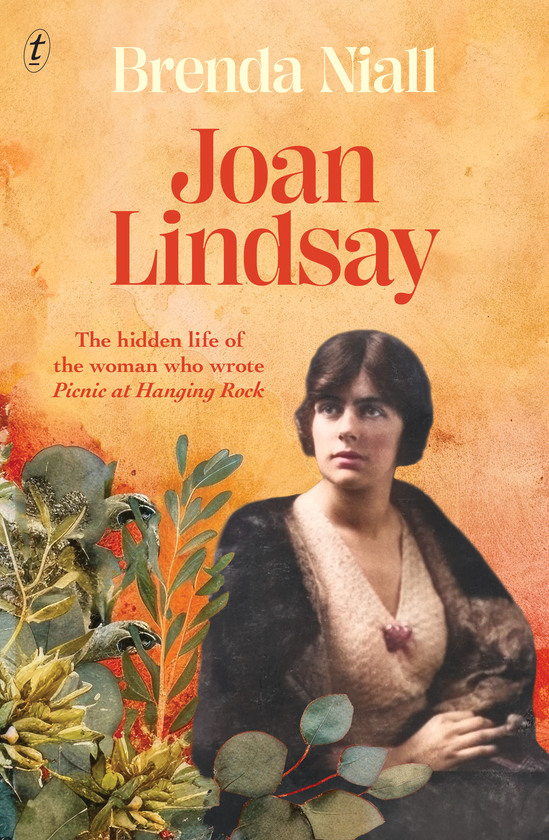
 JOAN LINDSAY – THE HIDDEN LIFE OF THE WOMAN WHO WROTE PICNIC AT HANGING ROCK
By Brenda Niall
Text Publishing Melbourne Australia 2025
ISBN: 9781923058019
RRP: $36.99 (PB)
Reviewed by Anne Henderson
In these days of personal intrusion – on social media and much more – on the lives of the famous or those who become noted in public, the idea of the writer/creator of the iconic Australian Picnic at Hanging Rock having a secret life is unimaginable. To go public or be sent public by one’s achievements, in our time, is to be exposed unremittingly. But Joan Lindsay, author of Picnic at Hanging Rock came from a very different era. And it is one that Brenda Niall, author of Joan Lindsay: The Hidden Life of the Woman Who Wrote Picnic at Hanging Rock has intricately sketched in seeking to discover what produced, in later life, a woman who could not only capture the world of her past but also imaginatively engage generations decades later and continue to mystify her readers.
Born in November 1896 into Melbourne’s late nineteenth century upper middle class family of barrister Theyre Weigall, Niall records that Joan Weigall’s childhood was one of “solid privilege and neglect”. A third daughter in a family still waiting for that son and heir, her mother whose Anglo-Irish start in life was the vice-regal pomp of Dublin Castle, as the daughter of Sir Robert Hamilton, was disappointed with Joan’s arrival. An only son would further swamp Joan’s significance in the family when he arrived in 1901. In the small and narrow confines of Melbourne’s Protestant gentry, the Weigall family had connections to Theyre’s great uncle, Chief Justice Sir William à Beckett, and the Boyd family of artists. Writer Martin Boyd was Joan’s cousin.
Niall draws a picture of the quiet, dutiful daughter Joan making the best of her experiences and in time catching up scholastically at Clyde School after a mediocre start with home schooling then known as having a governess. Her interest in words and art began to show in her teenage years. In time she would be “dux” of her school, a prefect and editor of the school magazine. An all-round model student.
Niall’s study of Joan (Weigall) Lindsay’s life is as much a study of a woman’s trajectory in early twentieth century Australia as it is about a hidden life of an artistic creator. For Joan Weigall emerged from her privileged schooling at Clyde Girls Grammar into a world where marriage was still the key to a successful adult life for a woman. Taking up a study or career for Joan was something she pondered over as the next step in social and professional development. It was not something that would define her in the same way it would a young man. Still, as a well educated woman, Joan was expected to use her talents in some professional way. Her best friend at Clyde, Marion Wanliss would go on to a distinguished career in medicine.
In the expectation of making her mark, Joan Weigall took up classes at the National Gallery in central Melbourne. Here she not only developed her painting skills but also mixed with the McCubbins of Macedon and the many artists who had formed a sort of colony on the outskirts of Melbourne at Warrandyte. Niall links Joan’s fascination with two McCubbin paintings – The Lost Child and Lost – as possible inspiration for the mystery and themes in Picnic at Hanging Rock. Her connections with the art world also brought her into contact with Daryl Lindsay whom she would marry in 1922 after Lindsay’s service in World War I had interrupted his aim to study at the Slade school.
Marriage to Daryl Lindsay would change Joan Weigall. In Melbourne, with Maie Ryan (later Maie Casey) she had occupied a small studio and seriously exhibited her paintings. Linked by marriage to the Lindsays, Joan was partnered with an energetic youngest son from a family of ten, four of whom – Percy, Lionel, Norman and Ruby, who married cartoonist Will Dyson – were to become successful professional artists and illustrators. Daryl would not match his four siblings’ artistic success but he was ambitious. He would in time become Director of the National Gallery of Victoria after a close association with Sir Keith Murdoch and time as “keeper of the prints” at the NGV.
Niall draws a picture of a young man in a hurry to network and build on contacts. In the world they knew, this inevitably led to Joan taking a back seat as wife and hostess at their home Mulberry Hill on the outskirts of south-east Melbourne at Langwarrin South. If there is a hidden life to explore, Niall makes it clear that while it was Joan’s decision to put her energies and talents into supporting her husband, it was also in keeping with what most women of her generation were expected to accept.
Thus it is that much of the book is an account of Daryl Lindsay’s career moves rather than any dramatic action on the part of Joan. As Niall sees it, Daryl Lindsay was very much absorbed in his career and not a little inclined to regard Joan’s achievements in the art world as of no moment – as his published memoir would in time attest. In fact, in her early exhibitions, Joan had drawn more significant praise than her husband.
Niall also scripts what many marriages of talented women to talented men became in those years. That is, the talented wife putting aside her own ambitions in order to support her husband. A lengthy trip to London in 1933 saw Daryl in his element seeking out old friends and new contacts, developing his connections to the Felton Bequest to the NGV and socialising a lot without Joan who was left to bide her time. They went to the theatre together but always sat apart. Joan’s attempts at writing plays failed. Her travel novel Through Darkest Pondelayo was published soon after she returned to Melbourne but it had a very short shelf life.
As Daryl’s career at the National Gallery proceeded, the Lindsays divided their time between Mulberry Hill and East Melbourne. The action of the book here is very much centred on Daryl Lindsay’s advancement. Joan learnt to tolerate her husband’s (artistic) fascination with ballerinas and also the professional connection he developed with Ursula Hoff. Daryl Lindsay had in fact “discovered” the German Jewish Hoff through Joan’s sister Mim. He appointed her to the NGV and, as Niall reports, was “entranced” with her. He had no worries that her qualifications were higher than his own; he seemed to regard her as another outstanding acquisition for the Gallery.
Meanwhile Joan involved herself with volunteer and unpaid work at the NGV. From menial tasks to writing entries for descriptions of art works. Niall demonstrates that while her contribution was unregarded, it was important. She played “mother” to needy students and brought the Gallery catalogue up-to-date. Meanwhile at the NGV, Daryl Lindsay stirred some with his energetic control. He was regarded by the Reeds of Heide as a “retrograde influence” and seen as uninterested in developing younger Australian painters.
Niall sees through Joan’s happy domestic goddess version of her life at this point concluding:
Joan had given up what might have been a promising painting career, but she hadn’t found her voice as a writer. Her marriage was held together by the rules of the time that made divorce almost unthinkable. Joan’s only recourse was silence or denial.
But glimpses of another Joan break through Niall’s account. Joan was happiest in the country and could spend long moments watching her hens. She wanted to live with the natural rhythms of the day and had no interest in clocks. In time, she would come to understand that Daryl’s attempt to sell Mulberry Hill in 1938 to ease their money worries showed “how little control she had over her life”. Had a buyer been found, she would have lost what she most held dear – her local contacts, her garden, her time for cooking and floral arrangements. These chinks of personality and reality are precursors for Picnic at Hanging Rock. But, the first step would be her memoir, published in November 1962, and titled Time Without Clocks.
The memoir was warmly received and did well. Joan was 66. Niall, however, judges the book to be “a rosy glow” saved only by Joan’s ability to be “affectionate without being sugary” while her “wit and her painter’s eye for place give life to her Mulberry Hill chronicles”. Encouraged by the success of her memoir, Joan produced Facts Soft and Hard about travelling with her husband in the US. It failed and was harshly criticised. The lesson that could be taken from this was that Joan needed to stay close to her own experience in Australia rather than venture abroad where her facts needed work. And so, whatever the immediate motivation a couple of years brooding may have brought, Joan Lindsay went on to produce Picnic at Hanging Rock in a matter of weeks which would be published in 1967 when Joan was 71.
As Niall writes: “Picnic at Hanging Rock was a phenomenon. More than half a century on, it still defies definition, provokes argument and sells copies.” In an understated way, Niall’s biography reveals an ironic destiny for Lindsay – her husband had overshadowed her in his roles as an Arts leader, even to the point of barely mentioning her in his memoir. In time, however, Picnic at Hanging Rock would become a literary icon and take Joan Lindsay’s name into history while Daryl Lindsay’s would fade from note.
Joan Lindsay’s talents had been in hibernation. A seed had generated in her as she stumbled here and there to hit the right target for her inspiration. But the subject matter of Picnic at Hanging Rock while completely imaginary can be traced to features of Joan Lindsay’s own life. Niall does a succinct job of delving into the novel’s setting, characters and drama.
The era is one that Lindsay/Weigall grew into with its overriding British ambiance set in the wilds of an ancient land. A land of mystery; a land that had needed no clocks to evolve. A natural bush setting she knew from her days at Macedon and Warrandyte. The heat of summer and the heavy clothing women needed to wear. The boarding school setting in times when girls were innocent/naive yet carried all the base human instincts of envy and bullying. The clash between the confinement of school and social rules and the freedom of the outdoors on a hot summer’s day. The urge to throw off the constraints of overdressing in a wilderness. The mystery of the great rock formation with its hidden surfaces and harsh terrain.
The plot is riveting. On a picnic outing to Hanging Rock near the slopes of Mount Macedon, a small group of schoolgirls and a teacher disappear after climbing the massive rock formation with its boulders and craggy gaps; the search continues; one girl who returns will die; the ending would be changed while the mystery only deepened. It is a classic seduction. Joan Lindsay’s ability to make the story read like a true event forgotten over time had readers searching old newspapers. In time, the movie would make Joan Lindsay a household name.
Brenda Niall’s Joan Lindsay: The Hidden Life of the Woman Who Wrote Picnic at Hanging Rock fills many gaps as to how and where the famous novel originated. Even so, no hidden life can match the novel itself.
Anne Henderson is Deputy Director of The Sydney Institute and author of Menzies at War, which was shortlisted for the 2015 Prime Minister’s Award for Australian History.