
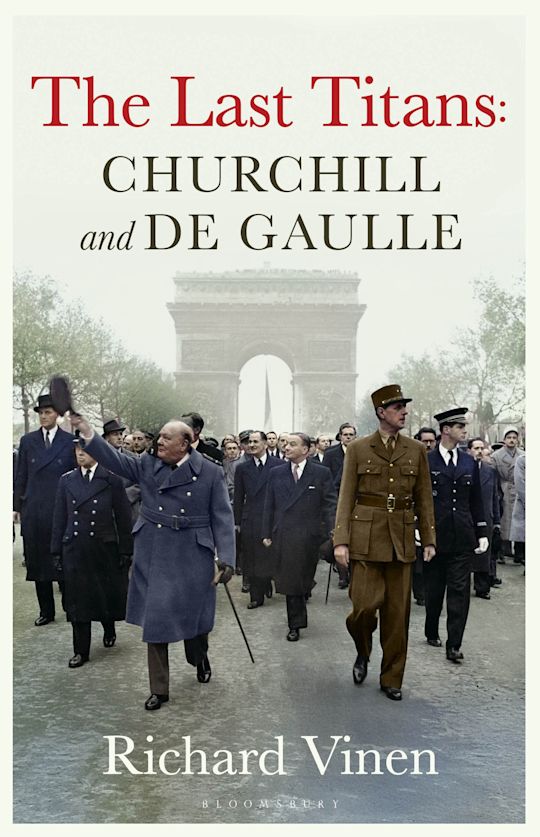
 TIED TOGETHER IN WAR THEY FACED EACH OTHER
THE LAST TITANS: CHURCHILL AND DE GAULLE by Richard Vinen
Bloomsbury Publishing 2025
ISBN: 9781526668936
RRP: $44.99 (HB)
Reviewed by Anne Henderson
One was short and rotund with an infectious personality, the other was tall and statuesque with little public show of emotion. They were the two Europeans – one British, one French – who stood tall as the Allied armies defeated Hitler, each a national hero. They were Winston Churchill and Charles de Gaulle, emblems of their respective nations. One faded politically after the war; the other was welcomed back home, resisted for a time and resurrected in the late 1950s to create a post war legacy for his country’s parliamentary system.
In Richard Vinen’s The Last Titans: Churchill and De Gaulle, the contrasts to be found in these two national icons are woven together to give new perspectives on their achievements, their strengths and weaknesses and their haunting legacies. This not only opens a new look at European history but also tellingly reveals time worn differences in English and French identities. In this engrossing retelling of an old story, Vinen captures much more than the personalities of two heroes; he sketches in absorbing detail two nations, so often at war in history, leaning on each other to survive and later to forge a modern future.
Both Churchill (born 1874) and De Gaulle (born 1890) were the products of happy childhoods and a military education. Little else in their development matched until they stood together in a mixture of ways against the Nazi occupation of Europe in World War II. Churchill’s aristocratic background left him with a dare devil attitude to military adventure both in the Boer War and for a brief time in World War I. However, his dominant preoccupation would be politics. De Gaulle, on the other hand, made no claims for any distinction of family background and espoused his military career as a mission to evoke the uniqueness of France and defeat the Germans. He was distinguished by his heroic contribution to the French army in World War I but, taken prisoner, he spent nearly three years as a prisoner-of-war with the Germans. His return to the French army after the armistice saw him devote his efforts to French military might. As Vinen puts it:
The first thirty years of De Gaulle’s adult life were spent thinking about a single great problem – how France was to be defended against Germany. Churchill’s life was not animated by any single problem. He did not fear Germany – though he did eventually come to fear Nazism.
De Gaulle’s nationalistic feelings for France permeated his response to major events of his era. The Dreyfus affair had torn France apart over more than a decade from 1894, unleashing bitter anti-Semitism as the French Jewish army officer Alfred Dreyfus was wrongly convicted and imprisoned for being a German spy until his exoneration in 1906. De Gaulle, however, while knowing Dreyfus to be innocent, was only interested in the harm the case had done to the French army not that done to the man himself.
Likewise, De Gaulle’s refusal to be deferential to his English hosts as he sat out (in England) the fall of France to the Nazis after 1940 owed much to his view of France as morally superior. Vinen points out that while De Gaulle made himself the leader of the Free French in London, through his connection with France’s African colonies, in fact 6,000 Gaullist forces in Britain from July 1940 were less significant to the war effort than the Poles or the Czechs for supplying fighter pilots. He quotes Winston Churchill as saying of De Gaulle, “He thinks he’s Joan of Arc but I can’t get my bloody bishops to burn him.”
Vinen sketches De Gaulle’s genius at gathering the remnants of French resistance together though his broadcasts. While Churchill and Britain struggled against Hitler until the attack on Pearl Harbor in December 1941 to get assistance from the United States, De Gaulle became a sort of rearguard action obsessively chipping away at his own French interests. Where Churchill was a man of much travel beyond Britain – albeit not further than India to the east – De Gaulle travelled little beyond France except to the French African colonies. As the D-Day landings approached, Churchill advised De Gaulle of what was to happen. The result was a huge argument as De Gaulle refused to broadcast to the Free French in support of the action. It was as if the Allies had usurped De Gaulle’s right to make decisions re France and that the Allies were an enemy invasion themselves. Of the fallout over the landings between Churchill and De Gaulle, Vinen writes, “the encounter between the two men over D-Day was to cast a shadow over Anglo-French relations for decades”.
Once France was liberated, with the action of the Americans, British and Canadians led by Churchill and Roosevelt, De Gaulle made his first visit to Washington where he sought a guarantee that the French army would be allowed to march into Paris ahead of any Allied show of strength. It would be De Gaulle’s rationalisation, in a speech he made after entering Paris on 25 August 1944, that Paris had been “liberated by itself”. Writes Viden:
It was only partially true that Paris had “liberated itself”. There had been an insurrection, but this alone would hardly have been enough to drive out heavily armed German troops if the American army had not been close. French soldiers, under General Leclerc, entered the city first but they did so because the British and Americans recognised the symbolic value of this rather than because the French had fought their way to Paris.
Ironically, both Churchill’s legacy and De Gaulle’s owe much to the fame they achieved in World War II. But Churchill ended the war with most of his political energy spent while De Gaulle was only beginning. Churchill would contribute far more in the post war years from his writings – six volumes on the history of World War II and four volumes on The History of The English Speaking Peoples and more besides. De Gaulle, was to begin his political career. In this, despite setbacks, he adjusted more easily to politics post war than Churchill.
For De Gaulle, achieving his political summit would take some years. After the initial elections in October 1945, he was proclaimed leader of a French coalition. But as Vinen writes: “De Gaulle did not want to ‘descend from his unique pedestal’. He wanted the political system to adjust to him rather than vice versa.” The situation could not endure and De Gaulle resigned after only two months. The following years for the French government’s Fourth Republic proved divisive and pressured by the Algerian independence movement. De Gaulle found himself reinstated as French leader in 1958 – within three years De Gaulle had established his authority. Vinen writes:
During the first three years of his presidency, De Gaulle conveyed an impression of resolution and certainty but, in reality, his own associates were often unsure about his policies …By 1962, the ambiguity was dissipated. Algeria was gone and the army was humbled. Ministers who disagreed with De Gaulle or simply showed themselves independent were eased out of office … The authority of the state had been restored and De Gaulle himself was in command of that state.
Thus, De Gaulle became a nation builder while Churchill stood tall as the hero who saved a nation from invasion by the Nazis. Churchill did far more to rescue De Gaulle’s native France than any gesture offered by the struggling Free French. It was Churchill’s aristocratic confidence that flowed through to offer strength and persistence to the British when they stood alone in the eight months of the blitz from 1940 to 1941. It was Churchill’s adaptability learned from years in politics that helped him cope with the stiff French leader in exile as the Allies battled with the realities of co-operation and war. Ironically, though, it would be the unflinching French nationalist with his single-minded love of the French republic that prevailed in a post war peace.
Vinen’s portrait of these two titans does much to unlock understanding of the long standing English/French relationship as much as it presents two of the most significant personalities who helped fashion Western politics in the twentieth century.
Anne Henderson is Deputy Director hard of The Sydney Institute and author of Menzies at War, which was shortlisted for the 2015 Prime Minister’s Award for Australian History.