
 THE STORY OF ONE; THE STORY OF MANY
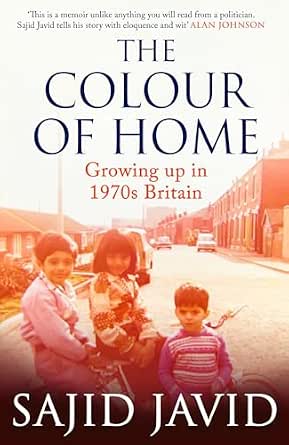
THE COLOUR OF HOME Growing up in 1970s Britain
By Sajid Javid
Abacus Books 2026
ISBN: 978 0 349 14762 8
RRP: $ 59.99 (HB)
Reviewed by Anne Henderson
As much of the West struggles with the civil challenge of multiethnic communities, while hate speech has become the order of the day on social media and anti-Semitism haunts Jewish communities, a book written with clarity, honesty, warts and all freshness but never judgemental suggests good can prevail over tough realities. And it is all the more powerful for letting the reader judge from the telling and never adopting a didactic or victim mentality. The effect is both moving and stimulating, offering hope.
Sajid Javid, former UK Chancellor of the Exchequer, has published a memoir of his growing up. As the son of Pakistani parents who emigrated to the UK in the early 1960s, The Colour of Home – Growing Up in 1970s Britain might have been an attempt to avenge the racism and discrimination he and his family had faced. Javid chooses another way. He writes the story without overt judgement, entwining the personal history of both his family, their Pakistani beginnings and family/friends network with the various stages of their settlement and culture clash in Rochdale near Manchester and, later, parts of the Bristol area.
The first chapter entitled “Run, Paki, Run” sets the tone for the book. Two five-year old children run the gauntlet of a pack of burly locals on their way to school. “We weren’t scared of ogres under bridges or stray dogs. We were only scared of the skinheads who gathered in the subway under the dual carriageway.” The children find their own way to fight back but Javid records the “pit-of-my-stomach feeling” as he notes yet another scrawled “Paki go home” on his dad’s shop front.
Javid can remember his rage and sense of injustice but as he reflects, on the next page, about his achievements as a Conservative MP and the backgrounds of his parliamentary colleagues it startles by comparison. He concludes: “There were no easy wins for me. No inheritance of trust funds. Just days of attempting to dodge scammers, including those in our extended family, and stopping the bailiffs clearing out Dad’s shop.”
Javid’s opening chapter sets the book’s trajectory immediately. It will be the story of triumph over huge odds, a sort of small Ulysses journey, an odyssey in modern times. At no stage – personal, family or public – does Javid resort to papering over the struggle, capturing the essence of his experience in pared down but striking story telling.
Told from Javid’s perspective, his memoir covers his Pakistani family background and its Muslim beliefs. These are related as part of one family’s story and become a rich and comprehensive source to help empathise with the protagonists. How marriages were made – Javid’s parents a love match while others arranged. There are strong beliefs about not marrying out so the family/friendship group is very intertwined and loyalty strong. This does not prevent rivalries and various tales of tribal letdown. All told frankly. Even small rivalries between Sajid and his four siblings – all boys.
There is no angst as Javid describes the lack of material belongings for the family. His father’s business was never a great success but the parents persevered to bring their children as good a life as they could find, living for much of the time in a two-bedroom flat above the shop. The brothers loved each other but there is no pity between them when competing for a possible prize. It is a touching moment when Sajid’s father brings home three second hand bikes for four boys when Sajid was five. After his older brother Khalid had pinched Sajid’s bike for an afternoon ride he was brought home bruised and knocked about after losing control of the bike. For Sajid it was an anxious moment: “I was frantic. Not about Khalid. But about my bike … I interjected like a hovering fly. ‘Is the bike OK?’ ‘Did you leave the bike in the street?’”
It is Javid’s sense of quiet mockery of such moments that lighten the book. He is knocked down by a car – not at great speed but enough for a neighbour to call an ambulance. While in hospital briefly, his younger brother Basit held court at school exaggerating his injury as if his brother would be away from school for months. When Sajid appeared at school at lunchtime – not wanting to miss the fun of last day of term – Javid writes:
I sauntered into the playground to aghast faces. My classmates gaped at me like they were seeing a ghost. … it became apparent that Basit’s sense of showmanship had got the better of him. He responded to any questioning that day with a theatrical shrug, before doing what all four-year-olds do when they’re in a bind. He ran away.
The Javid parenting was a long haul of tough love. Javid’s father would beat his boys with his shoe at any fraying of good behaviour. Javid’s mother, gentle and faithful, would intervene as she could – usually after any overly severe beating. While the boys had the run of the streets from an early age as their parents were tied to a poorly returning business, the threat of punishment largely kept them under control. Even then, they could stretch the boundaries.
At one point, Basit was sent back to Pakistan to be controlled in a more rigid culture. Back in London, the exchange having failed, Basit took to stealing aged around 11. Then, with Sajid as his holiday companion, he took to visiting machine arcades in spite of being under age. For part of the summer holiday, they raided local machines, having learnt how to fake the coin in the slot. Their eventual arrest culminated in a humiliating spectacle – a senior police officer dressing them down in front of their father who was in tears. The boys were, in time, spared a criminal conviction but the lessons – from local authorities and their father’s shoe – were learnt.
Tough love also came with its injustices. A few years later, Sajid was wrongly accused of stealing from his older brother (who had lied about some money at the family business) and underwent a severe bashing from his father. It took months before he could look his father in the eyes. It also seems that his mother intervened behind the scenes with his father. He was never hit again. Years later, his father would request Sajid meet him for a cup of tea where he apologised to Sajid for his mistake. These touching, harsh and soft stories throughout the book are revealing. Tough love is as much tough as it is love.
As debate rages over immigration in the UK and racial division, it is sobering to note that the Pakistani immigrants of the Javid generation possessed strong aspirations to make a success of their settlement. There was not much by way of handouts apart from the UK’s public medical and educational support. Aspiration was the thread that pushed the Javid brothers forward – none more so than Sajid.
The stories of Sajid’s determination to be allowed to study for his three A levels, in order to be accepted into university, is unique. He battled his comprehensive educational background that would have educated him down not up. Instead, he found a new school where he could take the A levels finding small ways to raise money needed; he worked on his books and paid for extra tutoring, even presenting himself at the bank for a loan on one occasion. It is an emotional moment not only for Sajid but also the reader, when he is finally at university and wins a complete set of the Encyclopedia Britannica. His delight at having information at the ready is hard to imagine in our times of the internet.
That Sajid Javid made a young man’s brilliant career in banking is today well known – one that saw him later stand for parliament and become number one financial officer in the UK. The story of his love life is quite the reverse – taking patience, devotion and determination. Here the odds were unexpected. Where Sajid faced bureaucratic, financial and public policy hurdles in his rise professionally, it would be his Pakistani background that threatened his way to lasting love.
Having met “the love of his life” as a cadet worker at an insurance firm, Javid told his father he had a special girl friend who was not Pakistani – an English girl from a well-off Bristol family. His father advised him to have a good time with her even if she was not from Pakistan. Through separations for college and university, Sajid and Laura made their plans to be together. It would be a visit from Sajid’s father after some years, as the relationship strengthened, that would stun Sajid. His father told him he could not marry Laura, as Sajid was already “engaged” to one of his cousins who lived in Leeds. He had been promised by his parents to her widowed mother in marriage. Parents and briede-to-be all knew it – but not Sajid.
Javid tells the story of what evolved from this announcement with tact and generosity to all involved, capturing the tension, the hurt for the intended bride, the upset, the fight against traditional mores and the resolution. It becomes an unravelling of the past to embrace the future. In time, Sajid and Laura’s wedding and its preparation blended their two cultures in gentle ways. They are still married having brought up four remarkable children. Their union says as much as anything in the book about multiculturalism and its potential.
Sajid Javid’s memoir is a gem of a book. It tugs at the heart strings in different ways. As part of its conclusion, Javid recalls the day his Mum proudly watched from the front row, as he, as Home Secretary, congratulated his brother Basit who was graduating as a senior police officer:
When Bas’s name was called, I shook his hand – and we hugged in front of everyone (before he mischievously tickled my hips). I caught the tears of pride welling in Mum’s eyes. Later, she turned to the two of us and said quietly, “If only your father were here – he’d be so proud.” Proud of the same two boys who, decades earlier, had ended up in a police cell in Weston-super-Mare.
Sajid Javid’s The Colour of Home – Growing Up in 1970s is no Pollyanna look back and it cuts at injustice without highlighting it. It is a story of both past and future – told from the height of success but also unflinching about revealing many darker aspects of British life for outsiders.
Anne Henderson is Deputy Director of The Sydney Institute and author of Menzies at War, which was shortlisted for the 2015 Prime Minister’s Award for Australian History.